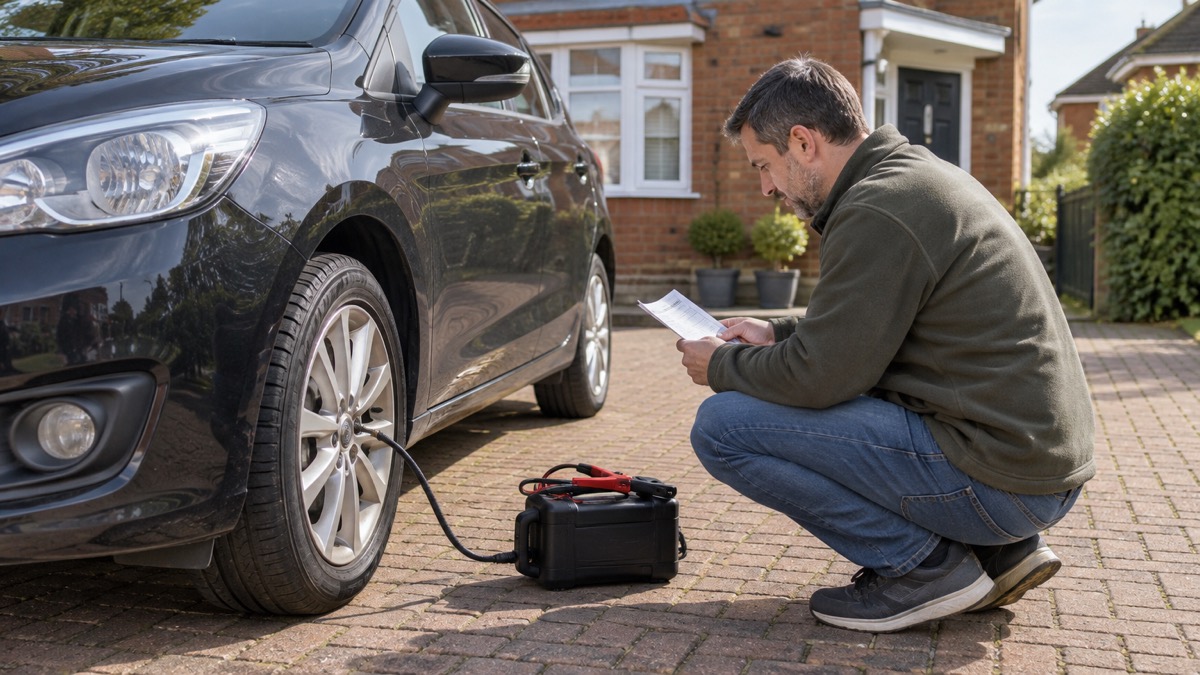
The NEBO Assist Air Jump Starter is a single portable unit that does four jobs: it jump-starts a car, inflates tyres, charges a phone and lights the way. The maker describes it as a 4-in-1 jump starter, air compressor, power bank and floodlight1. It is built around a 12V jump-start output rated at 1500A peak, and the maker says it suits any 12-volt car, SUV, 4x4, van or marine battery, with engines up to 8L petrol and 4L diesel2.
For a household, the appeal is that one item covers two of the most common roadside problems (a flat battery and a soft tyre) and doubles as backup light and phone power in a power cut. The maker's manual gives a full charge time of up to 4 hours, and the unit can be topped up at home by USB-C or in the car through the 12V adapter1.
This page sets out what the unit does, its specifications, how to jump-start and inflate safely, how to recharge it, and how to store it. Every instruction here comes from the maker's own manual or product page for this product. Where the two documents disagree, both figures are given.
What the NEBO Assist Air does, and who it suits
The unit combines four functions in one body weighing 1.1 kg and measuring 241 x 117 x 48 mm according to the maker's manual1. The maker's product page gives a slightly different weight, 1,150g; the two documents disagree by a few grams, which makes no practical difference to whether it fits in a glovebox or under a seat2.
The four functions are:
- Jump starter. A 12V output at 1500A peak for flat batteries on cars, SUVs, 4x4s, vans and marine batteries2.
- Air compressor. A maximum pressure of 120 psi, with a 24 inch air extension hose and an interchangeable nozzle kit for tyres and other inflatables1.
- Power bank. A USB-C port rated PD/QC3.0 20W and USB-A outputs at 5V 2.4A for charging phones and small devices1.
- Floodlight. White floodlight, red floodlight and an emergency red S.O.S. mode, cycled with the Floodlight ON/OFF button1.
It suits a household that wants one compact item in the car rather than a separate jump pack, foot pump and torch. It is not a substitute for a proper home backup power station: the maker's own figures put the battery at 55,500mWh, which is sized for starting an engine and topping up a phone, not running appliances1. If you want to understand how portable jump starters compare as a category, see Portable Jump Starters: What They Do and How to Choose One, and for the car kit as a whole, What to Keep in Your Car in Case of a Breakdown or Storm.
Specifications
The maker's manual and product page give the following figures. Where they differ, both are shown.
| Specification | Figure | Source |
|---|---|---|
| Battery capacity | 55,500mWh (manual); the product page also states "Powered by 15,000mAh Li-ion" | 1 |
| Battery cells | 5000mAh | 1 |
| Jump start output | 12VDC / 1500A peak | 1 |
| Suitable engines | 8L petrol and 4L diesel | 2 |
| Air compressor maximum | 120 psi | 1 |
| Air hose | 24 inch extension hose | 1 |
| USB-C port | PD/QC3.0 20W, bi-directional | 1 |
| USB-A outputs | 5V 2.4A | 1 |
| Charge time | up to 4 hours (manual); the product page states 3 to 4 hours | 1 |
| Dimensions | 241 x 117 x 48 mm (manual); 242 x 118 x 49 mm (product page) | 1 |
| Weight | 1.1 kg (manual); 1,150g (product page) | 1 |
| Operating temperature | 32°F to 113°F (0 to 45°C) | 1 |
| Discharge temperature | 14°F to 104°F (-10 to 40°C) | 1 |
The battery capacity figures need a word of explanation. The manual gives 55,500mWh and the product page describes the unit as "Powered by 15,000mAh Li-ion"1. These are different ways of describing capacity, so treat the manual's 55,500mWh as the specification figure and the product page's wording as the maker's marketing description. Neither changes what the unit will do in practice: start an engine, inflate a tyre, charge a phone.
Jump-starting a car
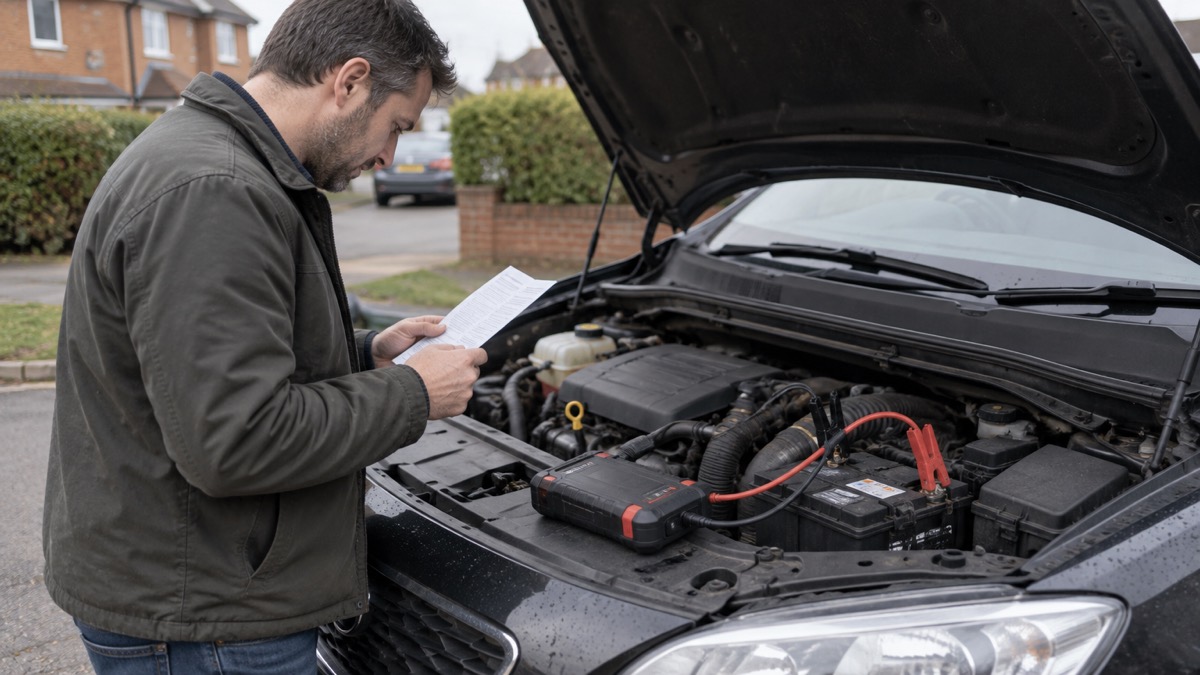
The maker's manual sets out the sequence and the limits. Connect the clamps, attempt the start, and if it does not catch, wait before trying again: "Allow 15 seconds between each jump-start attempt. If your vehicle does not start after three attempts, consult a certified mechanic"1. The product page repeats the same advice2.
That three-attempt rule matters. A car that will not start after three tries with a fully charged pack is unlikely to be suffering from a flat battery alone, and continuing to crank drains the pack and can damage the vehicle's starter. Stop and call for help.
The maker states that the jumper cables are spark-proof, "keeping you safe with the latest in smart battery and patented charging protection", and the manual describes NEBO Spark-Proof Technology as eliminating the potential of sparking while connecting and disconnecting jumper cables1. That is the maker's description of its own product. It does not remove the need to follow the connection order in the manual.
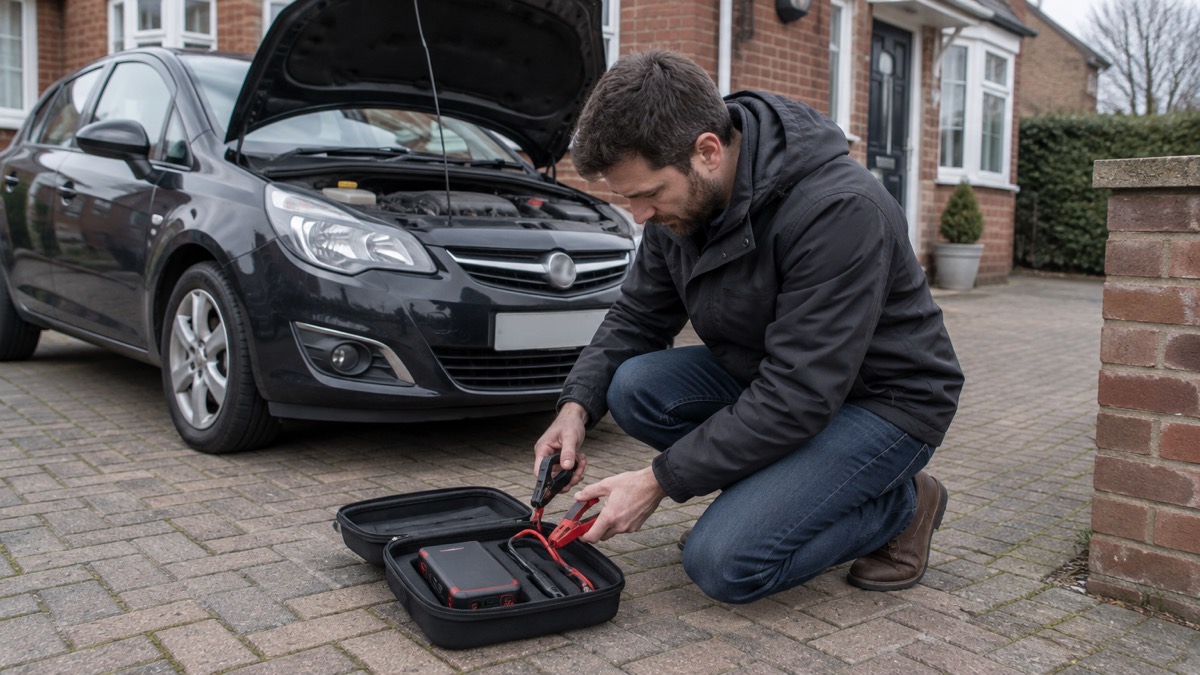
The 3-step jump start guide is printed directly onto the microfibre storage bag, so it is available when you need it2. Keep the bag in the car with the unit. A jump starter at home in a cupboard is no use at the roadside.
Inflating tyres and other inflatables
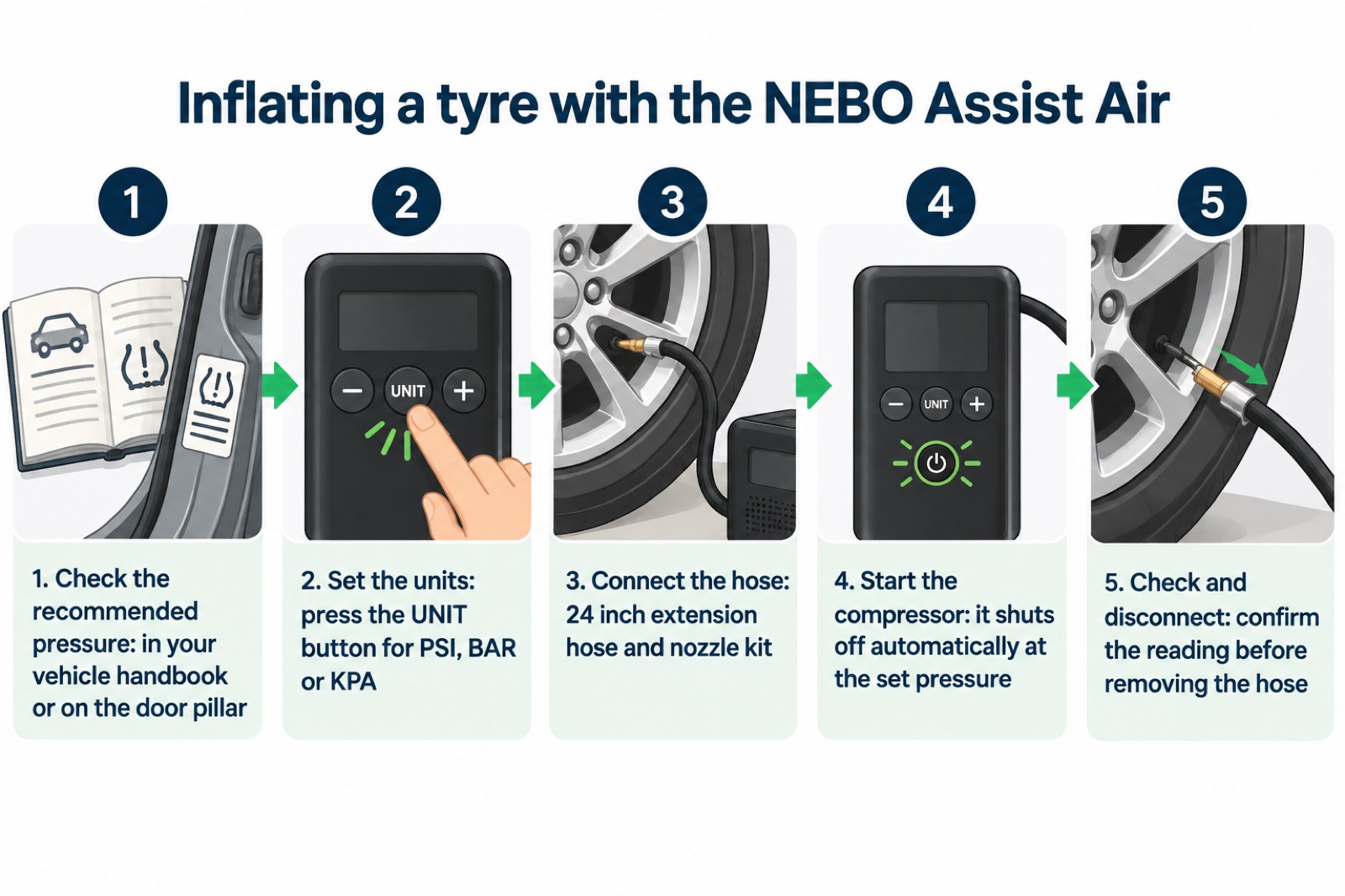
The compressor runs to a maximum of 120 psi and comes with a 24 inch air extension hose and an interchangeable nozzle kit for tyres, balls and other inflatables1. The maker's instruction is simple: "Always follow the manufacturer's recommended pressure"2. That means the figure in your vehicle handbook or on the door pillar, not a guess and not the maximum the compressor can produce.
The compressor shuts off automatically once the pressure has been reached, so you set the target and let it run2. The measuring units can be changed between PSI, BAR or KPA by pressing the UNIT button1. Set the units to match your handbook before you start, so you are not comparing a BAR figure with a PSI display.
A soft tyre is one of the most common reasons a car handles badly or a warning light comes on, and having a compressor in the boot means you can deal with it at the roadside rather than limping to a garage. It is not a repair: if a tyre is losing pressure repeatedly, it needs a proper inspection.
Charging a phone and lighting a power cut
The unit doubles as a power bank and a torch, which is where it earns its place in a household emergency kit as well as a car kit. The USB-C port supports 20W quick charge and the USB-A outputs run at 5V 2.4A1. The maker lists a pass-through charge feature, described as the ability to charge the unit and a device at the same time2.
The floodlight has four settings, cycled by pressing the Floodlight ON/OFF button: once for the white floodlight, twice for the red floodlight, three times for the emergency red S.O.S. mode, and four times to switch it off1. The red S.O.S. setting is a distress signal for the roadside; the white floodlight is the one for a dark room or a power cut.
Official advice on power cuts is consistent: use battery-operated lights or torches as an alternative light source rather than candles3. The Scottish Fire and Rescue Service gives the same guidance, recommending a battery or wind-up operated torch or lantern instead of a candle, with spare batteries kept somewhere easy to find4. A rechargeable floodlight with a long runtime fits that advice well, provided it is charged before the power goes.
That is the catch. The unit only helps in a power cut if it is charged when the power goes. Electricity North West advises charging your phone and any power packs as part of preparing for a power cut5, and SP Energy Networks suggests keeping a battery or solar charger handy to recharge a smartphone or tablet6. National Grid's planned power cut guidance makes the same point7. Treat the Assist Air as one of the packs you top up when a storm is forecast.
For more on lighting choices, see Emergency Lighting at Home: Torches, Lanterns and Candles, and for the wider picture, Power Cuts: A Household Guide.
Recharging the unit
The maker's manual gives a full charge time of up to 4 hours, at which point the LCD screen indicates 100%1. The product page states 3 to 4 hours; the two documents differ slightly, so allow up to 4 hours2.
There are two ways to charge it:
- At home by USB-C, using a wall outlet and the USB-C port2.
- In the vehicle, by plugging the 12V Car Charger into the vehicle's DC output (cigarette lighter)2.
The charge indicator shifts from green to red, signalling when it is time to recharge2. Green means the battery is healthy; red means charge it before you rely on it. Check it before a long journey, before a forecast storm, and at the start of winter.
The maker's manual lists the included accessories as a 24 inch air extension hose, a USB-A to USB-C cable, an interchangeable nozzle kit, a 12V car charge adapter, jumper cable clamps and a UK/EU charging adaptor1. The product page lists a USB-C to USB-A adapter, jumper cables, an air hose extension, an air nozzle kit, a 12V car charger and a storage pouch2. The two lists do not match exactly, so check the box against the manual when it arrives.
Storing it safely and keeping it ready
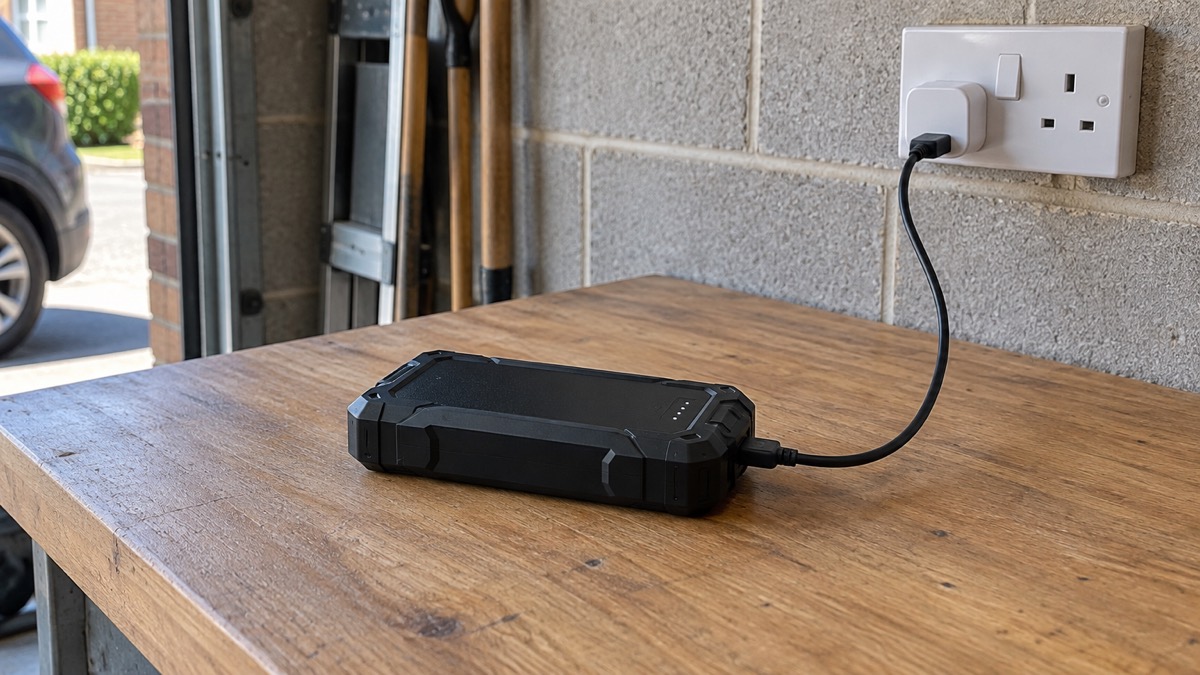
The maker's manual gives clear storage limits. The operating temperature is 32°F to 113°F (0 to 45°C) and the discharge temperature is 14°F to 104°F (-10 to 40°C)1. In practice that means do not leave it in a car that will bake in summer sun or freeze solid in a hard winter, and do not store it next to a radiator, stove or open flame1.
The manual's do-not list is short and worth following exactly: do not expose the unit to moisture, water, rain or snow, and keep it away from heat sources including open flames, radiators, stoves and ovens1. A car boot is fine for most of the year, but bring it indoors during extreme cold or heat.
A sensible routine for a household:
- Keep it dry and away from heat: the maker's manual says not to expose the unit to moisture, water, rain or snow, and to keep it away from heat sources including open flames, radiators, stoves and ovens1.
- Charge it at home: a full charge from the mains can take up to 4 hours, and the LCD screen shows 100% when it is complete2.
- Keep the storage bag with the unit, so the printed jump start guide travels with it2.
- Read the manual once in daylight, so the connection order is familiar before you need it in the rain.
The maker's product page states the unit is in stock and ready to ship2. For the wider question of what a household should keep ready, see Emergency Kit: What a UK Household Should Keep Ready and the Household Preparedness Checklist.
Where it fits in a household kit
A jump starter is one line on a longer list. A combined jump starter and compressor covers the jump leads and adds tyre inflation, which is why it earns space in a small car kit. The maker states that the unit will jump start any 12-volt car, SUV, 4x4, van or marine battery2, and the compressor reaches 120 psi max1.
For the home, the same unit covers light and phone charging, but it is not a substitute for a proper home backup power supply. If you want to understand the difference between a jump pack and a power station, see Backup Power at Home: A Household Guide. The maker's own larger units are covered at NEBO, including the NEBO INTREPID 1000 and the NEBO 5K Powerbank.
For a grab bag, the unit is a reasonable addition if you have a car, but it is not essential. A torch and a small power bank will do for most households; the jump starter is for the household that also wants roadside capability. The maker's manual warns that failure to follow the safety instructions may result in electrical shock, explosion or fire, which may result in serious injuries, death or property damage1.
Sources (7)
- NEBO Assist Air Jump Starter instruction manual, NEBO, 2026-10-25
- NEBO Assist Air Jump Starter product page, NEBO, 2026-10-25
- Power cuts, Scottish Fire and Rescue Service, 2026-10-25
- Tips to prepare for a power cut, Electricity North West, 2026-10-26
- Preparing for a power cut, SP Energy Networks, 2026-10-26
- Being prepared, National Grid, 2026
- Emergency kit, Scottish Government, 2026-10-22

 Ring Ultraboost 500
 Ring Ultraboost 1000
 Ring Ultraboost 1500