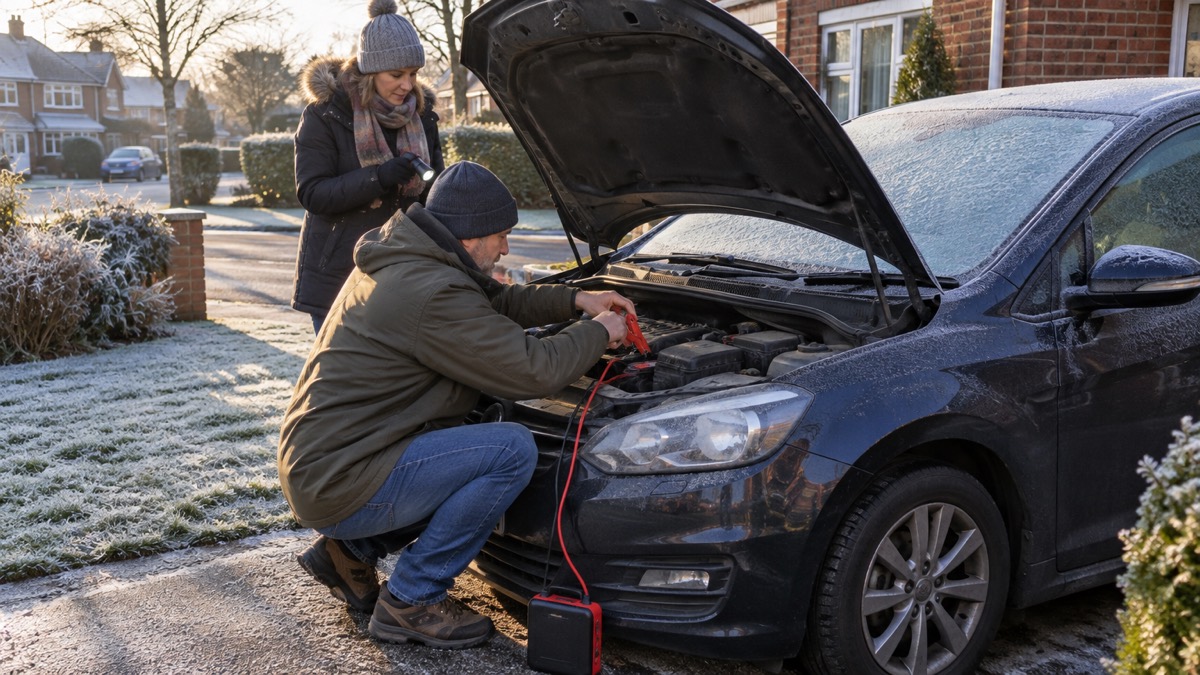
The Ring RJS020T Ultraboost 1000 is a handheld lithium-ion jump starter rated at 1000A peak and 250A rated output, with an 8000 mAh battery inside. Ring says it will start petrol engines up to 5.0L and diesel engines up to 2.0L, and that its Boost function will start a vehicle even when the battery is fully discharged1. It is a 12V device, so it is for the ordinary car, van or light commercial vehicle, not for a lorry or a plant machine.
For a household, that makes it two things at once. It is breakdown kit for the morning the car will not turn over, and it is a power bank with a torch for the evening the power goes out. Ring states that all its models have a power bank function, and this one has a Quick Charge USB-A port for charging phones and a USB-C input that Ring says uses PD30W fast charge technology1.
This page sets out what the Ultraboost 1000 is rated to do, how to connect it without damaging the car or yourself, how to charge and store it so it works when called on, and what the lights on the clamps mean. It is a description of one product from its maker's own published information, not a recommendation over any other.
What the Ultraboost 1000 is and who it suits
The Ultraboost 1000 sits in the middle of Ring's range of portable jump starters. It is built for the household that wants one device in the car that can restart a flat battery without asking a neighbour for a jump lead, and that can also top up a phone when the mains is off. Ring describes it as ideal for most cars, SUVs and light commercial vehicles1.
The maker's own description is the first thing to check against your own vehicle. Ring states that the Ultraboost 1000 operates in temperatures from -20°C to +55°C, making it suitable for year-round use1. The maker's figure is the one to go by rather than the size of the box. If you are weighing up the range, the Ring RJS030T Ultraboost 1500 is the next size up, and the Ring RJS010T Ultraboost 500 is the smaller one. For the general question of what these devices do and how to choose between them, see Portable Jump Starters: What They Do and How to Choose One.
It is also worth being clear about what it is not. It is not a battery charger and it will not repair a failing battery. It gives a burst of current to turn the engine; if the battery is old or the alternator is failing, the car may start and then fail again. It is a way to get moving and reach a garage, not a fix.
Specifications at a glance
Ring publishes the full specification on its product page, and the figures below are the maker's own1. Where a retailer lists something different, the maker's figure is the one to rely on.
| Specification | Ring's figure |
|---|---|
| Peak amps | 1000A1 |
| Rated output | 250A1 |
| Voltage | 12V1 |
| Battery capacity | 8000 mAh1 |
| Battery type | Rechargeable lithium-ion1 |
| Petrol engines | up to 5.0L1 |
| Diesel engines | up to 2.0L1 |
| Operating temperature | -20°C to +55°C1 |
| Unit dimensions | 204 x 125 x 105 mm1 |
| Unit weight | 0.91 kg1 |
| Carton dimensions | H 100 x W 130 x D 218 mm1 |
| Carton weight | 1.03 kg1 |
| Charging input | USB-C, PD30W fast charge1 |
| Power bank output | Quick Charge USB-A1 |
| Display | Digital LCD showing remaining battery level1 |
| Certification | E Regulation1 |
| Barcode | 50551752536571 |
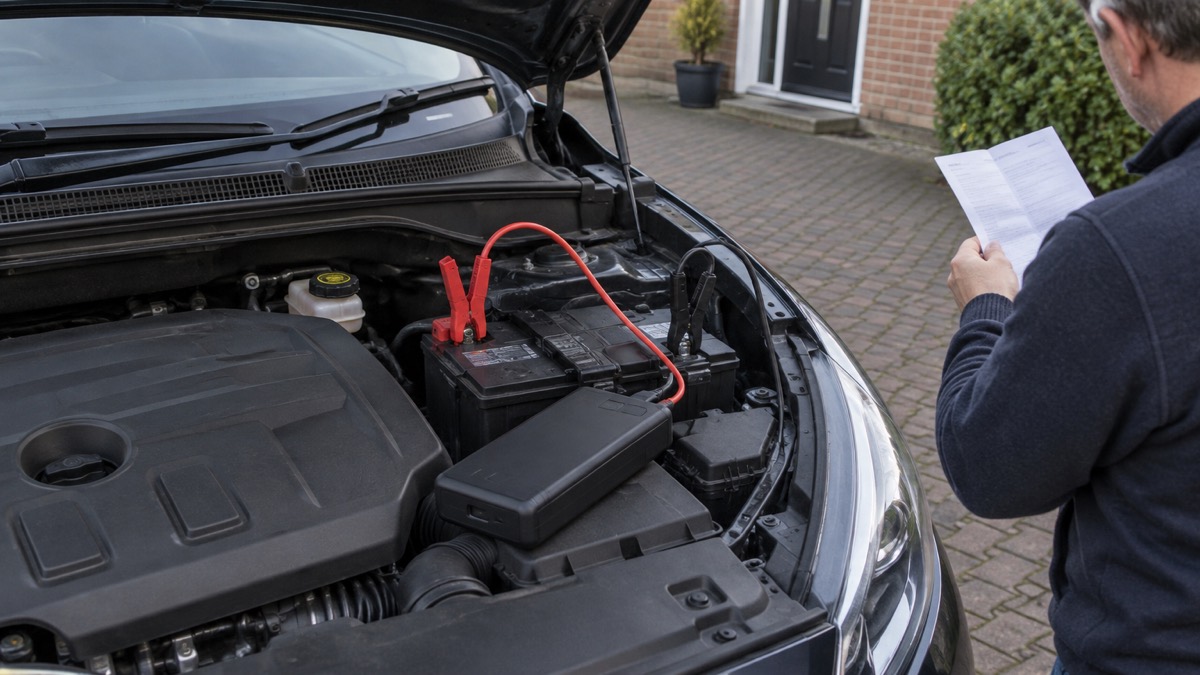
The LCD display is the feature that matters most in storage. Ring says it clearly shows the remaining battery level so you always know when it needs recharging1. A jump starter that has quietly drained in the boot is no use on the morning you need it, and a visible state of charge is the simplest defence against that.
Starting a car with a completely flat battery
The Boost function is the heart of the product. Ring states that it allows the jump starter to start vehicles even when the battery is fully discharged1. That is the situation most people actually face: not a battery that is a little low, but one that will not turn the engine at all after a cold night or a light left on.
The connection is made through the clamps, which Ring describes as a "Lock 'n' Load" battery terminal design for a secure, safe connection and easy-reach cables1. The integrated LED torch is there to light the battery terminals during use, which matters more than it sounds when you are crouched under a bonnet in the dark1.
The sequence, following Ring's own instructions for its product:
- Check the clamps and cables before use. Ring's maintenance advice is to check cables and clamps before use, every time1.
- Make sure the unit is charged. The LCD shows the remaining level1.
- Connect the clamps to the battery terminals, observing the polarity. The Lock 'n' Load terminal is designed to give a secure connection1.
- Watch the indicator light. A steady green light means the connection is correct1.
- If the light flashes green, the battery is below 9V: use the boost function1.
- If there are no lights at all, the battery is below 1V: use the boost function1.
- Start the engine, then disconnect the clamps and return the unit to its case.
Safety features that protect you and the car
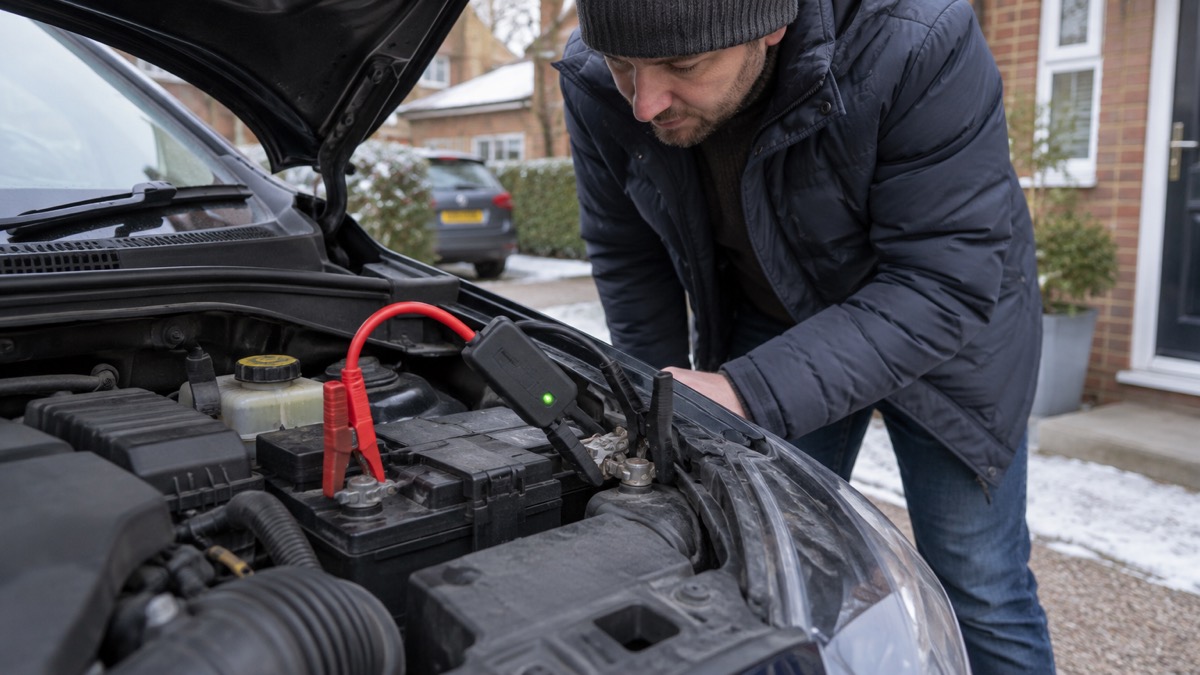
Connecting a jump starter the wrong way round can damage the vehicle's electronics and, in the worst case, cause a spark or a fire. Ring's answer is a system it calls Ringtelligence, which it says keeps users safe with reverse polarity protection and a spark-free design1. In plain terms, the unit detects a reversed connection and refuses to deliver current, and it is designed not to spark at the clamps when you connect it.
That protection is a backstop, not a substitute for care. Ring states that Ringtelligence keeps users safe with reverse polarity protection and spark-free design1. The spark-free design reduces the risk around a battery that may be giving off hydrogen gas, but it does not remove the need to keep flames and cigarettes away from an engine bay while you work.
Ring lists reverse polarity protection and a spark-free design, delivered through Ringtelligence, as the safety features of this unit1. For a household buyer, those are the checks worth making on any jump starter: a device that guards against connecting the clamps the wrong way round, and that does not spark at the terminals, is the one to look for.
The other safety feature is less obvious: the unit is small and light enough to handle safely. At 0.91 kg and 204 x 125 x 105 mm, it can be held in one hand while the other positions a clamp, which is exactly the situation the design is for1.
Using it as a power bank in a power cut
Ring states that all its models have a power bank function, and the Ultraboost 1000 has a Quick Charge USB-A port for exactly this1. In a power cut, that turns a car accessory into a household tool: a phone that stays charged is a phone that can call for help, check an outage map or reassure a relative.
Ring states that all models have a power bank function1. It is a phone-sized reserve, not a home backup system. It will top up a mobile phone, and it will do so more than once, but it is not intended to run a router, a fridge or a heater, and nothing in Ring's information suggests it should be used that way. For the bigger question of keeping a household running without mains power, see Backup Power at Home: A Household Guide, and for the wider picture during an outage, Power Cuts: A Household Guide.
The USB-C input is the other half of the story. Ring says PD30W fast charge technology enables quick recharging of the jump starter and fast charging of USB-C devices1. That means the same unit can be topped up quickly from a USB-C charger when power returns, and can pass a fast charge to a compatible phone.
Charging and storing it so it is ready
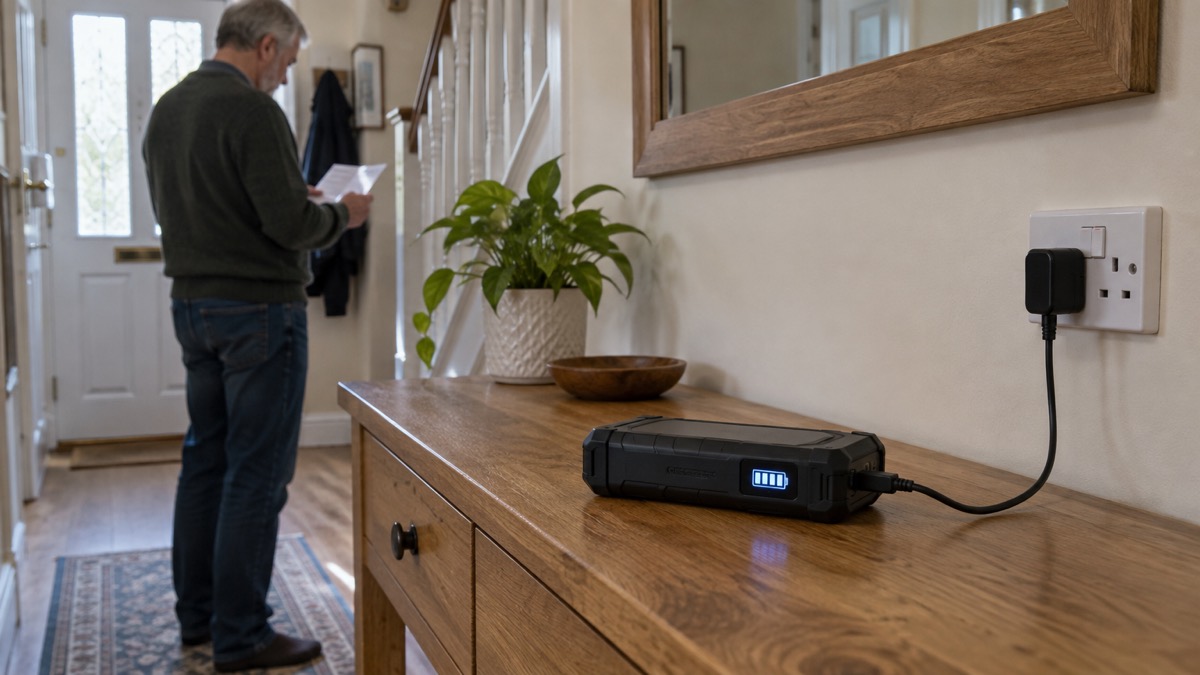
Ring's maintenance advice is short and worth following exactly: no regular maintenance is required, but keep it charged, store it safely, and check cables and clamps before use1. The maker also states that charging should be done indoors within the recommended temperature range, and that it should be fully charged before use1.
That indoor charging instruction is the one people get wrong. A jump starter left on charge in a cold garage over winter is being charged outside the conditions the maker specifies. Bring it inside, charge it there, and put it back in the car when it is full.
- Charge indoors, within the recommended temperature range, using the USB-C input1.
- Charge fully before first use1.
- Watch the LCD and recharge when the remaining level drops1.
- Store it safely, in the carry case supplied, so the clamps cannot touch metalwork1.
- Check the cables and clamps before every use1.
- Keep it within its operating range of -20°C to +55°C1.
The operating range is wide, which is reassuring for a UK winter, but it describes operation, not storage or charging. A unit that lives in the boot through a cold snap will still work when you need it, provided it was charged indoors beforehand.
Support, the model code and the wider Ring range
The model code for this unit is RJS020T, and the barcode on the carton is 50551752536571. Both are worth noting when you register the product or contact Ring, because the range contains several similar-looking units and the code is what identifies yours.
Ring Automotive is part of a larger group: Ring states that its parent company, OSRAM, has been a world leader in automotive lighting for over 100 years, and describes its own 40 years of lighting experience2. That background shows in the product: the integrated LED torch is a lighting feature as much as a convenience1. Ring's wider range of battery care products and chargers is described on its battery care page, and its torches on its torch page3.
For a household building a car kit around this unit, the sensible companions are the things that get you home or keep you safe while you wait: a hi-vis layer, a warning triangle and a warm layer. What to Keep in Your Car in Case of a Breakdown or Storm sets those out, and Why Carry a Hi-Vis Jacket and Blanket in the Car explains the visibility side. The Emergency Kit section page is the place to start if you are building the kit from scratch.
Sources (3)
- Ring RJS020T Ultraboost 1000 Jump Starter, Ring Automotive, 2026
- Torches, Ring Automotive, 2026
- Battery Care, Ring Automotive, 2026
 NEBO Assist Air Jump Starter
 Ring Ultraboost 500
 Ring Ultraboost 1500