

OSRAM is a lighting and automotive group whose name turns up on torches and on portable solar panels sold under the BATTERY charge label. For a household preparing for a power cut, the useful part is simple: a rechargeable torch that does not depend on the mains once charged, and a folding solar panel that can put charge back into a 12V battery or a small device when the electricity is off.
Neither is a whole-house backup. The BATTERYcharge SOLAR 200W is a portable panel rated at up to 200W, designed to charge and maintain 12V leisure batteries, with a 12V/20A charge controller that prevents overcharging and a USB output for small devices1. The torch range includes the LED inspect PRO TORCH 500, a 3.7V unit with a 2000mAh rechargeable battery, charged by USB-C and covered by a 2-year guarantee2.
What matters most in an emergency is not the brand but the routine: keep the torch charged, keep a power bank charged as well, and charge anything with a lithium battery where a fire would not trap you. Fire and rescue services across the UK are consistent on that point, and the sections below set out what they advise.
What OSRAM makes for UK households
OSRAM's household relevance on this site is narrow and worth stating plainly. It makes lighting, and it makes a range of portable solar chargers. The company says it is expanding its offering to include solar chargers built to withstand the elements5. The torch and the panel are the two product families a household preparing for an emergency is most likely to meet.
The rechargeable torch is the more immediately useful of the two. A torch that lives on a shelf and is topped up from the mains gives you light in the first minutes of a cut, before anyone has found the candles. Lancashire Prepared's emergency pack advice is to include a waterproof torch and spare batteries, checked regularly, and to consider a wind-up model6. A USB-C rechargeable torch fits that advice as long as you actually check it; a torch left flat for a year is a torch you do not have.
The solar panels are a slower, more deliberate purchase. They are not lighting; they are a way of putting charge into a battery without mains power. That makes them relevant to a long outage, to a caravan or campervan used as backup accommodation, or to keeping a vehicle or leisure battery healthy through a cold snap.
| Product | What it is | Rated output | Who it suits |
|---|---|---|---|
| BATTERYcharge SOLAR 200W | Portable folding panel for 12V leisure batteries, with charge controller and USB output1 | Up to 200W1 | Households with a caravan, campervan or 12V battery bank to maintain |
| BATTERYcharge SOLAR 100W | Solar panel5 | 100W5 | Smaller 12V setups where a lighter panel is easier to move |
| BATTERYcharge SOLAR 20W | Solar panel5 | 20W5 | Trickle charging and small devices |
| BATTERYcharge SOLAR 10W and 5W | Small solar panels5 | 10W and 5W5 | Keeping a single small battery or device topped up |
| LED inspect PRO TORCH 500 | Rechargeable inspection torch2 | 2000mAh battery, USB-C charging2 | General household emergency lighting |
OSRAM and Ring: how the two brands are linked
Ring Automotive states that its parent company is OSRAM, which it describes as having been a world leader in automotive lighting for over 100 years5. That is the link: Ring is part of the same group, and the two names can sit side by side on a shelf of car and outdoor accessories.
For a household, the practical consequence is about recalls, not ownership. A recall is issued against a specific brand and model, and you need to match the notice to the product in your hand. The Ring Automotive cordless tyre inflator, model RTC6000/RETC6000, is listed under the brand Ring Automotive7. The notice records the country of origin as China9. Nothing in that notice concerns OSRAM torches or solar panels, and it should not be read as one.
The lesson is the general one that fire services give: register electrical items with the manufacturer so you are told about safety recalls8, and if you choose not to register, check recalls through Electrical Safety First or the UK government website10. Because Ring and OSRAM share a parent, a household that owns both should check both names when a notice appears, rather than assuming one covers the other.
BATTERY charge Solar Chargers: what they do for a household
The BATTERYcharge SOLAR 200W is the model with the fullest published specification. OSRAM describes it as a high-performance, portable solar panel designed to charge and maintain 12V leisure batteries, delivering up to 200W of free solar power, with mono-crystalline panels in a robust aluminium frame1. It is suitable for caravans, campervans, RVs and outdoor use1.
The details that decide whether it is useful to you are these. It has a 12V/20A charge controller, which prevents overcharging while also allowing you to charge small devices through a USB output1. The USB-A output is rated 5V DC / 1.2A1. It comes with a 5 m battery lead and connecting clamps for immediate use, and it is lightweight and foldable with a sturdy aluminium stand and plug-and-play setup1. The carton bar code is 40621724165351.
What that means in practice: you can clamp it to a leisure battery and leave the controller to manage the charging, and you can plug a phone or a small torch into the USB port. The 5 m lead lets you put the panel in the sun while the battery stays under cover. The folding frame and stand mean one person can move it through the day to follow the light.
It is not a substitute for a charged power bank in the first hours of a cut. North Devon Council's emergency advice is to keep a charged portable power bank and charging cables in your kit11. A solar panel earns its place over days, not minutes, and only if the sun cooperates.
Solar charging in a power cut
A power cut does not stop the sun, but it does change what your solar kit can do. London Fire Brigade explains the principle behind plug-in solar panels: light from the sun hits the panels and generates energy, which flows into the electrical circuit for the home, providing electricity12. A portable panel like the BATTERYcharge works on the same principle but into a battery rather than the house wiring, which is why it keeps working when the grid does not.
Two limits are worth knowing before you rely on it. First, a planned outage is not compensated for lost solar export or lost electric vehicle charging; Scottish and Southern Electricity Networks states that it does not provide specific compensation for being unable to charge an EV or export electricity from solar panels during a planned outage, and that compensation follows Ofgem standards13. Second, the panel's rating is a figure for good conditions. OSRAM states the 200W unit works in overcast conditions1, which is honest but not a promise of full output in grey weather.
For a household plan, treat solar charging as the second day onwards. Use stored charge first, then let the panel work through the daylight hours. The backup power guide sets out how solar fits alongside other options, and the power cuts guide covers what to do in the first hour.
Getting a solar charger ready before an emergency
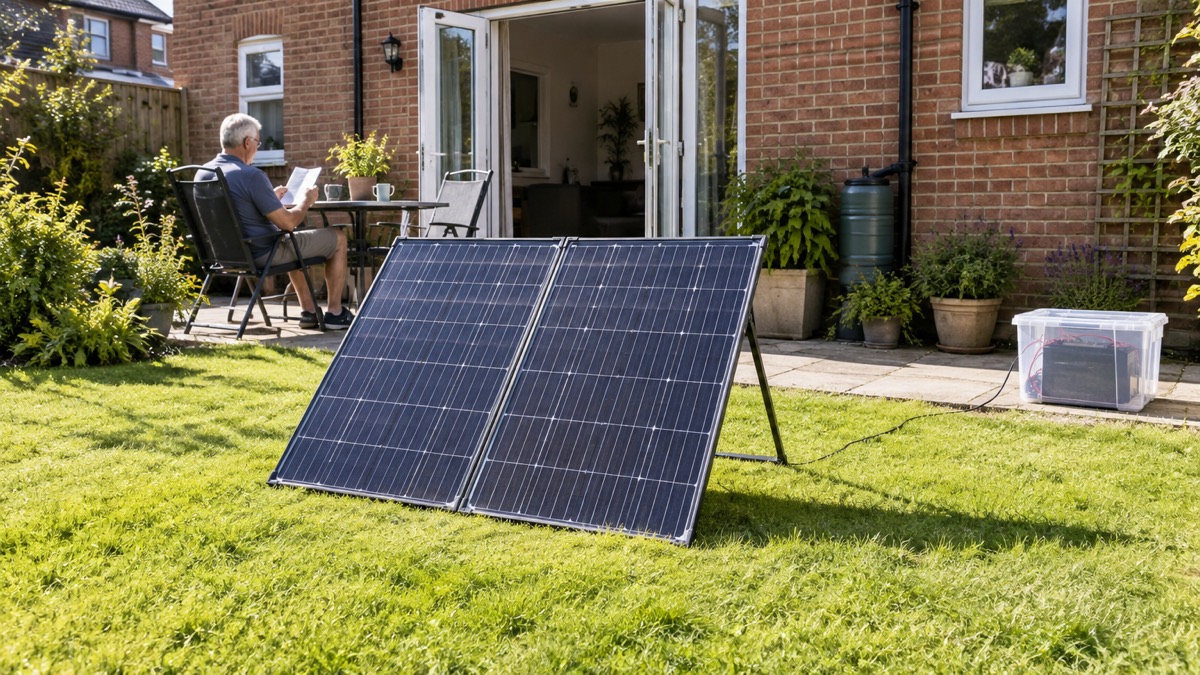
The work happens before the cut, not during it. A panel that has sat in a shed with a corroded clamp is no use on the night the lights go out.
- Check the kit against the maker's list. For the 200W panel that means the panel, the aluminium stand, the 5 m battery lead and the connecting clamps1.
- Charge everything that holds a battery. Keep a charged portable power bank and charging cables ready, as North Devon Council advises11, and top up the torch at the same time.
- Test the panel in daylight. Confirm the controller and USB output work before you depend on them, and note how the panel sits on its stand so you can repeat the setup in poor light.
- Keep a torch where you can find it in the dark. Lancashire Prepared suggests a waterproof torch with spare batteries, checked regularly6.
- Store the lead and clamps dry. Damp connections are the usual reason a stored panel disappoints.
Safe charging and battery care
Every device here contains a lithium battery, and the fire and rescue services are clear about how to treat them. The advice is not alarming, but it is specific, and it applies to a torch, a power bank and a phone alike.
Surrey County Council advises making sure both your battery and battery charger meet UK safety standards15. Manchester Fire and Rescue Service says to check for the CE or UKCA safety marking to make sure your battery and charger meet safety standards16. Tower Hamlets Council says to use the correct charger17, and Tandragee Fire Station warns that cheap chargers and batteries may not meet UK safety standards and can be dangerous18.
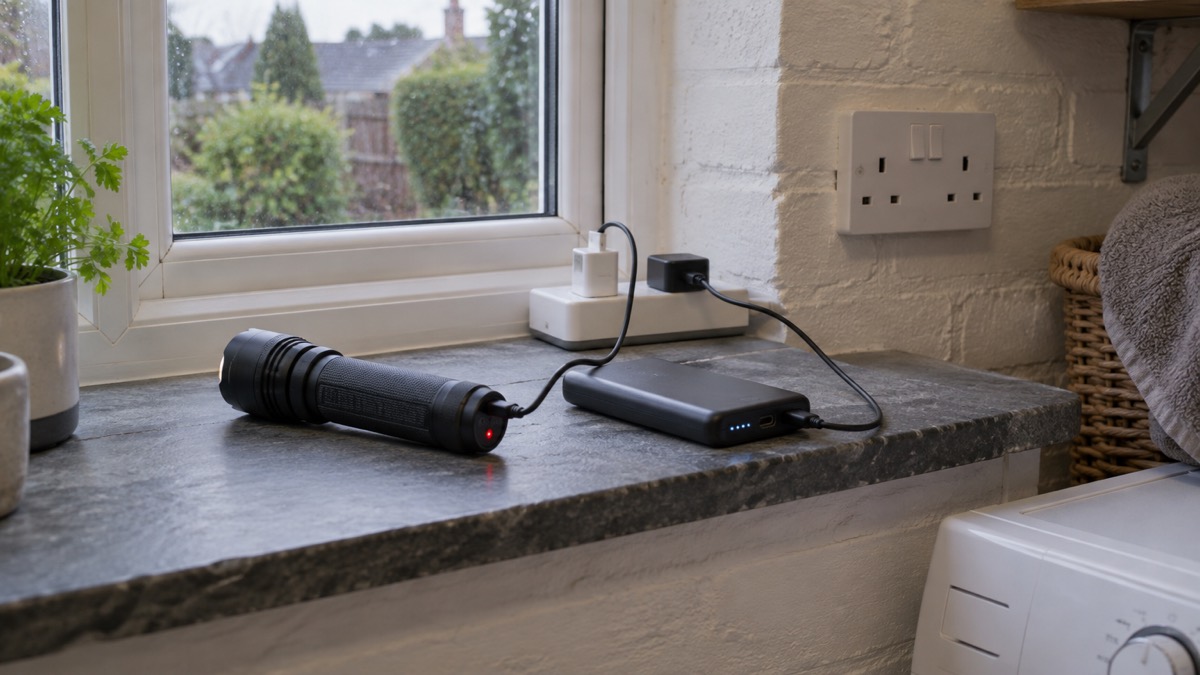
The rest of the routine is short. East Sussex County Council's product safety steps say to always charge in a safe place without blocking exits and to always unplug your charger when you have finished charging3. London Fire Brigade and the fire service in Northern Ireland both say to disconnect the charger once the battery is full, because continuous charging increases fire risk4. North Yorkshire Fire and Rescue Service says to always follow the battery usage, storage and charging guidelines in the user guide7. If a battery swells, London Fire Brigade's instruction is to stop charging immediately10.
Storing a solar charger between uses
Storage is where a good panel quietly fails. The maker's own description gives you the shape of it: the 200W unit is lightweight and foldable, with a sturdy aluminium stand1. Fold it, keep the stand with it, and keep the 5 m lead and clamps together so nothing goes missing between seasons.
Keep the panel and its cable dry and out of standing water. Bring it indoors when it is not charging, and check the cable and clamps for damage before the next use.
Official advice on portable gas heaters is to store spare cylinders outside where possible19. A lithium battery in a panel's controller, or a torch battery, deserves the same thought. Store it away from exits and away from anything that would burn readily.
Finally, keep the paperwork. A model name or number, a serial number and a purchase date are the details typically needed to register an appliance8, and registration is how a recall reaches you8. Write them on the inside of a cupboard door or keep them with the household emergency file.
Safety notices and recalls: how to check your OSRAM kit
Recalls are rare, and checking is quick. The Office for Product Safety and Standards issues recalls and alert notices on its website20, and London Fire Brigade's advice for white goods applies to any electrical item: regularly check whether your appliances have been recalled, using the government's product recall site, the manufacturer's website or Electrical Safety First's recall register21.
- Register the product with the manufacturer so you are informed of any safety recalls8.
- Check the government recall site for alerts and recalls covering your model23.
- Use Electrical Safety First's online product checker to see whether any of your appliances have been recalled25.
- Check the manufacturer's own site as well, since a maker may post a notice before it reaches a register21.
- If your appliance is not listed as recalled, it should be safe to use; if you still have concerns, contact the retailer or manufacturer8.
If something is wrong, report it. Surrey County Council advises that faulty batteries, chargers or units can be reported to your local Trading Standards Office15. If a battery has swollen, contact the manufacturer or a certified technician10. Fire services also encourage registering e-bikes and similar battery products for safety alerts26, and the same habit is worth applying to any lithium-powered kit in the house.
OSRAM support and warranty
The published support detail for the torch range is a 2-year guarantee on the LED inspect PRO TORCH 5002. Keep the receipt, because a guarantee is only as good as your proof of purchase date.
For anything else, the route is the maker's own product page and then the retailer. The model name or number, serial number and purchase date are what you will be asked for8, and the bar code printed on the carton, such as 4062172416535 for the 200W panel1, helps identify the exact item. If a product is subject to a recall, follow the notice's instructions rather than the general warranty route.
Where the kit sits in a household plan is modest but real. A charged torch covers the first hours of a cut, a charged power bank keeps a phone alive, and a solar panel extends both over days. The emergency kit guide and the lighting guide show where these fit alongside water, food and heating, and the storms and snow guide covers the weather that most often takes the power out in the first place.
Sources (26)
- OSRAM BATTERYcharge SOLAR 200W, Ring Automotive, 2026-10-29
- OSRAM LED inspect PRO TORCH 500, Ring Automotive, 2026-10-29
- Product safety, East Sussex County Council, 2026-10-29
- Batteries and chargers, London Fire Brigade, 2026-10-25
- Battery care and OSRAM solar chargers, Ring Automotive, 2026-10-29
- Emergency pack, Lancashire Prepared, 2026-10-29
- Electrical safety, North Yorkshire Fire and Rescue Service, 2026-09-14
- Electrical safety, Scottish Fire and Rescue Service, 2025-02-27
- Darlington BC - Details, Darlington Borough Council (Office for Product Safety and Standards notice)
- Lithium-ion batteries, Scottish Fire and Rescue Service, 2025-11-27
- Be prepared for emergencies, North Devon Council, 2026-10-29
- Plug-in solar panels, London Fire Brigade, 2026-10-25
- Planned power cuts, Scottish and Southern Electricity Networks, 2026-10-25
- Stay safe in a thunderstorm, Met Office, 2026-10-25
- Lithium batteries, Surrey County Council, 2026-10-28
- E-scooters, e-bikes and batteries, Manchester Fire and Rescue Service, 2026-10-29
- Battery safety, Tower Hamlets Council, 2026-10-29
- Lithium battery fire safety, Tandragee Fire Station, 2026-10-29
- Heating and gas, Scottish Fire and Rescue Service, 2024-11-21
- Electrical fire safety, Warwickshire County Council, 2026-10-29
- Total recalls: making white goods safer, London Fire Brigade, 2026-10-25
- Stay safe at home: e-bikes, Cheshire Fire and Rescue Service, 2026-09-30
- Maintain appliances and recalls, Manchester Fire and Rescue Service, 2026-10-29
- Electrical, Manchester Fire and Rescue Service, 2026-10-29
- Electrical items, London Fire Brigade, 2026-10-25
- Registering your e-bike or e-scooter for safety alerts and product recalls, London Fire Brigade, 2026-09-30