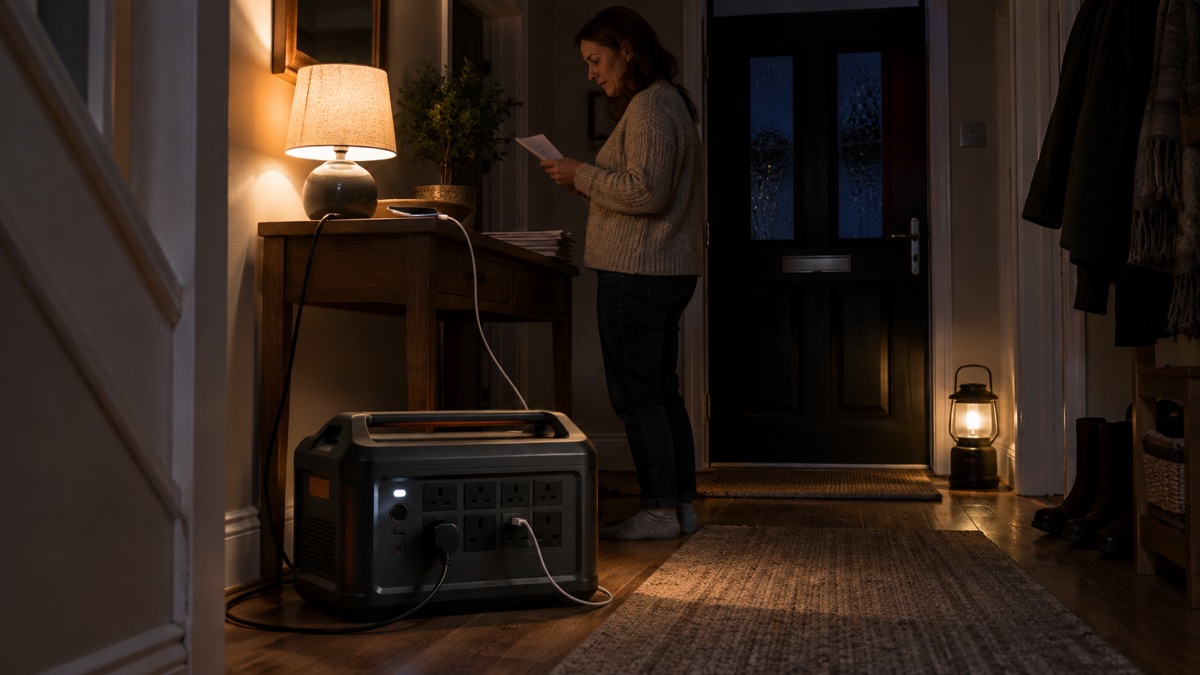
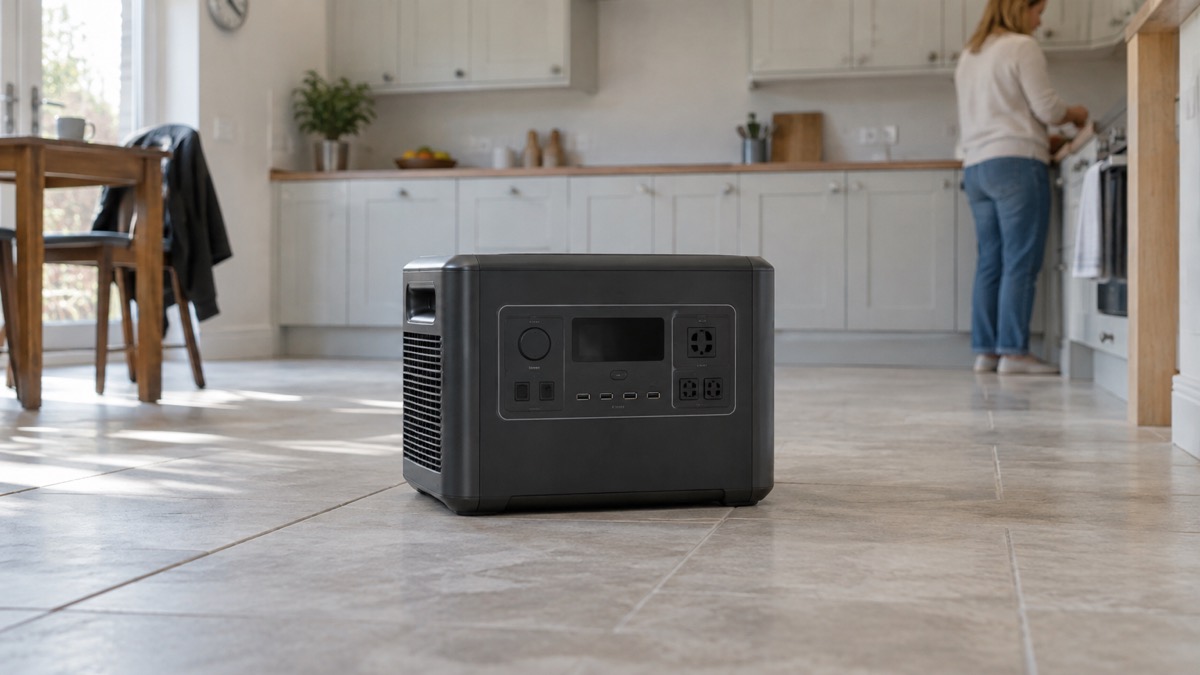
The NEBO Intrepid 1000 is a portable power station with a 960Wh lithium iron phosphate (LFP) battery, a pure sine wave inverter and two mains sockets rated at 1200W1. In a power cut it can run a few small appliances, charge phones and laptops, and keep a light on. It is not a whole-house backup: it is a box you carry to where it is needed, plug things into, and recharge afterwards.
The maker's figures decide what it suits. It weighs 13.5 kg and measures 38.61 x 31.75 x 22.61 cm, so it is a two-handed lift rather than something you tuck in a cupboard1. It charges from the mains in 1.5 to 2 hours, from a car in up to 12 hours, and from solar panels through its HPP port at up to 500W2. It can supply up to 15 devices at once across its sockets and USB ports1.
Before relying on it in an emergency, know three things: how to switch it on (press the power button for 2 to 3 seconds, or nothing will charge), how to keep the battery healthy (a 2 hour top-up every 3 months), and what to do if it ever overheats or swells (stop using it and contact the maker)2. The sections below take each in turn.
What the NEBO Intrepid 1000 is, and what it suits
The unit stores 960Wh at 48V in a lithium iron phosphate battery, which the maker also lists as 20000mAh1. The inverter is a pure sine wave type, the same shape of mains supply as the grid, which the maker says is safe for sensitive devices including medical equipment1. It has a single 1W floodlight built in, useful for finding the sockets in the dark1.
In plain terms, 960Wh is a modest amount of stored energy. It is enough for a run of small loads over an evening, not for heating, cooking or running a fridge for days. If you are working out what to keep running first, the priorities guide sets out how to decide, and Watts, Watt-Hours and Surge Explained covers the arithmetic behind capacity.
The LFP chemistry matters for a household that leaves the unit in a cupboard for months. It is the same family of battery used in many home storage systems, and the maker's maintenance schedule assumes long idle periods between uses. The unit is not a substitute for a generator or a home battery; it is the layer that keeps small essentials going while the mains is off. For how it fits alongside other options, see Portable Power Stations: What They Do and How to Choose.
Specifications
The maker's manual and product page give the full set of ports and ratings. Where the two documents differ, the manual's figure is given first.
| Specification | Figure |
|---|---|
| Battery capacity | 960Wh, 48V (20000mAh)1 |
| Chemistry | Lithium iron phosphate (LFP)1 |
| Inverter type | Pure sine wave1 |
| AC output | 2 x AC ports, 220V-240V, 1200W maximum1 |
| AC input | 175V-264V, 10A, 700W maximum1 |
| USB-C | 3 x PD 20W (60W max), 1 x PD 100W (100W max)1 |
| USB-A | 2 x 5V 2.4A, 12W (24W max)1 |
| DC5521 ports | 2 x 12V/3A (72W max)1 |
| Car port | 1 x 12V/10A (120W max)1 |
| HPP (solar) input | 11.5-50V, 20A, 500W maximum1 |
| Floodlight | 1 x 1W maximum1 |
| Switchover time | Under 10 milliseconds2 |
| Weight | 13.5 kg1 |
| Dimensions | 38.61 x 31.75 x 22.61 cm1 |
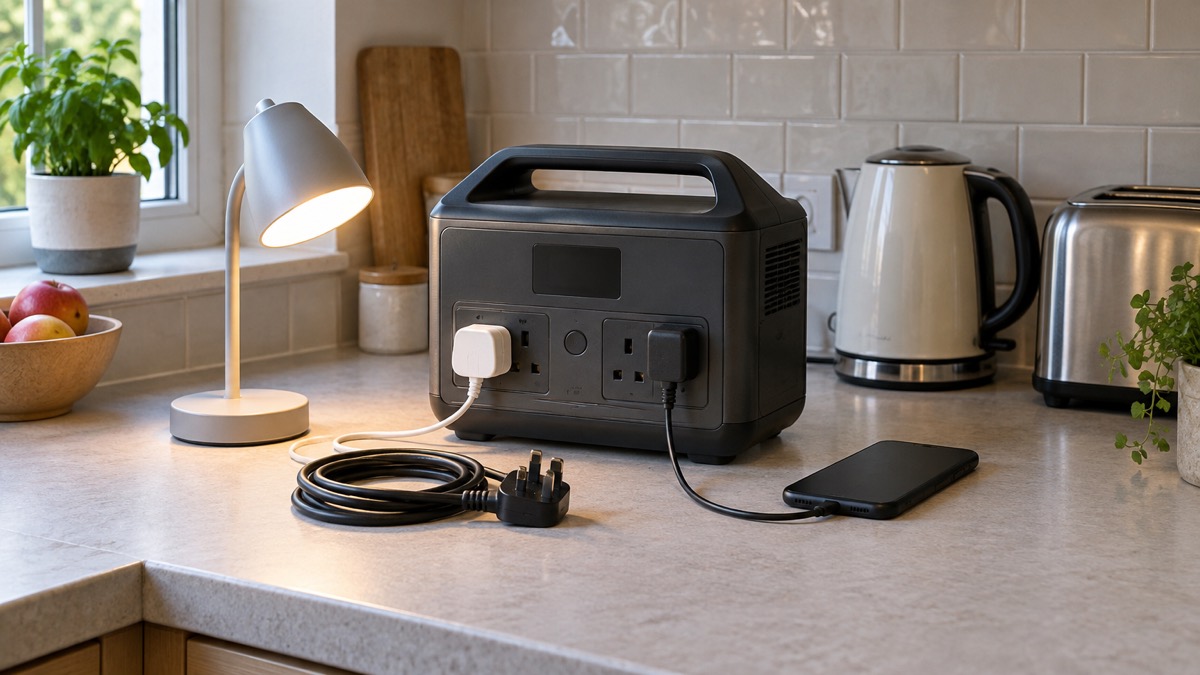
The product page lists the DC outputs slightly differently, as two DC2251 ports plus a car port, and the manual lists two DC5521 ports and a car port2. The two documents disagree on the port label; the ratings are the same. Check the labelling on your own unit before buying a cable for it.
Outputs: 1200W from two sockets, up to 15 devices at once
The two mains sockets deliver 1200W between them, which sets the ceiling for anything with a heating element or a motor1. A microwave is rated at 1000W, so it sits inside that ceiling, but only if little else is running at the same time3. Kettles, fan heaters and irons draw more than the unit can supply and are not sensible loads for it.
The maker gives two higher figures for short bursts. The manual says the unit can run power tools and appliances up to 2000W, and the product page describes an output surge up to 2400W1. These are peaks for starting a motor, not a level to run at. If an appliance's start-up draw is above 1200W, expect the unit to cope briefly or to shut down, depending on the load.
The USB and DC ports are where the unit earns its place in a power cut. With three USB-C ports, two USB-A ports, two DC5521 ports and a car port, the maker says you can charge up to 15 devices at once1. Phones, a radio, a torch and a tablet can all be topped up together without touching the mains sockets. For the cable and Power Delivery details, see USB-C Charging, Power Delivery and Cables Explained.
Using it in a power cut: EPS switchover in under 10 milliseconds
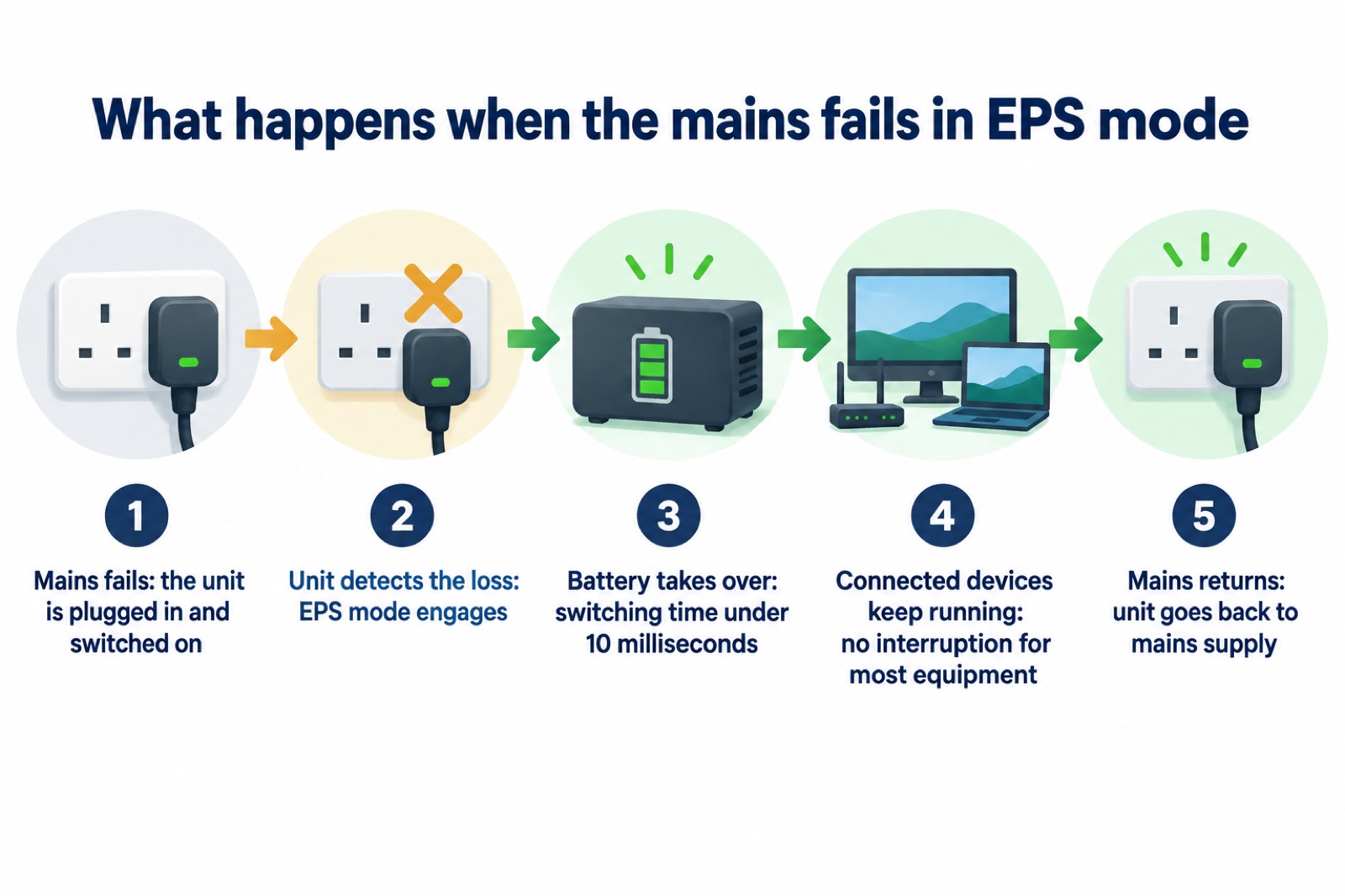
The unit has an EPS mode. The maker says it automatically switches to battery power during power outages or fluctuations, protecting connected devices from power loss and maintaining continuous operation, with a switching time of under 10 milliseconds1. That is fast enough that most equipment will not notice the change.
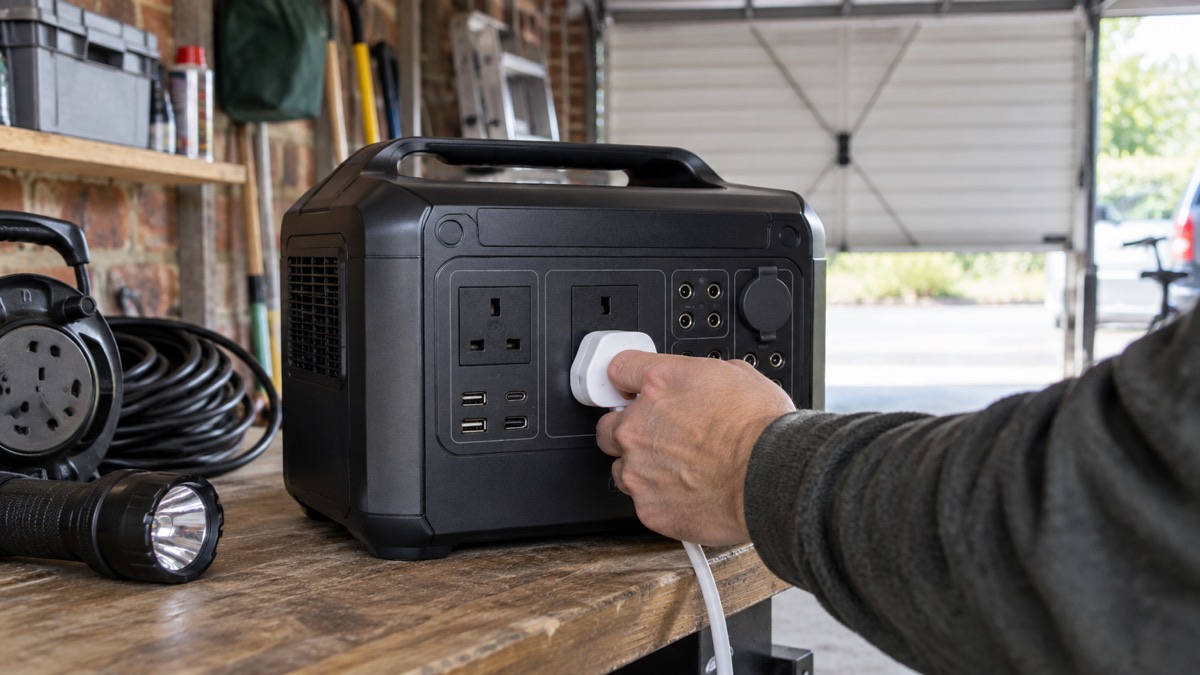
This is not the same as wiring the unit into your house. It means plugging a device into the unit, leaving the unit plugged into the mains, and letting it take over when the mains drops. The maker's instructions for its own product cover this mode; anything involving your home's fixed wiring is a different job, covered in Connecting a Generator or Battery to Your Home's Wiring. For how switchover times compare across units, see Using a Power Station as a UPS: Switchover Times.
How long a cut lasts shapes what you need. Most power cuts do not last very long, according to Wiltshire and Swindon Prepared4. An emergency power cut would typically last at least three hours5. In a planned emergency rota, power could be switched off or reconnected around 30 minutes before or after a published time depending on national electricity use6. A 960Wh unit will carry small loads through a three-hour cut comfortably; it will not carry a heater through one.
If the power goes, call 105 to report it or check on it, the number given by the Scottish Government's Ready Scotland service and by Northern Powergrid7. In England, Wales and Scotland the number is the same; keep it written down where you can find it without a phone signal.
Charging: mains in 1.5 to 2 hours, car or solar much slower
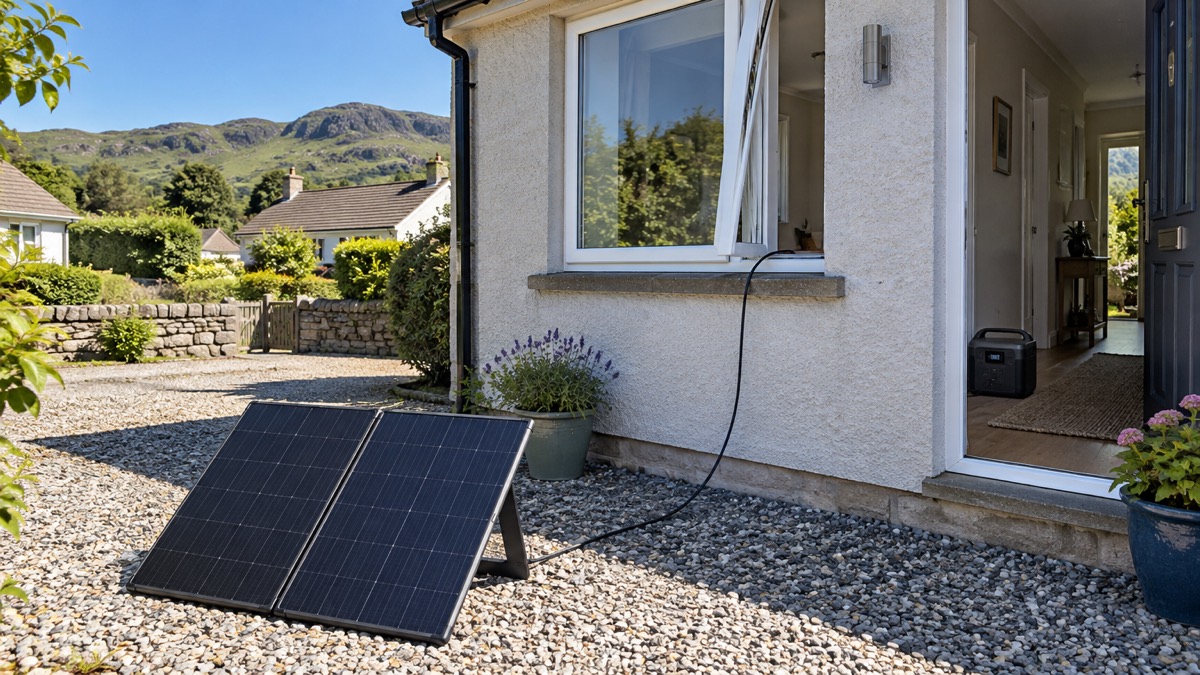
There are three ways to charge the unit: the AC charging cable, a 12V car charger, or a solar panel connected through the HPP port with a 5525 HPP cable, with the solar panel not included2. The speeds are very different.
- Mains: 1.5 to 2 hours to full capacity, and the manual gives the full charge time as about 1.8 hours2. The maker describes a recharge from 5% to 100% in under 2 hours1.
- Car: up to 12 hours to fully charge from a 12V car charger2.
- Solar: the HPP port accepts 11.5-50V at 20A, up to 500W1. The maker states that the voltage at the HPP port must not exceed 50V1.
Solar charging is the slowest and the most dependent on weather. Power stations can be charged with solar panels and will take a while to charge9. The same is true of any battery charged from a leisure battery: a 75 per cent charged battery may only take a few hours to charge fully, whereas a fully discharged battery may take more than 24 hours, according to the Caravan and Motorhome Club10. Plan solar as a top-up between mains charges, not as your only route.
Turning it on and keeping it topped up every 3 months
The most common mistake with a power station is expecting it to work without being switched on. The maker's product page is explicit: press the power button for 2 to 3 seconds to turn the unit on or off, and devices will not charge if you skip this step2. Practise this before an emergency, not during one.
The battery needs a regular top-up even when the unit is not used. The maker recommends that every 3 months you charge the Intrepid for 2 hours, and notes that during charging the fans may turn on and the unit should be left plugged in until the fan stops1. Put a reminder in the diary for the same date each quarter.
A simple routine keeps the unit ready:
- Store it in a cool, dry place, out of direct sunlight1.
- Charge it for 2 hours every 3 months1.
- Check the side vents for dust and foreign matter each time1.
- Leave it plugged in until the fan stops during charging2.
- Note the date of the last charge on a label on the unit.
For a wider seasonal routine, the Backup Power Checks Before Winter checklist covers the rest of the kit. For storage in more detail, see How to Store a Power Station When Not in Use.
Safe use, storage and what to do if it overheats
Lithium-ion batteries can overheat, start an intense fire that develops quickly, and even explode if not used correctly, according to West Sussex Council's safety guidance11. The risk is low when a unit is used as the maker intends, but the consequences are serious enough that the maker's instructions should be followed exactly.
The maker's manual sets out a list of things not to do: do not expose the unit to heat above 212°F (100°C) or incinerate it; do not disassemble it; do not puncture, crush or subject it to mechanical shock; do not drop it; keep it away from children and pets; keep it dry and away from moisture, water and corrosive materials; keep it away from heat sources; and do not cover or restrict air flow during operation1. Store it in a cool, dry place, not in direct sunlight, and do not cover it with towels, clothes or other items1.
The fire and rescue services give the same message in their own words. Mid and West Wales Fire and Rescue Service warns that lithium-ion batteries can overheat, catch fire or explode if improperly charged, handled, stored or disposed of13. Northern Ireland Fire and Rescue Service advises that all electrical items can overheat, so do not leave phones, tablets or laptops on the charge longer than necessary14. London Fire Brigade's summer guidance says to unplug once fully charged8. Electrical Safety First notes that major airlines are clamping down on the use of power banks on planes following a spate of incidents involving them15.
Keep a suitable extinguisher where you store the unit. Devon and Somerset Fire and Rescue Service advises that a fire extinguisher should be recharged after use16. For the wider picture on battery hazards, see Lithium-Ion Battery Safety at Home and What to Do If a Lithium Battery Catches Fire.
Support, warranty and disposal
For safety, warranty or exchange requests, the maker's product page gives a single contact address: INFOACGI@ACGBRANDS.COM2. Use it for anything to do with a fault, a swollen battery or a warranty claim, and stop using the unit while you wait for a reply.
At the end of its life, the unit must not go in the bin. The maker's manual states that the device and its accessories must be properly disposed of in accordance with local laws and regulations1. That means a household waste recycling centre that accepts batteries, not the general waste. For damaged batteries specifically, see How to Dispose of a Damaged Lithium Battery.
If you need help during a power cut and cannot use online services, UK Power Networks gives the number 0800 31 63 105 or the 105 phone number17. If you are deaf, hard of hearing or speech-impaired, Relay UK lets you call 999 through the app or from a textphone by dialling 18000 instead of the normal 1800118. For households that need extra support in a cut, the Priority Services Register is run by the electricity networks; National Grid's customer pages describe the extra help available19. A wind-up or battery-powered radio is a sensible companion to the power station, since it keeps working when the phone signal is weak20.
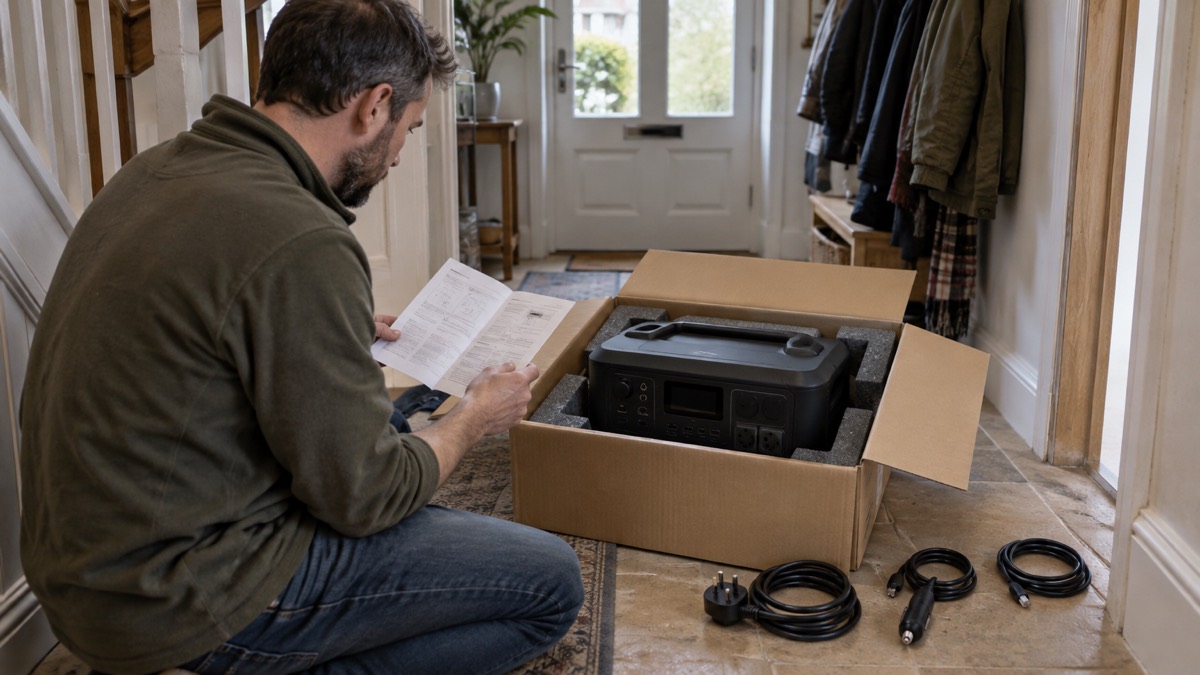
The maker's product page lists the unit as in stock and ready to ship, with all orders sent by DHL on a 2 to 3 day service depending on location, and states that orders cannot currently be shipped internationally2. Keep the user guide and the original packaging; both help if the unit ever needs to go back.
Sources (20)
- NEBO Intrepid 1000 user manual, NEBO Tools, 2026-10-25
- NEBO Intrepid 1000 product page, NEBO Tools, 2026-10-25
- Ratings of electrical appliances, Electrical Safety First, 2026-10-25
- Generators, Wiltshire and Swindon Prepared, 2026-10-25
- Emergency Power Cuts | Northern Powergrid, Northern Powergrid
- Emergency power cuts, Electricity North West, 2026-10-25
- Emergency plan, Ready Scotland, 2026-03-24
- Extreme weather summer guide, London Fire Brigade, 2024-05
- What to pack in an emergency kit - Which?, Which?
- Batteries, Caravan and Motorhome Club, 2026-10-25
- Lithium-ion batteries safety, West Sussex Council, 2023-07
- Batteries and chargers, London Fire Brigade, 2026-10-25
- Lithium battery fire safety, Mid and West Wales Fire and Rescue Service, 2026-10-25
- Think fire safe, don't risk it, Northern Ireland Fire and Rescue Service, 2023-09-25
- Power banks, Electrical Safety First, 2026-10-25
- Fire safety equipment, Devon and Somerset Fire and Rescue Service, 2026
- Power cut, UK Power Networks, 2026-10-26
- Relay UK, RNID, 2026-05-27
- Extra support our customers can get, National Grid, 2026
- Are you ready for big coat weather, Northern Powergrid, 2024-11-08