
YIYUANJI is a torch maker, and the one product of its that UK safety officials have published a notice about is a rechargeable torch sold through Amazon. If you own that torch, the advice is blunt: stop using it immediately and contact the distributor you bought it from to request redress1. The notice, numbered 2408-0050 and dated 30 January 2025, says the product presents a serious risk of fire and burns because, under fault conditions, the battery cells may overheat and enter into thermal runaway1.
If you are here because you are choosing lighting for a power cut, the same notice is still the most useful thing on this page. It tells you what to check before you rely on any rechargeable torch: the model, the batch, the instructions and the charger. A torch is one of the simplest pieces of emergency kit a household can keep, and one of the easiest to get wrong, because the risk sits in the battery rather than the beam.
This page sets out what YIYUANJI makes, how to check a model against the notice, how to charge and store lithium-ion kit safely, and where to go for support. For the wider picture, see Emergency Lighting at Home: Torches, Lanterns and Candles and Power Cuts: A Household Guide.
What YIYUANJI makes for UK households
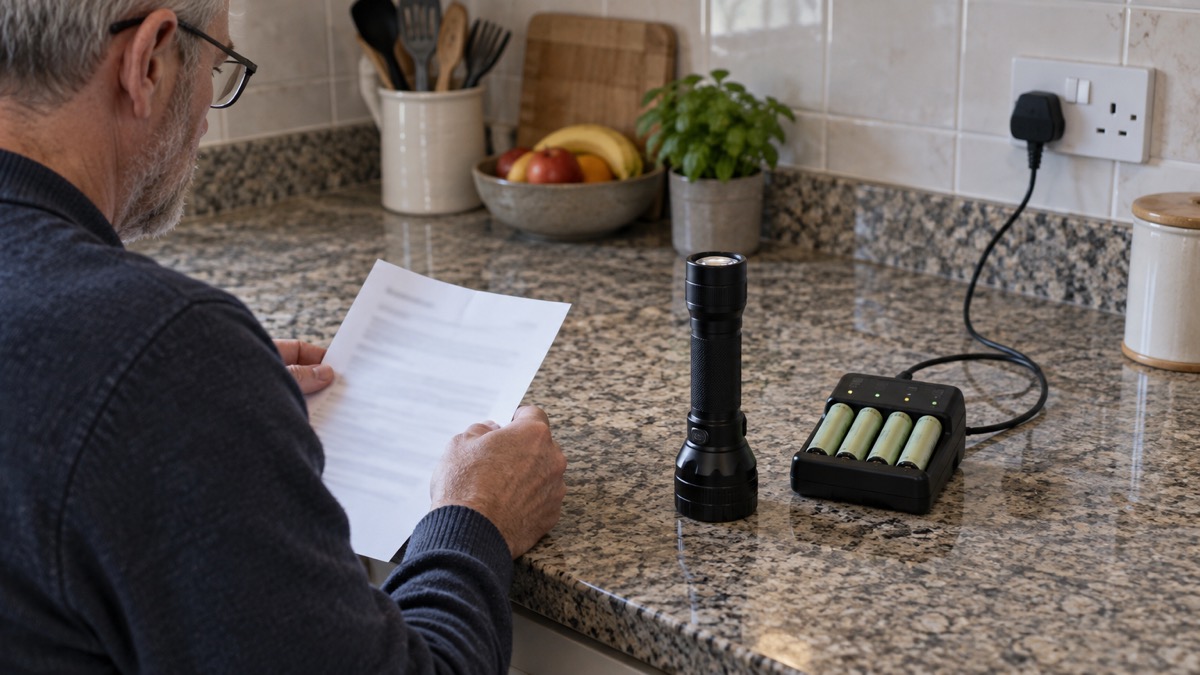
The product named in the official notice is a rechargeable torch supplied with rechargeable 18650 batteries and a four slot USB charger, in black1. The listing name adds the detail a buyer would recognise: a compact torch with four 18650 rechargeable batteries and a four slot USB charger, described as suitable for outdoor cycling, fishing, dog walking and waterproof, with three modes1. The notice also records that the instructions supplied with the product were inadequate, as they did not contain adequate safety information and details to ensure its correct and safe use1.
That is the whole of the kit as the notice describes it: a torch body, a set of rechargeable cells, and a charger that takes four cells at once. For a household, the practical shape of that kit matters more than the marketing. A torch with spare cells and a multi-slot charger is designed to be kept charged and rotated, which is exactly what emergency lighting needs. It also means the charging arrangement, not the torch, is where the fire risk lives.
The notice does not describe any other YIYUANJI product, and no other YIYUANJI item appears in the safety information available here. Treat anything else sold under the name as unidentified until you have checked it yourself against the official recalls pages.
Check the model and specifications before you rely on it
Before a torch goes into an emergency kit, identify it. The safety notice for the YIYUANJI torch gives the details to look for: the model name FL06, the batch numbers Torch FL06 - C218 - T122, the Amazon barcode X001LCK08V and the Amazon ASIN BOB593MM841. Those are the identifiers that let you match your own torch to the notice, and the ones a retailer will ask for.
| Detail | What the notice records |
|---|---|
| Product type | Gadgets - Torch1 |
| Model | FL061 |
| Batch numbers | Torch FL06 - C218 - T1221 |
| Amazon barcode | X001LCK08V1 |
| Amazon ASIN | BOB593MM841 |
| Country of origin | China1 |
| Counterfeit | No1 |
The same discipline applies to any rechargeable kit. Official guidance on e-cigarettes and vapes, which carry the same kind of lithium cell, is to look for a manufacturer's brand name or logo, model and batch number3. That is a good habit for torches, power banks and chargers too: if a product carries no maker, model or batch, you cannot check it against a recall and you cannot ask for redress.
Instructions are part of the specification. The YIYUANJI notice says the instructions supplied with the product were inadequate, as they did not contain adequate safety information and details to ensure the correct and safe use of the product4. Fire and rescue services make the same point in general terms: read and follow the manufacturer's instructions before use5. If the paperwork is missing, unclear or in a language you cannot read, that is a reason to set the item aside rather than guess.
What to work out before an emergency
A torch is only useful if the household knows where it is, who checks it and what it is for. That is a planning question before it is a kit question. Central and local government, the fire, police and ambulance services and other organisations take part in regular training exercises to prepare for emergencies, and households benefit from the same habit of thinking it through in advance6. Nottinghamshire County Council describes its own work as training and exercising with other key organisations to enhance the management of an emergency7.
For a household, the equivalent is a short conversation and a written note. Decide which rooms need light, where the torch and spare cells live, and who checks them. Practise your emergency escape plan together, as practising in advance will help everyone stay calm and get to safety more quickly8. The same principle applies to lighting: a torch you have to hunt for in the dark is not emergency kit.
- Decide the jobs: a torch for moving around the house, a light for the room the household gathers in, and a light for stairs and the route out.
- Decide the charging point: a hard, clear surface away from flammable materials and escape routes2.
- Decide who checks it: one person, on a regular date, so cells are charged and nothing has gone missing.
- Write it down: where the kit is, what it powers and what to do if it fails.
If anyone in the household has weak muscles or painful and stiff joints in their legs, plan for how they will get help if they fall in the dark. NHS Inform advises that if you cannot follow the getting-up instructions, you can consider getting a community alarm so you know help will always be available9. The Extra Help in an Emergency guide covers this ground in more detail.
Safe charging
Lithium-ion batteries are in most of the rechargeable things a household owns: mobile phones, vaping devices, e-bikes and scooters, vacuum cleaners, tablets and ear pods2. They are safe when charged as the maker intended and risky when they are not. Fire and rescue services advise charging batteries in a safe, visible location, away from flammable materials or escape routes2. The same wording appears in guidance from Mid and West Wales Fire and Rescue Service10 and South Wales Fire and Rescue Service2.
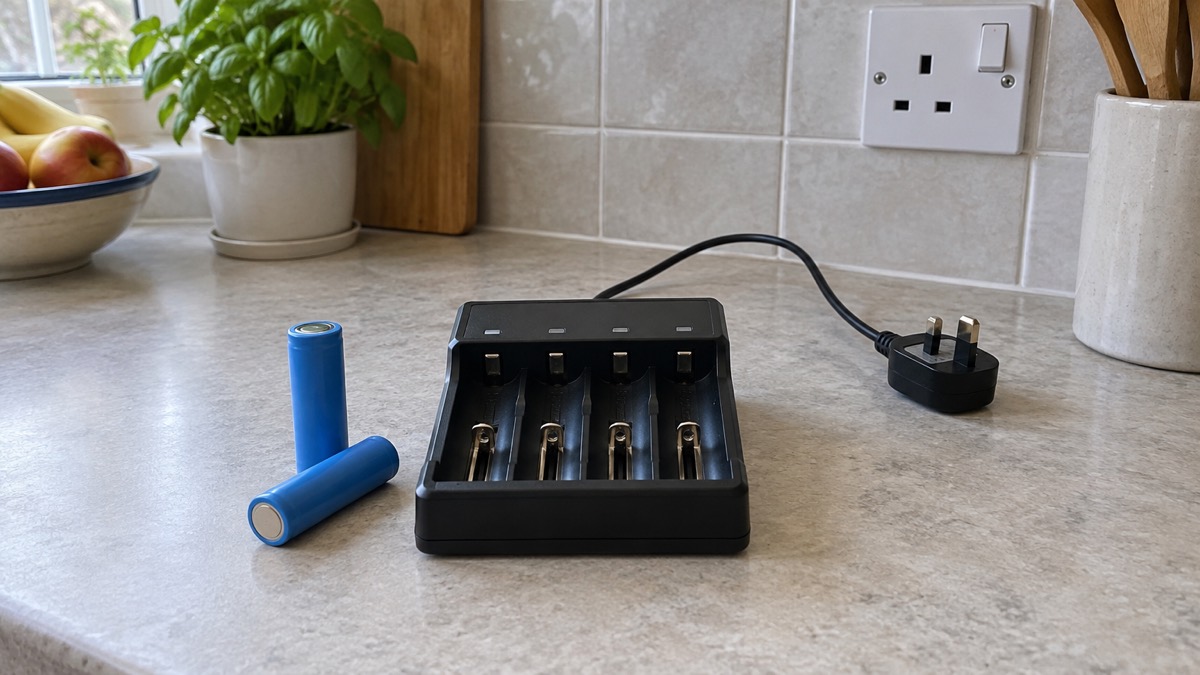
For phones, tablets and laptops, Northern Ireland Fire and Rescue Service advises using approved chargers and charging on hard surfaces11. The Health and Safety Executive's general point about electrical equipment is that cables, plugs, sockets and fittings must be robust enough and adequately protected for the working environment, and that machinery should have an accessible switch or isolator to cut off the power quickly in an emergency12. At home, that means a charger you can reach and unplug without moving furniture, and no charging on a bed, sofa or carpet.
The fire services' Charge Safely, Sleep Soundly campaign aims to encourage safe charging and storage, especially among high-risk groups, increase awareness of lithium-ion battery fire risks, and reduce fires and injuries caused by lithium-ion batteries13. Its purpose is to raise awareness and promote safer charging, storage and disposal practices13. That is the standard to hold your own kit to.
Safe use during a power cut or emergency
A charged power pack can be very helpful in an emergency or power cut14. The Met Office's advice for a power cut includes keeping important documents safe and handy15, and the government's storm guidance is to charge mobile phones, power banks and any back-up batteries for medical equipment in case there is a power cut16. Northern Ireland Direct gives the same advice when strong winds are forecast17. The pattern is consistent across the UK: charge before, not during.
A torch fits that pattern. Keep it charged, keep spare cells charged, and know where it is. When the power goes, use the torch rather than candles where you can. Northern Ireland Direct does advise keeping a supply of candles17, and candles have their place, but a torch with a charged battery is the safer default for moving around a dark house, and it does not add an open flame to a stressful evening.
If the emergency is a fire, get out and stay out, and call 999. If it is a medical emergency, stay calm while you wait for the ambulance18. If you are trapped in a vehicle in extreme weather, Flintshire Council's advice is to exercise to maintain body heat but avoid over-exertion, huddle with passengers and use your coat as a blanket, take turns sleeping so you see the rescue crews, drink fluids to avoid dehydration, and not waste battery power, though at night turn on the inside light if rescuers are nearby19. A torch with a long runtime earns its place in a car kit for exactly that last point.
Storing it so it is ready when needed
Storage is where emergency lighting quietly fails. A torch left in a drawer with flat cells is a torch you do not have. The government's Be Ready campaign advises building readiness gradually by picking up an extra item or two during regular shopping trips to spread the cost20. The same gradual approach works for keeping kit charged: a regular check, a regular top-up, and a spare set of cells ready to swap in.
- Keep the torch where you would reach for it in the dark, not in a cupboard behind other things.
- Store cells charged and cool, and keep the charger with them so the set stays together.
- Check on a fixed date, monthly is a reasonable habit, and swap in spare cells at the same time.
- Keep the instructions with the kit, so anyone in the household can use it correctly.
- Keep a second, simpler light in the kit, so a single failure does not leave the household dark.
For the wider kit, see Emergency Kit: What a UK Household Should Keep Ready and Backup Power at Home: A Household Guide. If you are storing power for medical equipment, the Staying Informed and in Touch in an Emergency guide covers communications and charging together.
What can go wrong and what to do
The failure mode named in the YIYUANJI notice is thermal runaway: under fault conditions the battery cells may overheat and enter into thermal runaway, which is why the notice describes a serious risk of fire and burns1. The notice also records that the instructions supplied with the product were inadequate, as they did not contain adequate safety information and details to ensure the correct and safe use of the product4. Both points matter: a fault is more likely to become a fire if the user has not been told how to charge and handle the cells.
If a lithium battery starts to smoke, hiss or swell, get everyone out, close the door behind you and call 999. Do not try to move a burning battery. The hazard is real: the official notice on the YIYUANJI Rechargeable Torch states that the product presents a serious risk of fire and burns as, under fault conditions, the battery cells may overheat and enter into thermal runaway13.
For other household electrical risks, the same principle of checking and replacing applies. Warwickshire Fire and Rescue Service advises periodically checking for any product recalls or safety notices related to your specific tumble dryer model, and notes that certain symptoms could suggest potential electrical or mechanical issues21. For fire, carbon monoxide, gas leaks and burst pipes, see Home Emergencies: Fire, Carbon Monoxide, Gas Leaks and Burst Pipes.
Safety notices and recalls
The YIYUANJI Rechargeable Torch was notified by Local Authority Trading Standards, and the listing has been removed by the online marketplace, Amazon1. The legal basis recorded is that the product does not meet the requirements of the General Product Safety Regulations 20051. The notice recommends owners stop using the product immediately and contact the distributor they purchased from to request redress1.
Checking for recalls is a habit worth building for every appliance in the house. Manchester Fire and Rescue Service advises checking your appliances are not subject to a product recall by checking the Office for Product Safety and Standards alerts and recalls page21. Fire Scotland points to the Electrical Safety First product recalls pages as another route22. Both are free to use and take a minute.
Recall notices are not rare, and they are not a sign that a maker is unusual. Recent examples include a product recall for Bull and Cygnus Fire Alarm Detection Systems23, a safety repair programme for Haier integrated heat pump tumble dryers where owners should check their model number and serial number online to see if their appliance is affected and contact the manufacturer to arrange a repair24, and a recall of YIYUANJI Rechargeable Torches whose instructions were inadequate, with owners advised to stop using the product immediately and contact the distributor they purchased from to request redress25. Food is covered too: the Food Standards Scotland notice on certain eggs imported from Ukraine gives the code stamped on eggs as 3UA1012066 and the approval code as a-UA-10-12-06-X-PC, PP26. The lesson is the same across product types: the identifier on the item is what lets you check it.
Support and warranty for UK buyers
The official notice does not give a YIYUANJI contact address or a warranty term. What it does give is the route to take: contact the distributor you purchased from to request redress1. If you bought through Amazon, that means the marketplace order and returns process, using the order confirmation, the listing name and the barcode or ASIN to identify the item1.
Keep the paperwork. Proof of purchase for a YIYUANJI torch is the order confirmation or receipt, plus the model and batch numbers and, where relevant, the Amazon barcode X001LCK08V or ASIN BOB593MM841. Those details are what a retailer or marketplace will ask for, and they are what lets you show that the item you hold is the item under notice.
Warranty terms vary by maker and product, and this page cannot state YIYUANJI's. Where a maker publishes a warranty, read it before you rely on the kit, and keep the receipt in the same place as the instructions. For a wider look at how UK households prepare, see Getting Started: Preparing Your Household for an Emergency and How the UK Prepares for Emergencies: A Household Guide.
Sources (26)
- Product Safety Report: YIYUANJI Rechargeable Torch sold via Amazon (2408-0050), GOV.UK, 30 January 2025
- Lithium-ion batteries, South Wales Fire and Rescue Service, 2026
- Smoking, Dorset and Wiltshire Fire and Rescue Service, 2026
- 2408-0050 Product Safety Report: Torch, GOV.UK, 2025
- Electric blankets, Humberside Fire and Rescue Service, 29 October 2026
- National emergencies, GOV.UK, 29 October 2026
- Our role in emergency planning, Nottinghamshire County Council, 29 October 2026
- Christmas safety tips, Warwickshire County Council, 29 October 2026
- What to do if you fall, NHS Inform, 30 April 2026
- Lithium battery fire safety, Mid and West Wales Fire and Rescue Service, 2026
- Student safety, Northern Ireland Fire and Rescue Service, 2026
- Electricity, Health and Safety Executive, 2026
- Charge Safely, Sleep Soundly campaign, Dorset and Wiltshire Fire and Rescue Service, 18 March 2025
- Prepare yourself, Wiltshire and Swindon Prepared, 25 October 2026
- What to do in a power cut, Met Office, 2026
- Storms, Prepare campaign, GOV.UK, 19 October 2026
- Strong winds weather warning information and advice, Northern Ireland Direct, 24 October 2026
- What to do when the ambulance is coming, South Western Ambulance Service NHS Foundation Trust, 29 October 2026
- Extreme weather, Flintshire County Council, 29 October 2026
- Be ready for emergencies, Be Ready campaign, GOV.UK, 21 October 2026
- Maintain appliances and recalls, Greater Manchester Fire and Rescue Service, 2026
- Your guide to fire safety, Scottish Fire and Rescue Service, 2026
- Product Recall: Bull and Cygnus Fire Alarm Detection System (FADS) (2607-0120), GOV.UK, 12 August 2026
- Haier to restart heat pump tumble dryer safety repair programme, GOV.UK, 9 September 2025
- Urgent safety check for 85,000 tumble dryers, GOV.UK, 10 December 2025
- FSS and FSA warns consumers and businesses not to eat or sell certain eggs imported from Ukraine, Food Standards Scotland, 10 October 2026