Cardiac Science is a maker of automated external defibrillators (AEDs), the portable devices that give a high-energy electric shock to the heart of someone in cardiac arrest1. For a household, the reason to know the name is simple: most cardiac arrests happen at home. South Western Ambulance Service puts it at 80% of cardiac arrests happening within the home, and London Ambulance Service reports that in London 76 per cent of cardiac arrests happen at home2. The person who needs the device is most likely to be a family member.
If someone collapses and is not breathing normally, the order of action does not depend on which make of device you own. Call 999 immediately, start CPR as soon as possible, ask someone to find a defibrillator, and continue until professional help arrives4. The 999 call handler can give you the exact location of the nearest registered defibrillator and talk you through CPR5.
This page covers what Cardiac Science kit does, how to keep it ready between emergencies, how to check for safety notices, and how to register a device so that ambulance control rooms can find it. It does not rank one defibrillator against another: any working AED, in date and registered, is better than none.
What Cardiac Science makes for UK households
Cardiac Science's relevance to a household is the AED itself: a device that checks the heart rhythm and will only advise a shock if one is needed11. That single design feature is what makes a defibrillator something an untrained neighbour or family member can use in the first minutes of a cardiac arrest, before an ambulance arrives.
The case for having one at home rests on where arrests happen. Ambulance services repeat the same figure: 80% of cardiac arrests happen within the home, so it could be a friend or family member who urgently needs your help2. London Ambulance Service adds that most cardiac arrests happen at home and encourages everyone to learn simple life-saving skills12. In London the share is given as 76 per cent, so the two services' figures differ slightly; both point the same way3.
A cardiac arrest can happen to anyone, from young children to older adults, and people with underlying heart disease may have a higher risk13. That is why a household plan should treat a defibrillator the way it treats a smoke alarm: a piece of kit that sits quietly, is checked on a routine, and is ready without warning.
For the wider picture of what to keep at home and how to plan, see First Aid at Home: A Household Guide and Health Emergencies: A Household Guide to Outbreaks, Pandemics and Medicine Supplies. A defibrillator belongs in the same conversation as a stocked first aid kit and a written household plan, not as a substitute for either.
Using a defibrillator in a cardiac arrest: call 999 first
The device is never the first step. Ambulance services across the UK give the same sequence, and it applies whatever make of defibrillator is on the wall or in the cupboard.
- Call 999 immediately and ask for an ambulance4.
- Start CPR as soon as possible, with chest compressions if it is safe to do so4.
- Ask someone to find a defibrillator if one is nearby4.
- Continue until professional help arrives4.
You do not need formal training to act. London Ambulance Service advises calling 999 immediately, starting chest compressions if it is safe to do so, and sending someone to get a defibrillator if one is nearby, even without formal training14. The call handler can guide you through CPR and direct you to the closest public access defibrillator7.
A cardiac arrest is recognisable: someone loses consciousness and won't respond to you, collapses with a low or undetectable heart beat, stops breathing, or isn't breathing normally, possibly with slow breaths, gasping or short periods that look like a fit13. If that is what you are seeing, act on it.
"The device checks the heart rhythm and will only advise a shock if one is needed."
For a child, the same first step applies. NHS Inform states that AEDs can be used on adults and children over 1 year8. If you are unsure, call 999 and follow the call handler's instructions; the device itself will analyse the rhythm before advising anything.
Powerheart defibrillators: what each model does
Cardiac Science's defibrillator range is sold under the Powerheart name. The models differ in who they are built for and how much guidance they give a rescuer, and those differences matter more to a household than any other specification.
| Model | Who it suits | What it does for the household |
|---|---|---|
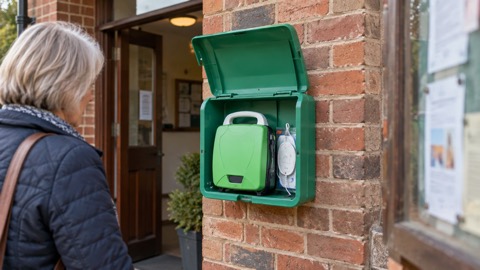
| Powerheart G5 | Homes, small workplaces and community sites | Fully automatic or semi-automatic options, with voice and text prompts that walk an untrained rescuer through the steps |
| Powerheart G3 | Workplaces and public sites already equipped with the G3 platform | A long-established semi-automatic unit, with pads and batteries ordered to match the model |
| Powerheart G3 Plus | Sites wanting the G3 platform with ECG recording | As the G3, with the ability to record the heart's electrical activity for the clinical team |
Whichever model a household owns, the operating principle is the same: the device analyses the rhythm and advises a shock only if one is needed11. The practical difference for a family is the level of prompting. A fully automatic unit delivers the shock itself once it has advised one, which removes a decision from an untrained rescuer; a semi-automatic unit asks the rescuer to press the shock button when prompted. Both talk the user through CPR timing and pad placement.
Model choice should follow the people who will use it. A household where the likely rescuer is a teenager, a neighbour or a visitor is best served by the model with the clearest spoken prompts. A household where the main user has had training may prefer the semi-automatic version, because it keeps the final shock decision with the rescuer.
The Powerheart range is one part of a household's emergency kit. For the wider list of what to keep ready, see Emergency Kit: What a UK Household Should Keep Ready.
Key specifications to check
When comparing defibrillators, the specifications that decide whether the device will work in an emergency are the ones about readiness, not the ones about size or weight.
- Pads expiry date. This is one of the details required when registering a defibrillator, and it is the first thing to check on any unit15.
- Battery status. The battery indicator tells you whether the unit is ready; a depleted battery is one of the two common reasons a device fails when needed16.
- Consumable shelf life. Pads and batteries have a long shelf life of between 2 and 5 years depending on the AED model, so the replacement date depends on which model you own9.
- Who it can be used on. AEDs can be used on adults and children over 1 year8.
- Self-test behaviour. The unit runs its own checks; a unit that fails a self-test is not ready, and the fault needs acting on before the next emergency.
The shelf life figure is the one households most often get wrong. Because it varies by model, the date on your own pads, not a general rule, is what counts. Write the pads' expiry date on a label on the cupboard door or in the household diary, and check it at the same time each year as your smoke alarm checks.
For the wider context of what a household should hold ready for a medical emergency, see First Aid at Home: A Household Guide.
Pads and batteries: expiry dates and replacements
Pads and batteries are the parts of a defibrillator that expire. The device itself may last years, but if the pads have dried out or the battery is flat, the unit will not deliver a shock when it matters.
South Central Ambulance Service warns plainly: an unchecked device with expired pads or a depleted battery could mean a lifesaving opportunity is lost during the first critical minutes of a cardiac arrest16. That is the whole reason for a checking routine.
Keep a small stock of spares if your household can. A spare set of pads and a spare battery mean that a device used once can be returned to service quickly, rather than waiting for a delivery. Store them where the defibrillator is kept, in the original packaging, and check their dates at the same time as the fitted set.
When a battery or a set of pads reaches its date, replace it and dispose of the old one properly. Fire and rescue services advise taking batteries and items containing batteries to household waste recycling centres or recycling points, and never putting old batteries or electrical items in any of your household bins, including recycling bins17. Manchester Fire and Rescue Service gives the same instruction for lithium-ion batteries: always dispose of them at household waste recycling centres or designated recycling points, and many shops have them18. A simple habit helps: set aside a bag just for batteries, and each time you remove a battery from a gadget, put it in the bag ready to take to a recycling point, or to be collected if your local council provides this service19.
Routine checks and safe storage at home
A defibrillator is only as good as its last check. Ambulance services ask defibrillator guardians to carry out regular checks and to update The Circuit so that 999 dispatch knows the device is ready for use20. South Central Ambulance Service makes the same request across Berkshire, Buckinghamshire, Hampshire and Oxfordshire: check your defib regularly, because every minute counts16.
A household check takes a few minutes and covers the same ground each time:
- Look at the status indicator or screen and confirm the unit reports itself ready.
- Read the pads' expiry date and note it against the calendar.
- Check the battery indicator and the battery's own date.
- Confirm the carry case, if you use one, holds the unit, a spare set of pads and a razor if your kit includes one.
- Confirm the device is stored where an adult can reach it quickly, and that everyone in the household knows where it is.
Storage matters as much as checking. Keep the unit somewhere dry and at room temperature, away from damp, and not in a loft or garage where extremes of temperature and moisture shorten the life of the pads. Make the check part of a bedtime routine: fire and rescue services advise making a bedtime check of the home, and adding the defibrillator to that round takes seconds21.
If the unit fails a self-test, treat it as out of service until the fault is resolved. Check the pads and battery first, replace anything out of date, and if the fault persists contact the maker or the supplier. Update The Circuit so the device is not shown as ready when it is not20.
Safety notices and recalls: how to check your device
The most reliable protection against a recall you never hear about is registration. Fire and rescue services advise registering electrical items with the manufacturer to be informed of any safety recalls18. Do that when the defibrillator arrives, and keep the serial number and purchase details with your household records.
Checking for notices takes three steps:
- Find the serial number on the device label and note it down.
- Check the maker's own safety notices and the Government's product recall and safety alert pages for the model name.
- Check The Circuit entry for the device, and update it if the unit has been replaced or taken out of service20.
Product safety notices are specific about which units are affected. A recall notice for a different product, the Bull and Cygnus Fire Alarm Detection System, shows how a notice identifies a batch: the defect was confined to a single batch of NCUs (batch reference 2410), and not all units in the batch were affected22. The lesson for a defibrillator owner is to match the serial number on your own unit against the notice, rather than assuming a recall applies to every device of that model.
If a notice does apply, follow the maker's instructions exactly. Do not continue to rely on a unit that a notice says should be withdrawn, and do not pass it on to someone else.
Support and warranty in the UK
Support for defibrillator owners in the UK comes from the ambulance services as much as from the maker. London Ambulance Service's defibrillator accreditation scheme offers guidance and support in buying, storing and using a defibrillator11. That is the number to call if you are unsure whether a device is suitable for your home or how to store it.
Training is available and free in many areas. London Ambulance Service provides basic life-support training courses and has raised awareness of the signs of cardiac arrest, and the number of people surviving cardiac arrest has risen significantly over the past few years14. In Wales, the Welsh Ambulance Services University NHS Trust supports familiarisation courses in basic life support and use of the defibrillator23. Save a Life Cymru runs short, interactive learning packages designed to help build your confidence to recognise a cardiac arrest, perform CPR, and use a defibrillator24. The Resuscitation Council UK leads Restart a Heart, which raises awareness of cardiac arrests and equips people with the confidence to act25.
Warranty terms are set by the maker and the supplier, so keep the purchase paperwork with the device and check the terms at the point of sale. What matters for a household is that the pads and battery dates are recorded, and that the device is registered on The Circuit, which is led by the British Heart Foundation with support from Resuscitation Council UK, so that 999 call handlers can find it5.
Registering a defibrillator with The Circuit
The Circuit is the national defibrillator database used by ambulance services. If you manage a defibrillator in your community, workplace, or school, it is essential to register it on The Circuit26. For a household with a defibrillator that neighbours might use, the same logic applies: an unregistered device is invisible to the ambulance service.
Registration is quick. It takes less than five minutes to register a defibrillator on The Circuit and there is no cost10. Register your defibrillator at www.thecircuit.uk27. When a 999 call is received for a suspected cardiac arrest, ambulance service control room staff can direct callers to the nearest available registered defibrillator10. The emergency call handler can provide the exact location of the nearest defibrillator to the caller5.
If your device was previously registered directly with an ambulance service, it still needs to be on The Circuit. All older community defibrillators that were directly registered with the ambulance service will need to be registered on The Circuit too, and you can check if yours is already registered by visiting www.defibfinder.uk27.
Registration is not a one-off. After registering, carry out regular checks and update The Circuit so that 999 dispatch knows the device is ready for use20. If the device moves, is replaced or goes out of service, update the entry.
For the wider picture of how households and communities prepare together, see Community Resilience: A Guide for Neighbours and Local Groups and Extra Help in an Emergency: Older, Disabled and Medically Dependent Households.
Sources (27)
- First aid provisions, ProtectUK
- Restart a Heart, South Western Ambulance Service NHS Foundation Trust
- Mum, I need an ambulance: teenager trains classmates in life-saving skills, London Ambulance Service NHS Trust, 2025-12-05
- Cardiac arrest, East of England Ambulance Service NHS Trust
- Unlocked defibrillator cabinets allow immediate access in an emergency, London Ambulance Service NHS Trust, 2025-01-06
- Some of the reasons people call, Welsh Ambulance Services University NHS Trust
- Emergency heart care, London Ambulance Service NHS Trust
- How to use an AED, NHS Inform, 2026-09-28
- PAD Information Pack, August 2026, South Central Ambulance Service NHS Foundation Trust, 2026-08
- Check your defib because every minute counts, South Central Ambulance Service NHS Foundation Trust, 2026-06-15
- Defibrillators, London Ambulance Service NHS Trust
- New Year, new skills: cardiac arrest survivor backs London Ambulance Service life-saving campaign, London Ambulance Service NHS Trust, 2026-01-09
- Cardiac arrest, NHS Inform, 2026-08-18
- Emergency heart care, London Ambulance Service NHS Trust, 2026-09-30
- AED, Northern Ireland Ambulance Service HSC Trust
- SCAS urges defibrillator guardians to keep checking their devices, South Central Ambulance Service NHS Foundation Trust, 2026-07-08
- Be battery aware, Greater Manchester Fire and Rescue Service
- Electrical fire safety leaflet, Greater Manchester Fire and Rescue Service
- Recycle your electricals campaign, North Yorkshire Fire and Rescue Service, 2024-05-01
- Are you the guardian of a defibrillator in your community?, North West Ambulance Service NHS Trust, 2024-03-05
- Safety at home, Dorset and Wiltshire Fire and Rescue Service, 2026-04-30
- Product recall: Bull and Cygnus Fire Alarm Detection System (FADS), GOV.UK, 2026-08-12
- Register your defibrillator, Welsh Ambulance Services University NHS Trust
- Save a Life Cymru, Welsh Ambulance Services University NHS Trust
- Ambulance service invites South West communities to attend CPR training events this Restart a Heart month, South Western Ambulance Service NHS Foundation Trust, 2026-10-30
- Improving outcomes in cardiac arrest: tools and resources, NHS England
- The Circuit: the new defibrillator database, North West Ambulance Service NHS Trust, 2025-07-10
 Cardiac Science Powerheart G5 AED