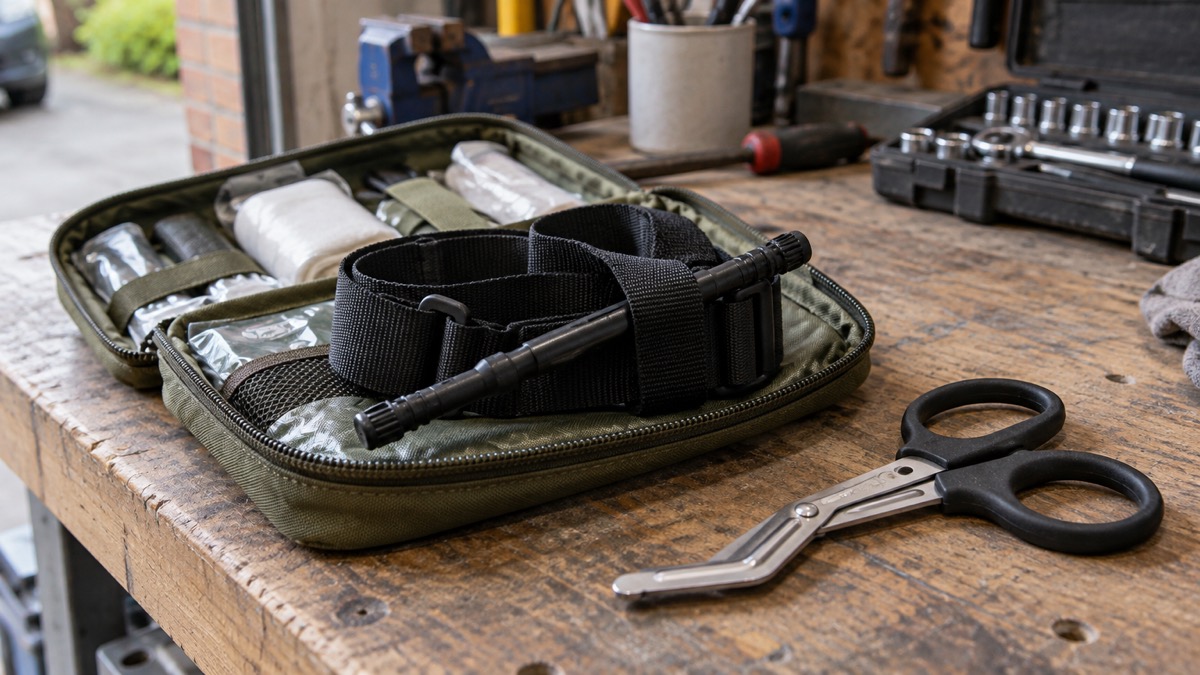
A tourniquet is for one situation only: bleeding from an arm or a leg so severe that it could kill someone, and that pressing hard on the wound has not stopped. The Resuscitation Council UK's 2025 first aid guidelines say to apply one as soon as possible for life-threatening bleeding from a limb that direct manual pressure has not controlled1. It is not for a cut that is oozing, a nosebleed or a graze.
If you are facing that situation now, the order is: call 999, press hard on the wound, and if the bleeding still will not stop, put a tourniquet on the limb close to and above the injury, tighten it until the bleeding stops, and leave it alone until paramedics arrive2. Tell the casualty it will hurt, because it will.
Most households will never need to do this. But knowing the trigger, the position and the one thing you must not do afterwards is what turns a frightening few minutes into a manageable one. This page sets out when a tourniquet is right, how to apply one, where it must never go, and what to do while you wait.
Use a tourniquet only for life-threatening bleeding from an arm or leg
The test is not how much blood you can see but whether the bleeding threatens life and whether pressure has failed. The Resuscitation Council UK sets out an escalating approach for life-threatening bleeding: manual direct pressure first, then a haemostatic dressing and/or a tourniquet1. A tourniquet is the last step in that sequence, not the first thing you reach for.
St John Ambulance describes the injuries where this arises: severe limb bleeding where serious damage has occurred, such as an amputation or blast injury, or rapid control of bleeding where the patient or clinician is in danger2. It lists the causes as injuries most likely following a gun shot, stabbing, power tool accident or serious road traffic incident2. In an ordinary home, the power tool accident is the one to keep in mind.
A tourniquet works by squeezing the limb so hard that blood cannot pass. That is why it can only be used on an arm or a leg, where there is a single bone or pair of bones to press against. Only use tourniquets on limbs, and seek emergency care as soon as possible4.
| Situation | Tourniquet? | What to do |
|---|---|---|
| Deep cut on the arm or leg, bleeding heavily | Only if firm direct pressure has not stopped it | Press hard on the wound, call 999, then apply if bleeding continues1 |
| Amputation or blast injury to a limb | Yes, as soon as possible | Call 999, apply high and tight above the injury1 |
| Bleeding from the neck, chest or belly | No | Call 999 and press on the wound; a tourniquet cannot be used here2 |
| Nosebleed, graze, small cut | No | Ordinary first aid; see our guide to cuts, grazes and wounds |
Before you start, protect yourself where you can. St John Ambulance advises removing only the clothing you need to, and for a severe bleed removing only the clothing around the bleed, as it is rare to need to remove all clothing6. That keeps the casualty warm and preserves their dignity while you work.
Call 999 first and press hard on the wound
The ambulance comes first. NHS ambulance services say to call 999 when someone is seriously ill or has life-threatening injuries, giving severe blood loss as an example7, and severe bleeding appears on their lists of reasons to call8. NHS inform's primary survey guidance is blunt: if the casualty is bleeding severely, apply pressure directly to the wound and phone 999 for help4.
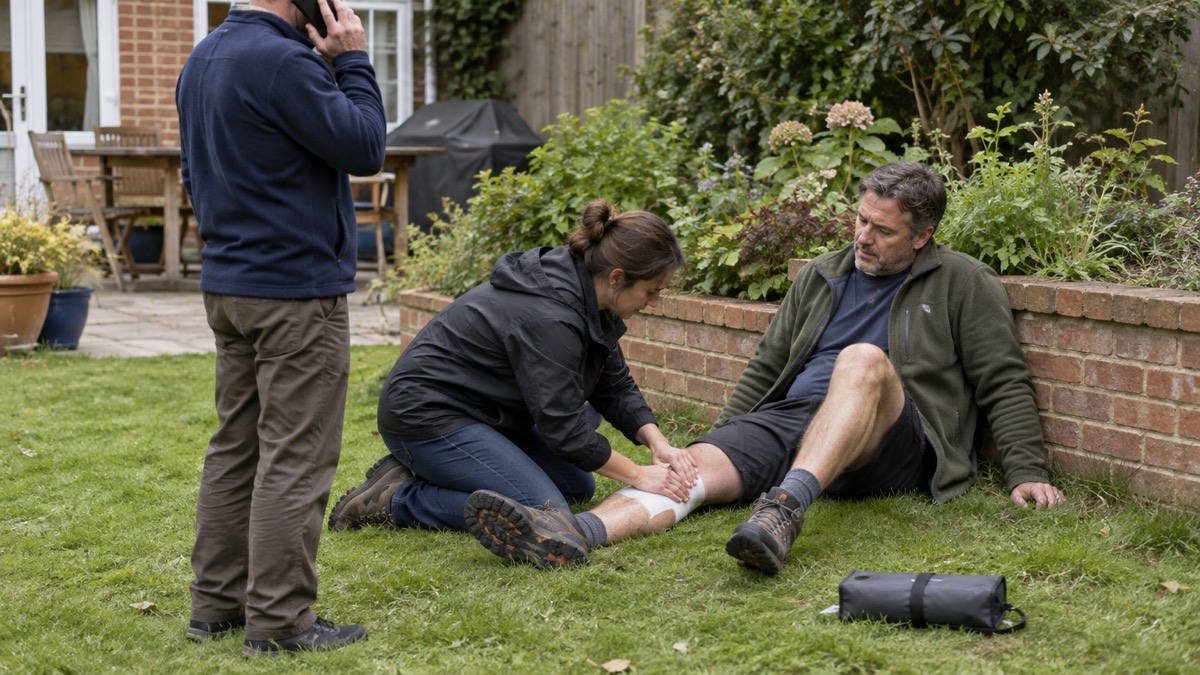
If there is someone else with you, let them make the call. NHS inform says to ask someone else to phone 999 while you help the injured person, and to give the call handler details of the injury and the extent of the bleeding5. That detail matters: it tells the control room what equipment and how many crews to send.
Then press. Firm, direct pressure on the wound with whatever clean material you have is the step that stops most bleeding, and it is the step the guidelines put before any tourniquet1. Keep pressing while you wait, and only move on to a tourniquet if the bleeding is life-threatening and pressure is not controlling it.
How to apply a tourniquet: high and tight above the wound
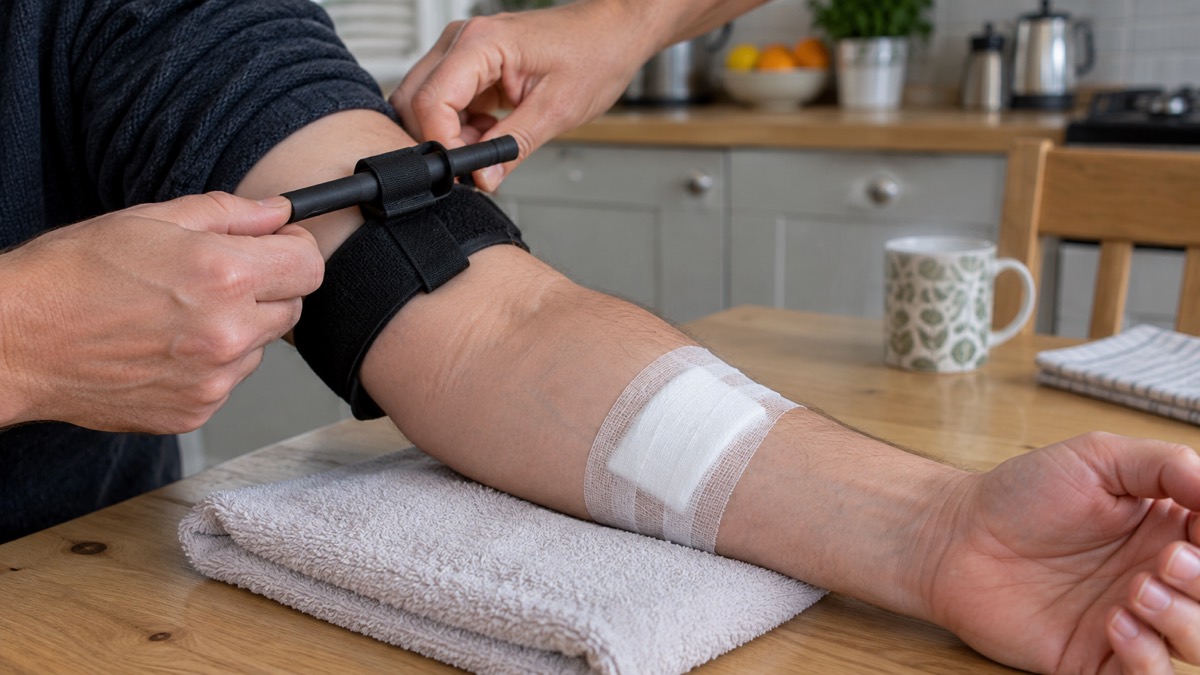
Position first. The Resuscitation Council UK says to place the tourniquet around the traumatised limb 5 to 7cm above the injury, but not over a joint3. St John Ambulance puts it slightly differently: place it around the limb close to and above the injury, and if you can place it below the elbow or knee, that is best, and never on a joint2. Both agree on the principle: above the wound, clear of the joint.
Then tighten. St John Ambulance's instruction is to pull the strap tight, so that you should not be able to get three fingers under the band once it is tight, then tighten the rod by twisting until the bleeding stops and secure it with the rod clip2. That three-finger test is the practical check that the band is doing something.
If you are using a purpose-made tourniquet, follow the maker's instructions on the packaging. If you are improvising, St John Ambulance describes the method: wrap the material around the limb and cross over the ends, tie the rod or winding key in with a knot, twist the rod to stop the bleeding, then secure the rod or hold it in place2.
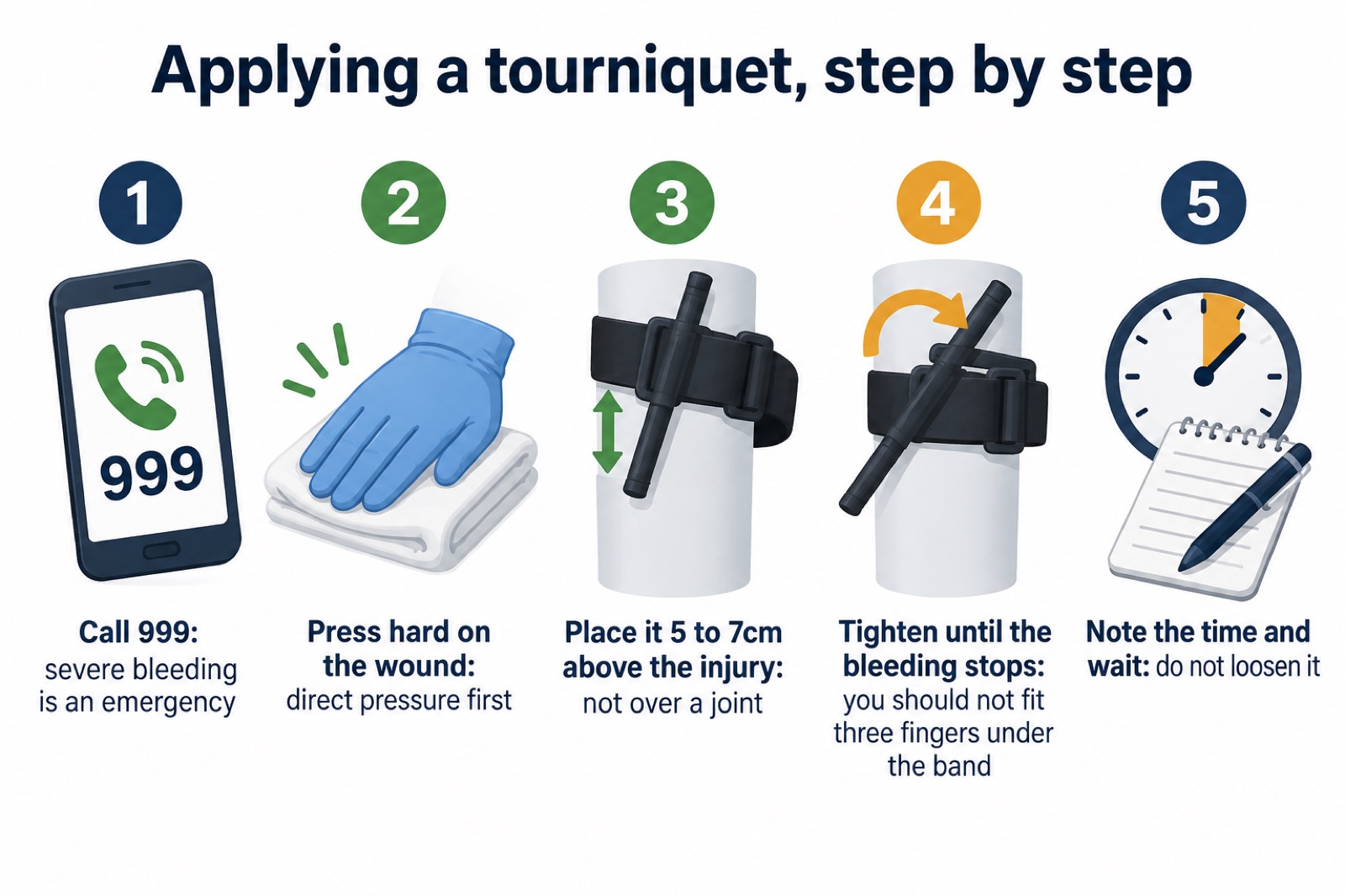
Tell the person what you are doing. St John Ambulance says to ensure the casualty knows you are applying a tourniquet and that it will hurt when you tighten it2. A few words of warning before you twist is kinder than a surprise.
Where a tourniquet must never go
The limits are as important as the method, and they are simple.
- Never on the neck, chest, belly or groin. A tourniquet only works on a limb, where it can compress the blood vessels against bone2. For bleeding from the torso or neck, call 999 and press on the wound.
- Never directly over a joint. The Resuscitation Council UK says not over a joint3, and St John Ambulance says never on a joint2. A joint will not compress properly and the band will slip.
- Never on a limb where the bleeding has already stopped with pressure. The escalating approach means a tourniquet is for bleeding that direct pressure has not controlled1.
- Never loosen it once it is on. St John Ambulance says that once a tourniquet is applied it should not be loosened, as the bleeding will start again2. The Resuscitation Council UK is explicit: do not release the tourniquet, and it should only be released by a healthcare professional3.
After it is on: note the time and leave it for paramedics
Once the bleeding has stopped, your job is to keep the person calm, keep the limb still and hand over cleanly when the crew arrives. Note the time you applied the tourniquet, so the paramedics know how long it has been on. Stay with the casualty, keep them warm and keep talking to them.
The ambulance service's own advice for the wait is simple: stay calm9. If you are on the street, stay with the patient until the ambulance or rapid response vehicle arrives; if you are in your car, turn your hazard lights on10. Those small actions help the crew find you quickly.
If a second tourniquet is needed, the Resuscitation Council UK says that in some cases you may need to apply a second tourniquet, above the first tourniquet, to control the bleeding3. That is a decision for the moment, made because bleeding is still coming through, not a routine step.
When the crew arrives, tell them what you did and when: that you applied a tourniquet, at what time, and whether the bleeding stopped. That handover is the reason for noting the time in the first place.
Learning first aid for severe bleeding
A tourniquet is a skill you learn by practising, not by reading. The Resuscitation Council UK's guidance is that life-threatening bleeding is managed with an escalating approach, from manual direct pressure through to haemostatic dressings and tourniquets1, and a first aid course is where those steps become familiar.
First aid training covers dealing with an emergency, how to do CPR and put someone in the recovery position, head injuries, severe bleeding, burns and broken or sprained bones, seizures, heart attacks and strokes, choking, severe allergic reactions and diabetic emergencies11. A course that includes severe bleeding will take you through pressure, dressings and tourniquets in the order you would use them.
If you want to be equipped at home, a dedicated bleeding control kit is the practical answer. The government's specification for public access trauma (PAcT) kits lists two tourniquets and two tourniquet application memoires among the contents12, alongside protective items, special dressings and clear instructions13. Our bleeding control kit checklist sets out what to keep and why, and the first aid kits for the home guide explains how a household kit is put together.
For the wider picture, start with our first aid at home guide and the primary survey, which is the order of checks to run before you treat anything. Our guide to how to stop severe bleeding covers pressure and dressings in more depth, and protecting yourself when helping covers gloves and masks.
Sources (13)
- 2025 Resuscitation Guidelines: First Aid Guidelines, Resuscitation Council UK, 2025
- Life-threatening bleed, St John Ambulance, 2026
- 2025 Resuscitation Guidelines: First Aid Guidelines, Resuscitation Council UK, 2025
- How to do a primary survey, NHS inform, 2026
- Severe bleeding first aid, NHS inform, 2026
- Protecting a patient's dignity, St John Ambulance, 2026
- Your service: 999, North East Ambulance Service, 2026
- When to call 999, South Western Ambulance Service, 2026
- What to do when the ambulance is coming, South Western Ambulance Service, 2026
- Using 999, East of England Ambulance Service, 2026
- Household emergency kit, nidirect, 2026
- Standards for public access trauma (PAcT) first aid kits and equipment, ProtectUK, 2026
- Bleeding heavily, British Red Cross, 2026
 Baby and Child Kit Checklist
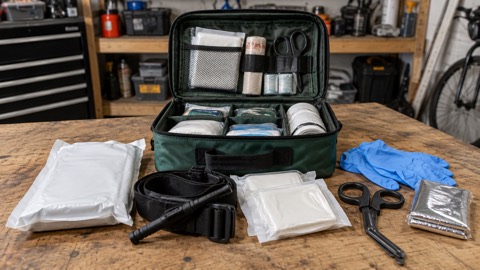 Bleeding Control Kit Checklist
 Car Kit Checklist
 CPR on a Baby
 CPR on a Child
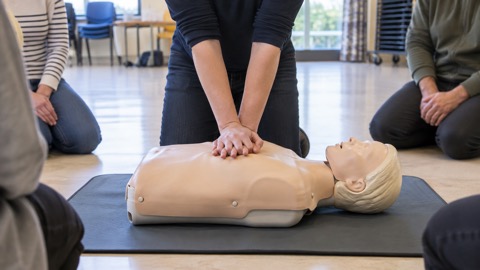 Chest Compression Rate and Depth
 Rescue Breaths or Hands-Only CPR
 Checking Breathing
 Agonal Breathing and CPR
 Breathing During CPR
 Recovery Position and Spine
 Cardiac Arrest vs Heart Attack
 Heart Attack First Aid
 Defibrillator Pad Placement
 Defibrillator on a Child