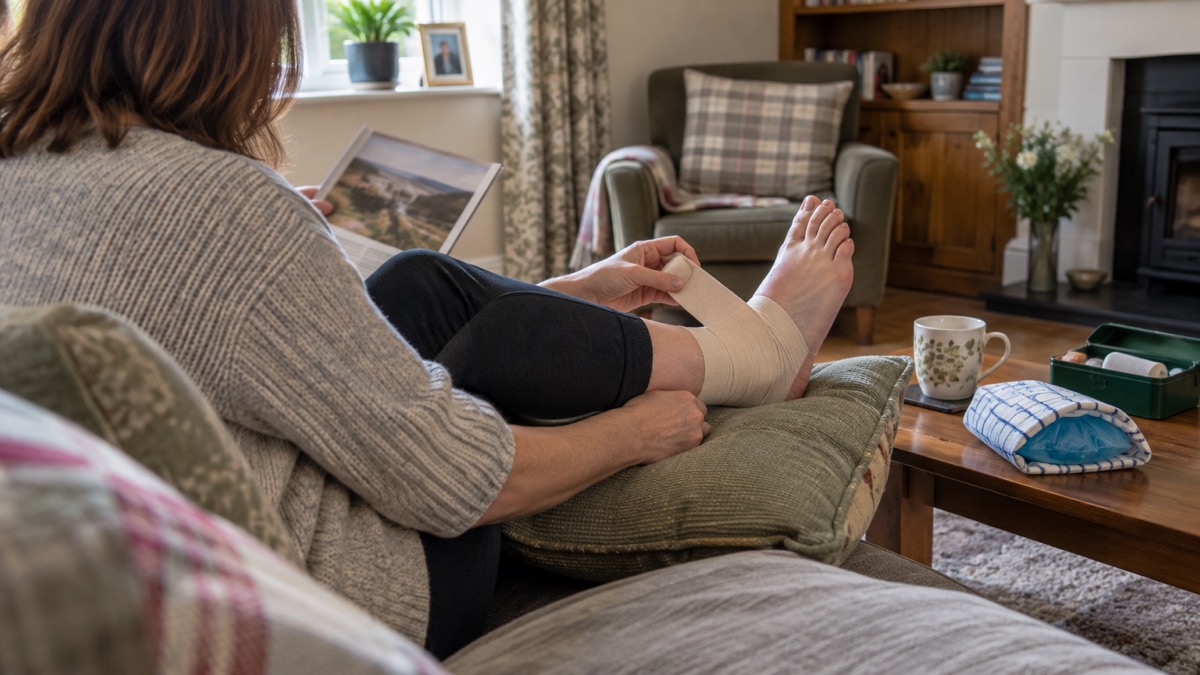
Most minor sprains and strains can be treated at home with self-care, according to NHS guidance, which names paracetamol or PRICE therapy as the techniques to use1. PRICE stands for protection, rest, ice, compression and elevation, and the compression and support part is where bandages come in: crepe bandages are mainly used for sprained or strained ankles or wrists, elasticated tubular bandages support joints like elbows and knees, and a triangular bandage can be used as a sling for an injured arm2.
The one sign that changes everything is swelling that will not settle. NHS Wales guidance is direct about it: if the swelling does not go down, it could be a break, so seek medical advice as an x-ray may be needed2. A walk in centre or urgent care centre can assist with sprains and strains and suspected broken bones, so a check-up does not always mean A&E4.
Crepe bandages: for sprained ankles and wrists
A crepe bandage is the stretchy, ridged roller bandage most households will recognise, and official guidance is consistent about what it is for. NHS Wales says crepe bandages are mainly used for sprained or strained ankles or wrists2. Vallance Medical NHS guidance, in its family medicine chest advice, lists a 3 inch crepe bandage as being for sprained joints and for holding dressings in the correct place5. Several integrated care boards, including Birmingham and Solihull, describe bandages generally as able to support injured limbs such as a sprained wrist, and also to apply direct pressure to larger cuts before hospital treatment6.
That combination of uses matters when you choose what to keep. A crepe bandage is not just a sprain tool: it is the same item you would reach for to hold a dressing on a wound, which is why it earns its place in a home kit. When you use it on a sprained ankle or wrist, wrap it firmly enough to give the joint support, but not so firmly that it affects circulation. NHS Inform's guidance on securing a dressing with a bandage gives the standard to aim for: firm enough to maintain pressure, but not so tight that it affects circulation7. Check the fingers or toes beyond the bandage: if they go pale, cold, tingly or numb, unwrap and reapply more loosely.
To keep the bandage in place you need something to fasten it. NHS Wales notes that safety pins can be used to secure a crepe bandage, or for securing a sling on the elbow8. Keep a few safety pins with the bandage itself, or use tape, so you are not hunting for them mid-emergency. A crepe bandage can also be reused after washing in most household practice, but keep a spare, because a wet or worn bandage gives much less support.
Supporting a sprained elbow or knee with a roller bandage
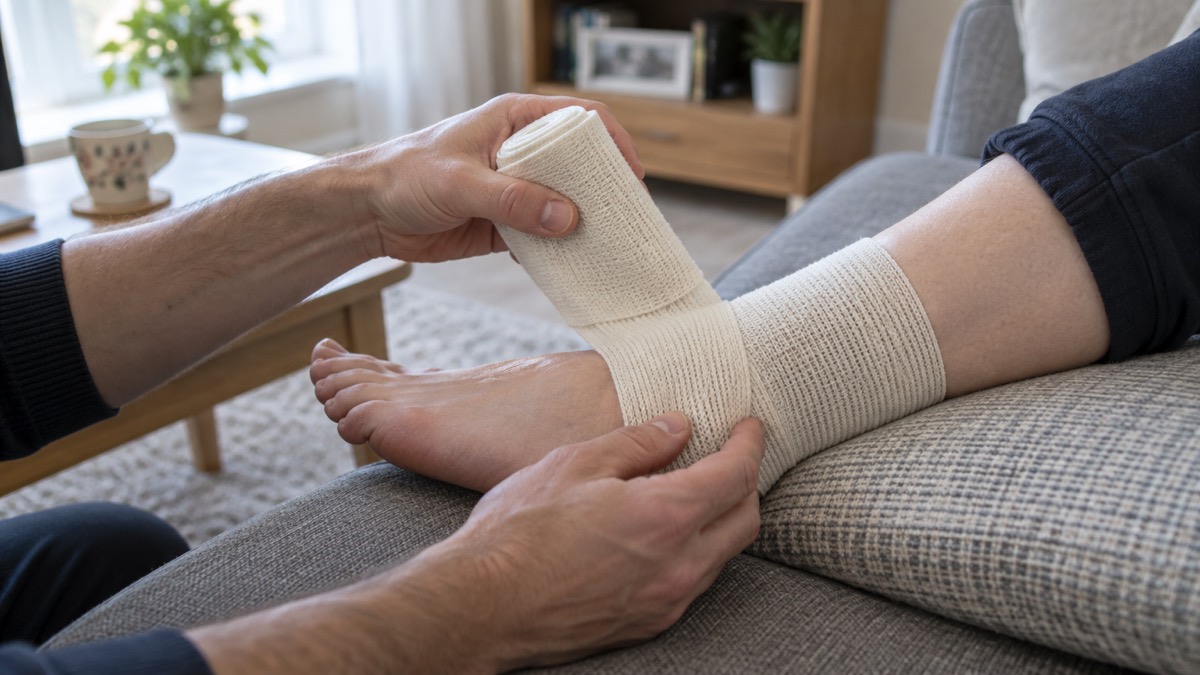
Roller bandages are the general family that crepe bandages belong to, and NHS guidance on first aid kit contents describes what they do: they are designed to support injured joints, manage swelling, maintain pressure on wounds and keep dressings secure3. That makes a roller bandage the right tool when the injury is at the elbow or knee, joints where a simple wrap-around crepe bandage on a wrist does not translate well, because the bandage has to bend around a moving hinge and stay put.
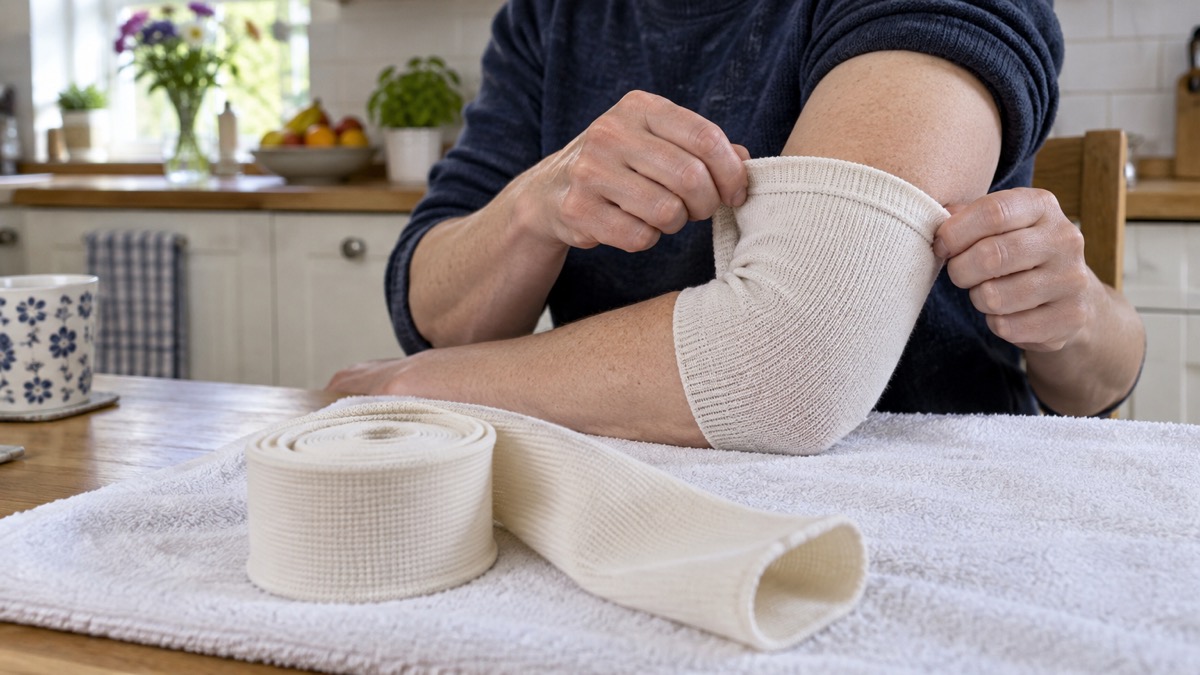
For an elbow or knee, an elasticated tubular bandage is often easier than a wrapped roller bandage. NHS guidance says elasticated tubular bandages can be used to support injured joints, such as the elbow or knee3. You slide it over the hand or foot and up the limb until it sits over the joint, and the tube shape holds itself in place without pins. If you do use a wrapped roller bandage on a hinge joint, the same circulation rule applies as for any bandage: firm enough to support, not so tight that it affects circulation7.
There is a limit to what support bandaging does. A bandage supports an injured joint and helps manage swelling, but it does not make a break safe. If you suspect the injury is more than a sprain, NHS Inform's fracture first aid advice is to advise the casualty to stay still, support the joints below and above the injured area with your hands, and place padding around the injury for extra support9. That is hands-on support, not a bandage, and it is what you do while you wait for help rather than a substitute for it. For children, NHS guidance on accidents says that if you have to move your child, be very gentle, put one hand above the injury and the other below it to steady and support it, using blankets or clothing if necessary, comfort your child and take them to hospital10.
Tubular bandages: what they support and how they go on
A tubular bandage is a continuous tube of fabric rather than a roll you wind on. NHS guidance on first aid kit contents sets out its two jobs: tubular bandages keep dressings on fingers or toes in place, or support joints like elbows and knees3. That makes it one of the most versatile items in a kit, because the same product family covers the smallest injury, a dressed fingertip, and one of the largest everyday joints, the knee.
There are two main kinds, and they go on differently:
| Type | What it does | How it goes on |
|---|---|---|
| Elasticated tubular bandage | Supports injured joints such as the elbow or knee3 | Slide it over the hand or foot and up the limb; no applicator needed |
| Gauze tubular bandage | Holds dressings in place on fingers and toes3 | Needs a special applicator3 |
The distinction matters when you buy. NHS guidance is plain that a special applicator is needed for gauze tubular bandages3. The applicator is a slim cage that you stretch the gauze onto before easing it over the digit. If you are stocking a kit for everyday sprains rather than wound care, an elasticated tubular bandage is the simpler choice, because it goes on without any extra tool.
For fingers and toes, the tubular bandage's job is to keep a dressing where you put it. Cut a short length, slide it over the finger or toe, and secure it with tape so it does not slide off. As with every bandage, check the digit afterwards for pale or cold skin beyond the bandage, which means it is on too tight, and reapply more loosely. The same circulation standard from NHS Inform applies: firm enough to work, not so tight that it affects circulation7.
Putting on an arm sling for an injured arm or wrist
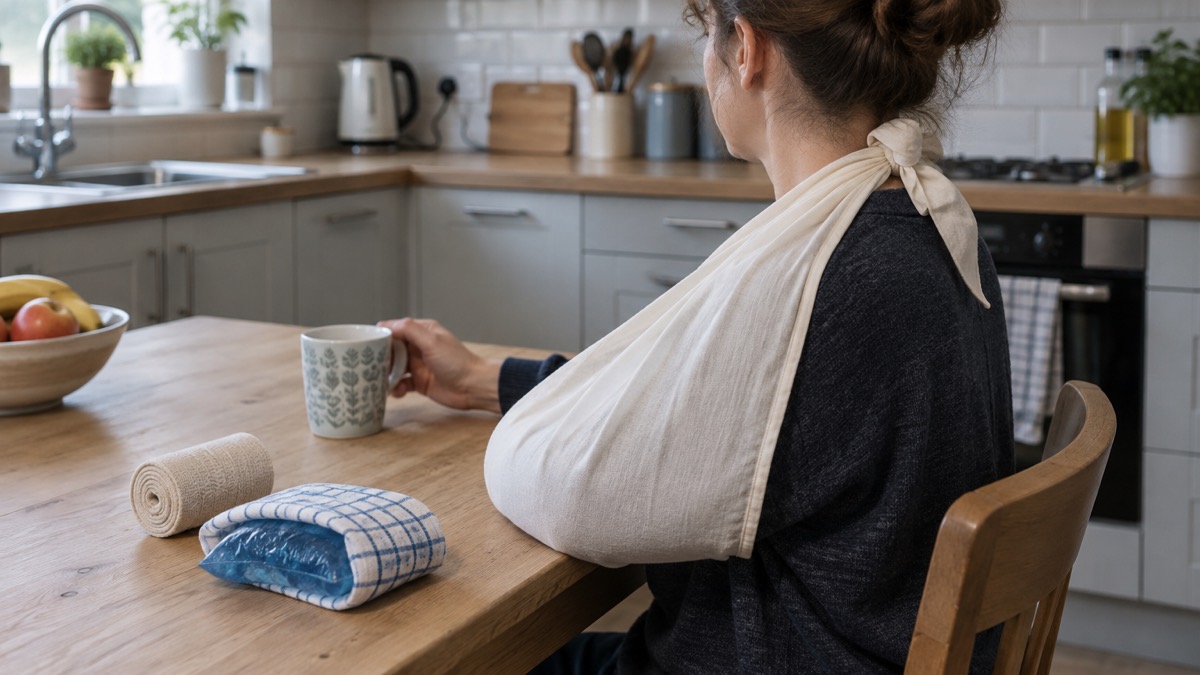
A triangular bandage is a soft, foldable piece of cloth, and NHS guidance describes its uses: it can be wrapped around limbs for support, used to secure dressings in place, or work as a sling3. NHS Wales gives the fuller picture of what a sling does: a triangular bandage can be used as a sling to lift a limb, tied at the back of the neck, to prevent blood loss, to secure a fractured collar bone or hand, and for sprains and strains if a crepe bandage is not available2.
That last use is the one that matters for a household sprain. If you have sprained a wrist and have no crepe bandage, a triangular bandage as a sling does the supporting job instead: it takes the weight of the arm off the injured joint entirely. To put one on, fold the triangular bandage open, rest the injured arm across the middle of it with the point of the triangle under the elbow, bring the two ends up around the neck and tie them at the back so the arm is cradled, then twist the point at the elbow and secure it. NHS Wales notes that safety pins can be used for securing a sling on the elbow8.
Keep the sling comfortable and check the hand. The fingers should stay a normal colour and feel warm; if they go pale or cold, the sling is positioned so that it is affecting circulation and should be adjusted. A sling is also the right support when you suspect a break and are moving towards help, because it holds the limb still without pressing on the injury. NHS guidance for children with a suspected broken bone adds the hands-on version: one hand above the injury and one below to steady and support it, using blankets or clothing if necessary10.
When swelling does not go down, it could be a break
The single most useful thing this page can tell you is when a sprain is not a sprain. NHS Wales guidance puts it plainly: if the swelling does not go down, it could be a break, so you should seek medical advice as an x-ray may be needed2. Swelling that settles over the first hours and days, with pain that eases as the joint rests, fits the pattern of a sprain or strain that can be treated at home1. Swelling that persists, or a joint you cannot bear weight on, needs a professional look.
Where to go depends on what you see. London Ambulance Service guidance lists what walk in centres and urgent care centres can assist with, and it includes sprains and strains, suspected broken bones, injuries, cuts and bruises4. So the usual route for a swollen ankle that will not settle is a walk in centre, urgent care centre or your GP, not necessarily A&E. NHS guidance for children's accidents gives the same tiered approach for other injuries: see your GP or go to a minor injuries unit or A&E depending on severity10.
Some signs mean you should not wait at all. NHS Inform's fracture guidance lists signs of shock as a concern with a fracture, especially if the thigh bone or pelvis are injured9. If the person shows those signs, cold clammy skin, sweating, rapid shallow breathing, weakness or dizziness, treat it as an emergency. While waiting for help, follow the fracture first aid steps: keep the casualty still, support the joints above and below the injury with your hands, and pad around it9. Do not test whether a joint can move, and do not try to straighten it.
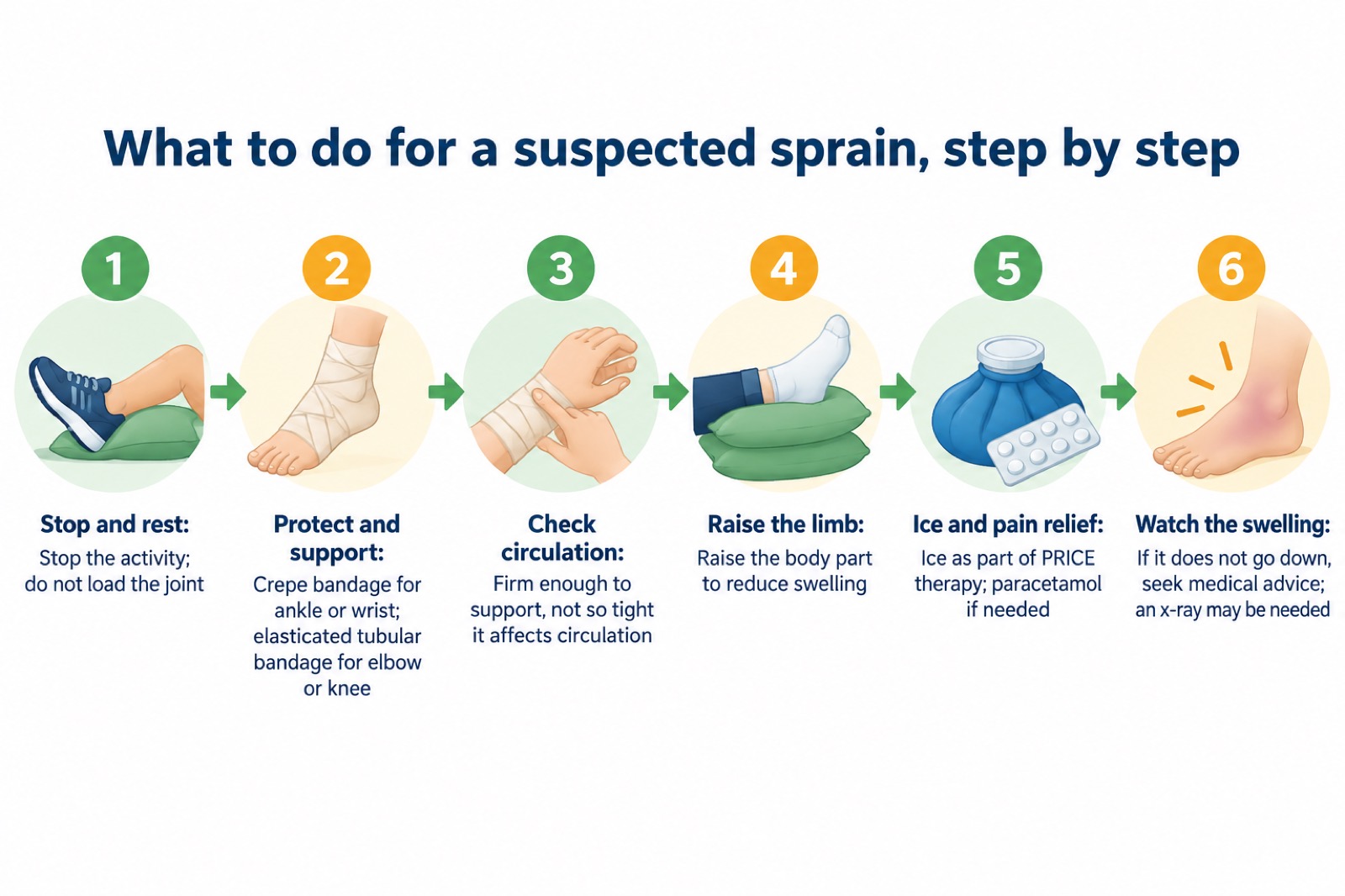
Treating a sprain at home: rest, ice and raising the limb
NHS guidance from Central East ICB says most minor sprains and strains are relatively minor and can be treated at home with self-care techniques, such as paracetamol or PRICE therapy1. PRICE therapy is protection, rest, ice, compression and elevation, and each part has a practical meaning for a household.
Protection and rest mean stopping the activity and not loading the joint. Compression is the bandaging covered earlier in this page: a crepe bandage for an ankle or wrist, an elasticated tubular bandage for an elbow or knee, firm enough to support but not so tight that it affects circulation2. Elevation means raising the injured part, and NHS guidance on frostbite gives the same principle for reducing swelling: raise the body part11. Prop a sprained ankle on cushions so it sits higher than the hip, or rest a wrist on a pillow.
Ice is the part people most often get wrong. The general rule is that ice should never be applied directly to bare skin. Wrap an ice pack in a cloth before use. If you want to compare the types of ice pack you can keep at home, see Instant or Reusable Ice Packs for Injuries.
Pain relief sits alongside the physical measures. Paracetamol is named by NHS guidance as a self-care technique for minor sprains and strains1. Keep to the dosage on the pack, and if pain is not controlled by ordinary doses, that itself is a sign the injury needs checking.
Keeping sprain and strain help to hand at home
A sprain tends to happen when you are doing something ordinary, and the help you need is whatever is in the cupboard at that moment. Official guidance across the UK is consistent that a first aid kit belongs in the household: NHS guidance on over-the-counter medicines advises keeping a first aid kit at home12. NI direct's first aid guidance sets out what a kit could include: plasters, bandages, safety pins or tape, pain relievers such as paracetamol or aspirin, antiseptic lotion or saline for cleaning wounds, cotton wool, a thermometer, tweezers for splinters, sharp scissors, sun block and child insect repellent13.
For sprains and strains specifically, the items that matter are:
- Crepe bandage, mainly for sprained or strained ankles or wrists, and for holding dressings in place2
- Elasticated tubular bandage, to support joints like elbows and knees3
- Gauze tubular bandage and its applicator, to keep dressings on fingers or toes in place3
- Triangular bandage, for use as a sling, and for sprains and strains if a crepe bandage is not available2
- Safety pins or tape, to secure a crepe bandage or a sling on the elbow8
- Sharp scissors, for cutting bandages, tape and plasters to size14
- Paracetamol, named by NHS guidance as a self-care technique for minor sprains and strains1
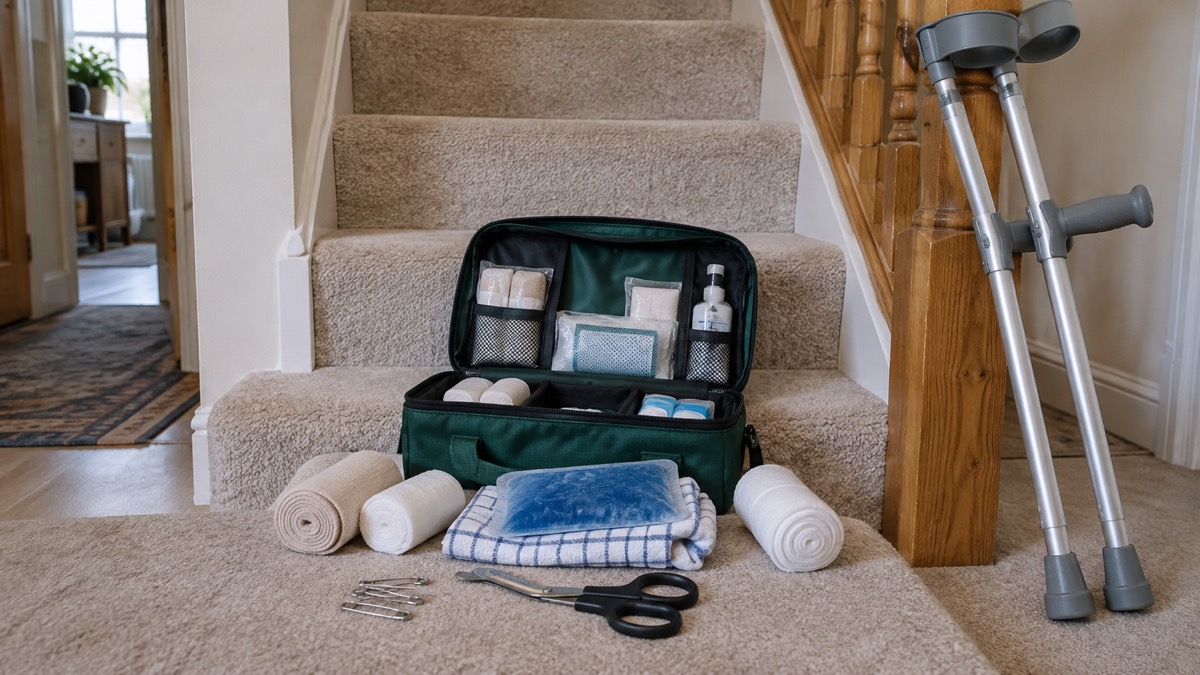
If you would rather buy a complete kit than assemble one, a ready-made kit covers the same ground. Flood warden guidance from Harborough District Council lists a typical kit's contents, which include a non-woven triangle bandage, a conforming bandage, safety pins, microporous tape, scissors and tweezers15. For help choosing between a ready-made kit and building your own, see Ready-Made Kit or Building Your Own, and for a fuller guide to contents, see First Aid Kits for the Home.
The same message comes from emergency planning, not just first aid. The UK government's Be Ready household emergency plan advises keeping a first aid kit or first aid items, and essential medication or medical supplies to last several days16. Power cut guidance from Horsted Keynes Parish Council says to have a first aid kit handy in case of an emergency17, and Dumfries and Galloway Council's household emergency pack advice includes a first aid kit18. The reason is simple: in a flood, a storm or a power cut, you may not be able to get to a pharmacy, so the bandage you need has to already be in the house.
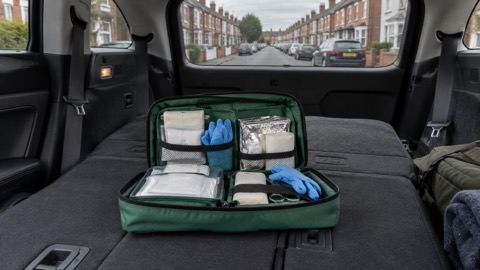
*A household kit with crepe and triangular bandages, safety pins and scissors covers most sprain and strain needs.
Learning the skills before you need them
Bandages only help if you know how to use them, and there are two easy ways to prepare. The first is the free Red Cross first aid app, highlighted by Argyll and Bute Council's emergency planning pages. It is available on iTunes, Google Play and Blackberry App World, and it gives you simple skills to deal with sprains and strains, broken bones, unconscious casualties and more, plus tips on how to prepare for emergencies, from severe weather to road traffic accidents19. Having it on your phone means the steps are with you at the sports field or the playground, not just at home.
The second is a practical course. NI direct's guidance makes the general point that first aid can treat all sorts of minor bumps and scrapes, but you should see a doctor for more serious accidents13, and a course helps you tell the two apart with confidence. For what is available and where to find one, see First Aid Courses. If you want the wider picture of what to do first at any incident, see What to Do First: Danger, Response, Airway and Breathing, and for suspected breaks specifically, What to Do for a Suspected Broken Bone.
One more habit worth forming: check your kit now and then. Bandages that have been washed many times lose their stretch, safety pins go missing, and scissors end up in a drawer elsewhere. A quick annual check, the same one you would give torches and smoke alarms, keeps the sprain kit ready for the day someone turns an ankle on the stairs.
Sources (19)
- Hot weather advice, NHS Central East ICB, 2026-10-05
- First aid kit advice, NHS 111 Wales, 2021
- What should I keep in my first aid kit?, NHS, 2026-10-25
- Your local 999 and 111 services, London Ambulance Service, 2026-08-10
- The family medicine chest, Vallance Medical NHS, 2026
- Self-care advice, NHS Birmingham and Solihull ICB, 2026-10-28
- Severe bleeding first aid, NHS Inform, 2026-07-24
- First aid kit, NHS 111 Wales, 2021
- Fracture first aid, NHS Inform, 2026-07-24
- What to do if your child has an accident, NHS, 2025-12-18
- Frostbite, NHS, 2025-06-09
- Health advice for public holidays, NHS Inform, 2026-09-15
- First aid, nidirect, 2025-12-04
- Newborn essentials and first aid, NHS 111 Wales, 2021-04-19
- Be flood ready: guidance for flood wardens, Harborough District Council, 2026-10-29
- Be Ready Household Emergency Plan, UK government, 2026
- 12 tips to prepare for a power cut, Horsted Keynes Parish Council, 2026
- Prepare for emergencies, Dumfries and Galloway Council, 2026
- Useful information for you and your community, Argyll and Bute Council, 2026
 Baby and Child Kit Checklist
 Bleeding Control Kit Checklist
 Car Kit Checklist
 Danger, Response, Airway
 CPR Steps for Adults
 2025 Resuscitation Guidelines
 Defibrillators (AEDs)
 Public Access Defibrillators
 Choosing a Defibrillator
 The Recovery Position
 Choking First Aid
 Cuts, Grazes and Wounds
 Burns and Scalds
 Adrenaline Auto-Injectors
 Sepsis Signs to Act On