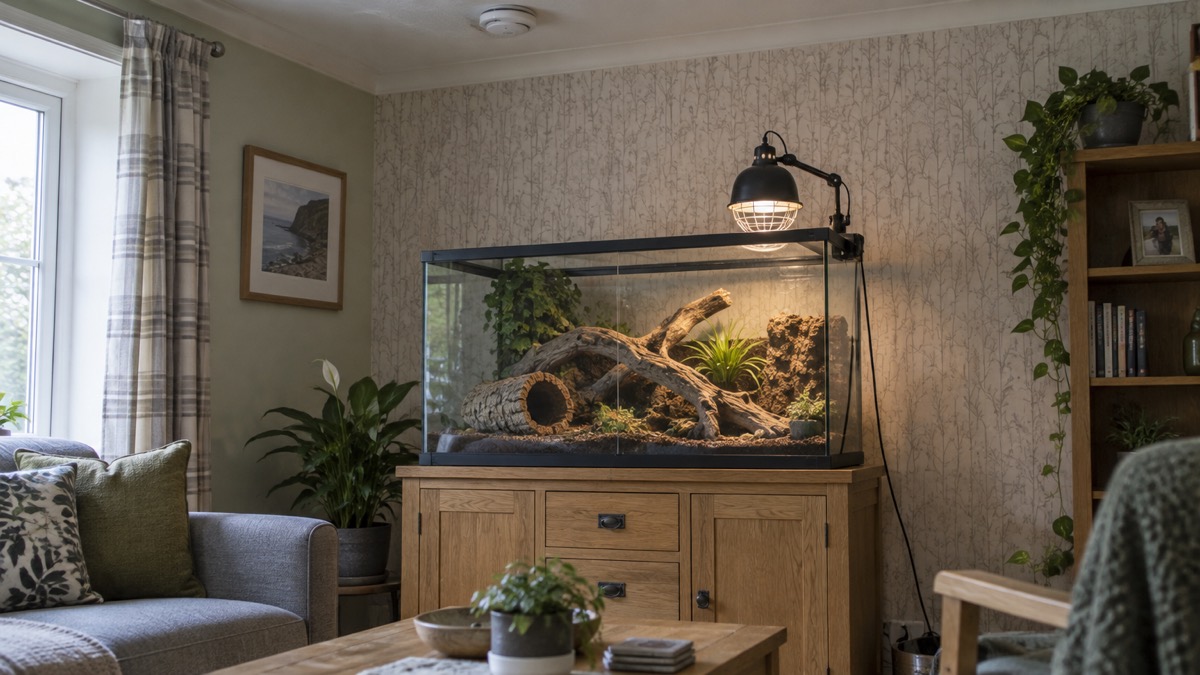
Yes, a reptile heat lamp can start a fire, and the risk comes from three things: the heat itself, what is close to it, and the condition of the electrical parts. A bulb or ceramic emitter runs hot enough to scorch wood, melt plastic and set light to dry bedding if it is placed too close, and fire services treat any heater placed near materials that could catch fire as a high risk1. Two reptile heat lamps have been the subject of official safety notices in the UK, one for a serious risk of fire and electric shock and one for a serious risk of electric shock2.
The good news is that the risk is manageable. Fit the lamp securely, guard it, keep combustible material well clear, check the plug and cable, and never leave a damaged lamp in use. If you own a Lusta LED Reptile Heat Lamp, the safety notice says to stop using it immediately and contact the distributor you bought it from2.
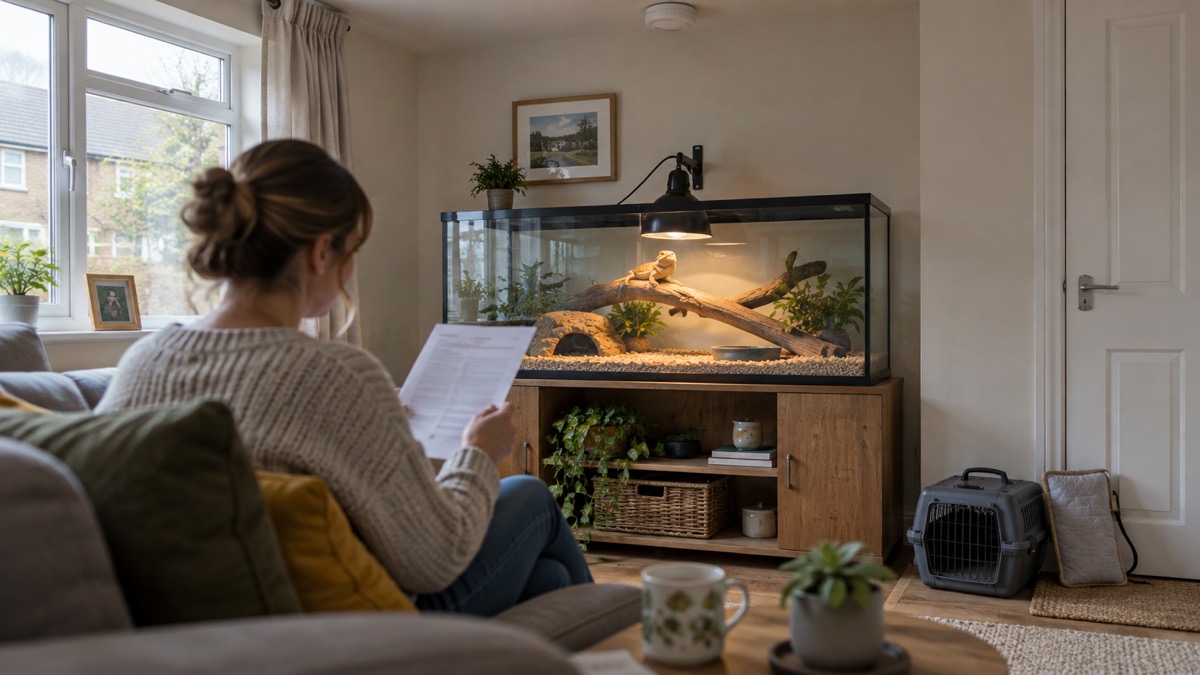
This page sets out how a heat lamp starts a fire, where it must never go, how to set one up safely, and how to include your reptile in your household emergency plan so that a power cut or an evacuation does not put the animal or your home at risk.
How a heat lamp can start a fire in a vivarium
A heat lamp does its job by getting hot, and that is exactly why it can start a fire. The heat radiates outwards, so anything within range, including wooden vivarium furniture, dry substrate, shed skin, plastic plants and cables, is being warmed continuously. Fire services describe electric or gas heaters placed too close to materials that could catch fire, including furniture or clothing, as a high risk1. In a vivarium the "furniture" is the décor and the substrate, and it is often dry and fibrous.
The second route is electrical. The Lusta LED Reptile Heat Lamp was found to present a serious risk of fire and electric shock because the fuse holder in the plug was damaged and the fuse had been fitted incorrectly. The notice explains that the fuse was only touching the damaged terminal, meaning there was not a reliable connection and it could cause arcing or a different higher breaking current than stated on the fuse2. Arcing inside a plug is a fire risk in its own right, and it happens out of sight behind the vivarium.
The third route is clutter. Fire services warn that hoarded materials can easily catch alight if they come into contact with heat sources such as overloaded extension leads, the kitchen hob or naked flames1. A vivarium setup often sits among extension leads, spare bulbs, boxes and bags of substrate. Keeping that area clear is part of heat lamp safety, not a separate housekeeping task.
Where a heat lamp must never go
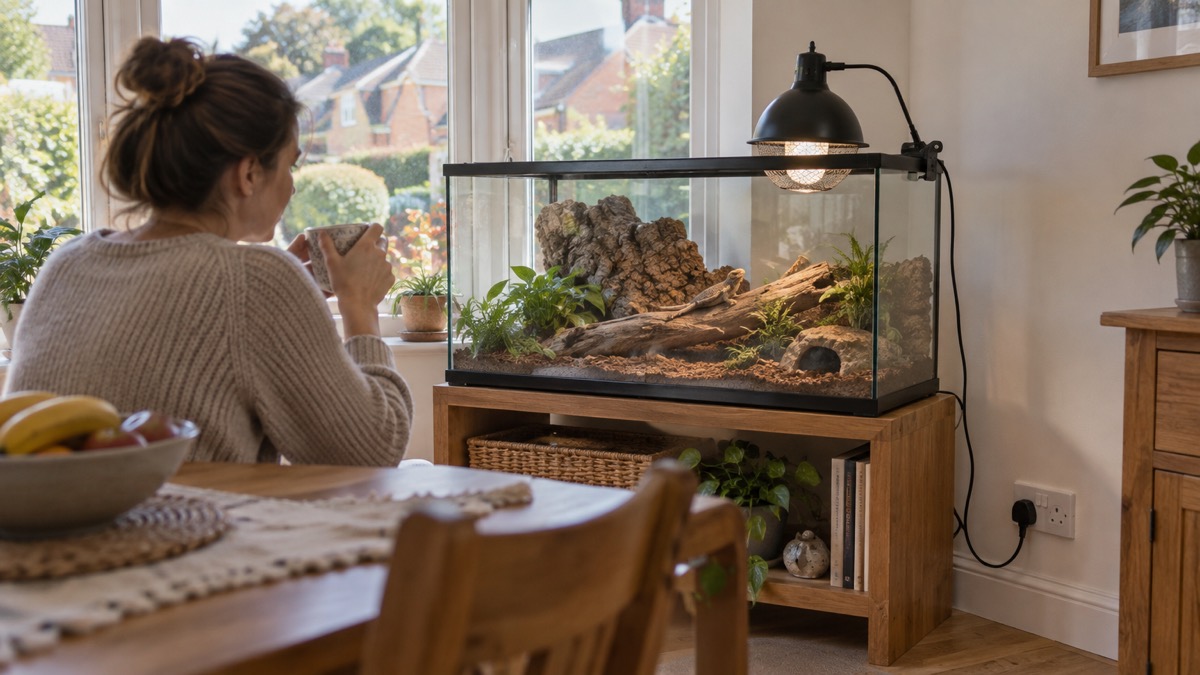
Some positions are simply not safe, whatever the fitting. The clearest rule from fire services is that items should never be piled near heat sources such as heaters, stoves or electrical outlets, because this increases the risk of fire7. In practice that means no stacked boxes, bags of substrate, spare bulbs or dry décor directly beside or beneath the lamp.
Fire services also warn that electric or gas heaters placed too close to materials that could catch fire, including furniture or clothing, is a high risk1. A vivarium is a small enclosed space, so "too close" arrives quickly. Keep the lamp at the distance the maker specifies, and keep wooden branches, cork bark and dry moss out of direct contact with the fitting.
There are other places a heat lamp should not be used at all. It is not a substitute for room heating, and it should not be left running where young children or animals are unattended: fire services advise against leaving a portable heater on if young children or animals are left unattended10. A vivarium lamp is fixed rather than portable, but the principle holds: if nobody is around to notice a problem, the setup needs to be sound before you leave it.
Safe setup: guards, thermostats and fittings
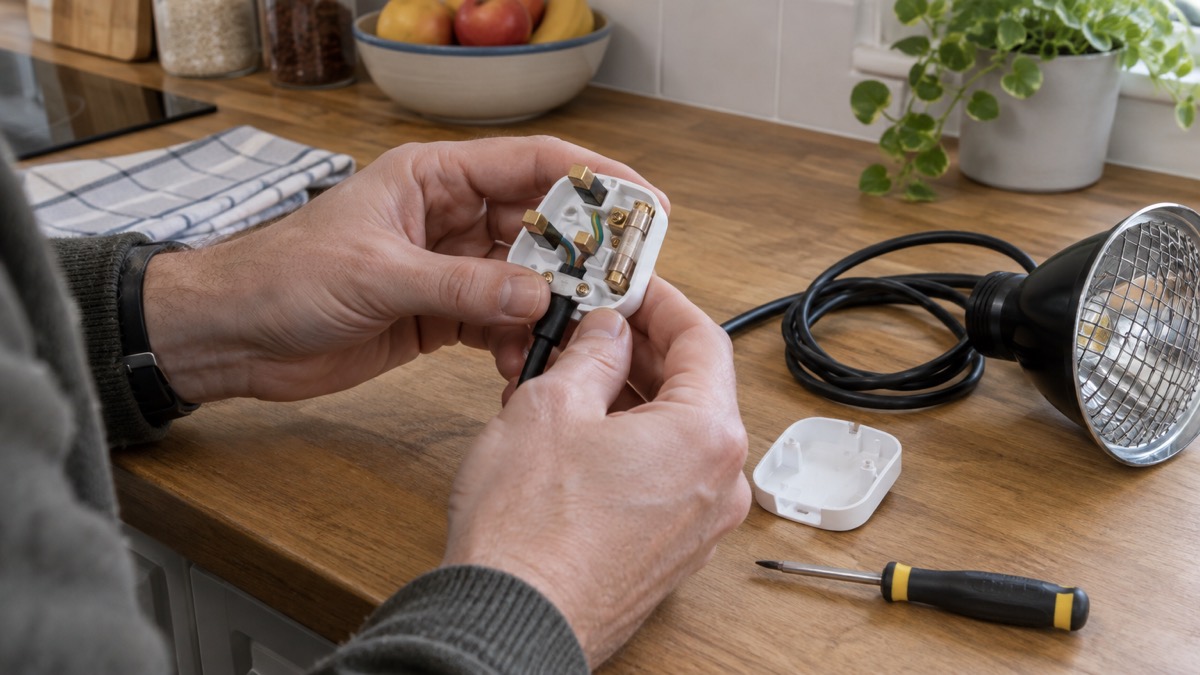
A safe vivarium heat lamp comes down to four things: the right fitting, a guard, clear space and a check on the electrics.
The fitting. Match the bulb or emitter to the holder. Halogen bulbs are much hotter than LED bulbs and are more likely to cause a fire if things are placed too close to them11. A ceramic heat emitter gives heat without light, which suits night-time use, but the holder and thermostat must be rated for it. Whatever you use, the lamp must be secured so it cannot fall into the vivarium; a lamp that drops onto dry substrate is a fire waiting to happen.
The guard. Use fire guards around heaters and ensure heaters are placed away from curtains, furniture or any other flammable materials4. Fire services also advise putting fireguards in front of very hot radiators, open fires or wood burners, and installing fireguards and safety gates to protect children from fires and stoves12. A guard around a heat lamp does the same job: it keeps the hot surface away from the animal, from bedding and from anything that could be dragged against it.
The electrics. Anything that heats up needs a lot of electricity and could be a fire risk, so follow electrical safety advice about charging devices14. Check the plug for a damaged fuse holder, a fuse that does not sit firmly, scorch marks or a frayed cable. If you find any of these, stop using the lamp.
The thermostat. A thermostat or dimming stat keeps the lamp from running flat out and reduces the chance of overheating. Set it to the temperature your species needs and check it with a separate thermometer rather than trusting the dial alone.
| Check | What to look for | What to do |
|---|---|---|
| Plug and fuse | Damaged fuse holder, loose fuse, scorching2 | Stop using the lamp and contact the retailer2 |
| Bulb type | Halogen runs much hotter than LED11 | Match the bulb to the holder and keep combustible material clear |
| Guard | Fitted and secure around the hot surface4 | Fit a fire guard and keep curtains and furniture away4 |
| Clear space | No clutter, boxes or dry décor near the lamp7 | Clear the area around the vivarium |
| Alarm | Working smoke alarm on the same floor15 | Test it regularly and never remove the battery |
Smoke alarms and heat alarms near a vivarium
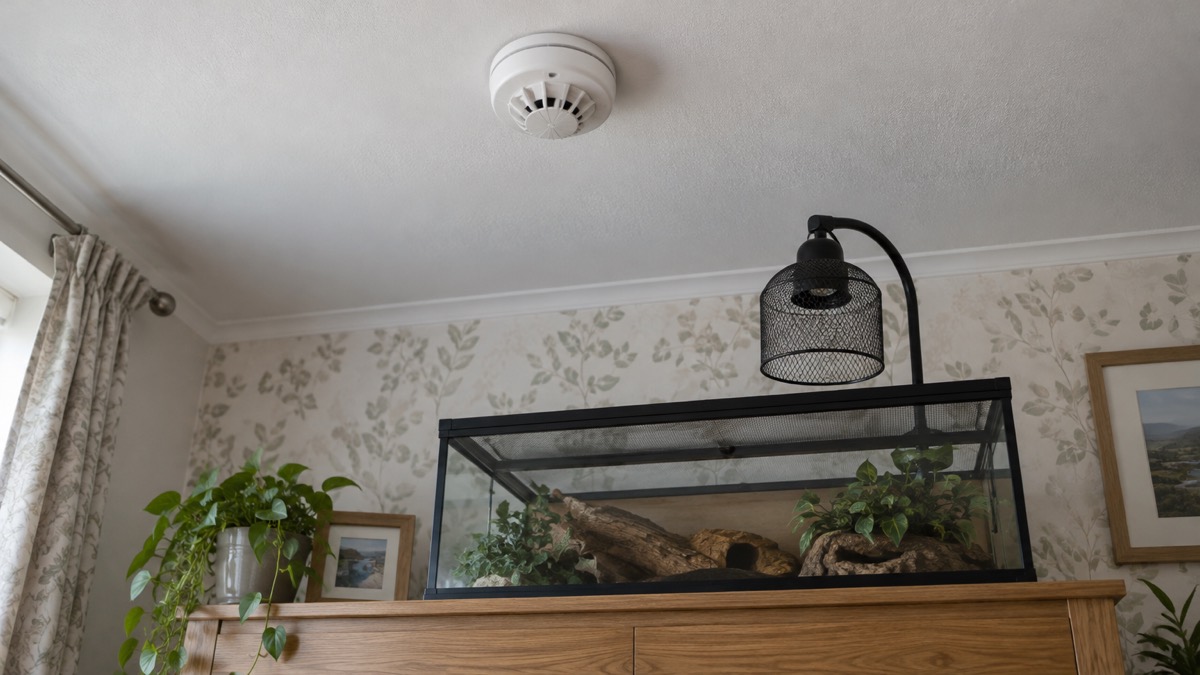
A working smoke alarm is the single most useful piece of safety equipment in any home with a heat lamp. Fire services stress the importance of a working smoke alarm, and after a flood they warn that there is an increased risk of fire from wet electrics, so a working alarm matters even more15. The same logic applies to a vivarium: if something starts smouldering behind the glass, you want to know before the fire spreads.
Where you site the alarm matters. Heat alarms are more suitable than smoke alarms for detecting fires in rooms where steam, fumes or moisture could cause nuisance alarms, and heat alarms are recommended for kitchens and garages16. A reptile room with a misting system, a water bowl or a humid vivarium can produce exactly that kind of moisture, so a heat alarm may be the better choice there, with smoke alarms elsewhere on the same floor.
Reptiles in your household emergency plan
A heat lamp is a mains appliance, so a power cut turns it off. That makes your reptile's warmth a planning question, not just a safety question. Fire services advise having a plan for pets and livestock as part of your emergency planning18. The same principle applies to a reptile: know how you will keep it warm, how you will move it, and what you will take if you have to leave.
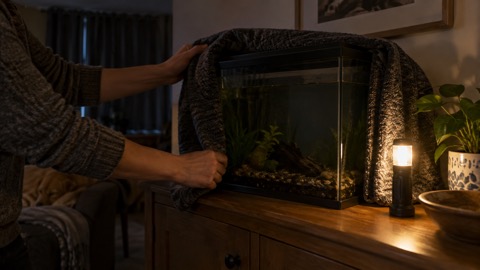
During a power cut. The lamp goes out with the power. Do not replace it with a candle or any open flame. Fire services advise using a standing electric torch or battery-powered lights in a power cut, because candles are a fire risk9. Keep the vivarium insulated with a blanket over the top and sides, leaving ventilation, and follow the maker's advice on how long your species can safely go without heat.
If you have to evacuate. Fire services advise taking your pets with you, and the emergency number is 9995. Have a secure carrier or tub ready by the door, with a heat pack that does not need mains power. Practise your escape route so you know what you can carry. If you cannot reach the animal safely, leave and tell the fire service where it is.
Battery safety. If you plan to use battery-powered heat or lighting as a backup, remember that batteries can fail. A power bank recall warned of a risk of fire because the units may overheat during use, and a radiator fan was recalled because the battery may fail during charging or in normal use, leading to thermal runaway19. Charge backup batteries where you can see them, and never leave a charging battery unattended overnight.
Checking for faulty bulbs and recalled products
Product recalls are the fastest way to remove a known fire risk from your home. Check the model and any product code against official safety notices, and stop using anything that matches.
| Product | Hazard | Date | Action |
|---|---|---|---|
| Lusta LED Reptile Heat Lamp | Serious risk of fire and electric shock; damaged fuse holder and incorrectly fitted fuse2 | 2023-12-29 | Stop using immediately and contact the distributor for redress2 |
| Nomoy Pet Reptile Heat Lamp, model NJ-07 | Serious risk of electric shock3 | 2023-12-15 | Check your model against the recall notice3 |
The Lusta notice also records that the product was not supplied with instructions giving the information and safety warnings needed for safe use, and that it does not meet the requirements of the Electrical Equipment (Safety) Regulations 20162. That is a reminder to keep the instructions for any lamp you buy and to follow them.
Beyond recalls, check your bulb regularly. Look for a cracked envelope, a blackened bulb, a loose fitting or a plug that feels warm. Halogen bulbs run much hotter than LED bulbs and are more likely to cause a fire if things are placed too close11. If a bulb has failed, replace it with the type the fitting is rated for rather than a higher wattage.
Where to get help and what to do next
If a fire starts, get out, stay out and call 9996. Do not go back inside for the animal. Tell the fire service where the vivarium is and what is in it.
For product safety, the official safety notices on GOV.UK list recalled products with their model numbers and hazards, and they tell you to stop using the product and contact the distributor2. Check them before you buy a second-hand lamp or accept a hand-me-down.
For household planning, the Pets and Animals in an Emergency: A Household Guide sets out how to include animals in your plan, and Including Your Pets in a Household Emergency Plan walks through the steps. If you are preparing for a power cut, Power Cuts: A Household Guide and Backup Power at Home: A Household Guide cover what to have ready. For the wider picture on fire, carbon monoxide and gas leaks, see Home Emergencies: Fire, Carbon Monoxide, Gas Leaks and Burst Pipes.
Sources (20)
- Fire safety for carers, Devon and Somerset Fire and Rescue Service, 2026
- Product Safety Report: Lusta LED Reptile Heat Lamp sold via Amazon, Office for Product Safety and Standards, 2023-12-29
- Product Recall: Nomoy Pet Reptile Heat Lamp, Office for Product Safety and Standards, 2023-12-15
- Burns prevention and tips, Mid and South Essex NHS Foundation Trust, 2026
- Get help in an emergency, Lincolnshire County Council, 2026
- Making a home escape plan, Warwickshire County Council, 2026-10-29
- Hoarding fire safety advice, Cheshire Fire and Rescue Service, 2026-10-25
- Camping safety, North Wales Fire and Rescue Service, 2026-10-29
- Safety in severe weather conditions, Devon and Somerset Fire and Rescue Service, 2026
- Portable heaters, Mid and West Wales Fire and Rescue Service, 2026-10-29
- Digital easy read fire safety booklet, London Fire Brigade, 2026
- Burns and scalds, Just One Norfolk NHS, 2026-10-25
- Fire safety advice for parents, Warwickshire County Council, 2026-10-29
- Stay warm safely in winter, Devon and Somerset Fire and Rescue Service, 2026
- Flooding, Cornwall Council, 2026-10-29
- Cooking fire safety devices, Greater Manchester Fire and Rescue Service, 2026-10-29
- Alarms and sprinklers, Warwickshire County Council, 2026-10-29
- Wildfires, South Wales Fire and Rescue Service, 2026-07-29
- Product Recall: ESR HaloLock Wireless Power Banks sold via Amazon, Office for Product Safety and Standards, 2025-11-26
- Product Recall: Valiant Radiator Fan, Office for Product Safety and Standards, 2025-11-07
 Pet Emergency Documents
 Storing Pet Food and Water
 Carer's Emergency Plan
 Pet Birds in Cold Weather
 Birds and Chickens in Heat
 Breaking a Car Window for a Dog
 Keeping a Cat Cool in a Heatwave
 Chocolate Poisoning in Dogs
 Christmas Hazards for Pets
 Dog Left Alone on a Hot Day
 Dog in a Hot Car
 Hypothermia in Dogs and Cats
 Dogs in Water or Coast Trouble
 Fireworks and Small Pets
 Fish in a Power Cut