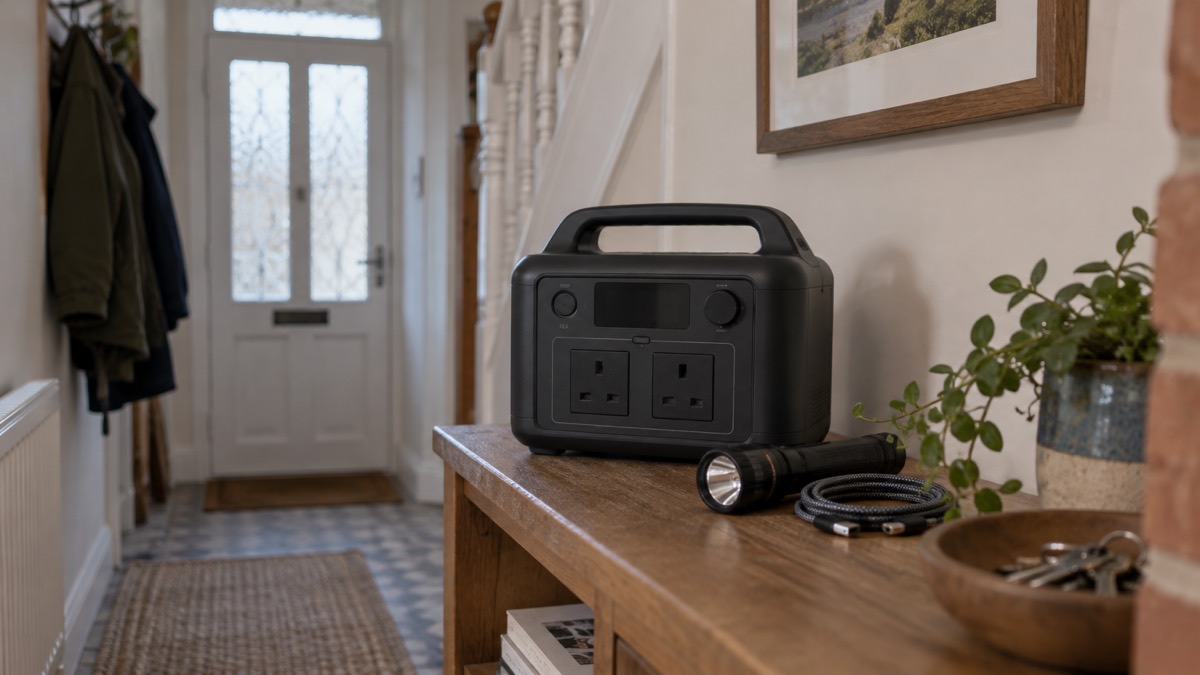
The BLUETTI AC60 is a portable power station with a 403Wh battery and a 600W AC output, built for carrying to where you need power rather than wiring into your home1. For a household preparing for a power cut, that means it can run small appliances and charge a phone many times over, and it can be topped up in four ways: from the mains, a solar panel, a car or a lead-acid battery1. It is rated IP65 for dust and water resistance, which matters if you keep it in a garage or shed1.
What it is not is a whole-house backup. It will not run an electric shower, an oven or a heat pump, and it will not keep a gas boiler going unless the boiler's controls are within its 600W rating and you have planned how to connect it. Think of it as a bridge: enough power to keep phones, lights, a router and a small fridge going through a short outage, and enough flexibility to recharge from several sources when the mains is off.
This page sets out what the AC60 can do in an emergency, how long it lasts, how to recharge it, how to use and store it safely through cold, heat and wet weather, how to add capacity with expansion batteries, and what the warranty covers. It is written for a household that wants to know whether this unit fits its plan, not for someone comparing specifications on a shop shelf.
What the AC60 is and what it suits in an emergency
The AC60 is a lithium iron phosphate (LiFePO4) power station with a pure sine wave inverter, two 230V AC outlets rated at 600W in total, and a set of DC and USB outputs for smaller devices1. The LiFePO4 chemistry is the same family used in many home battery systems, and the maker rates the AC60 at 3,000+ cycles to 80% original capacity, which means it should hold up over years of occasional emergency use1. The pure sine wave output matters for anything with a motor or sensitive electronics, because it produces a smoother waveform than a modified sine wave inverter.
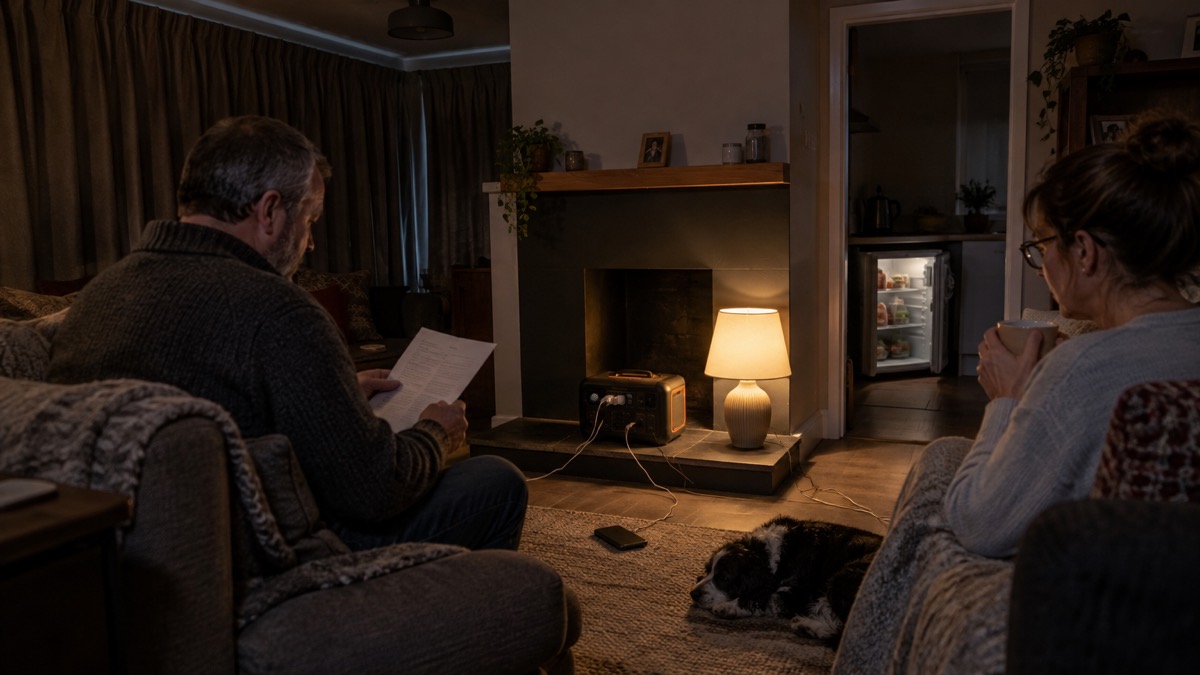
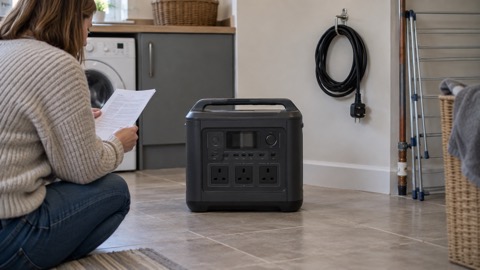
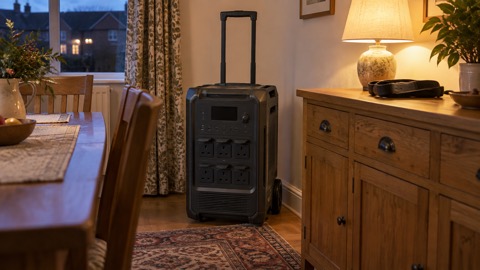
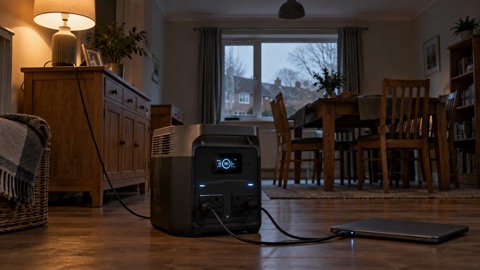
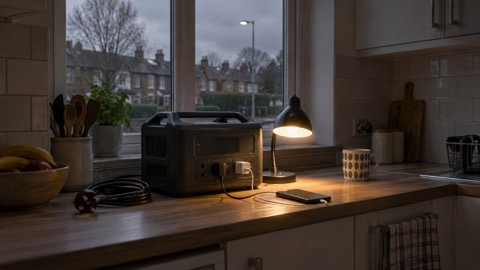
In a household emergency plan, the AC60 sits in the gap between a power bank and a generator. A power bank keeps a phone alive; a generator can run a fridge or a boiler but needs fuel, ventilation and a safe outdoor location. The AC60 runs silently indoors, needs no fuel, and can be recharged from a solar panel or a car if the outage is long. That makes it suited to:
- Flat or maisonette dwellers who cannot safely store or run a generator.
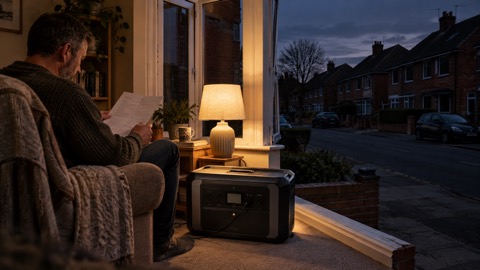
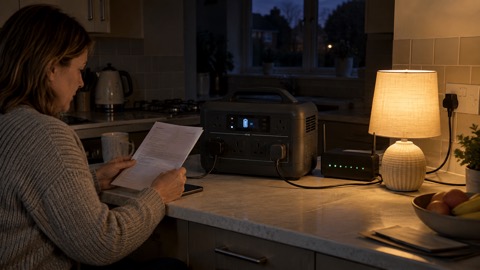
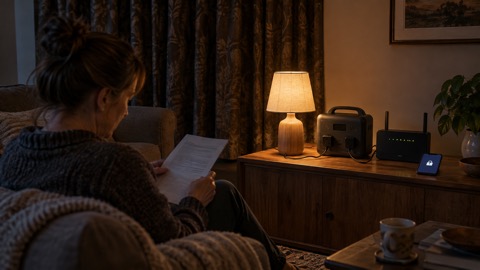
- Short outages of a few hours to a day, where the priority is phones, lights, a router and a small fridge.
- Flood or storm events where you may need to move power to a different room or take it with you if you evacuate.
- Camping and caravan use as a secondary role, which is how the maker also positions it5.
It is less suited to running high-draw appliances for long periods. A 600W rated output will not run a kettle, an oven or a tumble dryer, and even appliances within its rating will drain the 403Wh battery quickly. If your plan depends on keeping a fridge running for a day or more, you need either more capacity or a different approach; the portable power stations guide sets out how to size a unit to your needs.
The AC60 is part of the BLUETTI range, and the maker lists it alongside larger units and expansion batteries for households that want more capacity4.
Specifications at a glance
The table below sets out the maker's published specifications for the AC60. Where a figure is given in the maker's own units, it is reproduced here as stated.
| Specification | Figure |
|---|---|
| Battery capacity | 403Wh (22.4V, 18Ah)1 |
| Battery chemistry | LiFePO4 (Lithium Iron Phosphate)1 |
| AC output | 2 × 230V/2.6A, 600W in total1 |
| Surge power | 1,200W1 |
| Inverter type | Pure Sine Wave1 |
| AC charging input | 600W Max.1 |
| Solar input | 200W Max., VOC 12-28V, 8A1 |
| Car charging | 12/24V from cigarette lighter port, 200W Max.1 |
| Lead-acid battery charging | 200W Max. (12V / 24V)1 |
| USB-C output | 1 × 100W Max. (built-in eMark chip)1 |
| USB-A output | 2 × 5V/3A1 |
| 12V DC output | 1 × 12V/10A (car outlet, regulated)1 |
| Wireless charging pad | 1 × 15W Max.1 |
| Weight | 9.1kg (20.06lbs)1 |
| Dimensions | 290mm × 205mm × 234mm1 |
| Charging temperature | 0°C to 40°C1 |
| Discharging temperature | -20°C to 40°C (600W Max. from -20°C to 30°C; 500W Max. from 30°C to 40°C)1 |
| Storage temperature | 20°C to 40°C1 |
| IP rating | IP65-rated dustproof and water-resistant6 |
| Cycle life | 3,000+ cycles to 80% original capacity1 |
| Warranty | 60 months (AC60/AC60P)3 |
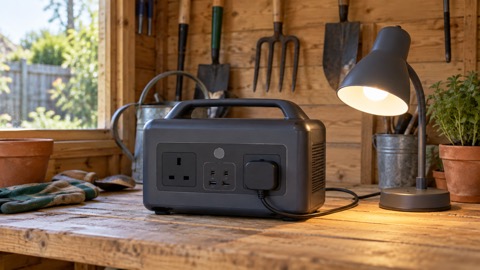
The IP65 rating is worth understanding. It means the unit is protected against dust and against water jets from any direction, not that it can be submerged. The maker describes an exterior rubber cover and water-resistant socket that prevent water ingress, with all components compactly sealed from dust and water7. That is useful if you store it in a damp garage or use it in a light shower, but it does not make it safe to leave out in a flood or a heavy downpour. For more on what IP ratings mean in practice, see the safety markings guide.
How long it will run your appliances
Run time depends on the wattage of what you plug in. The maker publishes a set of example run times for the AC60, which give a realistic picture of what a 403Wh battery can do1:
| Appliance | Typical draw | Run time stated by the maker |
|---|---|---|
| Mini fridge | 60W | 5+ hours1 |
| Ice maker | 250W | 1.3+ hours1 |
| Mini blender | 600W | 0.5+ hours1 |
| Light | 15W | 21+ hours1 |
| Mobile phone | 15W | 21+ charges1 |
These are maker figures and assume a full battery and ideal conditions. In practice, a fridge cycles on and off, so its average draw is lower than its rated wattage, and you may get longer than the headline figure. A light left on all evening will drain the battery steadily. The lesson for a household plan is to decide in advance what the AC60 will run and for how long, and to practise it once before an outage so you know what to expect.
If you want to work through your own appliances, the watts and watt-hours guide explains how to add up loads, and the power station run time guide covers fridges and laptops specifically.
Four ways to recharge it, including solar and the car
The AC60 can be recharged in four ways, which is the feature that makes it useful in a prolonged outage when the mains may be off for hours or days2. The maker's stated charge times are:
- Mains: about 1 to 1.5 hours with 600W turbo charging, and 0% to 80% in 45 minutes1.
- Solar: about 2.5 to 3 hours with a 200W panel1.
- Car: fully charged in 2.5 hours from a 12V or 24V cigarette lighter port at 200W Max.1.
- Lead-acid battery: 200W Max. from a 12V or 24V lead-acid battery, fully charged in 2.5 hours1.
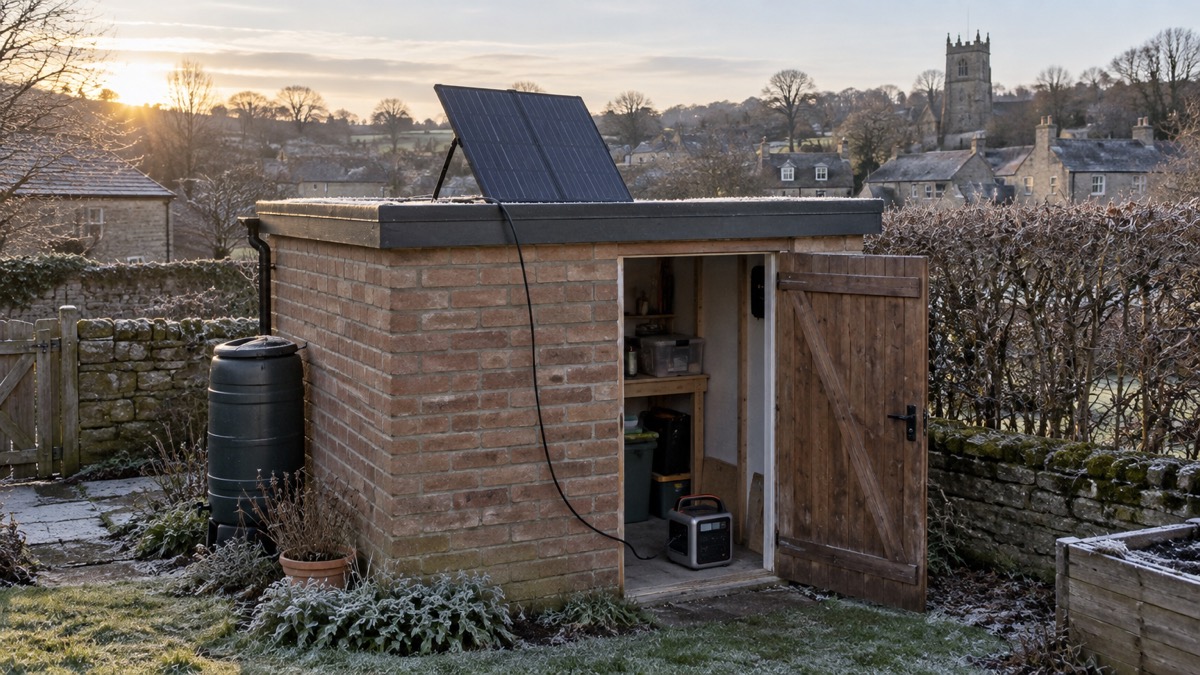
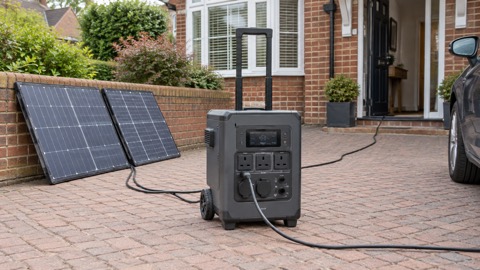
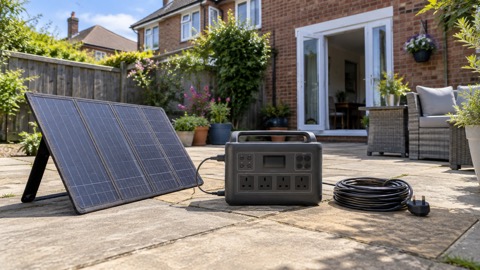
The solar option is the one that matters most in a long outage. A 200W panel is the maximum the AC60 will accept, and the input must be within VOC 12-28V and 8A1. That means you cannot simply connect any domestic solar panel; you need a portable panel or a set of panels wired to stay within those limits. The portable solar panels guide explains how to match a panel to a power station, and the solar charging time guide covers what UK weather does to the maker's headline figures.
The car option is useful if you have to leave home or if you want to top up while driving. The maker notes that you can use solar to charge a power station while driving if it is connected to mounted panels or your alternator9. That is a maker statement about its own products; check your vehicle's manual before connecting anything to the alternator.
Using it safely in cold, heat and wet weather
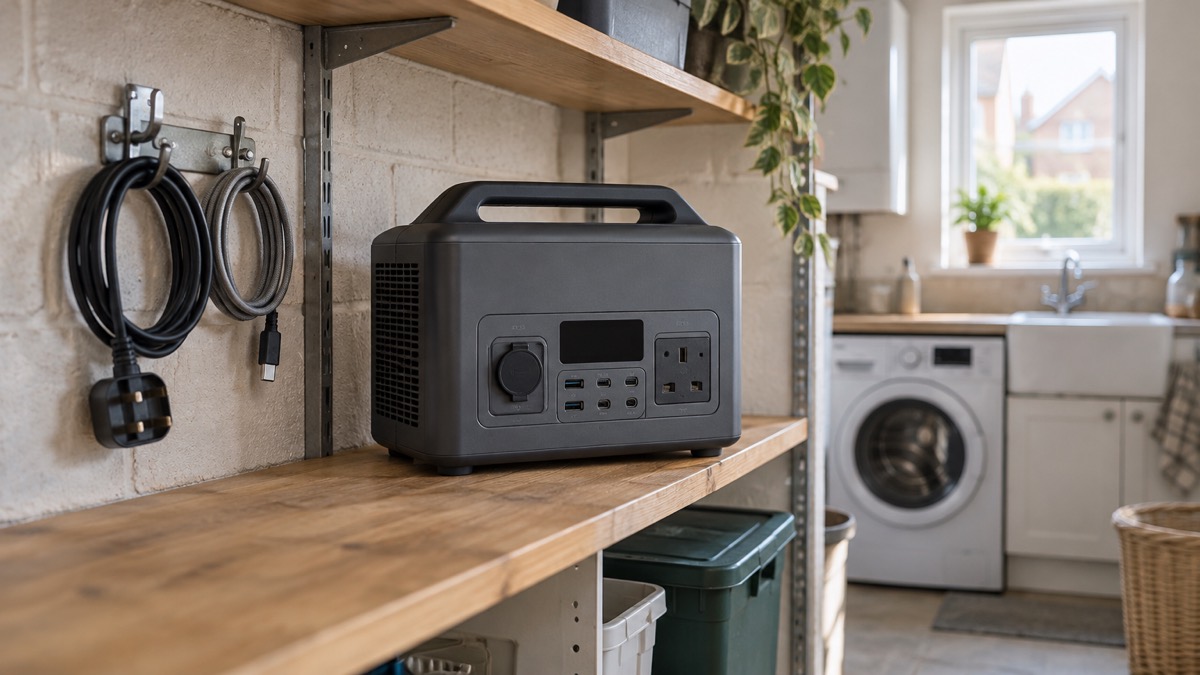
The AC60 is designed to be used outdoors as well as indoors, but the maker's temperature limits matter for a household that stores it in a shed or garage. The charging temperature range is 0°C to 40°C, and the discharging range is -20°C to 40°C, with the output derated from 600W to 500W between 30°C and 40°C1. The storage range is given as 20°C to 40°C1. In plain terms: do not charge it below freezing, do not expect full output in a heatwave, and do not leave it in a shed that drops below 20°C for long periods if you want to follow the maker's storage guidance.
That last point is awkward for UK households, because many garages and sheds sit below 20°C for much of the winter. The practical answer is to keep the AC60 indoors, in a cupboard or utility room, where the temperature stays within range. If you must store it in a cold outbuilding, bring it indoors to charge and let it reach room temperature first. The battery storage temperature guide covers this in more detail.
Cold weather also affects how you use the power in an outage. Official advice for cold weather is to wear several layers of thin clothing rather than one thick layer, to wear a hat and gloves outside, to close bedroom windows at night, and to move around every hour when indoors10. The NHS advises using a hot water bottle or an electric blanket to keep warm in bed, but not both at the same time11. If you are relying on the AC60 to run an electric blanket, check its wattage against the 600W output and plan how long you can afford to run it.
In hot weather, official advice is to ensure adequate ventilation and to wear loose, light clothing12. For the AC60, that means keeping its vents clear and not covering it while it is running or charging. The maker states that the unit has independent ventilation to enhance water drainage and heat dissipation7. Do not block those vents, and do not run it in a sealed cupboard.
In wet weather, the IP65 rating gives some protection, but the maker's description is of a rubber cover and sealed components, not a waterproof case7. Do not use it in standing water, do not leave it out in heavy rain, and dry it before opening any covers. If you are dealing with a flood, the flooding guide covers what to do first; power kit comes after safety.
Adding capacity: up to 2,015Wh with two B80 packs
The AC60's 403Wh battery is enough for a short outage, but a longer one will exhaust it. The maker's answer is expansion: the AC60 accepts up to two B80 expansion batteries, taking total capacity from 403Wh to 2,015Wh1. The maker also lists an AC60+B80 kit with 1,209Wh capacity and the same 600W output7. The AC60 is listed as compatible with up to 2×B802.
What does that mean in practice? With two B80 packs connected, you have roughly five times the stored energy of the base unit, which turns a few hours of fridge running into most of a day, or a few hours of a higher-draw appliance into a realistic option. The trade-off is weight and cost: each B80 adds bulk, and the combined unit is no longer something you carry in one hand. Plan where it will live and how you will move it if you need to.
Expansion batteries are not the only way to add capacity. A separate power station, a leisure battery or a home battery system can all play a role, and the home battery storage guide explains the difference between portable kit and fixed storage. The maker's own home battery backup range is rated for 3,000 to 6,000+ full charge cycles, which is a different class of product from the AC604.
If you are weighing up whether to expand the AC60 or buy a larger unit, the power station sizing guide sets out the questions to ask. The short version: add up the watt-hours you need for the outage length you are planning for, then compare that with the capacity on offer.
Warranty and support
The AC60 and AC60P carry a 60-month warranty, according to the maker's warranty page3. That is longer than the maker's general statement of 2 to 6 years across its range, and longer than the 2-year figure the maker lists for portable power stations generally on another page14. The maker's warranty tiers page lists 5 years for the EP500Pro and 4 years for the AC300 and B300, so the AC60's 60 months sits at the upper end of the range15. If you are comparing models, check the warranty stated for the exact model you are buying rather than relying on a general figure.
The maker also offers an extended warranty on some products. Its support article describes a two-year limited warranty for the AC200P, AC200Max and B230, extended by another two years16. That article does not mention the AC60, so do not assume the same extension applies; check with the maker or the retailer for your model.
For support, the maker publishes user guides for its products6. Before an outage is the time to read the guide for your unit, note the serial number, and register the product if the maker asks you to. Keep the receipt or order confirmation somewhere you can find it, because a warranty claim will need proof of purchase.
The AC60's certifications are listed by the maker as UL Standard, CEC, DOE, FCC and CA Prop 651. These are largely US-oriented marks; for UK use, look for the UKCA marking on the unit and its charger, and check the safety markings guide for what to look for. If you are buying a charger or cable separately, the safe chargers guide explains how to avoid unsafe marketplace products.
Keeping it ready between emergencies
A power station that is flat when the power goes is no use. The maker advises recharging the AC60 to 80% every 3 to 6 months when it is in storage1. Put a reminder in your phone or diary, and check the battery level at the same time as you test your smoke alarms. The power station storage guide and the backup power checks before winter checklist cover the routine in more detail.
A simple routine looks like this:
- Check the charge level every 3 to 6 months and top up to 80% if needed1.
- Run a test load such as a lamp or a phone charger to confirm the outlets work.
- Check the vents and covers are clear and undamaged, and that the rubber cover over the sockets is intact7.
- Store indoors within the maker's storage temperature range of 20°C to 40°C1.
- Keep the manual and receipt with the unit so you can find them in an outage or a warranty claim6.
Using it as a UPS and other questions
The AC60 has a UPS feature that the maker says switches over as soon as power cuts occur and powers essential loads1. That makes it useful for a router, a small fridge or a lamp: when the mains drops, the AC60 takes over. The maker does not publish a millisecond switchover figure on the AC60 page, so treat it as a short-gap backup rather than a guarantee for sensitive medical or IT equipment. The UPS mode guide explains switchover times and what they mean for different devices.
Pass-through charging is supported, so you can charge the AC60 from the mains while it powers devices1. That is useful in a long outage if you have a generator or a car battery to top it up, but remember the charging temperature range of 0°C to 40°C1.
Power Lifting Mode lets the AC60 run high-powered appliances up to 1200W, particularly resistive equipment such as electric grills, according to the maker1. The standard rated output is 600W in total, with 1,200W surge1. Power Lifting Mode is for short bursts on suitable appliances, not continuous heavy loads, and it will drain the 403Wh battery quickly.
In Silent Mode the maker states the AC60 operates at 45dB, which it describes as like a soft conversation1. That is quiet enough to run overnight in a bedroom or living room. If you are running heavier loads the fan may work harder, so keep the vents clear.
The BLUETTI App lets you check the AC60's status, charge or recharge it, and change some settings1. Do not rely on the app alone: keep the manual controls familiar in case your phone battery or the network fails.
If you need to power medical equipment such as a CPAP machine or oxygen concentrator, the medical devices guide explains what to check and how to plan for a backup supply. The AC60's 600W output and 403Wh capacity may be enough for some devices but not others, and medical needs should be planned with your clinician and supplier, not from a product page alone.
For a wider view of how the AC60 fits alongside generators, power banks and home batteries, start with the backup power at home guide and the power cut backup power checklist.
Sources (16)
- AC60 product page, BLUETTI, 2026-10-25
- Expansion battery, BLUETTI, 2026-10-25
- Warranty, BLUETTI, 2026-11-02
- Home battery backup, BLUETTI, 2026-10-25
- BLUETTI solar generator, BLUETTI, 2026-10-25
- User guides, BLUETTI, 2026-11-02
- AC240 and AC60 water-resistant and dust-proof portable power, BLUETTI, 2026-10-25
- User guide new, BLUETTI, 2026-10-25
- Caravan power station, BLUETTI, 2026-10-29
- How to stay safe in cold weather, NHS Inform, 2026-09-21
- Top tips to stay well in the cold weather, NHS Dorset, 2025-01-07
- Extreme weather, Flintshire County Council, 2026-10-29
- Keeping cool in summer, Derbyshire County Council, 2026-10-29
- Charger 1, BLUETTI, 2026-10-25
- BLUETTI EP500Pro, BLUETTI, 2026-10-25
- BLUETTI extended warranty, BLUETTI, 2026-11-02

 BLUETTI Apex 300 Power Station
 BLUETTI Elite 100 V2
 Anker SOLIX C2000 Gen 2
 Anker SOLIX C1000 Power Station
 EcoFlow DELTA Pro
 BLUETTI Elite 400
 Anker SOLIX C300 Power Station
 EcoFlow DELTA 3
 EcoFlow DELTA 2 and DELTA 2 Max
 EcoFlow DELTA and DELTA Max
 EcoFlow RIVER 3 and RIVER 3 Plus
 EcoFlow RIVER 2 and RIVER 2 Max