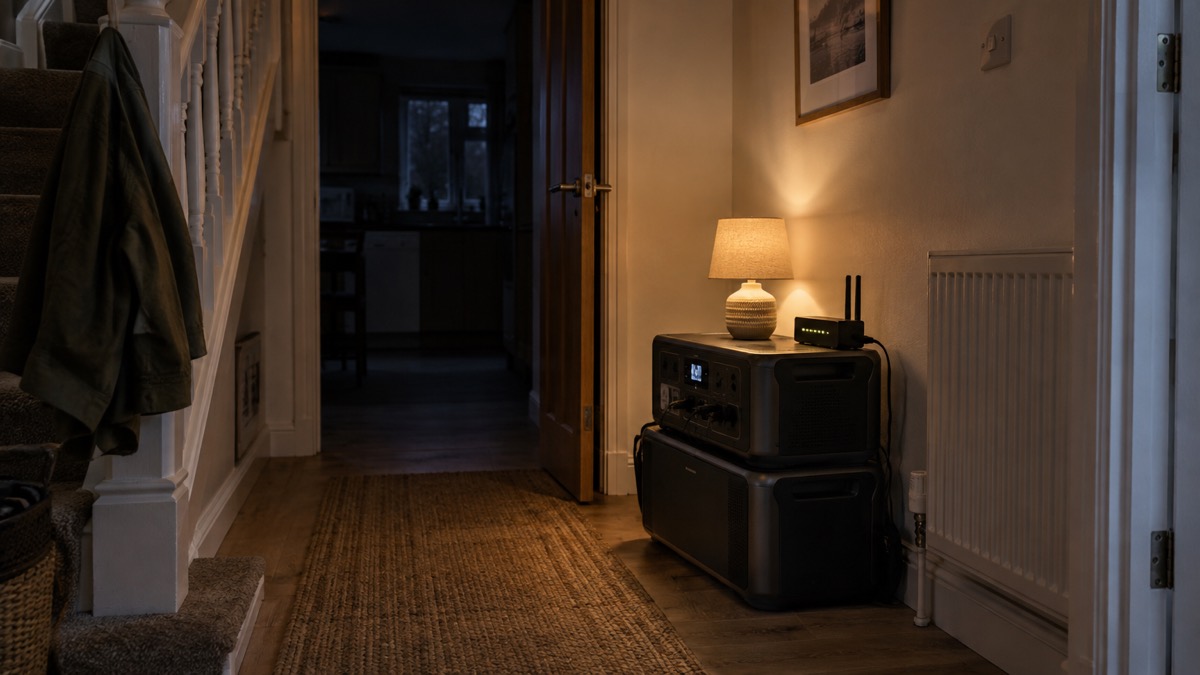
The BLUETTI AC300 is a home backup power station rated at 3,000W, and it does not work on its own: it needs a battery pack plugged into it. With one B300 pack it stores 3,072Wh, and BLUETTI lists the system as expandable up to 12,288Wh with up to four B300 packs1. For a household, that is the difference between keeping a router, a few lights and a phone charger going for a day and keeping a fridge and a boiler running through a longer outage.
It is built for the moment the mains fails. BLUETTI lists a 24/7 UPS mode that switches over within 20ms, so a device plugged into it does not notice the cut3. It also lists a 6,000W surge, which is what lets it start a fridge or a pump that draws far more at the instant it kicks in than it does while running1.
This page sets out what the AC300 does for a household preparing for a power cut, what it can and cannot run, how to charge and store it, and how to use it safely. It is a piece of kit, not a plan: pair it with the rest of your power cut preparations and decide in advance what you would plug in first.
What the AC300 is, and what it is not
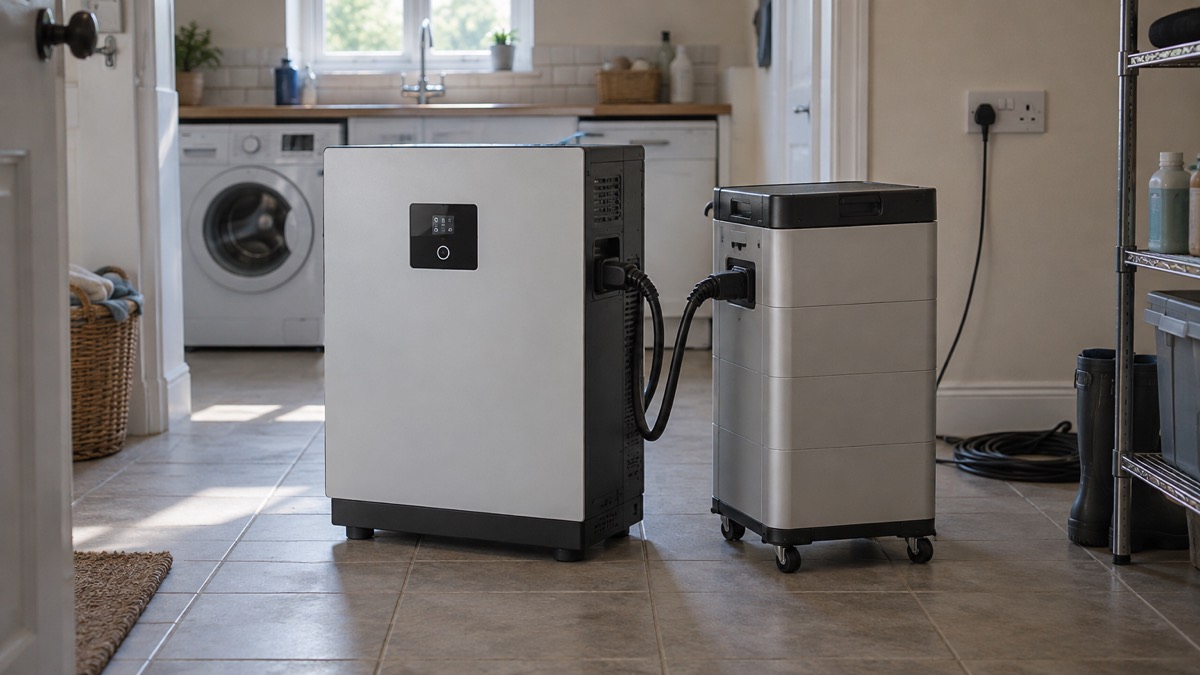
The AC300 is the inverter and control unit. It has no battery inside it, so on its own it stores nothing and runs nothing. You buy it with a battery pack, and BLUETTI describes the system as 100% modular, meaning you can divide it up and carry the parts around the home rather than moving one heavy box2. That matters in a real outage: the inverter can sit where you need the outlets, and the battery pack can live somewhere cooler and safer.
What it is not is a generator. It makes no electricity of its own; it stores electricity you put into it and gives it back. That means the planning question is not only "how much can it run" but "how will I refill it if the outage lasts longer than the charge". BLUETTI lists seven ways to recharge the AC300, including mains, solar, a car port and lead-acid batteries5.
It is also not a whole-house solution on its own. The UK version does not support split phase bonding, and BLUETTI lists split phase bonding at 240V and 6,000W only when the unit is paired with a Fusion Box Pro3. For most households the AC300 is a set of outlets you plug selected appliances into, not a replacement for the consumer unit. If you want to know how a battery can be wired into a home properly, read connecting a generator or battery to your home's wiring.
Battery capacity: 3,072Wh per B300, up to 12,288Wh
Capacity is the number that decides how long the system lasts, and BLUETTI gives it in watt-hours. One B300 pack holds 3,072Wh, and the AC300 accepts up to four of them for a maximum of 12,288Wh1. The maker's index pages repeat the same ceiling5.
There is a second battery option. BLUETTI also sells the AC300 bundled with the B300K pack, and lists that combination at 2,764.8Wh3. The maker's pages give 3,072Wh for the B300 and 2,764.8Wh for the B300K, so the two packs are not the same size. Check which pack is in the bundle before you work out run times.
| Battery pack | Capacity | Notes |
|---|---|---|
| B300 | 3,072Wh | Up to four per AC300, 12,288Wh maximum1 |
| B300K | 2,764.8Wh | Sold as an AC300 bundle3 |
What that means in practice is that capacity is a budget, not a guarantee. A 3,072Wh pack does not run a 3,000W load for an hour, because the inverter has losses and because you rarely run everything at once. The honest way to plan is to add up the wattage of what you would actually keep on, then compare it with the capacity you have. Our guide to watts, watt-hours and surge walks through the arithmetic.
If you need more storage later, BLUETTI sells expansion batteries separately, and the AC300 is listed as compatible with up to four B300 packs6. Adding a pack is the simplest way to extend run time without changing the rest of the setup.
What it can power: 3,000W continuous, 6,000W surge

The AC300's inverter is rated at 3,000W continuous with a 6,000W surge, and BLUETTI describes it as a pure sine wave inverter1. The surge rating is the one that matters for appliances with motors: a fridge or a pump can draw several times its running wattage for a moment when it starts, and the 6,000W figure is what the maker says the unit can handle at that instant1.
BLUETTI's own run-time examples for the AC300 with the B300K give a sense of scale. The maker lists 100 hours for a 30W speaker and 150 hours for a 20W light3. Those are small loads, and they show how far the capacity stretches when you are careful. A fridge, a boiler or a heater will use it far faster.
The practical approach for a household is to decide what counts as essential before the power goes. BLUETTI's own advice is to keep selected essentials such as lights, routers, refrigerators and communication devices running during an outage7. That list is a good starting point: the router keeps you informed, the fridge keeps food safe, the lights keep the house usable, and the phone keeps you in touch. Everything else is a bonus.
Keeping essentials on through a power cut with 24/7 UPS
The feature that makes the AC300 useful for a household rather than a hobbyist is its UPS mode. BLUETTI lists a 24/7 UPS that provides reliable emergency power for critical loads when the electricity goes off, and gives a switchover time of 20ms1. In plain terms, the unit sits between the mains and your appliance, keeps its battery topped up, and takes over almost instantly when the supply drops.
That is a different job from a plain power station, which you have to switch on and plug things into after the lights go out. A UPS is for the things you do not want to interrupt: a router, a phone base station, a medical device, a desktop computer. Ofgem's report on the August 2019 power outage describes how a widespread failure can affect transport and services, which is the kind of event where an uninterrupted supply to a router or a phone matters8.
For anyone who depends on electrically powered medical equipment, the advice from the network operators is consistent: make sure essential medical equipment has a battery backup so you can keep using it even if the power is out, and have backup power supplies checked and maintained by a competent person9. Northern Powergrid adds that people using electrically powered medical equipment should get a backup power supply if possible, join the free Priority Services Membership, inform carers and prepare essential supplies10. SP Energy Networks makes the same point for planned cuts, and adds that a stairlift should have a manual release handle11.
The 20ms switchover is fast enough for most home equipment, but it is not zero. If a device is sensitive to even a brief interruption, check with its maker. Our guide to using a power station as a UPS explains switchover times in more detail.
Charging it: mains, solar, car and lead-acid
How you refill the AC300 decides whether it is a one-outage gadget or a system that lasts. BLUETTI lists seven ways to recharge it5, and the main ones for a household are these.
- Mains: with the 30A AC charging cable, BLUETTI lists a maximum input of 3,000W and a full refill of the AC300 with a B300K in about 1.5 hours3. The maker also lists 5.5 hours for the same combination on a slower charge12.
- Mains plus an extra T500: with an additional T500, BLUETTI lists 2,300W input and a full charge in 1.8 hours, with the T500 sold separately3.
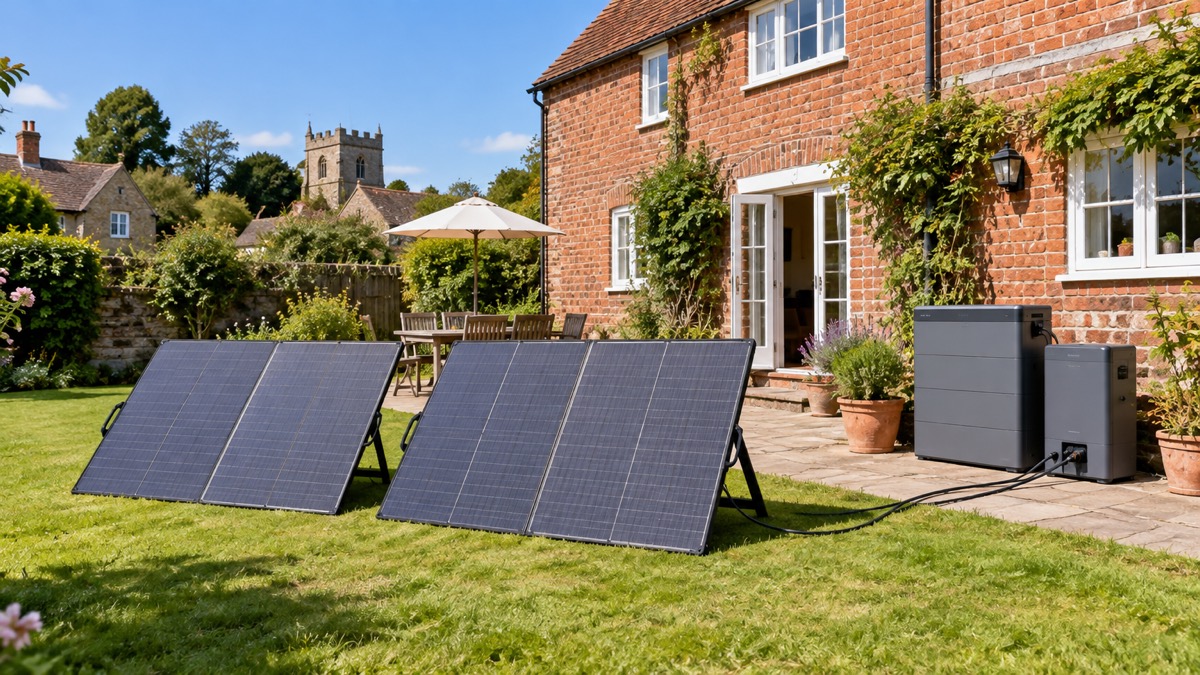
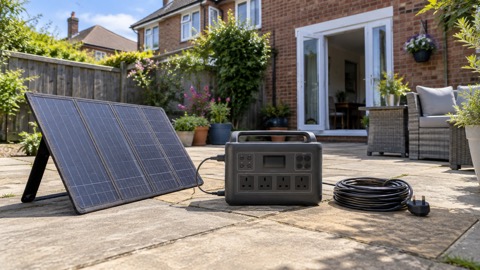
- Solar: BLUETTI lists up to 2,400W of solar input for the AC300 with the B300K, giving a recharge in 1.8 to 2.3 hours, and notes that a D300S is required for roof panel charging3. The AC300's own solar input is listed at 3,000W maximum1.
- Car: the AC300 has a car input that takes 12V or 24V from a cigarette lighter port1. BLUETTI also sells a separate alternator charger bundle for faster vehicle charging13.
- Lead-acid battery: BLUETTI states that the AC300 supports recharging from 12V or 24V lead-acid batteries3.
For a UK household, solar is the option that keeps working when the grid is down, but it is weather dependent. Our guide to portable solar panels for charging in a power cut covers what to expect in a British winter. If you are charging from a car, read can you charge a power station from your car first.
Swapping battery packs safely during use
One of the AC300's design features is that you can swap the battery pack during use. BLUETTI states that you can easily swap the battery pack during use without any hiccup3. That is useful if you have more than one pack: you can run on one while the other charges, or bring a charged pack in from another room.
The maker's support pages add a caution. BLUETTI says the unit can charge and discharge at the same time, but that this is not recommended in order to better protect the cycle life of the battery14. In other words, pass-through works, but the maker would rather you did not make a habit of it.
Battery safety is the part of ownership that matters most. Electrical Safety First advises checking the condition of a lithium-ion battery pack regularly for signs of swelling, dents, deformities and overheating, and stopping use and charging immediately if you notice damage15. The government's guidance on e-cycle batteries is blunter: damaged batteries can catch fire rapidly and without warning, and if you suspect damage you should replace the battery and not charge or use it16.
The AC300 uses lithium iron phosphate (LiFePO₄) cells, which BLUETTI lists as the chemistry for the AC300 series1. That is a different chemistry from many smaller power banks, and our guide to lithium-ion battery safety at home covers the general rules. If a pack does start to swell, what to do if a battery starts swelling sets out the steps.
Storing it so it is ready when you need it
A backup power station is only useful if it is charged and working when the power goes. That means treating it as part of your regular household checks rather than something you put in a cupboard and forget.
- Keep it charged. A unit that has been sitting empty for months may not have enough charge to run anything. Check the level regularly and top it up.
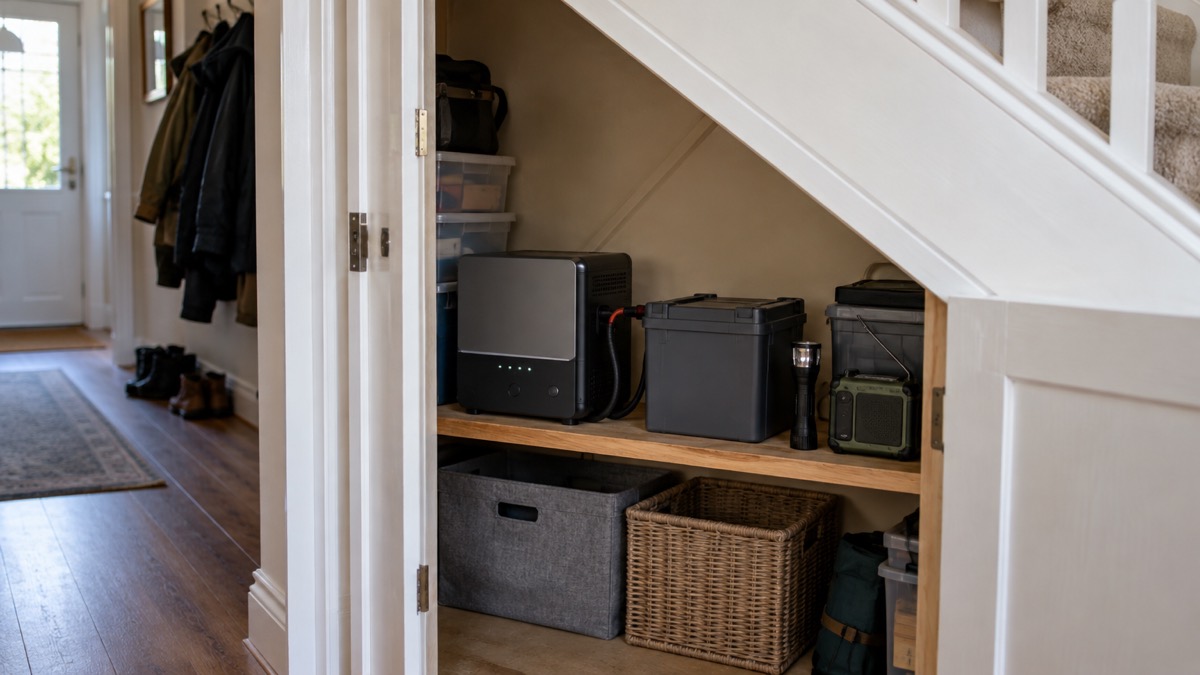
- Keep it accessible. The AC300 is modular, so you can store the inverter and battery separately, but both need to be reachable in the dark2.
- Check the battery. Look for swelling, dents or heat each time you use it15.
- Test the UPS. If you rely on it for a router or a medical device, unplug it from the mains occasionally and confirm the connected equipment stays on.
- Have a light and a radio. Network operators and charities advise keeping an emergency power cut kit topped up with extras such as a battery-powered radio17. Northern Ireland's government advice is to keep a supply of candles, though torches are safer18.
Birmingham City Council's advice on loss of utilities includes keeping some emergency cash accessible19, which is a reminder that a power cut can affect card machines and tills as well as lights. Our power cut backup power checklist puts these checks in one place, and how to store a power station when not in use goes into more detail on storage conditions.
Warranty and support: 4 years
BLUETTI lists a 4-year warranty for the AC300 and B3004. The same figure appears on the maker's product pages for the AC300 and on its warranty page, which sets out the tiers: 5 years for the EP500Pro, 4 years for the BLUETTI AC300 and B300, and 2 years for BLUETTI portable power stations and other brands' portable power stations6. The AC300's own product page also lists 4 years3.
There is one exception worth knowing. BLUETTI lists a 2-year warranty for the AC300 system when it is used with a Fusion Box Pro3. If you are buying the Fusion Box Pro to go with it, check the warranty terms for that combination.
BLUETTI publishes user guides for its products, and the AC300 has a dedicated user guide page21. The maker's support pages are the place to go for warranty claims and technical questions23. Keep your proof of purchase: a warranty is only as good as the record that you bought the unit.
| Item | Warranty |
|---|---|
| AC300 and B300 | 4 years4 |
| AC300 with Fusion Box Pro | 2 years3 |
| EP500Pro (for comparison) | 5 years20 |
Where it fits in a household plan
The AC300 is a serious piece of kit for a household that has decided a power cut is worth preparing for. It stores enough to keep essentials running, it switches over fast enough to protect a router or a medical device, and it can be refilled from the mains, the sun or a vehicle. What it cannot do is make electricity from nothing, so the plan around it matters as much as the unit.
Start with the essentials: decide what you would plug in first, work out how many watt-hours that uses, and match the battery packs to it. Register for your network operator's Priority Services Register if anyone in the household is medically dependent or needs extra help10. Keep a battery-powered radio and a torch alongside the unit17. And check the battery regularly, because a backup you have not looked at is not a backup15.
For the wider picture, our guide to backup power at home covers the alternatives, and the BLUETTI page lists the maker's other products. If you are still deciding between a power station and a generator, portable power station or petrol generator for a power cut sets the two side by side.
Sources (23)
- BLUETTI AC300 + B300K product page, BLUETTI, 2026-10-25
- BLUETTI home backup, BLUETTI, 2026-11-02
- BLUETTI AC300 + B300 product page, BLUETTI, 2022-05
- BLUETTI AC300 + B300 power system, BLUETTI, 2026-10-25
- BLUETTI cell introduction and AC300 index, BLUETTI, 2026-10-29
- BLUETTI expansion battery, BLUETTI, 2026-10-25
- BLUETTI portable power station collection, BLUETTI, 2026-11-02
- Power cuts, National Grid, 2026
- Strong winds weather warning: information and advice, nidirect, 2026-10-24
- Be winter ready, Electricity North West, 2026-10-26
- Loss of utilities, Birmingham City Council, 2026-10-29
- BLUETTI charger 1, BLUETTI, 2026-10-25
- BLUETTI alternator charger for road trips, BLUETTI, 2026-10-25
- BLUETTI support, BLUETTI, 2026-11-02
- Hoverboards and self-balancing boards, Electrical Safety First, 2026-10-25
- Battery safety for e-cycle users, GOV.UK, 2024-02-01
- Managing home dialysis during a power cut or energy blackout, Kidney Care UK, 2023-11-29
- What to do in a power cut, Northern Powergrid, 2026-10-26
- Planned outage, SP Energy Networks, 2026-10-29
- BLUETTI EP500Pro, BLUETTI, 2026-10-25
- BLUETTI user guide, BLUETTI, 2026-10-25
- BLUETTI user guides, BLUETTI, 2026-11-02
- BLUETTI warranty, BLUETTI, 2026-11-02

 BLUETTI Apex 300 Power Station
 BLUETTI Elite 100 V2
 Anker SOLIX C2000 Gen 2
 Anker SOLIX C1000 Power Station
 EcoFlow DELTA Pro
 BLUETTI Elite 400
 Anker SOLIX C300 Power Station
 EcoFlow DELTA 3
 EcoFlow DELTA 2 and DELTA 2 Max
 EcoFlow DELTA and DELTA Max
 EcoFlow RIVER 3 and RIVER 3 Plus
 EcoFlow RIVER 2 and RIVER 2 Max