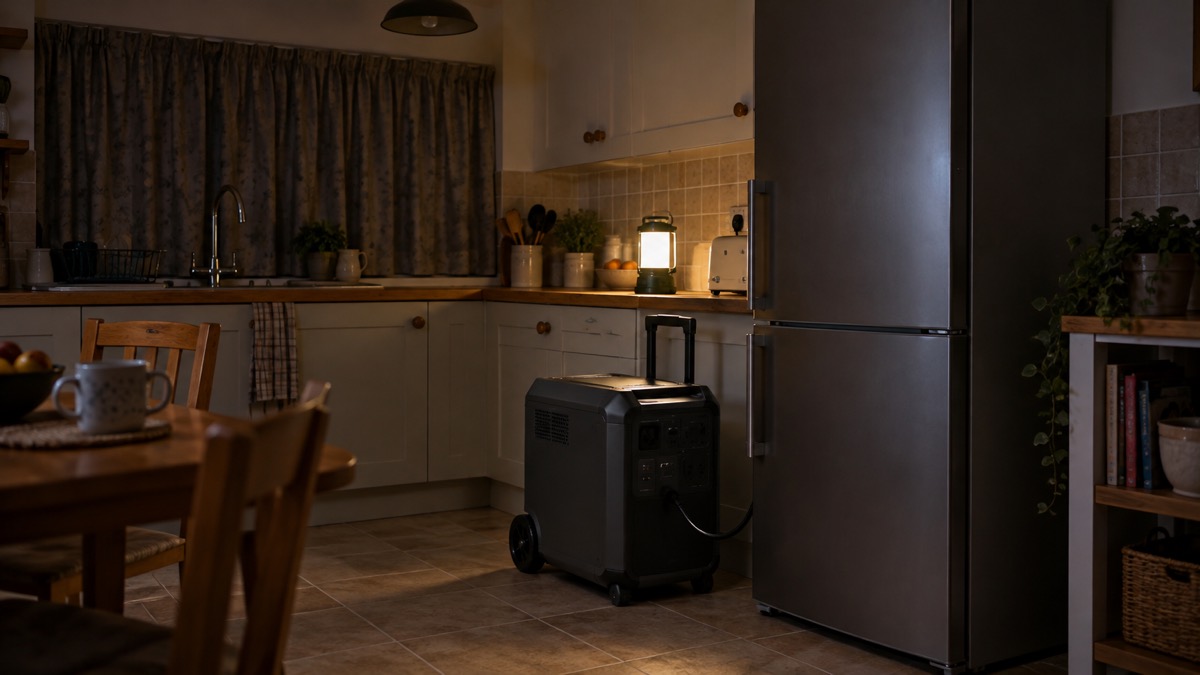
The BLUETTI EP500Pro is a large backup power station with a 5,100Wh LiFePO₄ battery, built to sit in a home and take over when the mains fails1. BLUETTI describes it as a seamless UPS backup power station, meaning it can pass power through to whatever is plugged into it and keep that load running when the supply drops1. For a household preparing for power cuts, storms or a flood that takes the electricity off, that combination of a large stored reserve and automatic backup is the point of the unit.
The headline figure for most people is run time. BLUETTI estimates 40 hours on a household fridge, 80 hours on 40W of LED lighting, 15 hours on a 250W desktop PC and 3 hours on an 8,000 BTU air conditioner1. Those are the maker's reference figures, and BLUETTI states plainly that the calculation results are for reference only and that actual results may vary between different loads1. Treat them as a planning guide, not a promise.
This page sets out what the EP500Pro does for a household in an emergency, its specifications, how to keep it charged and ready, where to put it, and what the warranty and support cover. It does not compare it with other products or give a price. If you are still deciding what kind of backup power suits your home, start with our guide to portable power stations and to deciding what to keep running when the mains fails.
What the EP500Pro is and what it does in an emergency
The EP500Pro is a single unit that stores mains electricity in a lithium iron phosphate battery and gives it back through mains sockets, USB ports and 12V outputs1. BLUETTI lists the battery as LiFePO₄, a chemistry chosen for long life and stability, and rates it at 6,000 cycles to 50% battery health1. In household terms, that is a battery designed to be cycled often over many years rather than a camping accessory used a few times a season.
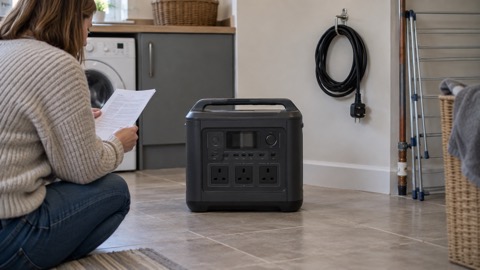
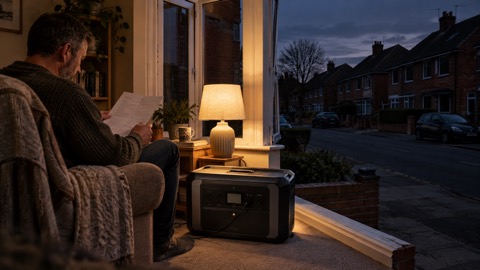
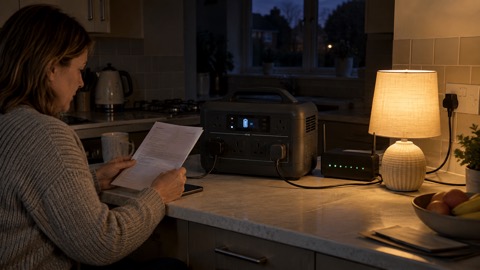
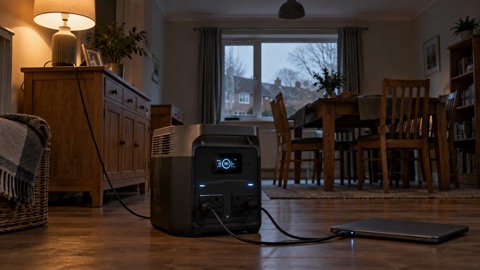
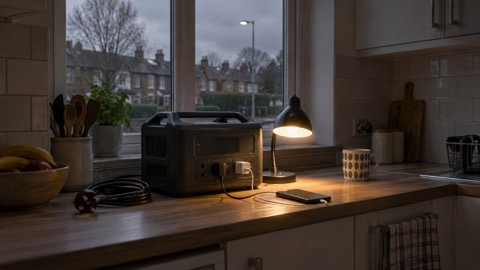
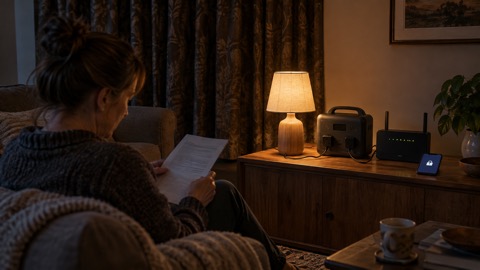
Its role in a household plan is the seamless UPS function. BLUETTI describes 24/7 UPS seamless power backup all day long, which means the unit can sit between the mains and a small set of appliances and keep them running when the power goes1. That suits a fridge, a router, a landline base station, a lamp or a medical device that must not stop. It is not a whole-house solution: it supplies what is plugged into it, up to its rated output.
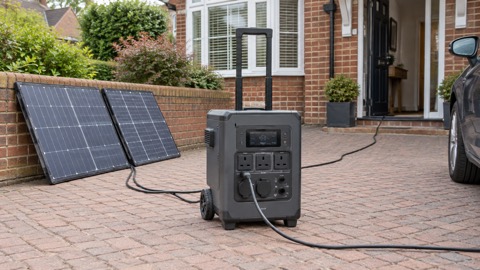
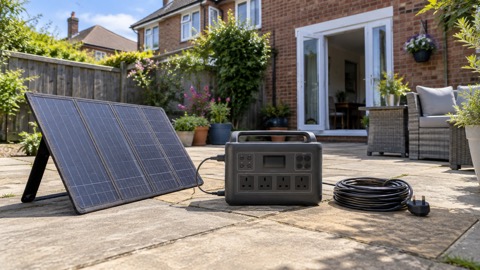
The unit can also be charged from solar panels as well as the mains. BLUETTI lists a maximum total input of 4,000W from AC and solar combined, with a solar input of 2,400W maximum at 35-150Voc and 12A across two strings1. That matters in a long outage, when the mains may be off for days and a portable panel is the only way to put energy back in. Our guide to portable solar panels for charging in a power cut explains how to size and site them.
Specifications at a glance
The table below sets out the maker's figures for the EP500Pro. Where BLUETTI's own pages disagree, both figures are given.
| Specification | BLUETTI figure |
|---|---|
| Battery capacity | 5,100Wh1 |
| Battery chemistry | LiFePO₄1 |
| Rated life cycle | 6,000 cycles to 50% battery health1 |
| AC rated power | 3,000W, peak 6,000W1 |
| AC outlets | 3 at 220-240V 50Hz1 |
| AC input | 3,000W maximum, no power brick needed1 |
| Solar input | 2,400W maximum, 35-150Voc, 12A x 21 |
| Maximum total input | 4,000W (AC and solar)1 |
| Recharge time | 1 hour to 80% at maximum 4,000W input1 |
| USB outputs | 2 x USB-C 100W (PD3.0); 2 x USB-A quick charging, 36W total; 2 x 5VDC 3A total1 |
| DC outputs | 1 x 12VDC 10A cigarette lighter; 1 x 12VDC 30A RV aviation port; 2 x 12VDC 10A DC 55211 |
| Wireless charging | 2 pads at 5/7.5/10/15W1 |
| Remote control | WiFi and Bluetooth1 |
| Dimensions | 580 x 300 x 760mm1 |
| Net weight | approximately 83kg1 |
| Colour | Elegant White1 |
| Certifications | PSE, FCC, CE, UN38.3, MSDS, SAA and ROHS1 |
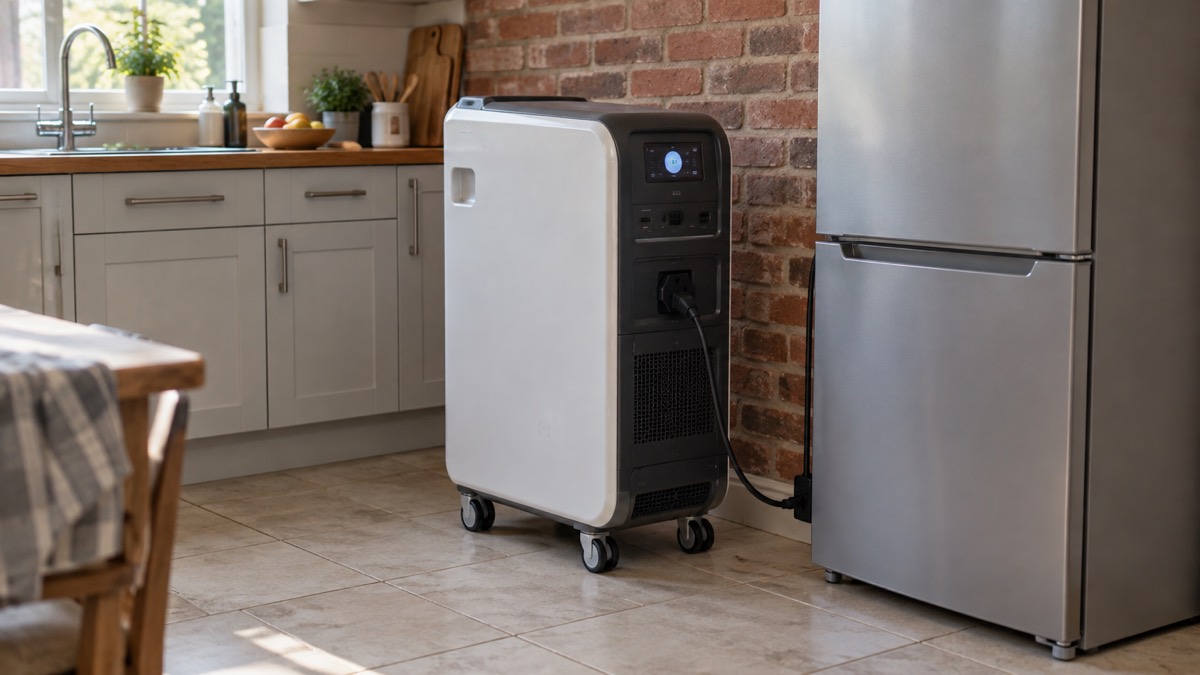
Two of these figures need a caveat. BLUETTI's product page gives the AC rated power as 3,000W with a 6,000W peak, while a separate BLUETTI page gives 4,000W1. Similarly, the product page lists three AC outlets, while a BLUETTI index page describes 15 versatile ports in total, which appears to count every connection rather than the mains sockets alone1. Count the sockets on the unit before you decide what to plug in.
Run time: about 40 hours on a household fridge
Run time is where a backup power station earns its place in a household plan, and it is also where the numbers are easiest to misread. BLUETTI's estimates for the EP500Pro are set out below. They assume a particular appliance and a particular consumption, and the maker states that actual results may vary between different loads1.
| Load | BLUETTI estimated run time |
|---|---|
| Household fridge | 40 hours1 |
| LED lighting (40W) | 80 hours1 |
| Desktop PC (250W) | 15 hours1 |
| Air conditioner (8,000 BTU) | 3 hours1 |
| Laptop (60Wh) | 80 charges1 |
| Mobile phone (15Wh) | 300 charges1 |
The fridge figure is the one most households care about. A fridge that stays closed holds its temperature far better than one that is opened repeatedly, so the practical run time depends as much on household behaviour as on the battery. If you want to understand why a 40W lamp and a 250W computer draw down the same battery at such different rates, our explainer on watts, watt-hours and surge sets out the arithmetic, and our guide to how long a power station will run a fridge or laptop goes further.
For context on how capacity scales, BLUETTI notes elsewhere that a 2,000Wh generator can run a 60W fridge for more than 30 hours5. The EP500Pro stores more than twice that, which is why the maker's fridge estimate runs to 40 hours rather than a single day.
Charging it and keeping it ready
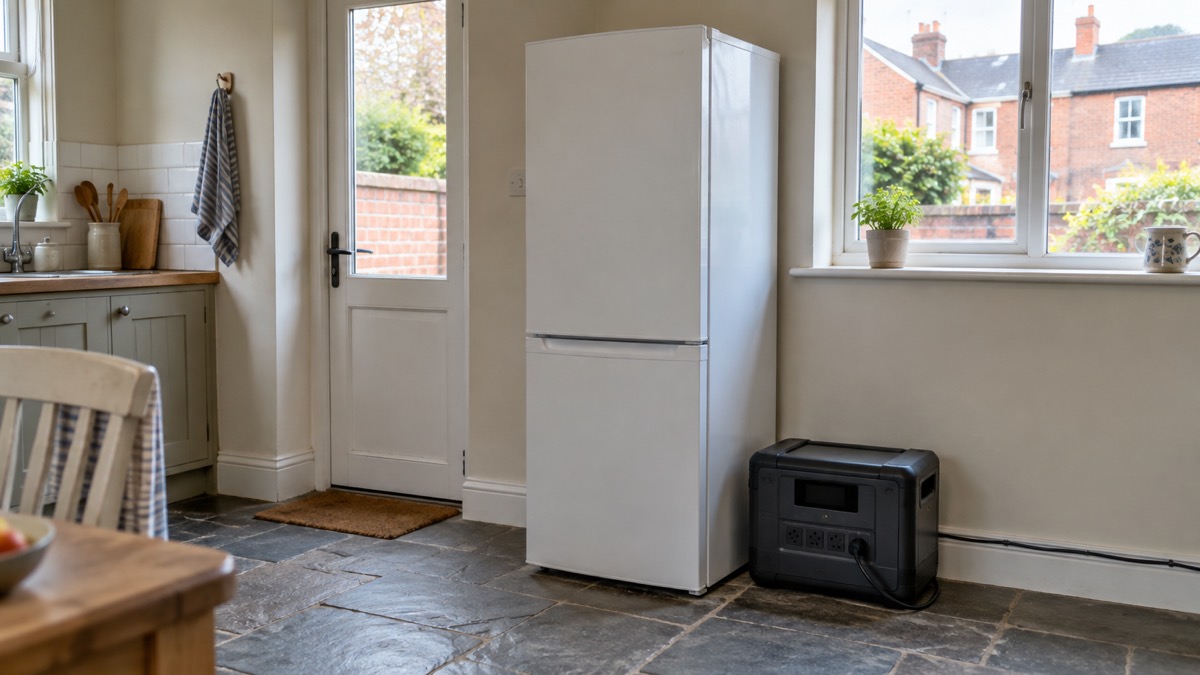
A backup battery is only useful if it is charged when the power goes. The EP500Pro can be recharged from the mains at up to 3,000W without a separate power brick, and BLUETTI states it reaches 80% in 1 hour at a maximum 4,000W input1. That speed matters after an outage: once the mains returns, the unit is back to full readiness quickly rather than sitting on charge for a day.
For a household plan, the routine is straightforward:
- Keep the unit charged and ready to run as a seamless UPS backup power station1.
- After any outage, recharge to full before the next one.
The discharge range is wider: BLUETTI lists -20°C to 40°C for running appliances1. So the unit can sit in a cold outbuilding and still supply power, but it should not be charged there in freezing conditions. For more on safe charging routines, see our safe battery charging at home checklist.
Where to keep and use it: temperature, humidity and 83kg
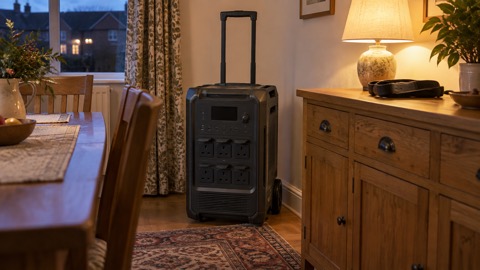
The EP500Pro weighs approximately 83kg and measures 580 x 300 x 760mm, so where it lives is a decision to make before it arrives, not after1. It is not a unit to carry up and down stairs in a hurry. Choose a spot on a solid floor, near the appliances you want it to back up, with room to reach the sockets and ventilation around it.
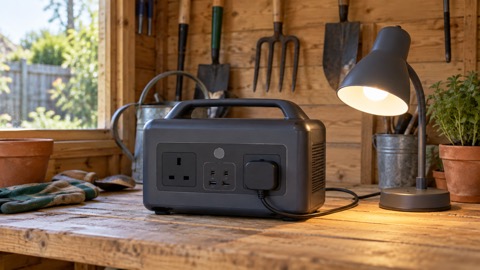
BLUETTI gives a storage ambient temperature of 0°C to 45°C and a working humidity of 10-90%1. Those are broad ranges, but they rule out a damp shed or an unheated outbuilding in a hard frost for long-term storage. A cool, dry, ventilated room inside the house is the sensible home for it. For comparison, the maker of a different power station advises using or storing its product between 20°C and 30°C, away from water, heat and other metal objects6. That is another maker's instruction for another product, but it shows how seriously manufacturers treat temperature and moisture around lithium batteries.
Practical points for siting it:
- Put it on a solid, level floor where it will not be knocked.
- Keep it away from water, damp and sources of heat.
- Leave access to the sockets and the display.
- Keep it out of a room that drops below freezing if you plan to charge it there1.
- Make sure the circuit you plug it into can take the load, and read our guide to extension leads and overloading before adding any.
Battery life, warranty and support
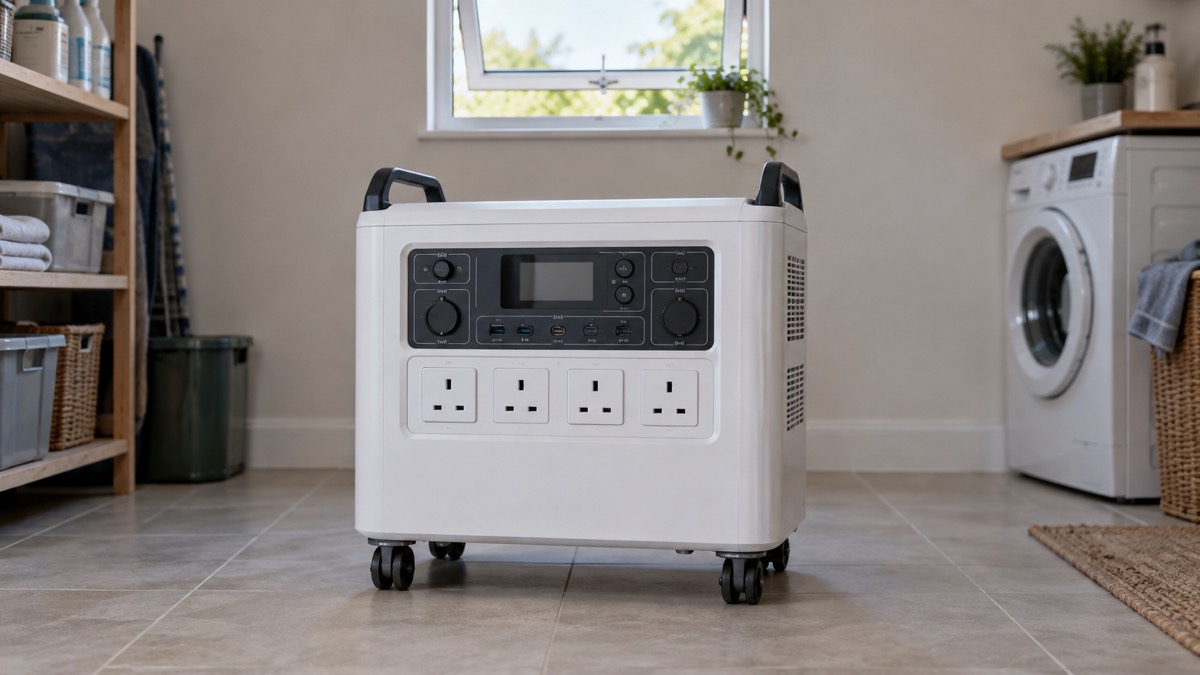
BLUETTI rates the EP500Pro battery at 6,000 cycles to 50% battery health and lists 50,000 hours of electronic life expectancy1. In practice, a unit used as a standby that is cycled only during outages will last many years, while one used daily as a primary supply will reach its cycle count sooner. The LiFePO₄ chemistry is the reason the maker can quote a cycle figure in the thousands rather than the hundreds1.
Warranty is where the maker's own documents need reading carefully. The product page states a warranty period of 5 years1, and a separate BLUETTI page also gives 5 years for the EP500Pro3. The maker's warranty guidance, however, lists the EP500PRO with a 48-month warranty period2.
BLUETTI's warranty tiers put the EP500Pro at the top of its range, above the 4 years given for the AC300 and B300 and the 2 years for BLUETTI portable power stations and other brands' portable power stations1. Support is available through BLUETTI's support pages and user guides, which cover setup and troubleshooting7. Register the product, keep the receipt and note the serial number somewhere you can find it in an emergency.
How it fits a household plan
The EP500Pro is a substantial piece of kit, and it suits a household that has already decided which appliances must keep running and wants a single unit to cover them. It is heavy enough to be effectively fixed in place, large enough to run a fridge for the best part of two days on the maker's estimate, and designed to sit on standby so that the switchover happens without anyone intervening1.
It is not the right answer for everyone. A household that mainly wants to keep phones and a radio going will find a small power bank lighter and simpler, as our guide to power banks explains. A household that needs to run a whole house, including heating and a large cooker, is looking at a different class of system, covered in our guide to home battery storage and to connecting a battery to your home's wiring. The EP500Pro sits between those: a serious reserve for a defined set of loads, kept charged and ready.
Whatever you choose, the preparation is the same. Decide what must stay on, work out how long it needs to run, keep the battery charged, site it safely and test it before you need it. BLUETTI's own product pages and support guides are the place to check the details for this unit1, and our power cut backup power checklist sets out the wider kit a household should have ready.
Sources (8)
- BLUETTI EP500Pro product page, BLUETTI, 2026-10-25
- BLUETTI warranty, BLUETTI, 2026-11-02
- Solar generator vs fuel generator, BLUETTI, 2026-10-25
- BLUETTI user guide, BLUETTI, 2026-10-25
- Caravan power station, BLUETTI, 2026-10-29
- EcoFlow DELTA user manual V1.1, _1724120671655.pdf), EcoFlow, 2024
- BLUETTI support, BLUETTI, 2026-11-02
- BLUETTI user guides, BLUETTI, 2026-11-02

 BLUETTI Apex 300 Power Station
 BLUETTI Elite 100 V2
 Anker SOLIX C2000 Gen 2
 Anker SOLIX C1000 Power Station
 EcoFlow DELTA Pro
 BLUETTI Elite 400
 Anker SOLIX C300 Power Station
 EcoFlow DELTA 3
 EcoFlow DELTA 2 and DELTA 2 Max
 EcoFlow DELTA and DELTA Max
 EcoFlow RIVER 3 and RIVER 3 Plus
 EcoFlow RIVER 2 and RIVER 2 Max