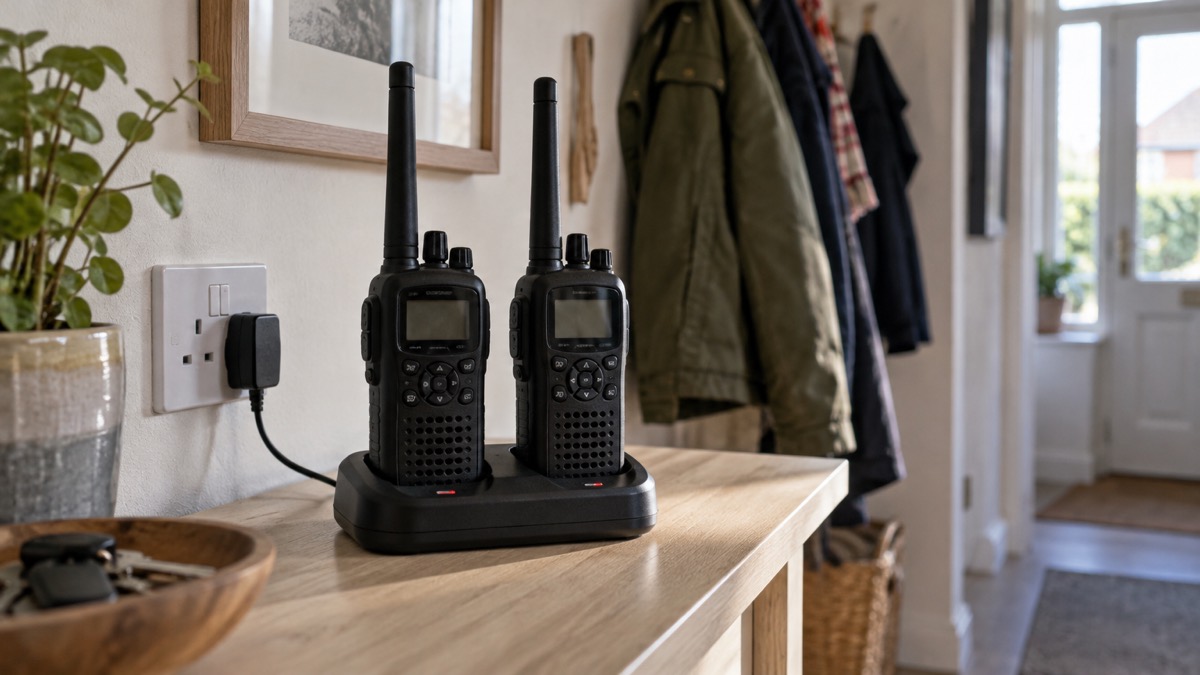
When the phones go down, radio is the form of communication the UK government itself plans to fall back on. Official public health planning for a national power outage states that emergency communications to the public would be limited to radio, on BBC Radio 2 and Radio 4, because it is "the most power resilient form of communication"1. Anyone with a battery-powered, wind-up or car radio, while the battery lasts, would be able to receive that advice1. That is why every piece of official household guidance in the UK tells you to keep a radio and spare batteries at home.
Two-way radios, the walkie-talkies sold as PMR446 sets, are a different tool. They let two people in the same household or street talk to each other without any network in between, which can help when mobile masts are down or when one of you is out checking on a neighbour. But official UK household guidance does not build its plans around them: it builds them around receiving information by broadcast radio, keeping mobile phones charged, and agreeing in advance how your family will reconnect if you cannot call. This page sets out what radios can do for an ordinary household, what to keep ready, and how the pieces fit together, so you can decide what belongs in your cupboard.
If you are weighing up walkie-talkies, the honest starting point is this: the official guidance that exists is about broadcast radio, and any two-way radio you buy is a supplement to that, not a replacement for it. Buy from a reputable seller, follow the maker's instructions, and check for recall notices, because unsafe electrical goods are a real and recurring problem in the UK2.
Why radio matters when phones and networks fail
Mobile networks are more fragile than most people assume. The Met Office's own wind warnings spell out that there is a slight chance power cuts may occur in severe storms, with the potential to affect other services such as mobile phone coverage7. Ofcom, the communications regulator, publishes guidance on staying connected in severe weather and recommends AM, FM and DAB radios precisely because they will help you receive weather warnings, news updates and information from your local authority or the UK Government when other routes fail8. Information might also come through the UK Government's emergency alert system, but only if mobile networks are still available8.
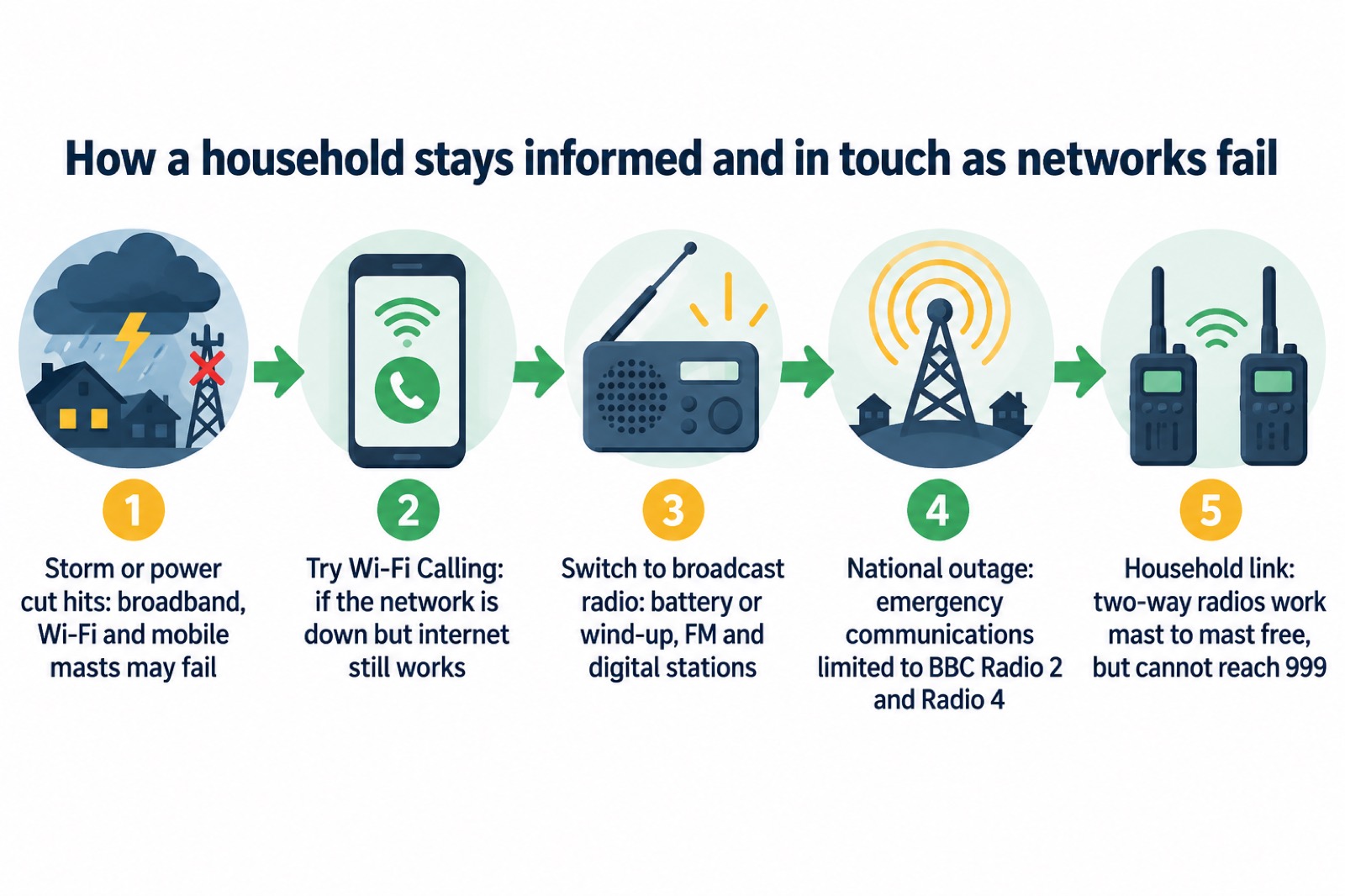
The practical chain of failure runs like this. A storm or power cut knocks out your broadband and Wi-Fi, or the mobile mast near you loses power. Your mobile may still work for a while over Wi-Fi calling if you have an internet connection, and official guidance says to try that: if your mobile network is down but you have a working Wi-Fi connection, you may still be able to make calls by enabling Wi-Fi Calling on your device6. But once both the network and the internet are gone, a phone is a paperweight with a torch. A radio keeps receiving.
That is why Greater Manchester's resilience guidance tells households to keep a battery or wind-up radio, with spare batteries, at home, because during a power cut updates may be communicated by BBC local radio and by Radio 2 and Radio 4 in the event of a national power outage9. Scottish Government guidance says the same: if the power is out, use a battery-powered or wind-up radio, try both digital and FM stations, and remember you can also use a car radio, though in severe weather it might be safer to stay indoors10. For a fuller walk-through of what to do in the first hour of a network failure, see what to do when phones and the internet go down.
Two-way radios sit alongside this as a household link rather than a news source. Their value is narrow but real: a set kept in the house and one in the car or a go-bag lets you talk to family a street or a field away without any mast, any subscription or any charged phone contract. What they cannot do is reach the emergency services, receive official broadcasts, or work over long distances the way a phone does. Treat them as one layer, with broadcast radio as the layer official guidance actually relies on.
What to keep ready: the radio itself, batteries and a written plan
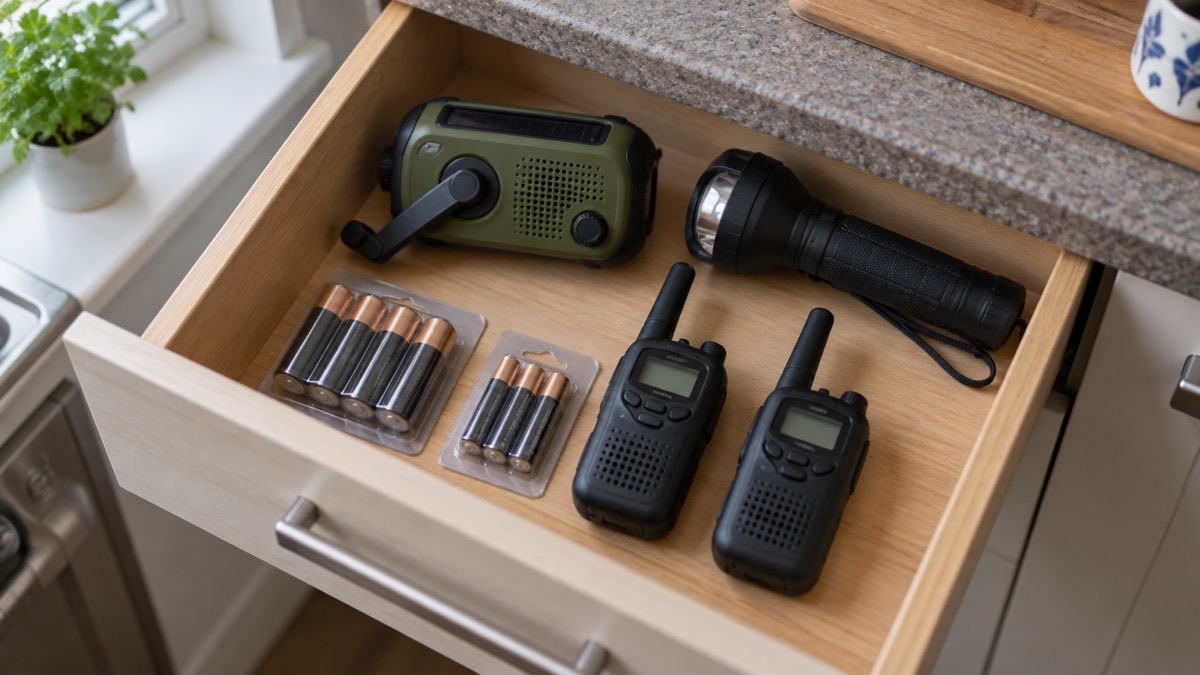
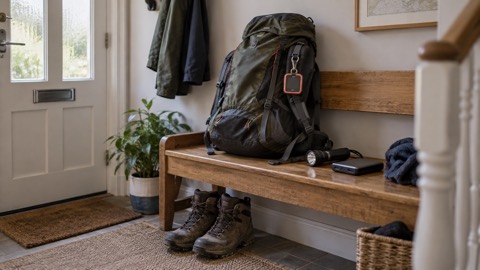
Every official checklist in the UK converges on the same core kit. The UK Government's Prepare campaign tells you to keep an FM radio, battery or wind-up, and to write down the frequencies of the national or local radio stations you use for news3. The Be Ready campaign for power cuts says the same: keep a battery or wind-up radio and spare batteries at home, because there might be updates communicated by radio during a power cut11. Neath Port Talbot's emergency kit checklist includes a radio, battery or wind-up12, and the Be Ready household emergency plan template lists an FM radio, battery or wind-up, specifically to get updates during a power cut4.
What to gather:
- A battery or wind-up radio, kept somewhere you can find it in the dark11
- Spare batteries, in the sizes the radio actually takes11
- A written list of station frequencies, on paper, not stored only on your phone3
- A charged mobile phone and some data available, in case Wi-Fi is down13
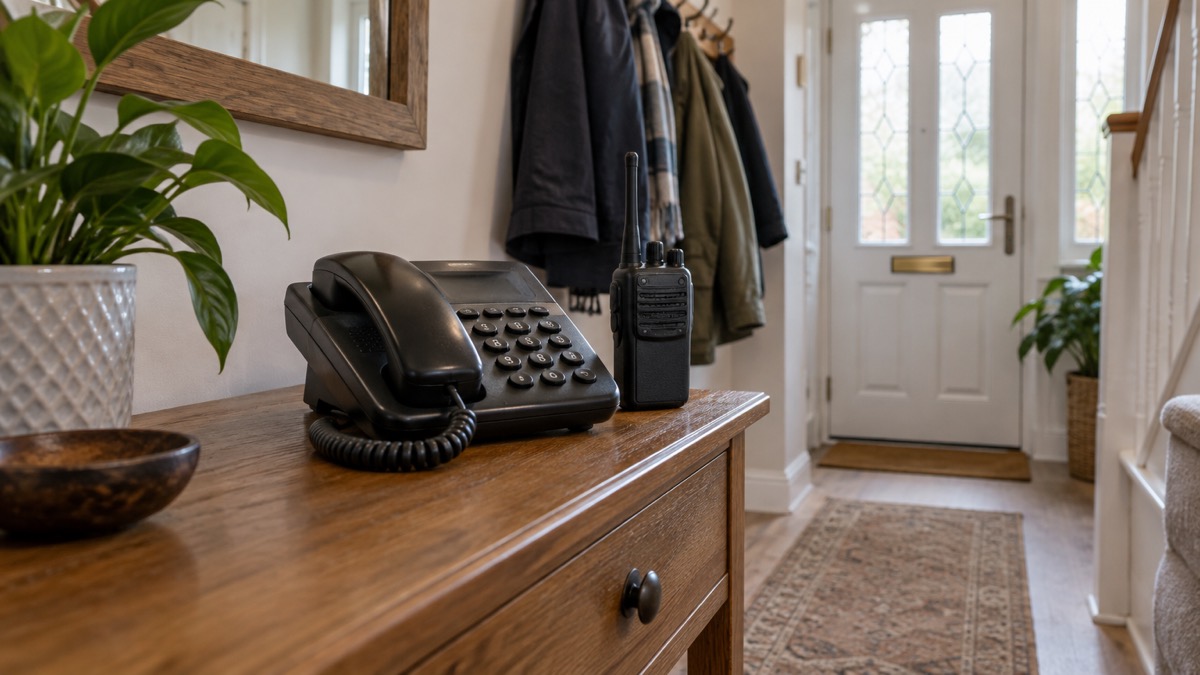
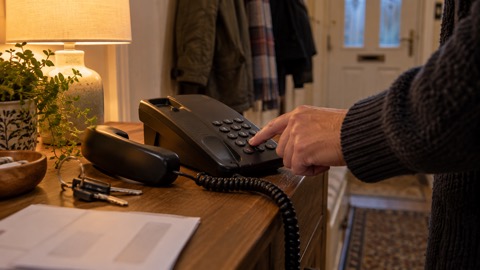
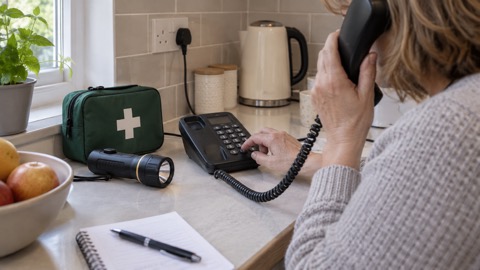
- A corded, old-style landline phone if you have a landline, which continues to work even when the power goes off14
- Written telephone numbers of family, neighbours and key services14
Wind-up radios deserve a particular mention for prolonged outages. Wiltshire and Swindon's preparedness guidance on a failure of the national electricity supply notes that if the power outage is prolonged, a wind-up radio is a good purchase, and that these often have a point where you can plug in your mobile phone to keep its battery topped up15. That combination, a radio you can crank by hand that also trickle-charges a phone, covers the two failure modes at once: no mains power for the radio, and a flat phone. For comparing the types in more detail, see emergency radios: wind-up, solar and battery types and wind-up or battery radios for emergencies.
If you add two-way radios to this kit, apply the same readiness discipline. A walkie-talkie with a flat battery is worse than useless because it creates false confidence. Keep rechargeable sets charged on a schedule, keep spare alkaline batteries if the model takes them, and store the radios where each household member knows to find them. Check them the same way you check your smoke alarms: on a fixed day, not when you happen to remember.
Agreeing your household plan before anything goes wrong
Kit is only half of it. The UK Government's Prepare campaign asks households to agree a backup plan with anyone who might need extra support, particularly if they live alone: if an outage happens and you cannot call, you or another trusted person they know will visit them in person, and they should follow emergency services advice if asked to evacuate3. That single agreement, made on a quiet afternoon, is what turns a communications failure from a crisis into an inconvenience. Decide now who walks to whose house, and in what order, when the phones die.
The same planning should cover any device in the home that depends on a network. Official guidance on phone and broadband outages tells you to check with the provider or manufacturer how medical or personal alarm devices work if the network is down, for example how a personal alarm or diabetes sensor would function if mobile or broadband service is lost6. If someone in your household relies on a telecare alarm or a monitored device, that conversation belongs in your plan, and there is more on this in telecare and personal alarms when phone lines go digital.
For two-way radios, the equivalent is agreeing the basics in advance. Decide who carries which set, when you will check in, and what to do if one of you does not answer. Write it down alongside your frequency list and phone numbers. A full template for this is in keeping in touch with your household: a contact plan, and the Be Ready household emergency plan is a free official template you can fill in as a family4.
"You could agree that if an outage happens and you cannot call, you or another trusted person they know will visit them in person."
Which stations to write down: frequencies by nation
The reason official guidance insists on writing frequencies on paper is simple: you will not remember them, and you cannot look them up when the internet is down. Local radio is the workhorse in most emergencies, because councils and resilience forums feed information to local stations first. Richmond's guidance on utilities failure notes that in large-scale power outages, local radio and BBC Radio 1 to 4 are the most likely to be transmitting16. In a national power outage, planning documents state, emergency communications to the public would be limited to BBC Radio 2 and Radio 41.
Write down a national station and a local one. Some examples of what households are being told to note, by nation:
| Nation or area | Station | Frequency |
|---|---|---|
| England (Surrey) | BBC Radio 4 | 92 to 94 FM17 |
| England (Surrey) | BBC Radio 2 | 88 to 91 FM17 |
| England (Warwickshire) | Free Radio | 97 / 102.9 FM18 |
| England (Cornwall) | BBC Radio Cornwall | FM 95.2 MHz East Cornwall, FM 103.9 MHz West Cornwall, DAB 11B19 |
| Scotland | BBC Radio Scotland | 92 to 95 FM18 |
| Scotland (Borders) | Radio Borders | 96.8 FM Selkirk, 102.3 FM Berwick, 103.1 FM Peebles, 103.4 FM Eyemouth18 |
| Wales (Ceredigion) | Radio Ceredigion | 96.6 FM, 97.4 FM, 103.3 FM20 |
| Wales | Radio Wales | 95.3 FM20 |
The pattern is the same everywhere: your local BBC station, your local commercial or community station, and one national BBC network as the fallback. Argyll and Bute's civil emergencies guidance adds that up-to-date information on the situation, including advice on what you should do and where to get further details, will be broadcast on local radio and television channels and websites21. During winter weather, Scottish Borders Council says local radio stations will provide regular updates on schools and school transport, so tune in during adverse weather22. A fuller guide to stations during power cuts is at which radio stations to tune into during a power cut.
Talking to each other: what two-way radios can and cannot do
A pair of walkie-talkies gives your household a private, network-free channel over short distances: house to garden, house to car, one end of the street to the other. No mast, no SIM card and no subscription sits between the two handsets. That is their whole value, and in a storm, a flood or a power cut it is not a small one. When one of you is out checking on an elderly neighbour and the mobile network is congested or down, a two-way set in each pocket does the job.
But be clear about the limits, because the marketing on the box will not be. Two-way radios cannot reach the emergency services: 999 is a phone service, reached by phone, text or relay4. They cannot receive official broadcasts, so they do not replace the battery radio in your drawer. And they cannot carry a signal over the horizon: the realistic working distance depends entirely on terrain, buildings and interference, and any figure printed on retail packaging should be treated as a best case, not a promise. If you need to reach someone beyond walkie-talkie distance with no mobile signal, the options that actually work are satellite based, covered in satellite messengers: what they do and how to choose one.
Assume others can hear you. Official planning notes that anyone with access to a battery-powered, wind-up or car radio can receive broadcast advice1, and the open nature of the airwaves is the same for shared two-way channels. Do not pass personal details, addresses or medical information over a radio channel you treat as private. Keep messages short and factual, listen before you transmit so you are not talking over someone, and agree your check-in routine in advance as part of your household plan.
Reaching the emergency services when phones are struggling
The emergency number throughout the UK is 9994. If you have a speech or hearing impairment, or you are with someone who does, there are established alternatives: Manchester Fire and Rescue Service lists 999 BSL, emergencySMS and Relay UK as alternative ways to contact the emergency services23. The East of England Ambulance Service explains that Relay UK is provided for people who are deaf, hard of hearing or speech impaired as an alternative option for contacting the emergency services24, and advises that you should only use emergencySMS to contact the emergency services if you have no other option24.
The critical point, and the one households most often miss, is timing. Bath and North East Somerset Council's guidance is blunt about it: for Relay UK and the 18000 service, "You have to set both services up before you can use them"5. Registration takes minutes on a quiet day and is impossible during the emergency. If anyone in your household could ever need these routes, set them up now. Step-by-step guides are at emergencySMS: how to register and text 999 and 999 BSL and Relay UK: contacting 999 if you are deaf.
There is also a plan for the worst case. Official guidance on communications outages says people with additional communication needs should continue to use established accessibility services where available, but that during a widespread communications outage these services may also be affected, in which case you should seek help directly from emergency responders or go to your nearest police station, fire station, ambulance station or hospital6. That is the final fallback, and it is worth every adult in the house knowing it: if nothing connects, you walk. More on the basics is in calling 999 and 112: what happens when you ring.
Weather, safety and looking after the kit
The UK's climate is the reason this kit exists. Essex Prepared notes that the UK sits in the path of predominantly westerly winds, where low pressure weather systems and their associated clouds and rain move eastwards or north-eastwards across the North Atlantic and then across the UK, bringing unsettled and windy weather particularly in winter25. Storms bring power cuts, and power cuts bring the risk that mobile coverage is affected too, as the Met Office's own warnings state7. Winter is when your radio kit earns its place, so check it before the first named storm of the season, not after.
If you expect to use a radio or two-way set outdoors, in a garage or shed, or around flooding, choose a weather-resistant model and keep it dry. For a radio that lives indoors, weatherproofing matters less than working batteries and a written frequency list. And whatever you buy, apply ordinary electrical safety. Mid and West Wales Fire and Rescue Service warns that 1.8 million chargers are bought online each year in the UK by mobile phone owners in search of a bargain, and unsafe electrical goods are a genuine fire risk2. Buy radios, chargers and accessories from reputable sellers, and check the government's product recall lists: a Power Evo wireless charging power bank sold via a high street retailer was recalled in June 2026, a reminder that even ordinary-looking kit can be withdrawn for safety reasons26.
If children will use the radios, supervise them and mind small parts. The Child Accident Prevention Trust reports that studies in Europe and America have shown increasing numbers of children swallowing magnets, and that doctors worry the same increase is being seen in the UK27. Younger children can mistake small magnets for brightly coloured sweets, and many teenagers and younger children have tried to create a fake tongue piercing using two magnetic balls and accidentally swallowed them27. Magnets that have fallen out of broken toys and devices are a particular risk for young children27. Check that battery covers are screwed shut and that no small magnetic parts have worked loose.
Where to get help and official guidance
In any emergency, the instruction that runs through all official guidance is to monitor the news and follow official advice on GOV.UK for what to do next; changes to advice may be communicated via the radio, television, internet, social media or the police28. Your radio is how you receive that when the internet is not an option. Local resilience forums and councils publish the local risks and the local stations for your area, and your council's emergency pages are the place to find your own area's equivalents.
For the national picture, the UK Government's emergency alert system sends test and real messages to all 4G and 5G phone networks in the UK29, so keep alerts switched on and know what a genuine one looks like, covered in emergency alerts: how the UK phone warning system works. For specific hazards, such as a hazardous materials incident, official guidance again points to monitoring the news and following official advice on GOV.UK28. And for the underlying help with phone and broadband problems, including the extra support providers must give vulnerable customers, see extra help from phone and broadband providers and the wider staying informed guide.
The short version of this whole page: keep a battery or wind-up radio with spare batteries, write your station frequencies on paper, agree who walks to whose house when the phones die, register any accessibility services before you need them, and know that 999, and in the worst case your nearest emergency services station, are the routes that matter. Two-way radios can add a useful household link on top of all that. They are the last layer, not the first.
Sources (29)
- Keeping warm or cool in extreme weather: scripts for broadcast media, UK Government, 2025-12-16
- Electrical safety in the home, Mid and West Wales Fire and Rescue Service, 2026-10-29
- Get prepared for emergencies, UK Government Prepare campaign, 2026-10-21
- Be Ready Household Emergency Plan, Be Ready campaign, 2026
- If you can't speak when you call 999, Bath and North East Somerset Council, 2026
- Phone and broadband outages, UK Government Prepare campaign, 2026-10-12
- Accessible UK weather warnings, Met Office, 2026-10-24
- Stay connected in severe weather, Ofcom, 2026-10-13
- Loss of essential services, Greater Manchester Combined Authority, 2026-10-29
- Emergency plan, Scottish Government Ready Scotland, 2026-03-24
- Power cuts, Be Ready campaign, 2026-10-21
- NPT Prepared emergency kit checklist, Neath Port Talbot Council, 2026-10-29
- 12 tips to prepare for a power cut, Horsted Keynes Parish Council, 2026
- Winter weather: ready and prepared, Argyll and Bute Council, 2026
- Failure of National Electricity, Wiltshire and Swindon Prepared, 2026-10-25
- Utilities failure, Richmond Council, 2026-05-22
- Surrey Prepared ICE template, Surrey County Council, 2026-10-29
- Prepared: personal resilience, Scottish Borders Council, 2026-10-29
- Storm preparation, Cornwall Council, 2026-10-29
- Advice in emergencies, Ceredigion County Council, 2026-10-29
- Preparing for civil emergencies in Argyll and Bute, Argyll and Bute Council, 2026
- Schools winter advice, Scottish Borders Council, 2026-10-29
- Additional advice for people with a hearing impairment, Manchester Fire and Rescue Service, 2026-10-29
- Contacting 999 with a speech or hearing impairment, East of England Ambulance Service, 2026-10-29
- Protecting your family in severe weather, Essex Prepared, 2026-10-29
- Product recall: Power Evo Wireless Charging Power Bank 5V, UK Government, 2026-06-03
- Magnet safety, Child Accident Prevention Trust, 2025-12-17
- Hazardous materials incident, UK Government Prepare campaign, 2026-10-13
- Emergency alert test, Sunday 7 September at 15:00, Wiltshire and Swindon Prepared, 2026-10-25
 Free Alert Services
 Emergency Apps
 Digital Switchover Checklist
 When Phones and Internet Fail
 Official Warnings and News
 Emergency Radios
 Telecare on Digital Phone Lines
 Mobile Networks in Power Cuts
 Broadband Outages
 Router and Hub Power Cuts
 Wi-Fi Calling
 Satellite Messaging and SOS
 Satellite Messengers
 Calling 999 and 112
 Non-Emergency Numbers