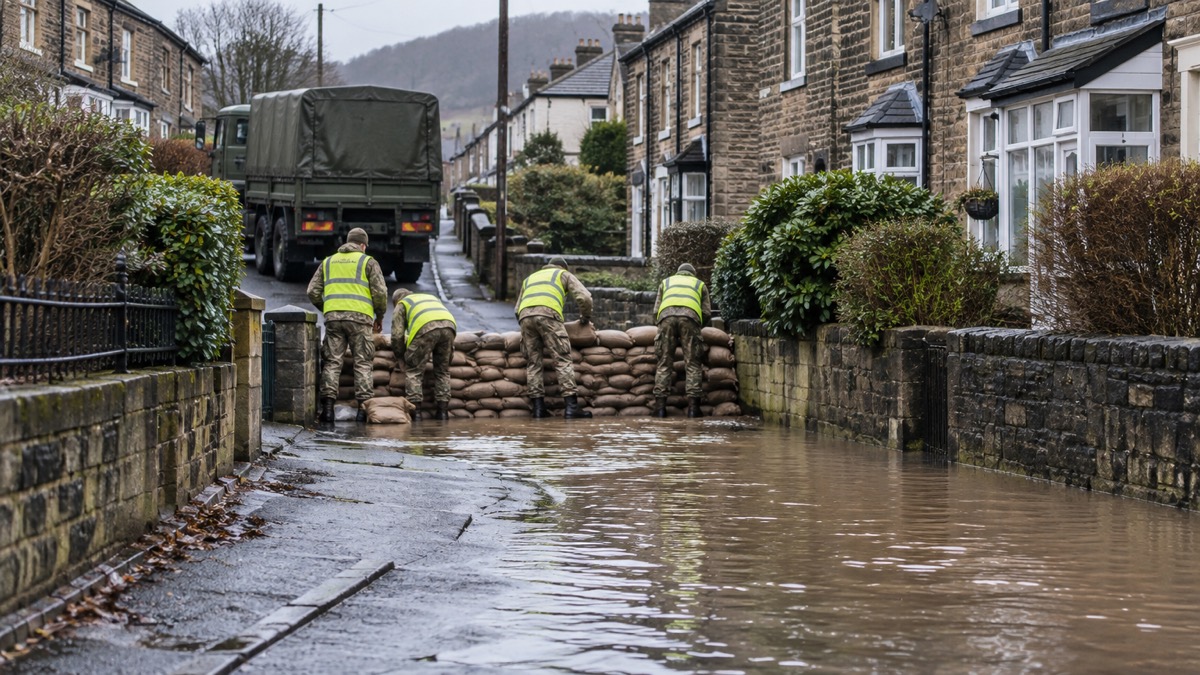
Seeing soldiers filling sandbags or delivering water in a British town is unusual but not alarming, and it does not mean the response has been taken over by the military. It almost always means one thing: the ordinary emergency services and the council have more demand than they can meet, and a civil authority has formally asked the armed forces for help. That request is made under arrangements called Military Aid to the Civil Authorities, usually shortened to MACA1.
The key point for your household is that the civil authorities stay in charge. The police, fire and ambulance services lead the response, your council co-ordinates welfare such as shelter and temporary accommodation, and the armed forces arrive as extra hands and equipment to fill a specific gap2. If a civil emergency is declared that affects you, you will be notified by the police4.
Military aid to the civil authorities: help when local resources run out
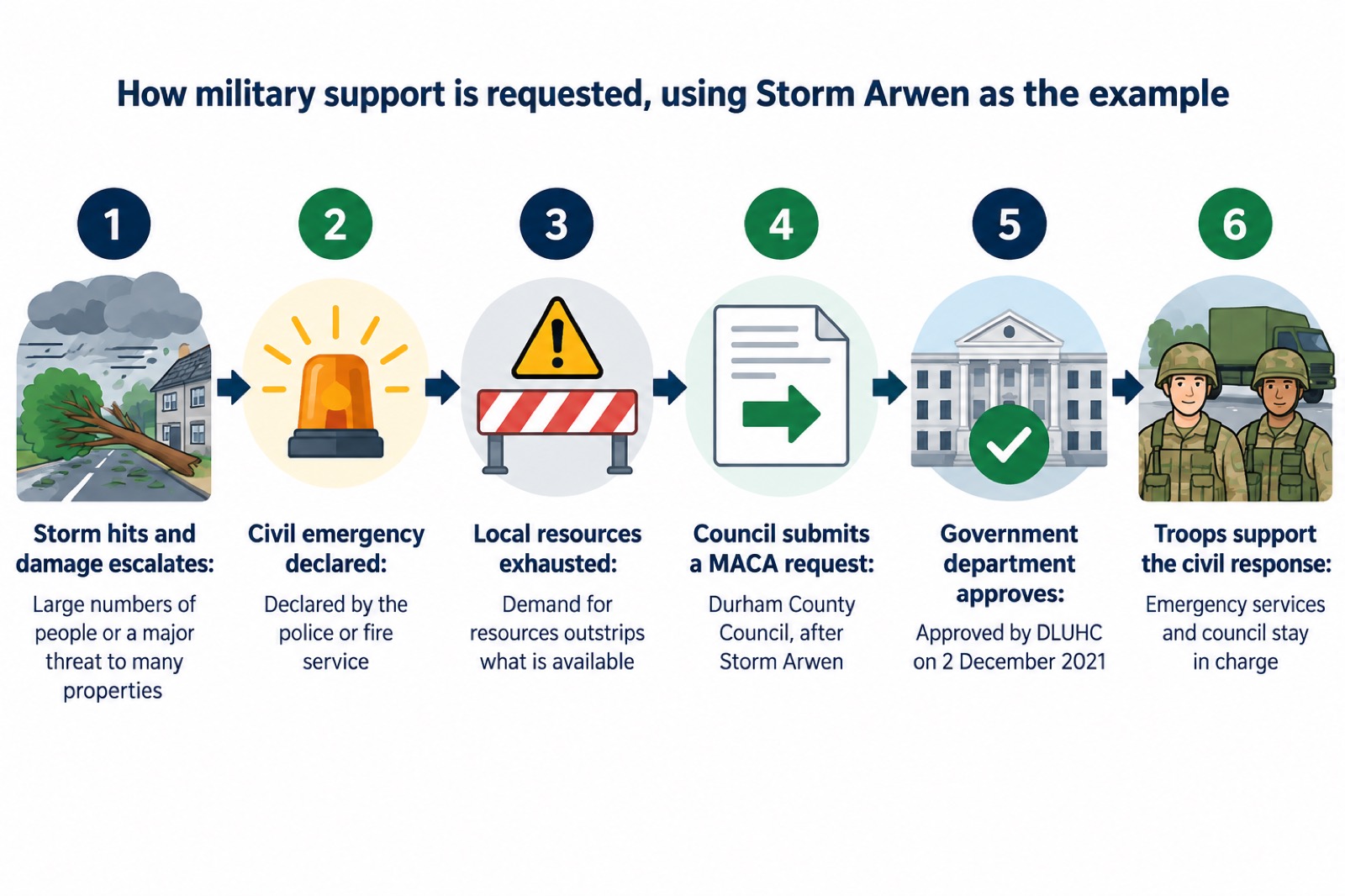
Military Aid to the Civil Authorities is the mechanism by which the armed forces can be brought in to support the civilian response to an emergency. As the government's own risk guidance puts it, "Where the demand for resources outstrips what is available, military support may be requested under Military Aid to the Civil Authorities ('MACA') arrangements"1. The phrase to notice is "where the demand for resources outstrips what is available". The armed forces are not a first response. They are a backstop, called upon when the people, vehicles or specialist equipment normally available to a council or an emergency service are exhausted or insufficient for the scale of the event.
This matters for what you should expect as a household. In almost every emergency you are likely to face in the UK, you will deal first with the ordinary responders: the police, fire and ambulance services, your local council, utility companies and volunteers. Local authorities are responsible for co-ordinating welfare support for their communities in an emergency, including providing temporary shelter in rest centres and meeting any need for temporary accommodation where evacuation is extended3. If lots of people have to leave their homes, the local authority will provide temporary emergency accommodation8. Military personnel, if they appear at all, will be working alongside these services, doing tasks the civil authorities have asked them to do.
The kinds of situations that can exhaust local resources are set out in national and local risk planning. Argyll and Bute Council, for example, lists the effects a civil emergency can have on a community: loss of electricity, telephone, water or gas; short term evacuation from your home; temporary isolation cutting off communities; damage to your home or nearby buildings; and injury, severe illness or death of members of your family or the wider community4. Any of these at large scale, across many households at once, is the sort of event that can push a council towards requesting military help. You can read more about how these risks are assessed nationally in our guide to the National Risk Register.
When the armed forces are called in
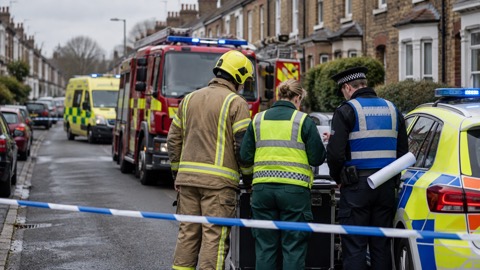
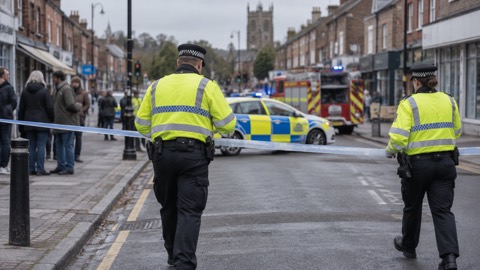
There is no single switch that brings in the military. What usually happens first is that an incident escalates. A civil emergency can be declared by the police or fire service when the situation surrounding different types of incident escalates to involve large numbers of people or a major threat to many properties4. That declaration is a civilian decision, made by the emergency services, and it is the point at which the response shifts into a co-ordinated, multi-agency effort. You can read more about this in our guide to what it means when a major incident is declared.
The clearest recent UK example of the full sequence is Storm Arwen, which hit parts of northern England and Scotland in late 2021. Thousands of homes lost power for days in cold weather, and local resources were stretched beyond capacity. Durham County Council submitted a request for Military Assistance to Civil Authorities, which was approved by the Department for Levelling Up, Housing and Communities on Thursday 2 December 20212. Two things are worth noting from that example. First, the request came from the council, a civil authority. Second, it was approved by a government department, showing that MACA requests pass through central government rather than being a local or military decision alone.
The timing of military involvement also depends on how long the emergency lasts. Community groups responding alongside the official effort after Storm Arwen mostly provided support for around three to seven days, with the longest running to 21 days2. Some infrastructure emergencies run far longer: the government's risk planning notes that in a reasonable worst-case scenario affecting electricity infrastructure, it could take 6 to 12 months for the affected infrastructure to be fully repaired, and restoration of affected gas infrastructure could take approximately 3 months9. Military support in a very long emergency would be one part of a much wider government response, not a permanent presence.
Who asks for military support and who decides
The short answer is that a civil authority asks, and a government department decides. The armed forces do not deploy themselves into a UK emergency. The Storm Arwen example shows the shape of it: the council submitted the request, and the Department for Levelling Up, Housing and Communities approved it2. Around that decision sits the wider structure of who does what in an emergency, and knowing that structure helps you understand who to turn to.
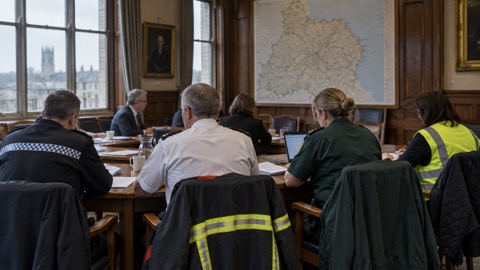
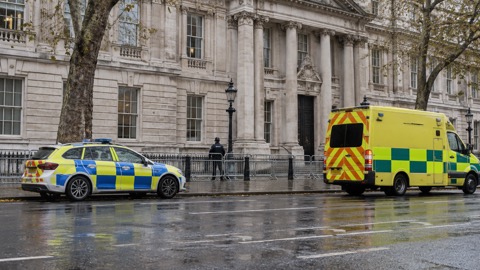
In a major incident, police, fire and ambulance services may all respond, and other organisations may also help, including councils, NHS services and utility companies10. The council's role is distinctive: local authorities are responsible for co-ordinating welfare support for their communities, including rest centres and temporary accommodation where evacuation is extended3. Argyll and Bute Council describes its own principal concerns in an emergency as support for the emergency services, support and care for the local and wider community, and co-ordination of the response by organisations other than the emergency services, such as the voluntary sector5. Surrey County Council similarly notes that in an incident the emergency responders will be supported by the county council, your borough or district council, and other organisations, with support plans prepared and practised in advance11.
| Who | Their role in an emergency | What it means for you |
|---|---|---|
| Police, fire, ambulance | Lead the emergency response; police lead at the scene | Call 999 if you are involved in or witness an emergency12 |
| Your local authority | Co-ordinates welfare: rest centres, temporary accommodation, support for the community3 | Contact the council for shelter, housing and recovery help |
| Utility companies and NHS | Restore services and treat casualties10 | Report outages to the utility, not to the council |
| Voluntary sector | Co-ordinated by the council; practical help and emotional support5 | Look for their calls for support if you want to help |
| Armed forces | Support under MACA where local resources run out1 | Extra capacity, working to the civil authorities |
| Government departments | Approve MACA requests2 and co-ordinate national support | Behind the scenes, but it shapes what arrives locally |
One layer below the principal responders is worth understanding so you do not expect the wrong thing from the wrong body. Town and parish councils are not an emergency service and have no statutory responsibility to plan for, or respond to, emergencies; they are not trained, equipped, empowered or resourced to carry out the functions of an emergency service13. If your village or parish has a community emergency plan, it complements rather than replaces the professional response. Our guide to what your council does before, during and after an emergency covers the local authority role in more detail.
What troops and other responders can do in a flood, storm or other emergency
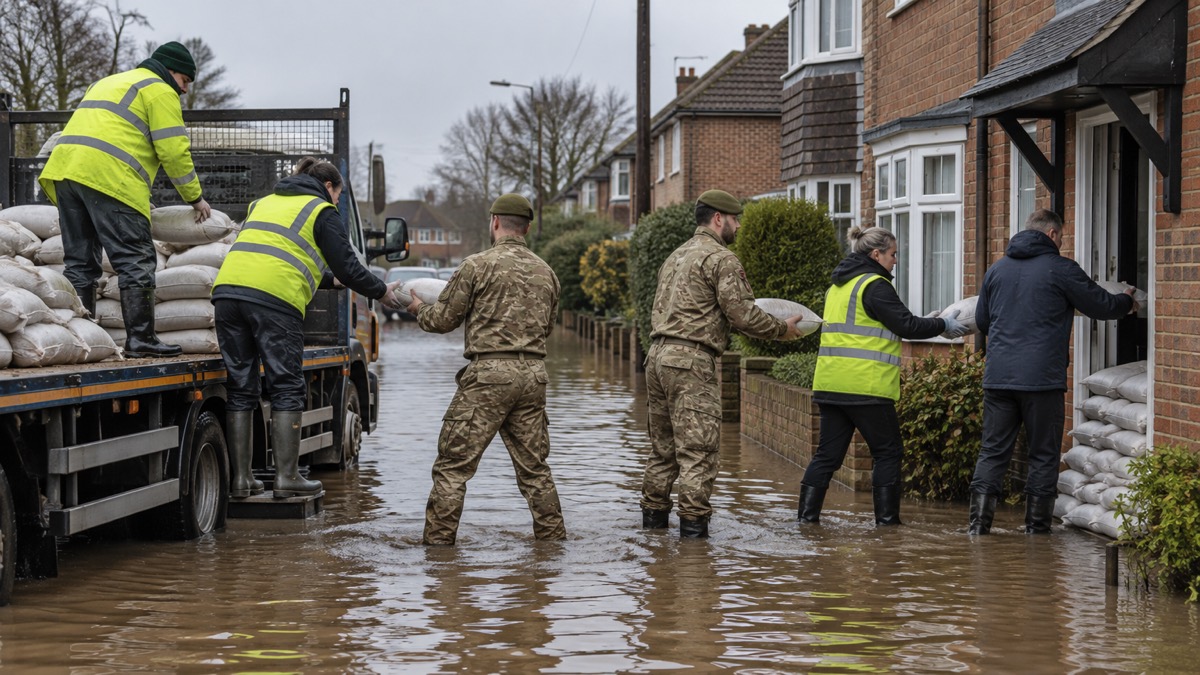
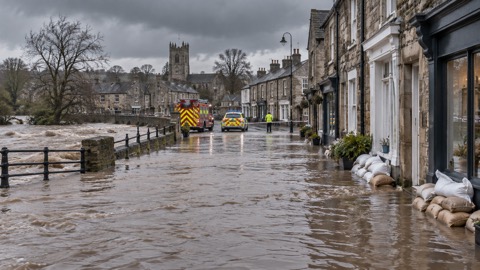
When the armed forces are brought in, they take on tasks the civil authorities assign: the practical, physical work of moving supplies, reaching cut-off communities and supporting the emergency services. To understand what that looks like, it helps to see the jobs that need doing in a flood or storm and who normally does them.
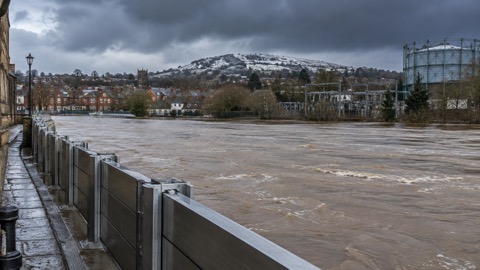
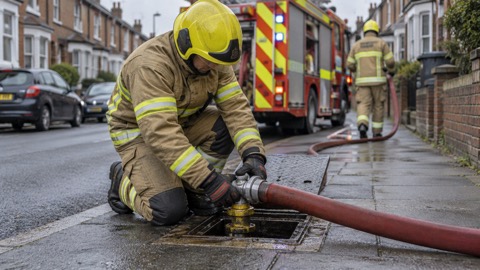
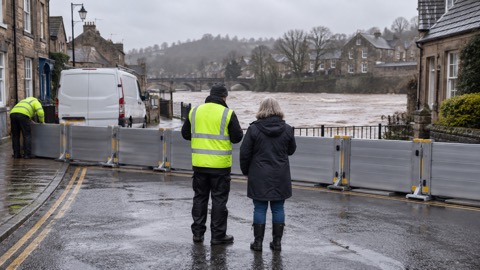
The emergency services provide emergency relief when flooding occurs and can co-ordinate evacuations15. During severe flooding, local authorities work with the emergency services and co-ordinate shelter for people evacuated from their homes16. The London Fire Brigade describes its flood response as including helping people to safety, typically also assisting other services such as the police, ambulance and environmental health, and keeping hospitals, prisons and essential services like gas and electricity functional in floods17. The Brigade is clear about one boundary in its own work: "We don't undertake underwater rescues or searches, this is conducted by the police"17. That division of labour, each service doing what it is trained and equipped for, is exactly the pattern military support follows when it arrives.
Alongside the professional services sit trained volunteers, and they are often the help you actually see first:
- Flood wardens can help keep streams and culverts near your home clear if you are unable to do so, provided they are not running fast or deep; contact you if there is a flood risk; keep in touch during a flood; advise where you can get sandbags and deliver them if not busy elsewhere; and support the local authority if it opens a rest centre18.
- Volunteer coastguard rescue officers rescue trapped people, search for missing people and support emergency services during floods19.
- Community Emergency Plan volunteers help keep the community safe where the incident does not pose an immediate threat to life, which can include helping out in a power cut or storm and informing neighbours of a flood warning11.
- The British Red Cross works alongside statutory agencies and voluntary sector partners, providing practical help and emotional support to people and communities affected by emergencies5.
The same principle of working to the civil authorities applies to the armed forces. Troops deployed under MACA do not choose their own tasks and do not take command of the incident. They add capacity: more people, more vehicles, and the ability to work in difficult conditions for sustained periods. If your household needs help, you still ask the same people you would ask in any emergency, the emergency services in a life-threatening situation, and your council for welfare, shelter and recovery.
What the armed forces do not do
The limits matter as much as the capabilities, because they tell you what not to wait for. The armed forces do not replace the police, the fire service, the ambulance service or your council. The police remain the lead service at the scene, and if a civil emergency is declared that affects you, you will be notified by the police4. Military personnel support the response; they do not run it, and the request that brings them in comes from a civil authority and is approved by a government department2.
The same boundaries apply throughout the response system. Each responder does what it is trained and equipped to do, and no more. The London Fire Brigade, for all its flood capability, does not undertake underwater rescues or searches because that is conducted by the police17. Flood wardens, for all their usefulness, cannot stop flooding, cannot rescue you if you are in danger, for which you should call 999, cannot clear gulleys and streams whilst they are in full flow as this is dangerous, and must not go into flood water18. Town and parish councils are not emergency services and have no statutory responsibility to respond13.
For your household, the practical reading of these limits is this: the arrival of troops does not mean every problem is now solved, and it does not create a new service to call. It means the existing services have more capacity. You still call 999 in an emergency12, you still contact your council for shelter and recovery help, and you still follow the instructions of the emergency services and other authorised responders10.
What it means for your household when the military arrives
If military personnel arrive in your area, the effects on your household are the same as in any serious emergency; the troops are one part of the response to them. The effects a civil emergency can have include loss of electricity, telephone, water or gas; short term evacuation from your home; temporary isolation cutting off communities; and damage to your home or nearby buildings4. Preparing for those effects, rather than for the sight of uniforms, is what gets you through. Our getting started guide and the emergency kit guide cover the basics.
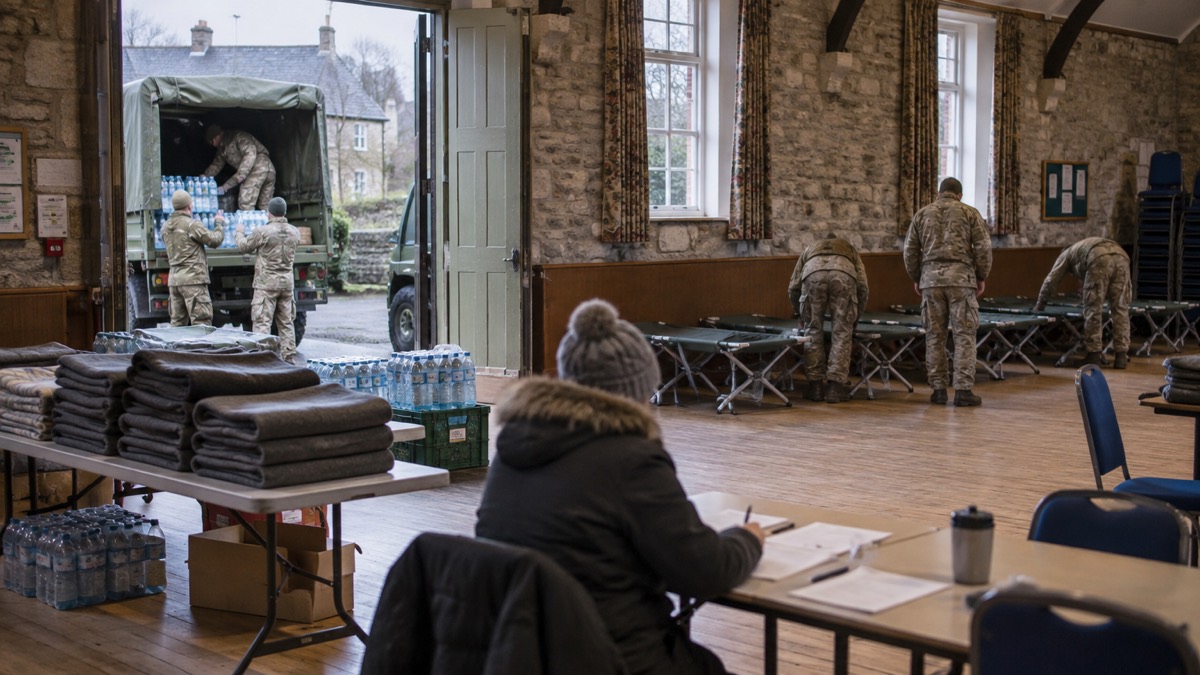
If you are evacuated, the local authority will provide a rest centre for your initial safety and welfare if required20, and if lots of people have to leave their homes, the local authority will provide temporary emergency accommodation8. Where a disaster has caused deaths or serious injury, the police lead the response for families and friends arriving at the scene, including a secure Friends and Family Reception Centre set aside in the immediate aftermath21. For larger or longer incidents, a Humanitarian Assistance Centre may be set up, with lead responsibility sitting with the local authority, in consultation with the police, and staffed by people from a wide variety of organisations; set-up begins within 24 hours and it may be of some months in duration22. You can read more in our guide to what a Humanitarian Assistance Centre is.
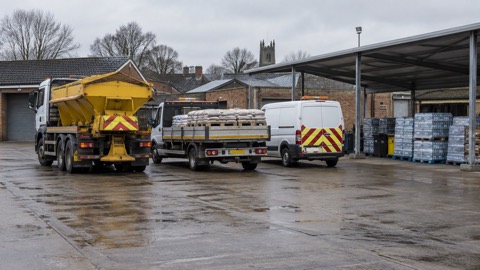
If supplies run short, there are established arrangements. Where a private water supply runs dry, assistance is usually limited to the provision of an emergency supply of bottled water for drinking to overcome the immediate need23. Alternative supplies in a wider emergency can include bottled water, or water supplied in tanks or bowsers15. Where circumstances pose a danger to life or human health, the local authority has power to require the local water company to supply water by means other than in pipes for a specified period3. Troops may be involved in distributing such supplies, but the arrangements and the decisions are civilian.
After the immediate emergency, help continues. Contact your local council if your property is flooded, as there may be assistance available to help you recover and clean up20, and you may be able to get financial support from your local council after a flood24. The emergency services or local authorities will let you know when it is safe to go home and will provide information about specific actions you should take when returning25. If you have nowhere to stay, your local council may be able to help with emergency housing26. Our guide to who houses you if an emergency leaves you homeless covers this in detail.
Following official advice and emergency alerts during military support
Whatever responders are on the ground, including troops, the instruction to your household is the same: follow official information. In an emergency, pay attention to official sources of information such as the websites and social media accounts of local authorities, government agencies or emergency services, or messages to your mobile phone from the UK Government Emergency Alerts Service6. The Emergency Alerts service was launched in December 2023 to issue alerts to compatible smartphones when there is an imminent threat to life. Alerts can be sent by the UK Government, the Scottish Government or other public bodies that deal with emergencies, for example the police or your local council27.
The standard public advice for a major incident is consistent across sources. West Midlands Ambulance Service's major incident guidance for the public is to move to a place of safety if it is safe to do so, follow instructions from emergency services and other authorised responders, avoid the incident area unless advised it is safe to enter, and follow official updates from emergency services and local authorities10. Belfast City Council's advice adds the two rules that matter most: follow the advice of the emergency services, and don't put yourself or others in danger7.
"Move to a place of safety, if it is safe to do so. Follow instructions from emergency services and other authorised responders."
In Scotland, the national readiness campaign advises checking official sources including websites and social media accounts of emergency services, government agencies and local councils, plus local radio, TV and the internet27. The same campaign advises households to know who to contact if flooding happens16. If you are at the scene of an emergency and it is safe to do so, you could play a vital role by providing first aid, comfort and support while waiting for the emergency services to arrive6. Our staying informed guide covers how to keep information flowing when networks are strained.
Volunteering alongside the armed forces
Seeing the response in action often makes people want to help. The right way to do that is to join the organised effort, not to turn up at a cordon. The national guidance is to join or support a local volunteering or community group before an emergency happens, such as a local charity, a flood action group or a Neighbourhood Watch28. During an emergency, if you would like to help, look out for calls for support from local community groups and your local councils; in some emergencies calls for support may come from national government or national voluntary organisations6.
There are established routes into organised volunteering, all of which provide training:
- Community First Responders support their local community by attending emergency calls ahead of an ambulance19.
- Fire and emergency support service volunteers receive all necessary training, including working with the fire service at the scene of an incident, first aid and assisting people with disabilities; completing all essential training may take about 40 hours in total29.
- You can become a volunteer with Greater Manchester Fire and Rescue Service and help keep communities safe by delivering informative, educational and practical support28.
- Flood warden schemes, such as the one covering Crickhowell and surrounding villages, train volunteers to support households before, during and after a flood18.
The voluntary sector is co-ordinated into the official response rather than acting separately. The Voluntary and Community Sector Emergencies Partnership, a voluntary sector-led partnership, exists to bring together member organisations to deliver a more coordinated response to emergencies30. In Argyll and Bute, Argyll Voluntary Action has staff and volunteers in each of the main centres of population and can offer support, with availability depending on capacity in any specific location and on the nature of the emergency5. During an emergency or crisis, the public can help, if it is safe to do so, by checking on neighbours and vulnerable people in the community to see if they need any help or assistance9. Our community resilience guide goes into this in depth.
Where to get help and information in an emergency
The places to turn are the same whether or not the armed forces are involved. In a life-threatening emergency, if you are involved in an emergency or witness to it, dial 999 and alert the police, fire, ambulance or coastguard service12. For everything else, your first port of call is your local council: for rest centres and temporary accommodation if you are evacuated8, for recovery assistance and clean-up help after flooding20, for possible financial support after a flood24, and for emergency housing if you have nowhere to stay26.
For information rather than help, use official sources: the websites and social media accounts of emergency services, government agencies and local councils, plus local radio, TV and the internet27, and emergency alerts to your mobile phone6. If a civil emergency is declared that affects you, you will be notified by the police4. After the emergency passes, the emergency services or local authorities will tell you when it is safe to go home and what to do on returning25, and you should seek support if you need it once home25. Public Health Wales advises that when helping someone affected by flooding, you should check that there are no immediate physical health needs, for example they may require an ambulance or a hospital visit31.
Some emergencies bring specific help lines and arrangements. In a national medicine shortage, the government works with medicine suppliers and the NHS to manage supply issues and ensure that shortages have as little impact on patients as possible32. Households that need extra help, such as older, disabled or medically dependent people, should be on their utility's priority register; see our extra help guide. And if you want to understand the wider system that decides when help of any kind arrives, our guides to how central government responds and local resilience forums explain it.
Sources (32)
- National Risk Register, HM Government, 2020
- Storm Arwen Review, Durham County Council, 2022
- National Recovery Guidance: Humanitarian Aspects, HM Government, 2013
- Preparing for Civil Emergencies in Argyll and Bute, Argyll and Bute Council, 2026
- Roles and Responsibilities of Emergency Responders, Argyll and Bute Council, 2026
- Be Informed About Hazards, UK Government Prepare Campaign, 2026
- Emergency Advice, Belfast City Council, 2026
- Evacuating Your Home, Nottinghamshire County Council, 2026
- 2023 National Risk Register, HM Government, 2023
- Major Incidents: Public Advice, West Midlands Ambulance Service NHS Foundation Trust, 2026
- How Emergency Services Can Help, Surrey County Council, 2016
- Protecting Your Family, Essex Prepared, 2026
- Community Resilience, Nottinghamshire County Council, 2026
- Community Resilience in Herefordshire, Herefordshire Council, 2026
- Flooding: Developing Our Knowledge, Scottish Environment Protection Agency, 2026
- Responsibilities for Flooding, Scottish Environment Protection Agency, 2026
- Flood Response: Techniques and Procedures, London Fire Brigade, 2026
- Adverse Weather Events and Flood Wardens, Llangattock Community Council, 2026
- Volunteering and Helping Others, UK Government Prepare Campaign, 2026
- Don't Panic, Prepare Booklet, West Yorkshire Prepared, 2020
- Emergency Plan: Reception Centres, Reigate and Banstead Borough Council, 2026
- Reception Centres and Humanitarian Assistance, Cornwall Council, 2026
- Private Water Supplies, Argyll and Bute Council, 2026
- What to Do After a Flood, HM Government, 2026
- Step 3: Recovering from an Emergency, Essex Prepared, 2026
- Financial Help After a Fire, HM Government, 2026
- Find and Share Information in an Emergency, Scottish Government Ready Campaign, 2026
- Prepare Your Community, Greater Manchester Combined Authority, 2026
- Fire and Emergency Support Service, Warwickshire County Council, 2026
- National Risk Register Annex F, City of York Council, 2023
- Flooding and Health, Public Health Wales, 2026
- Advice for Patients During a Medicines Shortage, NHS Specialist Pharmacy Service, 2025
 30-Day Household Checklist
 Emergency Plan Template
 Supply Interruption Checklist
 National Risk Register
 How Emergency Risks Are Scored
 Civil Contingencies Act 2004
 What Counts as an Emergency
 Category 1 and 2 Responders
 Local Resilience Forums
 Strengthening Local Resilience
 What Your Council Does
 Central Government Response
 Gold, Silver and Bronze Command
 Major Incident Declared
 Emergency Powers