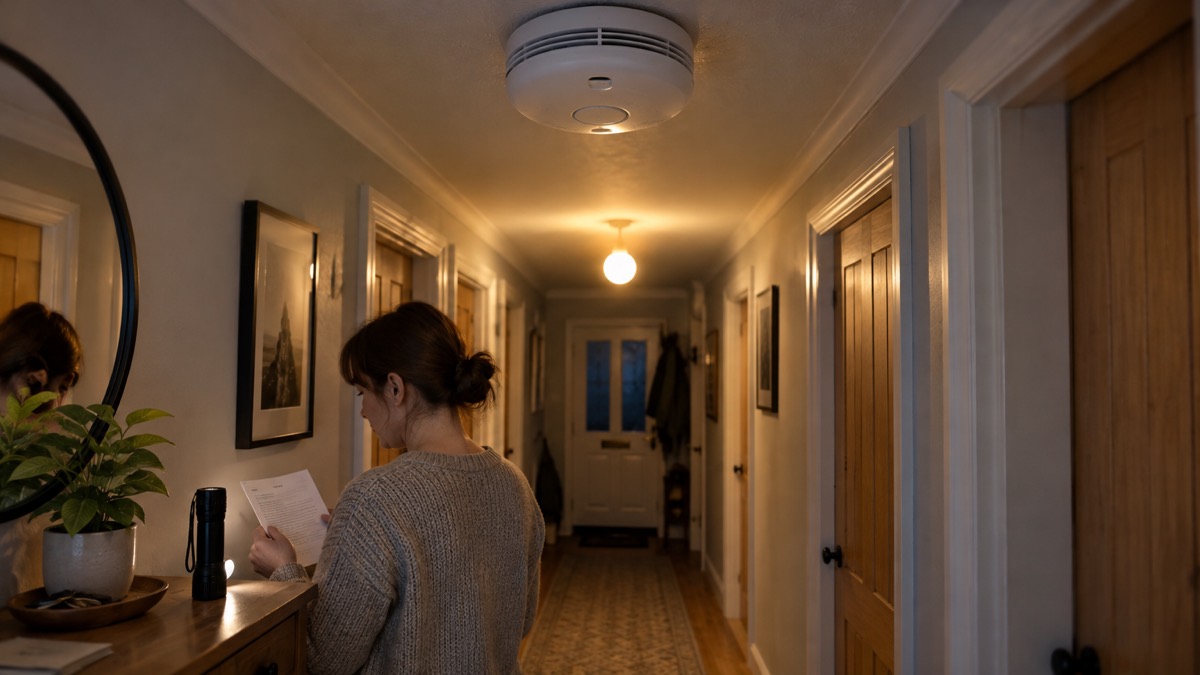
The FireAngel ST-622 is a battery-powered smoke alarm with a sealed lithium battery that the maker says lasts the life of the unit, which it gives as 10 years. It is a standalone alarm: it does not link to other alarms, and it is not designed for kitchens. For a household getting ready for emergencies, its value is simple. It is one of the few pieces of safety kit that works without mains power, without you remembering to change a battery, and without any action beyond a weekly press of the test button. If the power goes out in a storm, or you are asleep during a flood-related outage, it keeps watching for smoke.
The alarm uses Thermoptek sensing, which the maker describes as combining optical sensing with thermal enhancement to give a faster response1. It is certified to BS EN 14604:2005 and related standards1. The maker's product page says the sensor will deteriorate after 10 years and recommends replacing the whole unit then, rather than trying to keep it going2.
This page covers what the ST-622 does, where it suits and where it must not go, how to fit and test it, what to do when it sounds, and how to replace it at end of life. It is written for an ordinary UK household, not for a trade installer.
ST-622 and ST622: one Thermoptek multi-sensor smoke alarm
Searches for "ST-622" and "ST622" both lead to the same product. The maker lists it as the FireAngel ST-622 Thermoptek Smoke Alarm, and the datasheet describes the sensor type as Thermoptek Multi-Sensor3. There is no separate model hiding behind the missing hyphen.
What that means in practice is that the alarm watches for smoke using two methods at once. The maker's manual says Thermoptek technology combines optical sensing with thermal enhancement, providing a faster response1. An optical sensor spots smoke particles; the thermal element responds to the heat a fire produces. Together they are intended to react to a range of fires rather than one type.
The alarm is certified to BS EN 14604:2005, EN 14604:2005+AC:2008 and carries the certification marks 2797-CPR-676744, KM676743 and FSTDOP190011. For a household, the certification matters because it shows the alarm has been tested to a recognised standard, not just assembled to a price. The distributor Safelincs describes the ST-622 as the technology of choice for the UK Fire & Rescue Services3; that is a retailer's claim, not an official statement, so treat it as background rather than a reason to choose this model over another.
The ST-622 is one of a family. The maker's guide notes that an end-of-life ST-622, ST-620 or ST-623E can be swapped for a fit-and-go replacement that uses the same baseplate4. If you already have one of those older units on your ceiling, the baseplate is likely to be reusable, which saves drilling new holes.
Sealed lithium battery: 10 year life
The ST-622 is powered by an internal lithium battery, and the maker describes it as a 10 year life smoke alarm1. The product page goes further, calling it a sealed, tamper proof battery that will last the lifetime of the alarm2. You cannot open the unit and swap the cell.
That design has real advantages for emergency preparedness. A battery you cannot remove is a battery nobody forgets to replace, and it cannot be borrowed for a torch or a toy at the wrong moment. Staffordshire Fire and Rescue Service points households towards alarms fitted with sealed 10 year batteries as an alternative to models with changeable cells5. FireAngel's own guidance for its replaceable-battery units says those need a battery change every 1 to 2 years, depending on the type of battery used6. The sealed unit removes that chore entirely.
The trade-off is that the whole alarm has a shelf life. The maker's product page says the sensor within the unit will deteriorate after 10 years, so it recommends replacing the unit to ensure you are protected2. The battery and the sensor are matched to the same span, so when one reaches its end, so does the other.
The battery is automatically enabled when the alarm is fully locked onto the base plate, and deactivated when the alarm is removed1. That means a new alarm sitting in its box is not draining, and an alarm taken down for decorating is not chirping on a shelf. The datasheet describes this as easy installation with automatic battery engagement on the base plate3.
If the alarm does start to chirp, the manual says it will continue to warn of a low battery condition for at least 7 days, and recommends replacing the alarm immediately, and certainly within 7 days1. On a sealed unit, a low battery warning is effectively an end-of-life notice.
Where the ST-622 is suitable: homes, flats and caravans
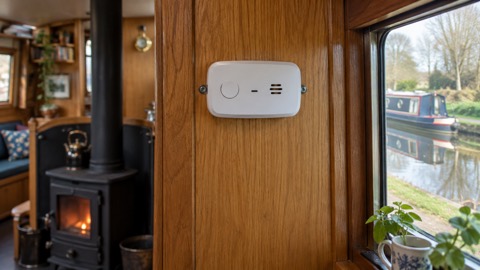
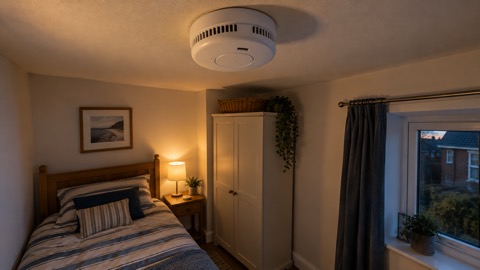
The ST-622 is a domestic alarm. The maker's manual lists it as suitable for mobile homes and caravans, individual flats and bedsits, and individual sleeping or resident rooms in institutions and hotels1. FireAngel's guidance for its battery-powered alarms says this type can be fitted in living rooms, bedrooms, hallways, landings and dining rooms7.
For flats, there is a condition. The manual says the alarm can be used in individual flats and bedsits provided a primary fire detection system already meets regulatory requirements for common areas such as lobbies and corridors1. In other words, your own alarm adds protection inside your front door; it does not replace whatever the building management is required to provide. If you live in a block, it is worth knowing what the building's own system covers before relying on your own unit alone.
| Setting | Suits the ST-622? | What the maker says |
|---|---|---|
| House, bungalow, flat interior | Yes | Living rooms, bedrooms, hallways, landings, dining rooms7 |
| Individual flat or bedsit | Yes, with a condition | Only where a primary system already covers common areas1 |
| Caravan or mobile home | Yes | Listed as suitable for mobile homes and caravans1 |
| Kitchen | No | Reacts to cooking fumes; fit a heat alarm instead2 |
| Shop, office, industrial unit | No | Not intended for non-residential, commercial or industrial use1 |
Caravan owners should note that FireAngel's own FAQ points to specific models for leisure vehicles, naming the FA6611 smoke alarm with escape light and the FA3313 carbon monoxide alarm as suitable for caravans, motorhomes and campervans6. The ST-622 is listed in the manual as suitable for mobile homes and caravans, but if your van is your main concern, the maker's leisure-vehicle guidance is the place to check.
Why it must not go in a kitchen
The ST-622 must not be fitted in a kitchen. The maker is direct: the ST-622 has not been designed to be installed in a kitchen as it will react to cooking fumes, and for fire detection in the kitchen you should fit a FireAngel Heat Alarm2. FireAngel's product FAQ repeats the point for its Multi-Sensor alarms generally, saying they are not recommended for kitchens due to the likelihood of nuisance alarms from cooking fumes8.
Fire and rescue services across the UK give the same advice independently. Dorset and Wiltshire Fire and Rescue Service says it does not recommend fitting a smoke alarm in the kitchen because cooking fumes can set it off9. The service adds that if you would like an alarm in the kitchen it needs to be a heat alarm10. That is not a quirk of one brand; it is how smoke alarms behave around steam, fat and burnt toast.
A nuisance alarm is more than an annoyance. It trains people to ignore the sound, or to take the battery out, which is exactly the wrong response. If you want kitchen cover, a heat alarm responds to temperature rather than smoke and is the type the fire service recommends there. Our guide to heat alarms explains how they differ, and the comparison of heat alarm or smoke alarm sets out which goes where.
Two other things to avoid, both from the maker's manual. Do not paint the smoke alarm, as this may block the openings and prevent smoke from entering the sensor1. And do not use solvents or cleaners on it, as they may cause damage to the sensor or circuitry; wipe it with a slightly damp cloth instead1. The manual also says the alarm should be cleaned once every 3 months using a vacuum cleaner fitted with the soft brush attachment1.
Fitting on the ceiling: no more than 600mm below the highest point
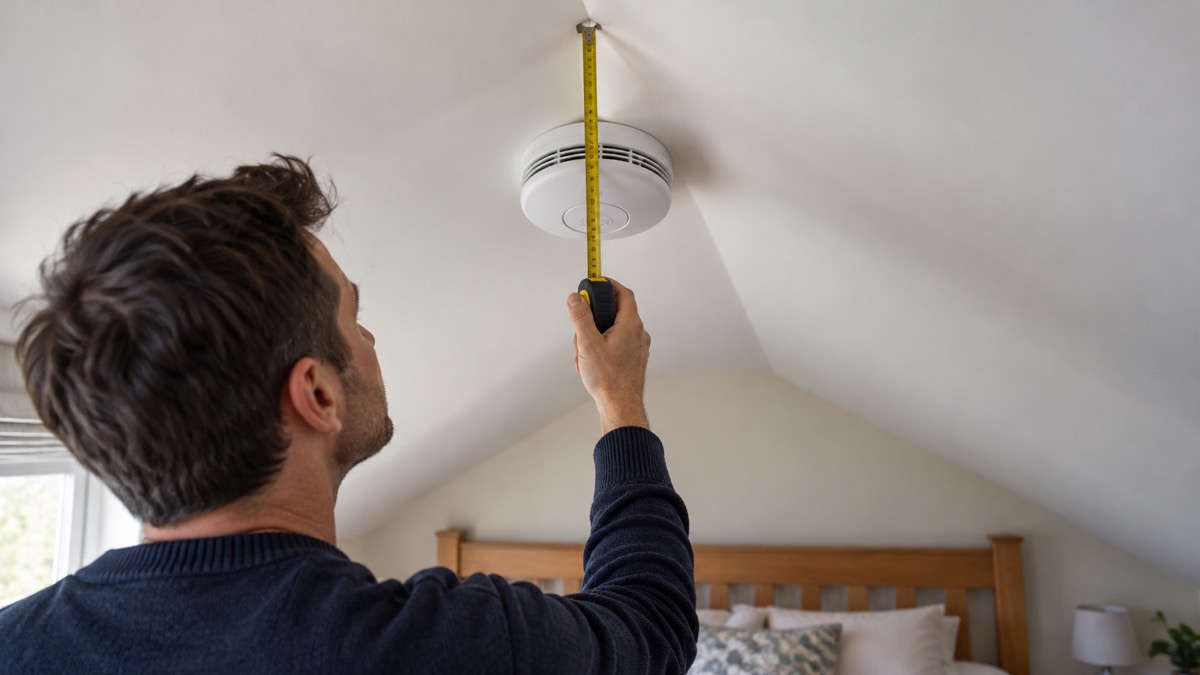
Placement decides whether an alarm works. Smoke rises and pools at the highest point of a room, so the alarm needs to be near that point but not tucked into a dead corner where air does not circulate.
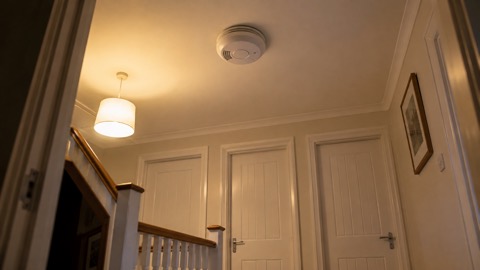
The maker's rule is that smoke alarms should be positioned at no more than 600mm vertically below the highest point in the room1. FireAngel repeats the same figure across its installation guidance for battery and mains alarms7, and its trade guidance says to allow a maximum of 600mm vertically down from the apex on peaked or sloped ceilings12. The same 600mm rule appears in Aico's homeowner guidance13, so it is a general principle rather than a quirk of this model.
Horizontal clearance matters too. The manual says smoke alarms should be sited at least 300mm from light fittings and walls1, and FireAngel's battery-alarm guidance adds that it should be at least 300mm from light fittings and walls, if possible in the centre of the room7. Warwickshire Fire and Rescue Service gives the same advice in older imperial terms: fit the alarm as close to the centre of the room as possible, but at least 30 centimetres (12 inches) away from any wall or light fitting, screwed to the ceiling or with a specialist sticky pad14. Suffolk Fire and Rescue Service's factsheet says alarms should be screwed into the ceiling and normally fitted at least 30cm (12") away from any wall or light fitting15.
If you are mounting on a wall rather than the ceiling, the manual gives a narrower band: the top of the detection element must be between 150mm and 300mm below the ceiling, and at least 300mm from a wall1. Ceiling mounting is the normal choice.
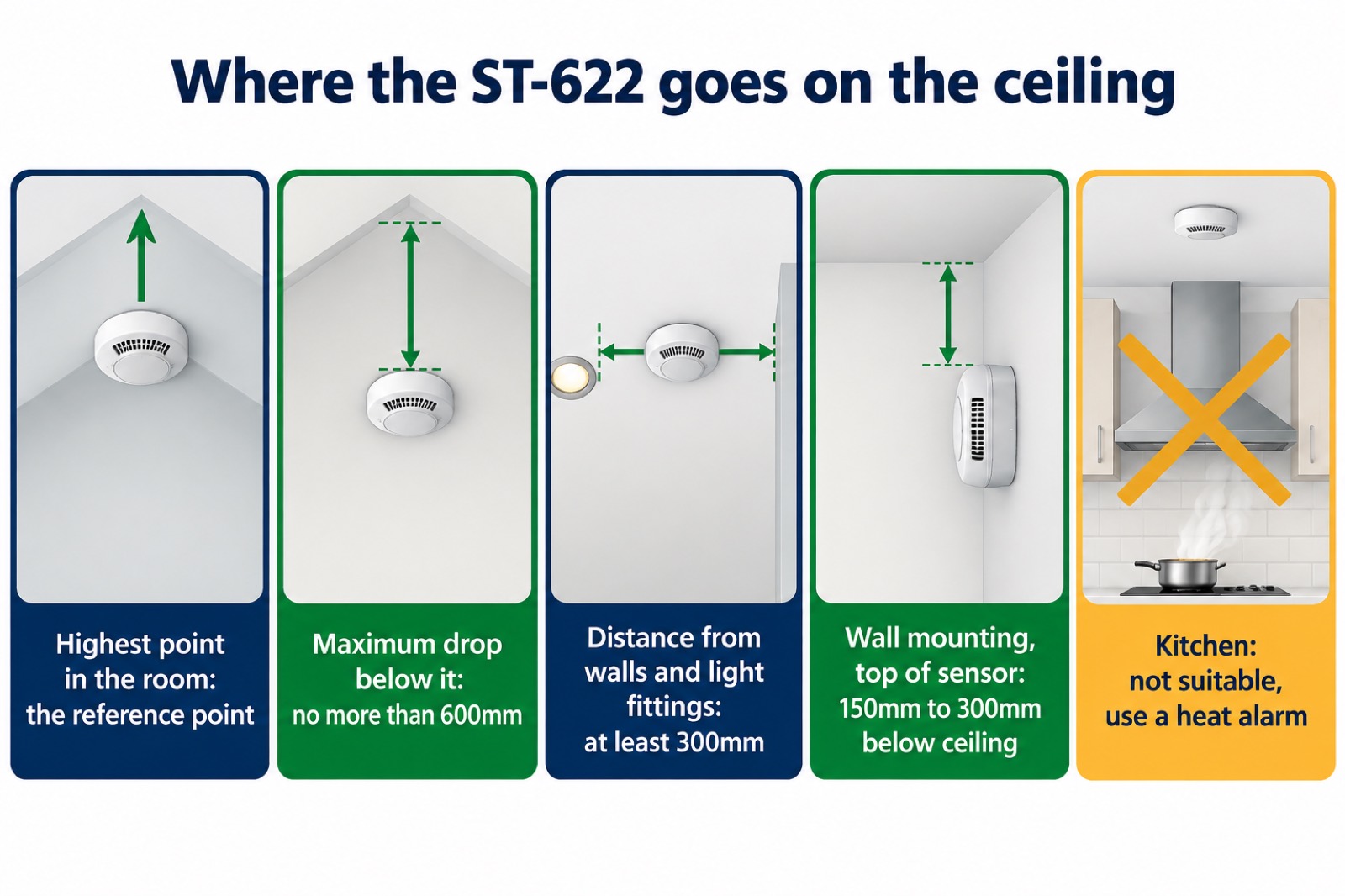
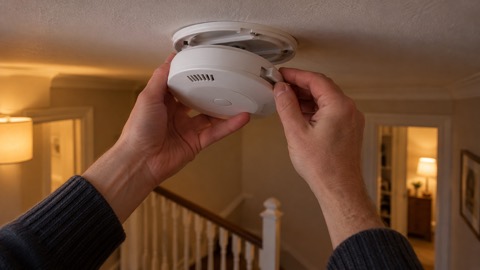
The practical steps are straightforward. Choose a ceiling position near the centre of the room, at least 300mm from any wall or light fitting, and no more than 600mm below the highest point. Fix the baseplate, then twist the alarm onto it until it locks; the battery engages automatically at that point1. Test it once fitted. If you are unsure how many alarms your home needs, our guide to how many smoke alarms and the wider page on where to fit smoke alarms go through it room by room.
Test your smoke alarm every week
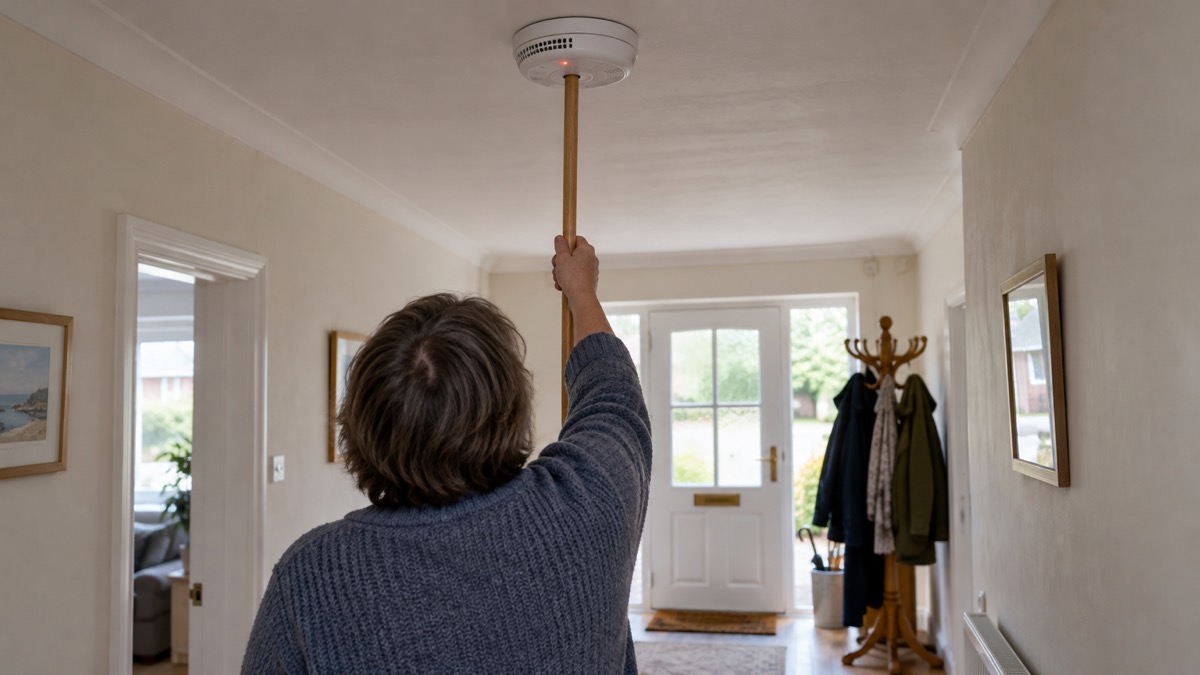
Weekly testing is the single habit that keeps a smoke alarm useful. The maker's manual carries it as a warning: you should test your smoke alarm every week1. Fire and rescue services say the same thing in every part of the UK. South Wales Fire and Rescue Service says to test your alarm weekly16. Essex County Fire and Rescue Service says to test the batteries in your smoke detector every week17. The Northern Ireland government's fire safety guidance uses the STOP Fire message, in which T stands for test those smoke alarms weekly to make sure they're working18. Dorset and Wiltshire Fire and Rescue Service says every home should have a working smoke alarm on each level, tested once a week19, and its working-from-home guidance repeats the weekly test20.
The ST-622 makes this easy. Its product page says the large button allows easy testing with a sweeping brush from the floor below2. That matters for high ceilings, for older residents, and for anyone who should not be climbing on chairs. When you press the test button, the manual says the unit will give an audible alarm consisting of 2 cycles of 3 loud beeps, then stop automatically1. If you hear that, the alarm and its battery are working.
A few habits make weekly testing stick:
- Pick a fixed day, such as bin day or the first of the month, and test every alarm in the house on that day.
- Test after any work near the alarm, after decorating, and after returning from a trip away.
- Vacuum the alarm every 3 months with the soft brush attachment, as the manual instructs1.
- If an alarm does not sound when tested, do not assume it is fine. FireAngel advises consulting the manual, as the battery could be running low or the alarm could be coming to the end of its life and need replacing21.
For more on the routine, see how often to test smoke and CO alarms.
What to do when the alarm sounds
An alarm sounding is an instruction, not a suggestion. The maker's manual is unambiguous: if your smoke alarm activates and you are not absolutely certain of the source of the smoke, get everyone out of the house immediately1.
"If your smoke alarm activates and alarms and you are not absolutely certain of the source of the smoke, get everyone out"
The order of actions is:
- Get everyone out by the nearest safe route. Do not stop to investigate, collect belongings or fight the fire.
- Close doors behind you as you leave where you can do so safely.
- Call 999 from outside the building.
- Stay out. Do not re-enter until the fire service tells you it is safe.
If you are trapped and cannot get out, our guide to what to do if you cannot escape a fire covers sealing yourself into a room and making your presence known. Our page on what to do if a fire starts in your house walks through the same sequence in more detail, and how fire and rescue services respond to a call explains what happens after you dial.
If you are certain the alarm is a false alarm, the ST-622 has a Smart Silence feature. The datasheet says it allows the alarm to be silenced for up to 10 minutes in the event of a known false alarm3, and the manual says the alarm will enter a reduced sensitivity reset cycle for approximately 10 minutes1. During that period the red LED flashes more rapidly than normal, approximately once every second1. Crucially, the datasheet adds that during these 10 minutes, if additional smoke is detected, the alarm will sound3. Silence is a pause, not a disable.
If the alarm is beeping rather than sounding a full alarm, that is a different problem. Our page on why your smoke alarm keeps chirping covers the causes, and how to stop smoke alarm false alarms deals with cooking and steam triggers.
Replacing an end-of-life ST-622 on the same baseplate
When the ST-622 reaches the end of its 10 year life, or its low battery warning will not clear, it is replaced as a whole unit. The good news is that the baseplate usually stays on the ceiling.
FireAngel's homeowner FAQ says to replace an end of life ST-622 alarm with a FireAngel FA6615-R Optical Smoke Alarm with 5 year replaceable batteries or a FireAngel FA6620-R Optical Smoke Alarm with 10 year sealed for life battery, without requiring a new base plate4. The product FAQ gives the same advice22, and the maker's smoke alarm guide says you can swap an end-of-life ST-622, ST-620 or ST-623E for a fit-and-go replacement that uses the same baseplate4. The product page names the FA6620-R or FA6615-R and notes you can fit either without changing the base plate or leaving unsightly holes in your ceiling2.
The maker's guidance on its FireAngel One range adds a condition: those smoke, heat and Combi alarms use the same MP7 baseplate as many existing fire alarms, including the ST-622, FA6620-R or FP2620W2-R, provided the baseplate is in good condition and has been correctly installed4. So check the baseplate before assuming a straight swap. If it is cracked, discoloured or was fitted badly, replace it.
| Replacement | Battery arrangement | Baseplate |
|---|---|---|
| FireAngel FA6615-R | 5 year replaceable batteries | Same baseplate, no new one needed4 |
| FireAngel FA6620-R | 10 year sealed for life battery | Same baseplate, no new one needed4 |
The choice between them is a matter of routine. The FA6615-R needs a battery change every few years; the FA6620-R does not, but the whole unit still has a life span. Our comparison of sealed 10 year or replaceable battery alarms sets out the trade-offs, and when to replace a smoke, heat or CO alarm covers the timing.
Once the new alarm is on the baseplate, test it. FireAngel's guidance for reattaching an alarm says to remove it from the base plate, reattach it, then test it twice; if you hear three beeps it is fitted correctly, and if it does not sound or keeps flashing amber or chirping, replace it or contact Customer Support if it is under warranty23. That guidance is written for mains-powered alarms, but the principle of testing after fitting applies to any alarm.
Support, warranty and where to get help
FireAngel publishes a full manual and datasheet for the ST-622, and its support pages cover installation, testing and beeping alarms1. If an alarm misbehaves, the maker's first advice is to consult the manual, because a beep when not being tested can mean a low battery or an alarm at the end of its life21. The maker's page on how to stop a FireAngel alarm beeping is the place to start for its own products.
For households where someone is deaf or hard of hearing, a standard smoke alarm may not be enough on its own. Dorset and Wiltshire Fire and Rescue Service suggests considering interlinked smoke alarms that connect to the telecare, carecall or lifeline system24. The government's fire safety guidance for people with sight, hearing or mobility difficulties notes that you can have linked alarms installed so that when one alarm detects a fire, they all go off together25, and Suffolk Fire and Rescue Service's home safety guidance makes the same point, adding that linked alarms are useful in a large house or over several levels26. The ST-622 is not one of those; it is standalone. Our page on smoke and CO alarms for deaf and hard of hearing people covers the alternatives.
If you want alarms that all sound together, the maker advises having them interlinked so that if one alarm sounds, they all sound11, and notes that every alarm on the system needs to be interlinked with alarms from the same range23. Our guide to interlinked alarms explains how linking works, and wireless or wired interlinked alarms compares the two approaches.
For a household building a fire plan around this alarm, the wider home emergencies section covers escape plans, kitchen fires, electrical fires and more. A working alarm on each level, tested weekly, is the foundation; an escape plan and a fire safety checklist make sure everyone knows what to do when it sounds.
Sources (26)
- FireAngel ST-622 User Manual, FireAngel, 2024-09
- FireAngel ST-622 Thermoptek Smoke Alarm product page, FireAngel, 2026-08-21
- FireAngel ST-622 Data Sheet, FireAngel, 2024-09
- FireAngel Homeowner FAQs, FireAngel, 2026-11-02
- Smoke alarms, Staffordshire Fire and Rescue Service, 2026-10-29
- FireAngel FAQs, FireAngel, 2026-11-02
- Installing your battery powered smoke alarm, FireAngel, 2024-10-16
- FireAngel Product FAQs, FireAngel, 2026-10-29
- Kitchen safety, Dorset and Wiltshire Fire and Rescue Service, 2026
- Smoke alarms, Dorset and Wiltshire Fire and Rescue Service, 2026
- Installing a mains powered smoke alarm, FireAngel, 2024-08-27
- The different types of fire alarms and where to install them, FireAngel, 2024-08-27
- Where to put smoke alarms, Aico, 2023-11-01
- Smoke alarms, Warwickshire County Council, 2026-10-29
- Smoke alarms factsheet, Suffolk Fire and Rescue Service, 2014-01-09
- Smoke alarms, South Wales Fire and Rescue Service, 2026-08-20
- Home safety advice, Essex County Fire and Rescue Service, 2026-10-29
- Fire safety and prevention, nidirect, 2025-06-09
- Keep looking if you're cooking: fire safety warning, Dorset and Wiltshire Fire and Rescue Service, 2018-10-01
- Working from home, Dorset and Wiltshire Fire and Rescue Service, 2021-01-04
- Maintaining and testing your FireAngel smoke alarm, FireAngel, 2024-08-27
- FireAngel smoke alarm guide, FireAngel, 2026-07-15
- How to stop a FireAngel alarm beeping, FireAngel, 2024-08-27
- Hearing and sight difficulties, Dorset and Wiltshire Fire and Rescue Service, 2025-11-19
- Fire safety for people with sight, hearing or mobility difficulties, HM Government, 2021-11
- Fire safety in the home, Suffolk Fire and Rescue Service, 2021-11

 FireAngel FA3313 CO Alarm
 FireAngel FA3322 CO Alarm
 FireAngel FA3820 CO Alarm
 FireAngel FA6812 CO Alarm
 FireAngel FA6813 CO Alarm
 FireAngel FA6829S CO Alarm
 FireAngel CW1-PF CO Alarm
 FireAngel W2-CO-10X CO Alarm
 FireAngel FP1820W2-R CO Alarm
 FireAngel FP2620W2-R Alarm
 FireAngel ST-632 Smoke Alarm
 FireAngel ST-750 Smoke Alarm