
The EcoFlow DELTA Pro 3 is a large portable power station: a battery in a wheeled case that you charge from the mains and then plug appliances into when the power is off. EcoFlow gives its capacity as 4096Wh, its continuous output as 4000W, a surge of 8000W and a 6000W X-Boost figure for appliances that need more than their rated draw to start1. It is a serious piece of household kit rather than a camping accessory, and it weighs 51.5 kg1.
For an ordinary household, the practical questions are what it will run, how you keep it charged, and whether you can physically move it when the lights go out. This page sets out the maker's own specifications and instructions so you can judge whether it suits your home, and how to use it without taking risks with the battery, the wiring or the weather.
What the DELTA Pro 3 is and who it suits
A portable power station is a rechargeable battery pack designed to deliver electricity where you need it, with AC sockets, USB ports and DC outlets built in4. The DELTA Pro 3 follows that pattern at the top end of the domestic range: EcoFlow lists it with a 4kWh capacity, 4000W output and an LFP battery2. LFP, or lithium iron phosphate, is one of the two chemistries now common in these units, the other being lithium-ion5.
The capacity figure is the one that decides what the unit is for. Guidance from Machine Mart puts units over 1000Wh in the bracket for home backup, powering tools or running appliances such as fridges, while 200 to 500Wh units suit phones, laptops and small lights6. At 4096Wh the DELTA Pro 3 sits well above that line, which is why it is sold as home backup rather than camping kit. It is also why it is heavy and expensive in space: this is a unit you site in one place and wheel out when needed, not one you carry up a ladder.
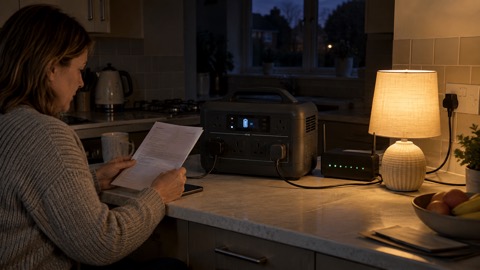
It suits a household that wants to keep a fridge, a freezer, lighting, broadband and phone charging going through a long outage, and that has somewhere dry and ventilated to keep it. It is more than a small flat needs, and its weight makes it a poor choice for anyone who could not move it safely alone. If you are still working out what you need to keep running, start with deciding what to keep running when the mains fails and the wider guide to portable power stations.
Output: what 4000W will actually run
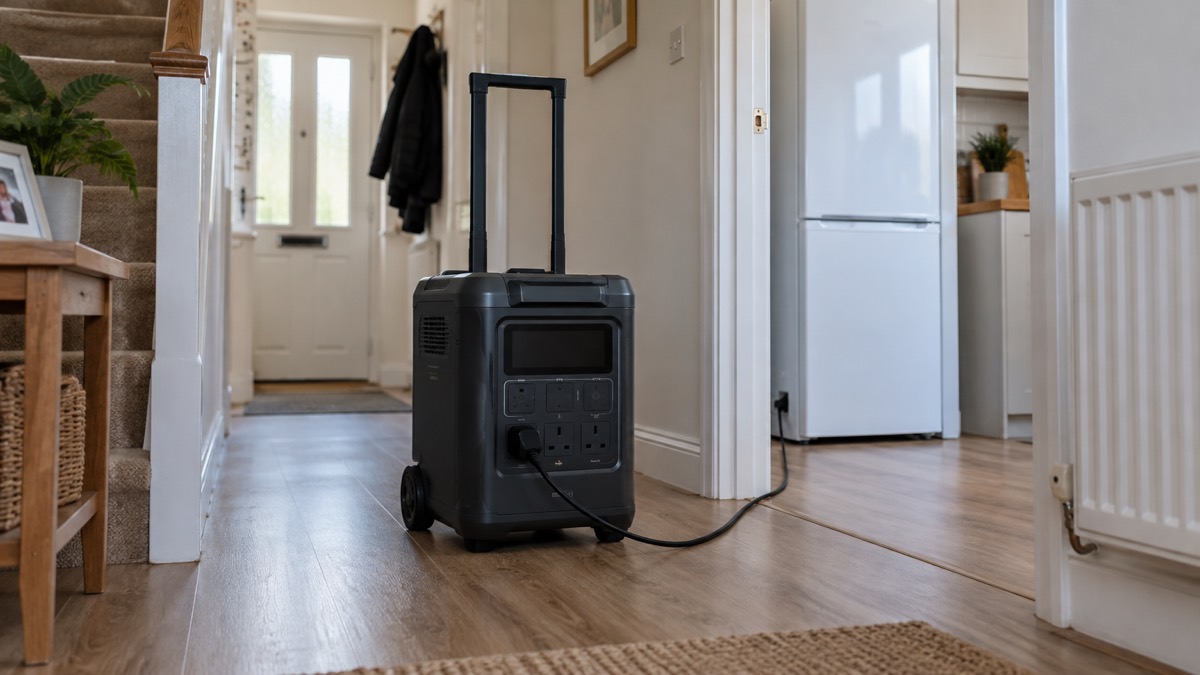
EcoFlow rates the DELTA Pro 3 at 4000W continuous output, with a surge of 8000W and X-Boost up to 6000W1. The distinction matters. Continuous output is the power the unit can supply steadily; surge output is the higher short-term capacity that covers the initial spike when a motor starts up7. A fridge compressor, a freezer or a pump draws a brief spike well above its running figure, and the 8000W surge is there for that moment.
X-Boost is a different mechanism: EcoFlow says the 4000W output powers high-demand appliances from washing machines to EV chargers, and that X-Boost surges to 6000W when needed2. The maker lists the maximum device power supported by X-Boost as 6000W1. Treat that as the maker's claim for appliances that would otherwise trip the unit, not as a licence to run everything at once.
The unit has five AC outlets, two USB-C ports at up to 100W, two USB-A ports at 18W maximum, and 12V DC outputs totalling 378W1. That spread is what makes it useful in an outage: you can run the fridge from an AC socket while phones and a router charge from USB.
| Output | Rating | What it suits |
|---|---|---|
| AC outlets (5) | 4000W maximum, 8000W surge1 | Fridges, freezers, lighting, broadband, small appliances |
| X-Boost | 6000W maximum device power1 | Appliances that need a boost to start |
| USB-C (2) | 100W maximum1 | Laptops, tablets, phones |
| USB-A (2) | 18W maximum1 | Phones, small devices |
| 12V DC | 378W total1 | Car-style accessories, router, radio |
Two cautions. First, a power station is not always suited to high-draw tools such as table saws, air compressors or large angle grinders, and the battery can drain quickly under sustained heavy loads5. Second, the total you draw is limited by the battery, not just the inverter: a 4096Wh battery running a 4000W load will not last an hour. For the arithmetic, see watts, watt-hours and surge explained and how long a power station will run a fridge or laptop.
Charging from the mains, solar, a car or a generator
EcoFlow gives the mains charging input as 200-240V at 12.5A, 2900W maximum1. The headline claim is a charge from 0 to 80% in just one hour3. That speed is the reason a unit this size can be practical: you can top it up in the window before a forecast storm, or during a lull in an outage if the mains returns briefly.
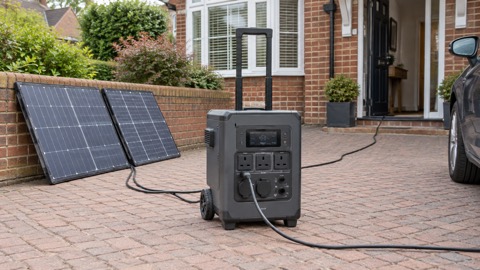
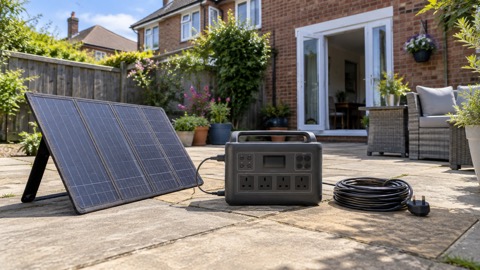
Solar charging is rated at 2600W across two ports: a high-voltage port at 30-150V and 15A, 1600W maximum, and a low-voltage port at 11-60V and 20A, 1000W maximum1. EcoFlow sells the unit bundled with a 400W folding panel as a solar generator, quoting 2600W solar input alongside the 4kWh capacity and 4000W output8. The maker also quotes 99% MPPT efficiency for that panel, which is the tracking efficiency of the charge controller rather than a promise about British weather8.
Car charging is slower: EcoFlow lists a 12V input at 8A maximum and a 48V input at 20A maximum1. Combined charging from several sources at once can reach up to 7000W, according to the maker3.
For panel sizing and realistic UK charging times, see what size solar panel you need and how long solar charging takes in the UK. If you are charging from a vehicle, car charging covers the limits.
Adding extra batteries: up to 12kWh
The DELTA Pro 3 accepts up to two extra batteries, which takes capacity from 4kWh to 12kWh2. EcoFlow names the compatible units as the DELTA Pro 3 Smart Extra Battery and the DELTA Pro Smart Extra Battery1. Each extra battery holds 4096Wh and weighs 33 kg1.
The connection is by a dedicated DC port rather than a mains lead: the extra battery has an input port rated 40V-58.4V at 80A maximum and an output port rated 40V-58.4V at 100A maximum9. EcoFlow describes the arrangement as connecting in parallel to expand capacity up to 12kWh1. In practice you are buying run time, not more sockets: the output limits of the main unit still apply.
| Configuration | Capacity | What changes |
|---|---|---|
| Main unit alone | 4096Wh1 | Base run time |
| Main unit plus one extra battery | 8192Wh | Roughly double the run time |
| Main unit plus two extra batteries | 12kWh2 | Maximum expansion |
The extra battery has its own charging temperature range of 0°C to 45°C and a discharge range of -10°C to 45°C9. EcoFlow also lists a refurbished version of the Smart Extra Battery, which the maker's page marks as members-only10.
If you are weighing up whether to expand a power station or invest in fixed storage, home battery storage sets out the difference.
Weight, size and moving a 51.5 kg unit
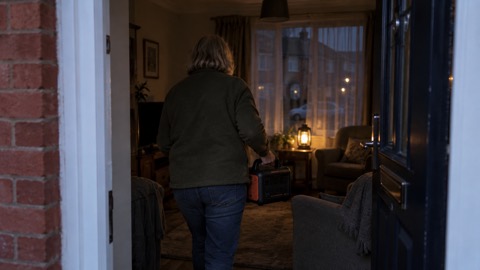
The main unit weighs 51.5 kg (113.54 lb) and measures 693 by 341 by 410 mm1. That is heavy enough to need planning. Two adults lifting a 51.5 kg box is a back injury waiting to happen; the unit is designed to be wheeled, and it should be kept somewhere it can be moved without lifting.
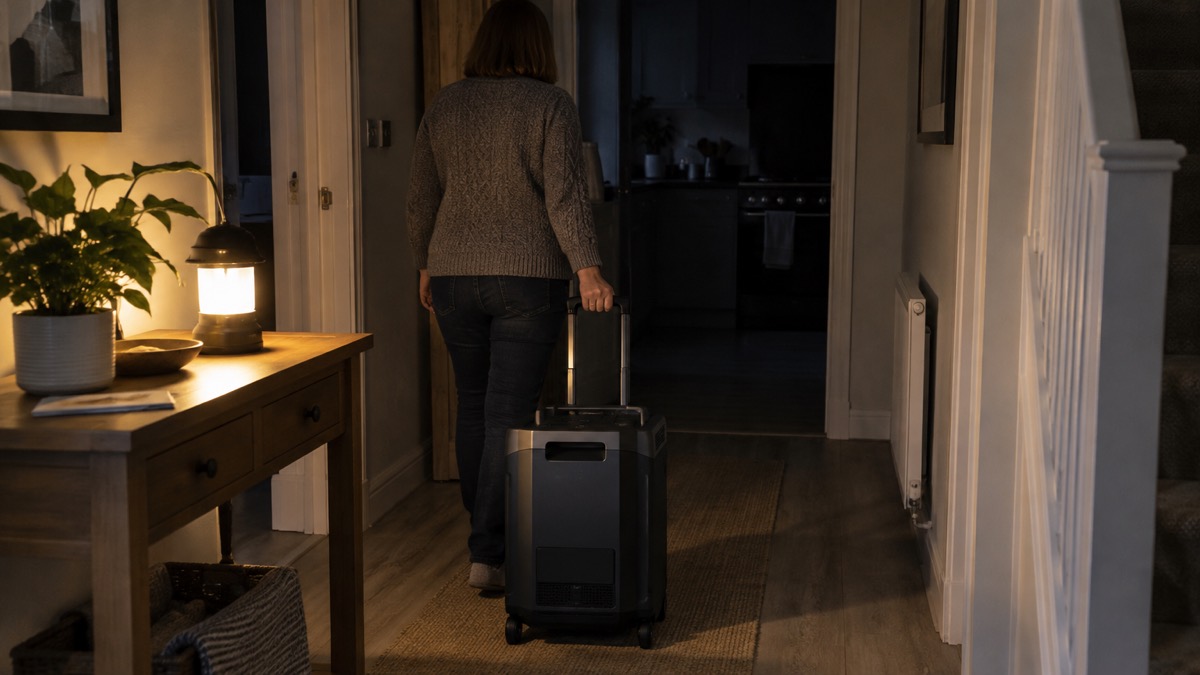
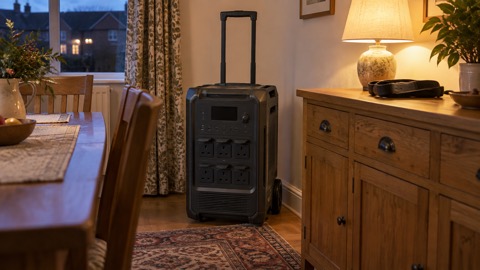
Think about the route before you buy. A unit this size needs a level floor, a door wide enough to pass through, and a storage spot that is dry, ventilated and within reach of the appliances it will serve. EcoFlow recommends a long-term storage temperature of 20°C to 30°C and an optimal operating temperature of 20°C to 30°C1. A damp shed or a freezing garage is the wrong home for it.
The extra batteries add 33 kg each1. Two of them plus the main unit is a stack of equipment that needs a permanent, stable position, not a cupboard you empty in the dark. For more on siting and seasonal checks, see how to store a power station when not in use and the backup power checks before winter.
Using it safely: rain, heat, GFCI and the app
EcoFlow states that the device is suitable for use in well-ventilated indoor environments or sheltered outdoor environments, to avoid the impact of rain and dust on the device1. The battery pack carries an IP65 waterproof and dustproof rating, but the main unit is IP20, with no waterproof and dustproof rating1. That combination is easy to misread: the cells are protected, the unit as a whole is not. Keep it out of the rain.
On electrical protection, EcoFlow says the unit is equipped with an internal GFCI ground circuit, and that users can connect an external GFCI protector, but the GFCI support switch must be turned on in the app for the external protector to function properly1. If you are using the unit outdoors under cover, or in a garage, that app setting is worth checking before you rely on it.
The unit also has a battery management system that EcoFlow says monitors 40 safety indicators 24/7, providing warnings and active protection around the clock, inside a UL-certified 5VA grade fireproof shell1. Those are maker claims about the product's design, not a substitute for sensible placement: keep it away from flammables, do not block its vents, and do not charge it on a soft surface.
For the wider picture on using backup power during an outage, including what not to plug in, see using generators and power stations during an outage. If you are thinking about wiring the unit into your house circuits, read connecting a generator or battery to your home's wiring first: this is not a plug-and-play job.
Warranty, battery life and support
EcoFlow offers a 5-year warranty across the board on the DELTA Pro 31. The battery is rated for 4000 cycles to 80% capacity1. The maker's test conditions are specific: after 4000 cycles at a rate of 0.5C/0.5C at 25°C, the battery maintains over 80% of its state of health1. In ordinary terms, that is a long service life if the unit is kept at reasonable temperatures and not cycled hard in the cold.
The chemistry is LFP2, which is the longer-lived of the two common lithium chemistries used in these units5. Machine Mart's buyer guidance notes that most units last several years with proper care, offering hundreds of charge cycles4; the DELTA Pro 3's maker figure is far higher, but it depends on the test conditions quoted above.
Support runs through EcoFlow's own channels and app. The unit connects over Wi-Fi at 2.4GHz, Bluetooth and CAN1, and EcoFlow lists compatible accessories including the EcoFlow 800W Alternator Charger, the EcoFlow Smart Generator (Dual Fuel), the DELTA Pro to Smart Generator Adapter, the PowerInsight Home Energy Manager, the WAVE 2 and the DELTA Pro Smart Extra Battery, noting that all devices need the latest firmware for compatibility1.
If Bluetooth or Wi-Fi will not connect, EcoFlow's reset procedure is to switch the unit off and press and hold the power button for more than 5 seconds; the LCD lights up and blinks once to confirm the Bluetooth connection has reset1. If it does not blink once, repeat it.
Where the DELTA Pro 3 fits in a household plan
The DELTA Pro 3 is a 4096Wh battery with a 4000W output, expandable to 12kWh, that will run the core of a home through a long outage if you can house it, move it and keep it charged1. It is not a generator: it stores energy rather than making it, so its usefulness depends on how you refill it, from the mains before an event, from solar during it, or from a car.
Before you buy, work out what you actually need to keep running, then match the capacity to that list. The power cut backup power checklist and what capacity power station you need will get you there. If you are comparing a battery with a fuel-burning alternative, portable power station or petrol generator sets the two side by side.
EcoFlow's own range is covered on the EcoFlow brand page, and the wider subject on backup power at home.
Sources (11)
- EcoFlow DELTA Pro 3 product page, EcoFlow, 2026-10-25
- Portable power stations, EcoFlow, 2026-10-25
- EcoFlow DELTA Pro 3 portable power station, EcoFlow, 2026-10-25
- Portable power station buyers guide, Machine Mart, 2026-10-25
- Can a portable power station run power tools?, Machine Mart, 2026-10-25
- How to choose a portable power station: 6 key tips, Generators Direct, 2026-06-19
- Portable power stations camping, EcoFlow, 2026-10-25
- EcoFlow DELTA Pro 3 Solar Generator (PV400W), EcoFlow, 2026-10-25
- EcoFlow DELTA Pro 3 Smart Extra Battery, EcoFlow, 2026-10-25
- EcoFlow DELTA Pro 3 Smart Extra Battery (Refurbished), EcoFlow, 2026-10-25
- Portable power stations vs generators, Machine Mart, 2026-10-25

 BLUETTI Apex 300 Power Station
 BLUETTI Elite 100 V2
 Anker SOLIX C2000 Gen 2
 Anker SOLIX C1000 Power Station
 EcoFlow DELTA Pro
 BLUETTI Elite 400
 Anker SOLIX C300 Power Station
 EcoFlow DELTA 3
 EcoFlow DELTA 2 and DELTA 2 Max
 EcoFlow DELTA and DELTA Max
 EcoFlow RIVER 3 and RIVER 3 Plus
 EcoFlow RIVER 2 and RIVER 2 Max