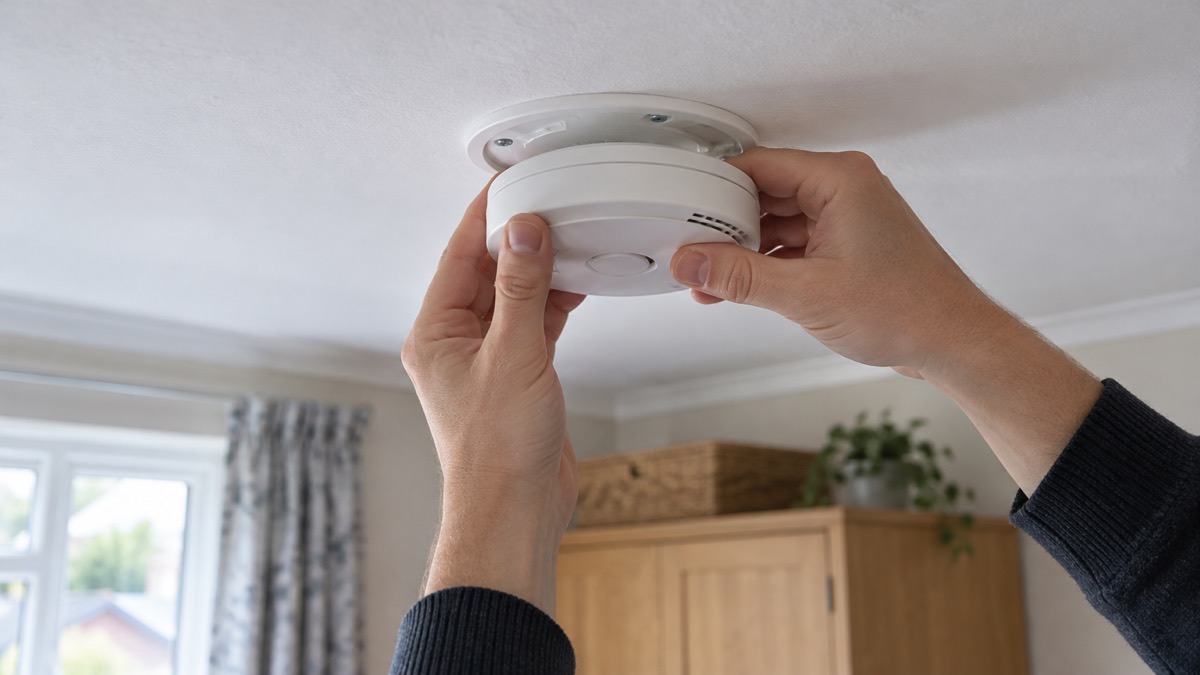
The Firehawk FHB10 is a long life optical smoke alarm with a sealed-in 10 year lithium battery, made by FireHawk and sold in the UK by distributors such as Safelincs1. It is a ceiling-mounted alarm for hallways, landings, living rooms and bedrooms, with an 85dB sounder, a large combined test and silence button, and a red light that shows it has power and that it is in alarm1. Because the battery is sealed in, there is nothing to change each year: you fit it, test it, and replace the whole alarm at the end of its life.
It is aimed at ordinary households, and in particular at anyone replacing an older FireAngel alarm. FireHawk makes an adaptor plate that lets the FHB10 mount on existing FireAngel ST620, ST622 and ST750 base plates, so the swap can be done without new wiring, new holes or redecorating4. A separate adaptor also lets it fit FireAngel SO-601 base plates6.
This page sets out what the alarm does, the specifications that decide where it suits, how to fit and test it, what its warnings mean, and how to get support or recycle it at the end of its life. It does not cover every alarm on the market; for that, start with Smoke Alarms: Types and How to Choose One.
What the Firehawk FHB10 is and who it suits
The FHB10 is an optical smoke alarm, which means it looks for smoke rather than a fast rise in heat3. Optical sensing is the usual choice for the rooms people live and sleep in, because it responds to the smouldering fires that produce a lot of smoke. If you are weighing up sensor types, Optical or Ionisation Smoke Alarms sets out the difference.
Its defining feature is the sealed battery. FireHawk describes it as a long life optical smoke alarm with a sealed-in 10 year battery, and the distributor lists the battery life as 10 years1. That suits a household that wants to fit an alarm and forget about battery changes, and it removes the common failure where a battery is taken out for another device and never replaced. The trade-off is that when the battery reaches the end of its life, the whole alarm is replaced rather than just the battery. Sealed 10-Year or Replaceable Battery Alarms compares the two approaches.
FireHawk has built in several features to keep nuisance alarms down: a unique X-Profile detection chamber controlled by bespoke software, an integrated insect screen, and TSE (Thermal Stability Enhancement) technology, which the maker says provides stability across a range of environmental conditions, reducing nuisance alarms whilst enhancing detection1. The distributor describes the same chamber and screen as reducing false alarms2.
It is a battery-powered alarm, not a mains one, so it does not need an electrician. If your home has mains-powered alarms and you are deciding whether to stay with them, see Battery or Mains Smoke Alarms.
Specifications
The figures below come from the maker's product page and the distributor's listing. Where they differ, the maker's figure is given first.
| Specification | Figure | Source |
|---|---|---|
| Type | Optical smoke alarm, battery powered | 3 |
| Battery | Sealed-in 10 year lithium | 1 |
| Sound level | 85dB | 3 |
| Dimensions | 84mm diameter, 34mm deep (maker lists 8.4 x 3.4 cm) | 1 |
| Weight | 80g (maker lists 0.08 kg) | 1 |
| Installation position | Ceiling | 3 |
| Operating temperature | 0°C to +40°C | 3 |
| Storage temperature | 5°C to 30°C | 3 |
| Relative humidity | Less than 85% | 3 |
| Suitable rooms | Hallways, landings, living rooms, bedrooms | 1 |
| Standards | Kitemarked to BS EN 14604: 2005; CE and UKCA marked; suitable for BS 5839-6 Grade F1 installations | 3 |
| Fixing | Screws included | 2 |
| Warranty | 10 years | 1 |
| End of life | Yes, Valpak's WEEE Distributor Take-back Scheme | 1 |
The maker gives the size as 8.4 x 3.4 cm and the weight as 0.08 kg; the distributor lists 84mm diameter, 34mm deep and 80g, which are the same measurements in different units1. The distributor also lists the alarm as suitable for installations meeting BS 5839-6 Grade F1 requirements, and separately as BS 5839-6; the fuller wording is the Grade F1 one3. For what those grades mean in practice, see Alarm Standards: BS 5839-6, BS EN 50291 and System Grades.
Where to fit it
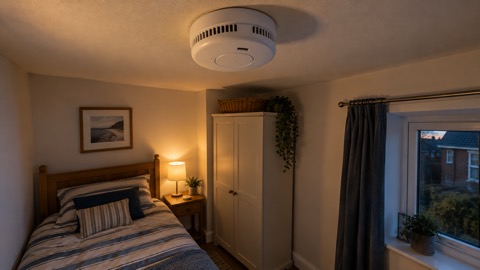
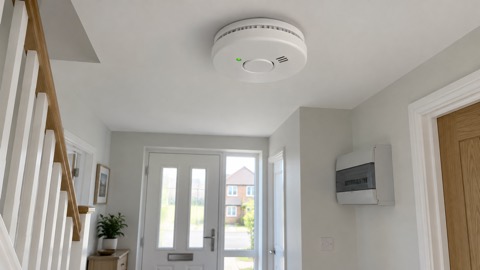
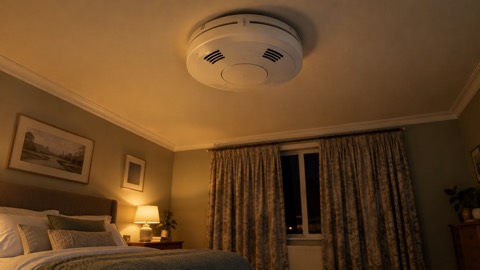
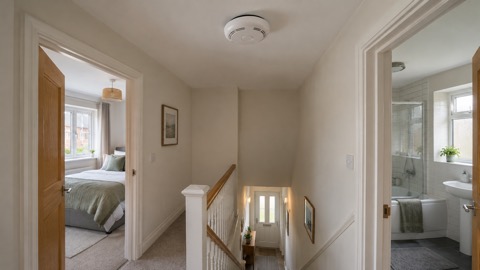
FireHawk lists the recommended locations as bedrooms, hallways and landings, and living areas, and the distributor describes the optical sensor as suitable for hallways, landings, living rooms and bedrooms1. The alarm is designed to be fixed to the ceiling3. Those are the rooms where people sleep and where fires most often start or spread at night, which is why they come first.
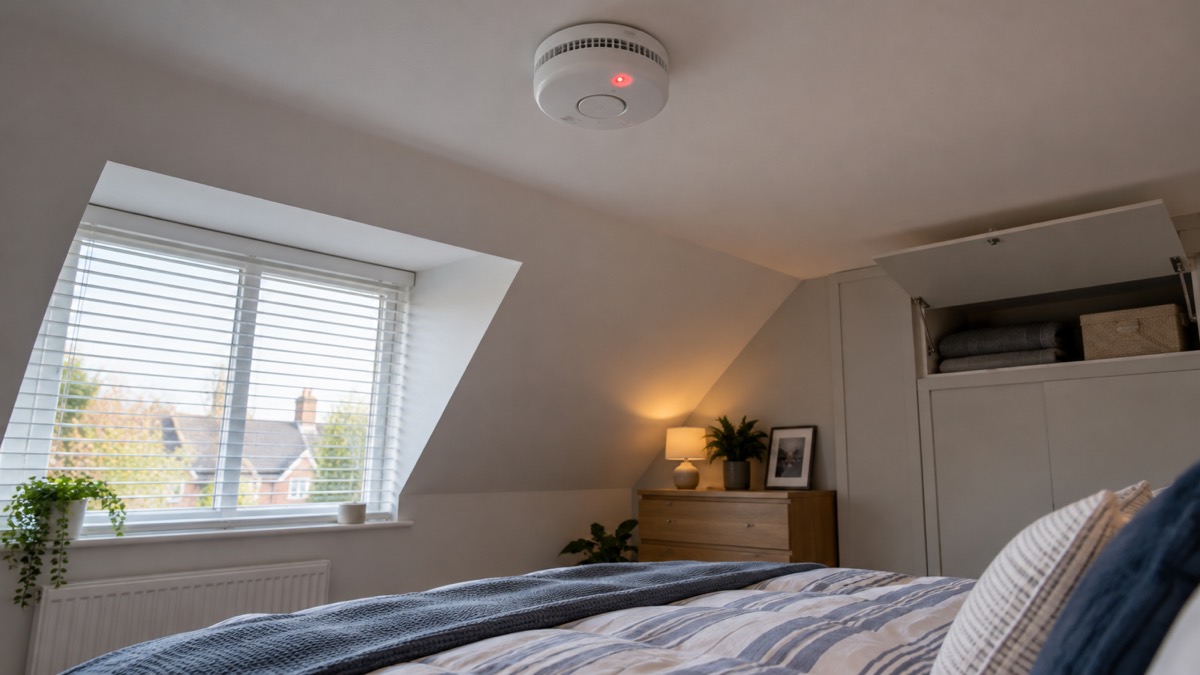
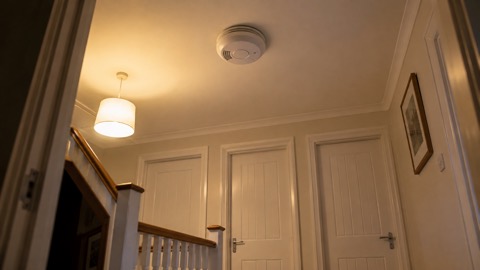
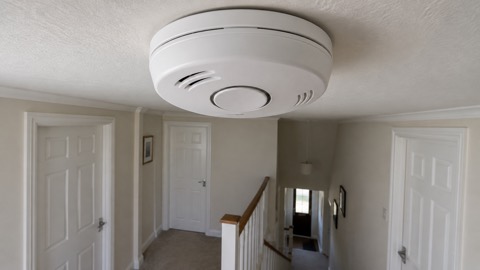
Fit it where smoke will reach it: on the ceiling in the middle of a room or landing, not tucked into a corner where dead air can delay smoke getting to the sensor. The alarm is for indoor use, with an operating range of 0°C to +40°C and relative humidity below 85%3. That rules out bathrooms, where steam can trigger nuisance alarms, and garages or outbuildings, where the cold and damp fall outside its limits. For a garage, kitchen or utility room, a heat alarm is the usual choice; see Heat Alarms: What They Do and Where They Go and Heat Alarm or Smoke Alarm: Which Goes Where.
How many you need depends on the size and layout of your home. How Many Smoke Alarms Does a House or Flat Need? works through it, and Where to Fit Smoke Alarms covers positions in detail. If you want alarms that sound together throughout the house, the FHB10 is the standalone version; the FHB10-RF is the one that links with the FireHawk RF-Link range, which includes smoke alarms, heat alarms, CO alarms and a hard of hearing alarm7. Interlinked Alarms: How Linking Works explains the options.
Fitting the alarm to its mounting plate
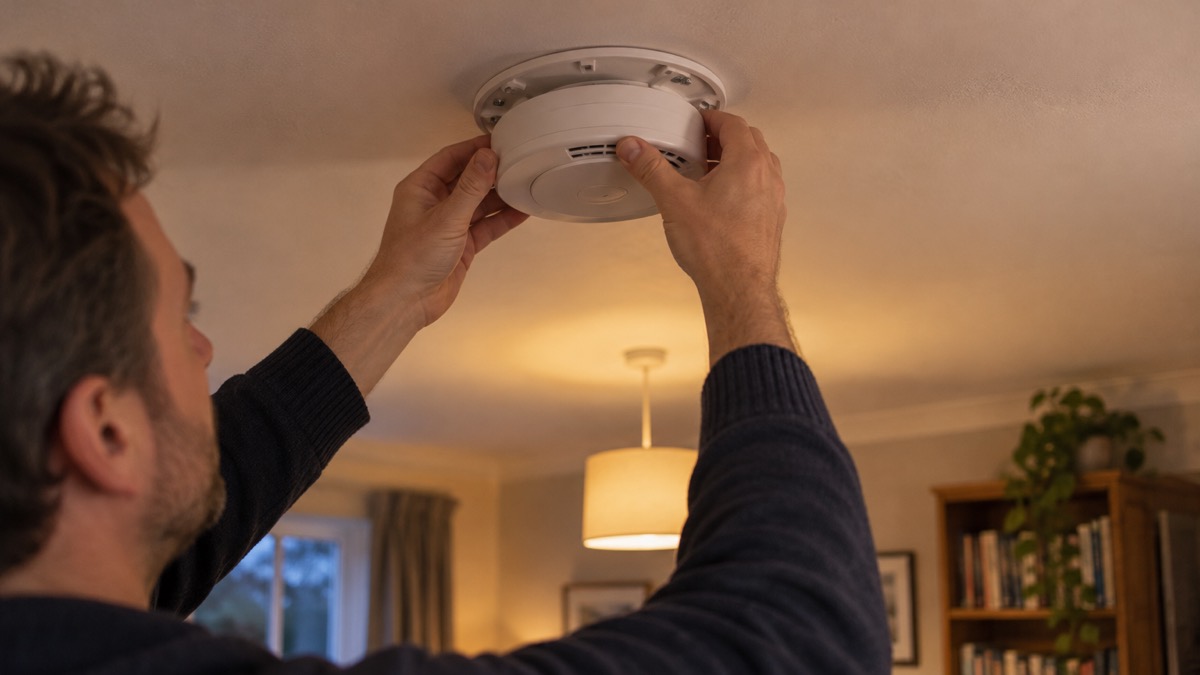
The FHB10 uses an Auto Switch Mounting Plate: power is automatically switched on when the alarm is attached to its mounting plate and off when it is removed1. That means there is no separate switch to remember, and the alarm cannot be left running while it sits on a shelf.
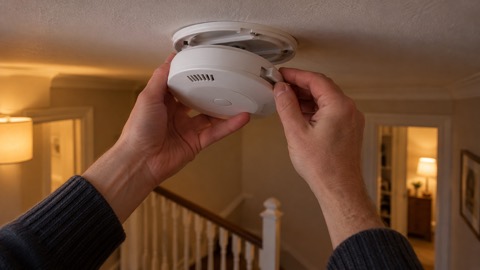
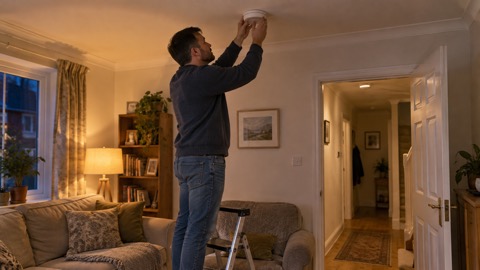
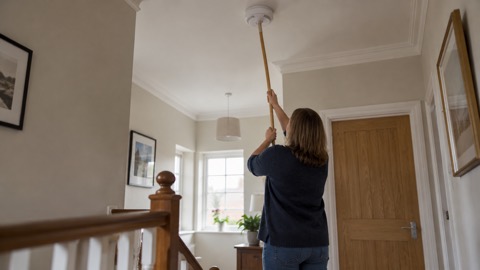
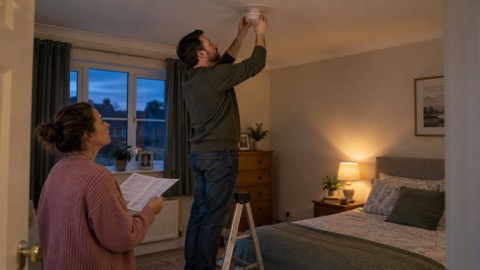
To fit it, screw the mounting plate to the ceiling using the screws supplied, then offer the alarm up to the plate and rotate it clockwise until it clicks and locks into position8. FireAngel's guidance on its own base plates is worth following in spirit: turn the alarm as far as possible on the baseplate to ensure it is engaged and secure, and expect a snug baseplate to need extra force9. Test the alarm once it is fitted, before you rely on it.
To remove it, use a pen or small screwdriver to depress the lock tab, then rotate the alarm anti-clockwise to release it4. Power switches off as it comes off the plate1. If you take it down to decorate, refit and test it as soon as you can, so the household is not left without a working alarm.
Replacing a FireAngel alarm without drilling new holes
If you already have FireAngel alarms on the ceiling, the FHB10 can often go straight onto the existing base plate. FireHawk makes an adaptor plate that allows the FHB10 smoke alarm and the FireHawk FHH10 heat alarm to be mounted quickly on to existing FireAngel ST620, ST622 and ST750 alarm mounting plates, with no new wiring, no tools and minimal mess4. A separate adaptor does the same for FireAngel SO-601 base plates, removing the need to drill additional holes or redecorate6.
The sequence for a FireAngel swap is:
- Rotate the old FireAngel alarm anti-clockwise to remove it from the base plate10.
- Discard the standard base plate supplied with the Firehawk alarm10.
- Rotate the Firehawk alarm clockwise onto the adaptor plate until you hear a click10.
- Test the alarm before fitting10.
- Rotate the alarm and adaptor plate clockwise onto the old FireAngel base plate on the ceiling10.
The adaptor plate is screwed onto the existing FireAngel bracket, and the alarm is then aligned so that the vertical line on the side of the casing sits halfway between the lug and the pin on the adaptor plate, before rotating clockwise until it clicks and locks4. The adaptor plate carries a 10 year warranty5. If you are replacing a FireAngel ST-620, the distributor describes the FHB10 with the adaptor as fitting in its place with no need to drill further holes11; the FireAngel ST-620 page covers the alarm being replaced.
Testing, silencing and reading the red light
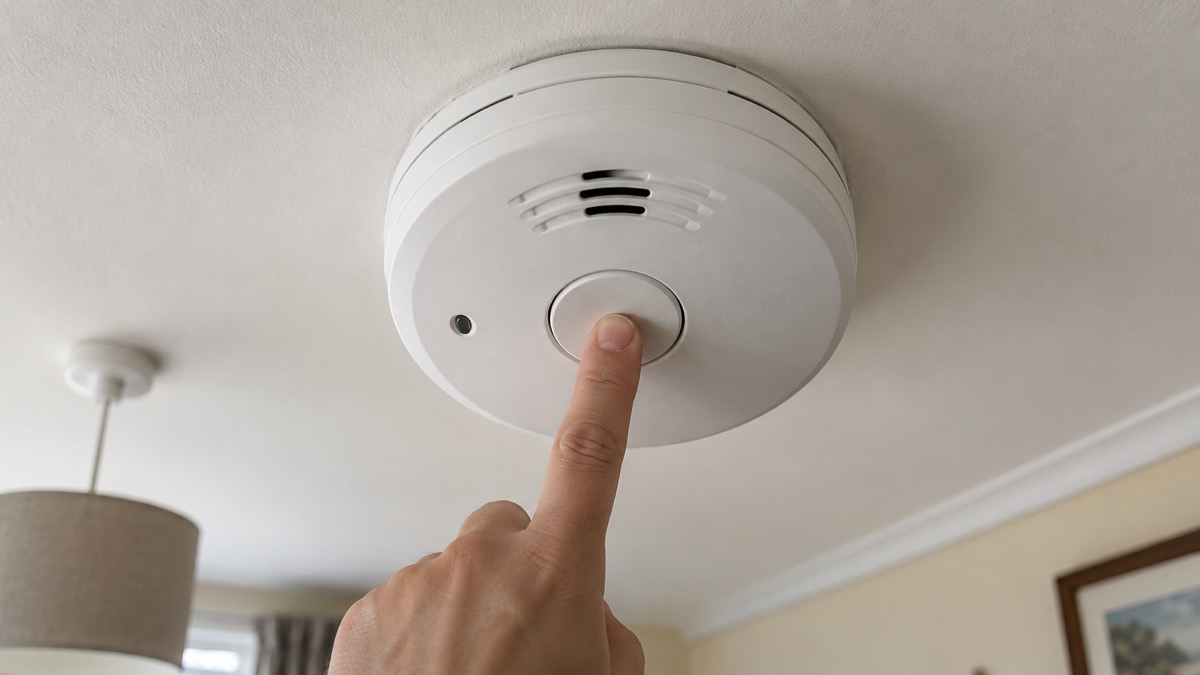
Test the alarm regularly using the extra large test button, which the distributor describes as a large combined test and silence button1. The button does two jobs: it sounds the alarm so you can check it works, and it silences a nuisance alarm in a non-emergency situation1. How Often to Test Smoke and CO Alarms sets out a routine.
The red light tells you what the alarm is doing. It flashes once a minute to indicate power, and flashes constantly to indicate an alarm condition1. So a slow blink is normal and means the battery is live; a rapid flash means the alarm has detected smoke. If the light is doing neither, the alarm is not powered, and you should check it is properly seated on its plate.
If cooking sets it off, press the silence button, open a window or use the extractor, and let the air clear. The X-Profile chamber, insect screen and TSE technology are there to reduce nuisance alarms, but no optical alarm can ignore smoke entirely1. Never take the alarm down and leave it off to stop it sounding. How to Stop Smoke Alarm False Alarms has more on causes and cures, and Kitchen Fires: Cooking Safety and Prevention covers the cooking side.
Low battery and end-of-life warnings
When the battery runs low, or the alarm reaches the end of its life, it chirps to tell you. FireHawk says the low battery warning can be silenced for up to 10 hours, maintaining continuous protection during sleeping hours1. The distributor says the same of the end-of-life warning, which can be silenced for up to 10 hours and is described as useful for night time alerts2.
That 10 hour silence is a night-time measure, not a fix. It buys you a quiet night without leaving the household unprotected, but the alarm still needs replacing. When the chirp starts, note the date, plan the replacement, and do not keep silencing it indefinitely. Why Does My Smoke Alarm Keep Chirping? explains the different chirp patterns, and When to Replace a Smoke, Heat or CO Alarm covers timing.
Children, sleeping and the limits of any alarm
An alarm is only part of a fire plan. FireHawk's own warning on its product page is blunt: experience has shown that children may not be woken by fire alarm tones, children should never be left alone in a house, families should have a rehearsed fire escape plan, sleeping children must be woken and taken outside to safety, and the fire and rescue service should always be called without delay, no matter how small the fire1. FireAngel gives the same warning about children and alarm tones in its guidance for home occupiers8.
"Experience has shown that children might not be woken by fire alarm tones. It is important that children are never left alone in a dwelling."
Put that into practice: make and rehearse an escape plan, as set out in How to Make a Fire Escape Plan, and agree who wakes the children if the alarm sounds at night. If someone in the household is deaf or hard of hearing, a standard sounder may not be enough; Smoke and CO Alarms for Deaf and Hard of Hearing People covers the alternatives, and FireHawk's RF-Link range includes a hard of hearing alarm7.
Support, warranty and recycling
The FHB10 carries a 10 year warranty from FireHawk, matching the battery life1. Keep the instructions and your proof of purchase with your household paperwork, so a claim is straightforward if the alarm fails early.
If you need help with a FireHawk alarm, the maker's support line is freephone 0800 008 6568, or you can text 07885 831239 if you are unable to call12. Greater Manchester Fire and Rescue Service gives those details to residents whose alarms were fitted by the fire service and are still covered by their guarantee12. If your alarm was fitted by your local fire and rescue service, ask them first what they cover; arrangements differ between services in England, Scotland, Wales and Northern Ireland, and Wales and Northern Ireland: Alarm Rules and Fire Services covers the devolved rules.
At the end of its life, do not put the alarm in the household rubbish. The distributor lists it as covered by Valpak's WEEE Distributor Take-back Scheme, so it can be returned for recycling through that route3. Take the old alarm down, fit the replacement, and test it the same day.
Sources (12)
- Firehawk FHB10 product page, Fireblitz, 2026-08-17
- 10 Year Sealed Lithium Battery Optical Smoke Alarm Firehawk FHB10, Safelincs, 2026-10-29
- Firehawk FHB10 10 Year Battery Smoke Alarm, Safelincs, 2026-10-29
- FireAngel to FireHawk FHB10 Adaptor Plate, Fireblitz, 2025-10-10
- Firehawk FHB10 Adapter Plate (replace FireAngel ST620, ST622, ST750), Fireblitz, 2026-08-17
- FireAngel SO601 Toast Proof Optical Smoke Alarm, Safelincs, 2026-10-29
- Battery Powered Optical Smoke Alarms, Fireblitz (FireHawk)
- Important information for home occupiers, FireAngel, 2026-02-06
- RF-BW-T Interlink Push Fit Base, FireAngel, 2026-08-21
- FireAngel ST622 10 Year Thermoptek Smoke Alarm, Safelincs, 2026-10-29
- FireAngel ST-620 Thermoptek Smoke Alarm, Safelincs, 2026-10-29
- Problem with your smoke or heat alarm, Greater Manchester Fire and Rescue Service, 2026-10-29
 FireAngel FP2620W2-R Alarm
 FireAngel ST-632 Smoke Alarm
 FireAngel ST-750 Smoke Alarm
 FireAngel SW1 Smoke Alarm
 FireAngel SW10 Smoke Alarm
 FireAngel SB1 Smoke Alarm
 FireAngel SM-SN-1 Smoke Alarm
 FireAngel FA6611 Smoke Alarm
 FireAngel FA6615 Smoke Alarm
 FireAngel FA8620BW Alarm
 Kidde 2030-DSR Smoke Alarm
 Kidde 2030-DCR CO Alarm