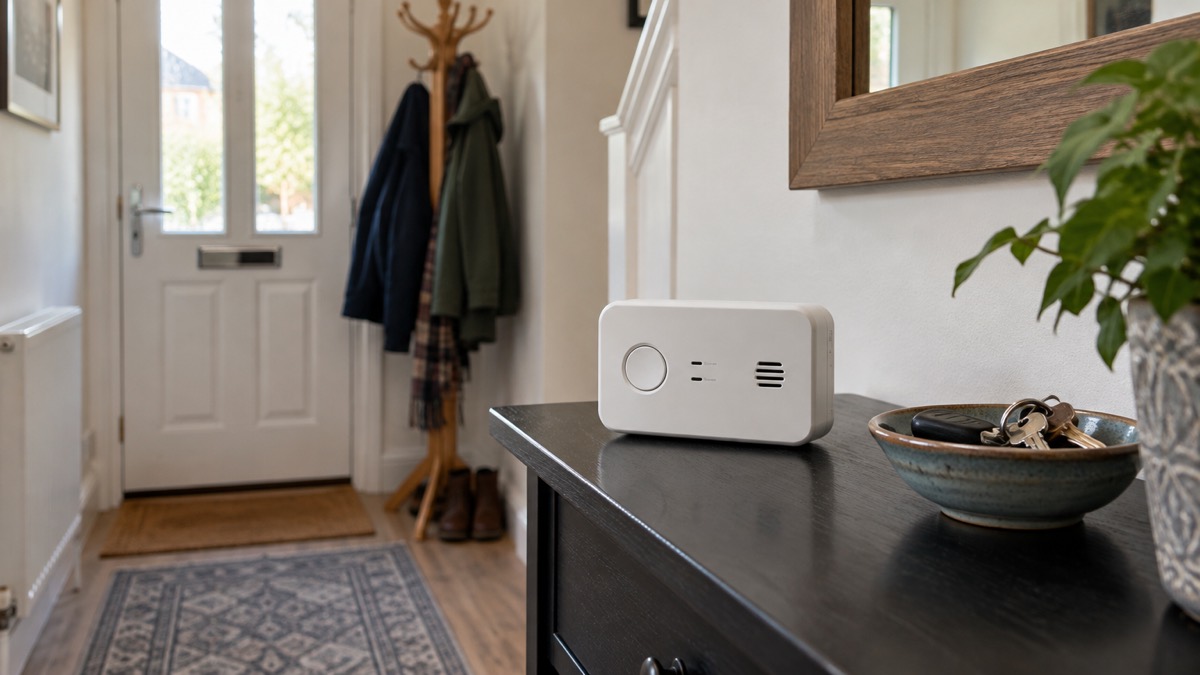
The Firehawk CO7B is a battery-operated carbon monoxide alarm with a sealed-in long-life lithium battery that lasts as long as the sensor: 7 years1. It detects carbon monoxide from fuel-burning appliances and fires from 30ppm, sounds at 85dB, and shows power, alarm and fault conditions on separate LED indicators2. There is nothing to wire in and nothing to recharge. You fix it to a wall or stand it on a shelf at head height, press the test button now and then, and replace the whole unit when the sensor reaches the end of its life.
That last point is the one to understand before you buy. The CO7B is a sealed unit: when the sensor expires, the alarm tells you with three short beeps every minute, and the answer is a new alarm, not a new battery1. The same alarm is sold in a 10-year version, the CO7B-10Y, with a 10-year sensor and battery3. Both are standalone units, both are certified to BS EN50291-1:2018 and BS EN50291-2:2019, and both are CE and UKCA marked1.
This page sets out what the CO7B does, where to put it, how to test it and read its lights, what its beeps mean, and how to get support if something goes wrong. If you are still deciding whether you need a carbon monoxide alarm at all, start with our guide to carbon monoxide alarms.
What the Firehawk CO7B is and what it does
Carbon monoxide is the gas you cannot see, smell or taste, and it comes from appliances that burn fuel: boilers, cookers, fires, portable heaters. The CO7B exists to catch it in the room where it is produced. The maker describes it as a battery-operated carbon monoxide alarm with a sealed-in long-life lithium battery, built around a Figaro electrochemical sensor that it says ensures accuracy and longevity1. The retailer's specification lists the sensor as electro-chemical and the power as a sealed lithium battery2.
The unit is small: 100mm high, 65mm wide and 30mm deep, weighing 80g2. It has dedicated test and silence buttons, so operating it does not depend on remembering a sequence2. The maker lists an automatic sensor test as well as the manual test button, and LED indicators for power, alarm and fault condition1.
What it does not do matters just as much. It is a carbon monoxide alarm, not a smoke alarm, and it will not warn you of a fire. It is a standalone alarm, not an interlinked one, so it will not set off other alarms in the house3. And it does not detect gas leaks: a carbon monoxide alarm responds to carbon monoxide, not to the smell added to mains gas. Our page on whether a carbon monoxide alarm can detect a gas leak explains the difference, and if you smell gas, follow the gas leak guidance instead.
For a household with a boiler, a gas cooker, a wood burner or an open fire, that combination, sealed power, a 7-year sensor and a loud sounder, is the whole job in one box. The question is whether 7 years or 10 years suits you better, which the last section covers.
Specifications
The figures below are the retailer's published specification for the CO7B, with the maker's own figures where it gives them2.
| Specification | Firehawk CO7B |
|---|---|
| Type | Battery carbon monoxide alarm, standalone2 |
| Sensor | Electro-chemical, 7-year life2 |
| Detection level | From 30ppm2 |
| Sound level | 85dB2 |
| Power | Sealed lithium battery, 7-year life2 |
| Indicators | LED for power, alarm and fault1 |
| Controls | Dedicated test and silence buttons2 |
| Dimensions | 100mm high, 65mm wide, 30mm deep2 |
| Weight | 80g2 |
| Operating temperature | -10°C to +40°C2 |
| Relative humidity | 30% to 90%2 |
| Environmental suitability | Indoors2 |
| Approvals | BS EN50291-1:2018; BS EN50291-2:20191 |
| Marking | CE and UKCA marked2 |
| Warranty | 7-year manufacturer's warranty2 |
Two of these figures decide how you live with the alarm. The 30ppm detection level is the threshold at which it responds to carbon monoxide, and the 85dB sounder is loud enough to wake most people in a nearby room, though not everyone: if someone in the household is deaf or hard of hearing, a standard sounder may not be enough, and our guide to alarms for deaf and hard of hearing people sets out the alternatives. The maker lists the alarm as suitable for rooms with fuel-burning appliances or open fireplaces, and gives its operating humidity as 30% to 90%2.
Where to put it
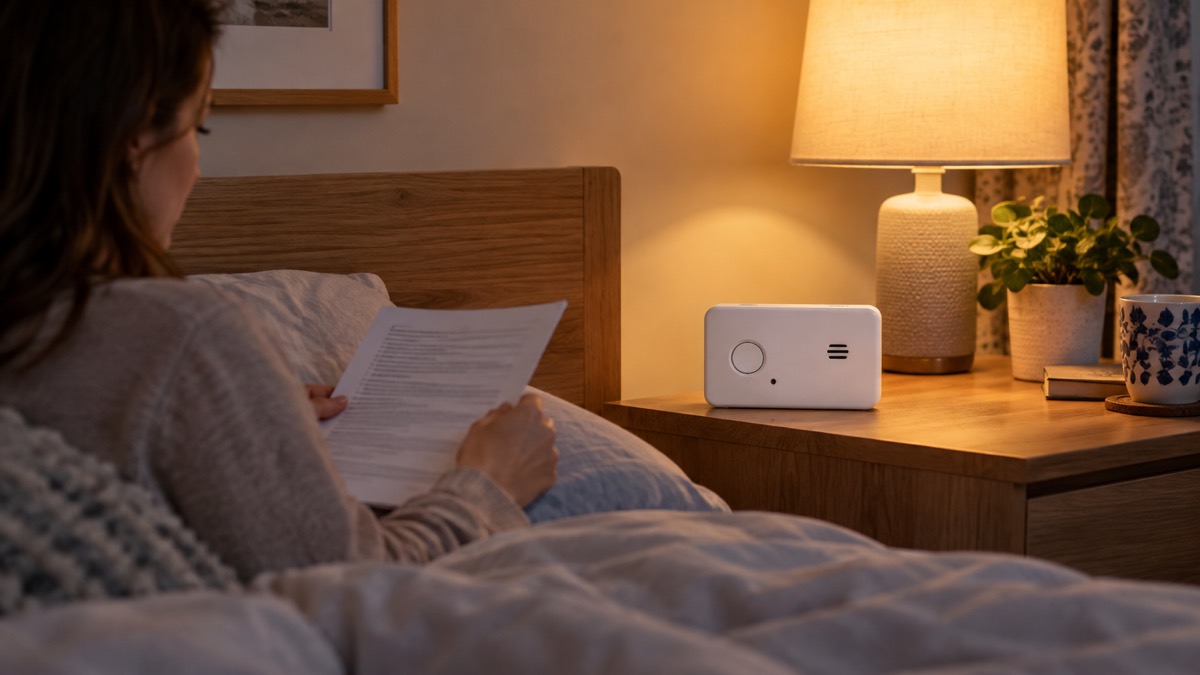
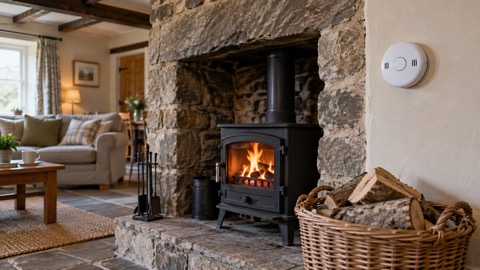
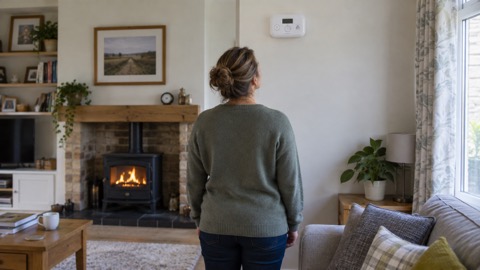
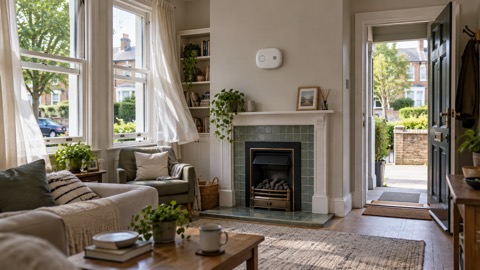
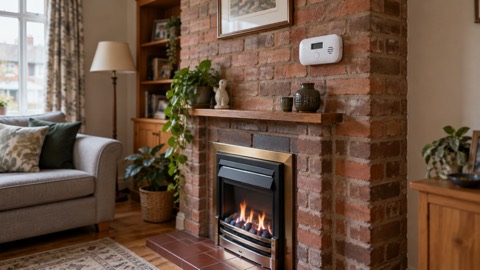
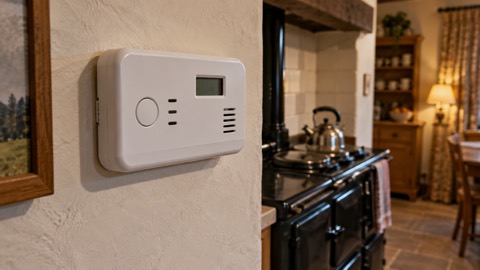
Fit it high up in the same room as the potential source, around 15cm from the ceiling and at least 1 metre away from boilers, cookers and fires, and not directly above a source of heat or steam; a shelf is suitable4. The maker's own installation guidance says to place it high in the room, above the tops of windows and doors, but no closer than 150mm from the ceiling5. The retailer lists the installation position as mount at head height or stand at head height, and the suitable rooms as bedrooms, hallways, kitchens, landings and living rooms2.
Those two pieces of placement advice sit together rather than conflict: high in the room, but not jammed against the ceiling, and clear of the appliance itself. The reason for the distance from cookers and boilers is that heat and steam can affect the sensor and cause false readings. The reason for height is that carbon monoxide mixes with warm air and rises.
A practical way to plan it:
- The room with the boiler or fire: one alarm, high on a wall or on a shelf, at least a metre from the appliance4.
- Bedrooms: the retailer lists bedrooms as a suitable position, and an alarm near where people sleep gives you the best chance of hearing it at night2.
- Holidays: the maker says the mounting system allows the alarm to be fixed to a surface or used free-standing, making it ideal for holidays6. Take it with you to a caravan or rented cottage with a fuel-burning appliance.
- Not in a bathroom or directly over a cooker: steam and cooking fumes are the usual causes of nuisance alarms.
If you want the fuller reasoning on siting, including how many alarms a home needs, see where to put a carbon monoxide alarm.
Fixing it to a wall or standing it free
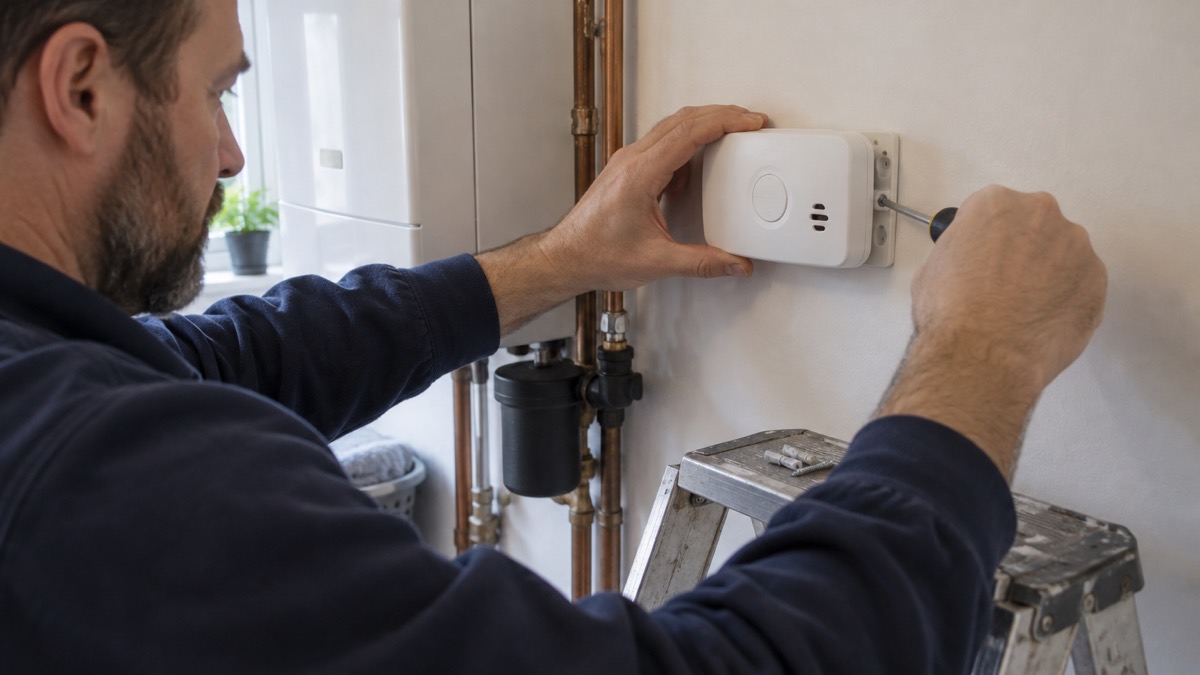
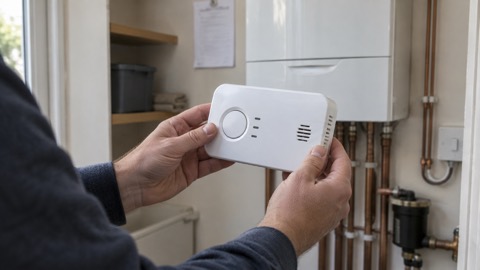
The CO7B gives you both options out of the box. The retailer lists the fixing options as freestanding and screws, with the screws included2. The maker describes a versatile mounting system that allows the alarm to be fixed to a surface or used free-standing1.
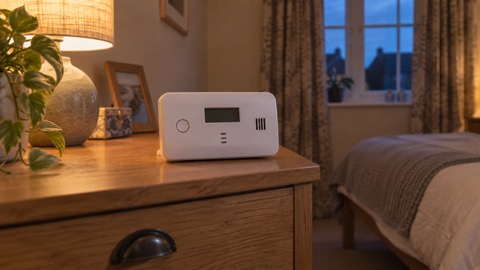
Wall mounting suits a permanent position: a hallway wall, a landing, the wall of the room with the boiler. Use the screws supplied and follow the maker's height guidance, high in the room but no closer than 150mm from the ceiling5. Standing it free suits a bedside table, a kitchen shelf or a holiday let where you do not want to drill anything.
Whichever you choose, keep the alarm clear. Do not box it in behind curtains, do not put it where furniture will knock it, and do not cover it. If you move house, take it with you if it is still within its life, and fit it in the new home on the same principles.
Testing it and reading the lights
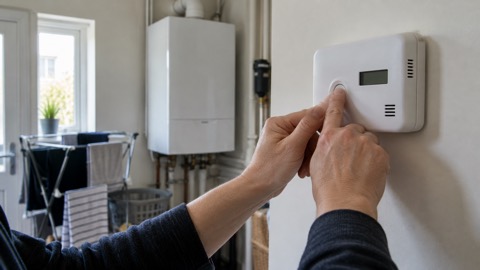
The CO7B has individual LED indicators for power, fault and alarm, so the light tells you which of the three states the alarm is in3. The retailer describes testing as one press to test the alarm, with a green light that flashes about once a minute as the reassuring sign that all is well and no batteries need changing3.
A simple routine:
- Press the test button and confirm the alarm sounds. The CO7B has a dedicated test button for this2.
- Check the green light is flashing about once a minute, which the retailer describes as the normal running state3.
- Look at the fault light. A fault indication is not something to ignore; treat it as a prompt to contact the supplier.
- Test regularly. Our guide to how often to test smoke and CO alarms sets out a routine you can keep to.
If the alarm sounds for real, do not press silence and go back to bed. The correct response is to get everyone into fresh air and call the gas emergency service, which our page on what to do if your CO alarm sounds walks through step by step. The CO7B does have a silence function: the maker states it silences the alarm for up to 10 minutes1. That is a pause for ventilation and investigation, not a fix.
Three short beeps every minute mean the sensor has reached the end of its life
This is the signal that catches people out. The maker states plainly: "END OF LIFE INDICATOR. 3 short beeps every minute indicate end of sensor life."1 The CO7B-10Y uses the same signal6. When you hear it, the alarm is telling you it can no longer be relied on to detect carbon monoxide, and the answer is to replace the whole unit.
It helps to know how this differs from other beeps you may have heard from alarms in the house. Independent testers describe chirping every 30 seconds as the sign that a carbon monoxide alarm is ready to be replaced7. Fire and rescue service guidance on smoke alarms describes a beep every minute or so as a possible low battery warning, and notes that hard-wired alarms can do this too because they often have a battery backup10. The CO7B has a sealed battery that cannot be changed, so a low battery warning and an end of life warning both point the same way: the alarm is nearing the end of its service and needs replacing.
The maker also states that low battery warning chirps can be silenced for up to 10 hours, which it describes as ideal for night-time use1. The retailer says the CO7B-10Y's end of life warning can be silenced for up to 10 hours3. Use that to get through the night, then act in the morning. Do not silence it and forget it.
If you are unsure which beep you are hearing, our page on why your carbon monoxide alarm is beeping sorts the patterns out.
CO7B or CO7B-10Y: how the two versions differ
The two alarms look alike and work the same way. The difference is how long they last and what they can tell you afterwards.
| Firehawk CO7B | Firehawk CO7B-10Y | |
|---|---|---|
| Sensor life | 7 years2 | 10 years3 |
| Battery | Sealed lithium, 7-year life2 | Sealed lithium, 10-year life3 |
| Warranty | 7-year manufacturer's warranty2 | 10-year warranty7 |
| Detection level | From 30ppm2 | From 30ppm3 |
| Sound level | 85dB2 | 85dB3 |
| Fixing | Freestanding or screws included2 | Freestanding or wall mounted, fixings included3 |
| Data to a phone | Not listed | Data Scan via iPhone app3 |
| Suitability | Boat and marine, camping, home, travel2 | Caravan, camping and boats, home, travel3 |
The CO7B-10Y adds a Data Scan feature: the retailer says it is compatible with the feature for use via an iPhone app, downloading the serial number, report and manufacture dates, product life remaining and expiration date, device removals and tests, and counts of pre-alarms, CO levels and faults3. Independent testers note that data recorded by the alarm can be sent to a phone7. That is useful if you want a record of what the alarm has seen, for example in a rented property or a holiday let. The CO7B listing does not include it.
The choice comes down to how long you want to go before replacing the unit. A 7-year alarm means one replacement in the time a 10-year alarm would still be running. The maker's own product information for the CO7B 10Y carries the line "FOR FIRE AND RESCUE SERVICES"6. If you are weighing up sealed against replaceable battery alarms more generally, our comparison of sealed 10-year or replaceable battery alarms sets out the trade-offs.
Using it in a caravan, on a boat or on holiday
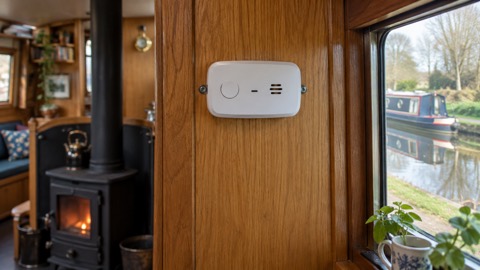
The CO7B is listed as suitable for boat and marine use, camping, home and travel2. The CO7B-10Y is listed for caravans, camping and boats as well as the home3. The maker says its battery carbon monoxide alarms are ideal for the home or travelling on holiday, giving protection from CO poisoning wherever you are11.
That matters because holiday accommodation brings its own risks: unfamiliar appliances, gas hobs, paraffin or gas heaters, and sometimes a boiler that has not been serviced. The operating range of -10°C to +40°C covers a cold caravan in winter and a hot awning in summer2. The free-standing option means you can stand it on a shelf or table at head height without fixing anything1.
Two cautions. First, the alarm is listed as suitable for indoor use, so do not leave it out in the rain2. Second, if you are using a portable fuel-burning heater, the official advice is that there must be good ventilation, and paraffin heaters should be filled to just below the maximum level to allow for expansion when the fuel warms up12. An alarm is a backstop, not a substitute for ventilating the space and using the heater as instructed.
Meeting the rules in Scotland, Wales and Northern Ireland
Firehawk states that its CO range is approved to BS EN50291:2010 + A1:2012 and meets the requirements of Part J of the Building Regulations and the regulations in Northern Ireland, Wales and Scotland14. The retailer lists both the CO7B and the CO7B-10Y as compliant with Northern Ireland legislation (2024) and Scottish and Welsh legislation (2022)2.
What that means in practice is that the alarm is built and certified to the standard the regulations refer to, so fitting it is not the weak link. What the regulations require in a particular home, and where, is a separate question, and it differs between the nations. Our guide to alarm standards explains BS EN 50291 and the system grades, and our page on Wales and Northern Ireland alarm rules covers the devolved requirements. If you are a landlord or you are buying for a rented property, check the current requirement for your nation before you rely on any single alarm.
Support, warranty and disposal
The CO7B carries a 7-year manufacturer's warranty, matching its 7-year sensor and battery life2. The maker lists the warranty as 7 years1. Keep the receipt or order confirmation; a warranty claim will normally need proof of purchase and the date.
For support, the CO gas safety charity publishes Firehawk's contact details: the website is www.fireblitz.co.uk, the email is sales@fireblitz.co.uk and the phone number is 01322 342238, with data sheets available on the website14. Greater Manchester Fire and Rescue Service publishes a freephone support line for FireHawk alarms it fitted that are still covered by its guarantee: 0800 008 6568, or text 07885 831239 if you cannot call15. The same guidance says that both suppliers, FireAngel and FireHawk, will post out a replacement alarm if the issue cannot be resolved over the phone15.
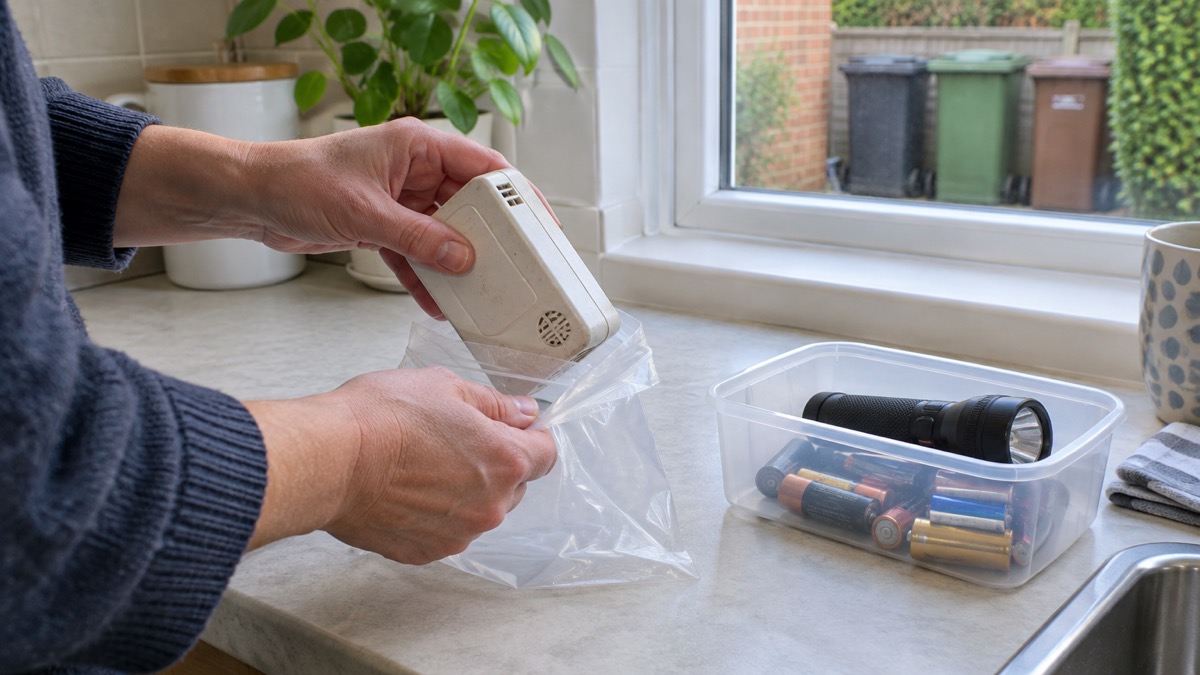
When the alarm reaches the end of its life, do not put it in the household rubbish. The retailer lists both the CO7B and the CO7B-10Y as covered by Valpak's WEEE Distributor Take-back Scheme2. Take the old unit to a participating retailer or a household waste recycling centre that accepts small electricals.
Sources (15)
- FireHawk CO7B Carbon Monoxide Alarm (7 Year), Fireblitz, 2026-08-17
- Firehawk CO7B 7 Year Sealed Longlife Battery Carbon Monoxide Alarm, Safelincs, 2026-10-29
- Firehawk CO7B-10Y 10 Year Battery Carbon Monoxide Alarm, Safelincs, 2026-10-29
- How to install and test carbon monoxide detectors, Which?, 2026-07-14
- Where to install CO alarms, Fireblitz, 2025-03-19
- CO7B 10Y, Fireblitz, 2026-08-26
- What to do when a carbon monoxide detector goes off, Which?, 2026-07-14
- Carbon monoxide symptoms, Which?, 2026-07-14
- Five ways to avoid a carbon monoxide build-up, Which?, 2026-07-14
- Problems with smoke alarms | Devon and Somerset Fire and Rescue Service, Devon and Somerset Fire and Rescue Service
- FireHawk alarms, Fireblitz, 2026-08-28
- Strong winds weather warning: information and advice, nidirect, 2026-10-24
- Portable heaters, Mid and West Wales Fire and Rescue Service, 2026-10-29
- About CO alarms, CO-Gas Safety, 2024-02-18
- Problem with your smoke or heat alarm, Greater Manchester Fire and Rescue Service, 2026-10-29
 FireAngel FA3313 CO Alarm
 FireAngel FA3322 CO Alarm
 FireAngel FA3820 CO Alarm
 FireAngel FA6812 CO Alarm
 FireAngel FA6813 CO Alarm
 FireAngel FA6829S CO Alarm
 FireAngel CW1-PF CO Alarm
 FireAngel W2-CO-10X CO Alarm
 FireAngel FP1820W2-R CO Alarm
 Kidde K7DCO CO Alarm
 Kidde K5DCO CO Alarm
 Kidde K10LLDCO CO Alarm