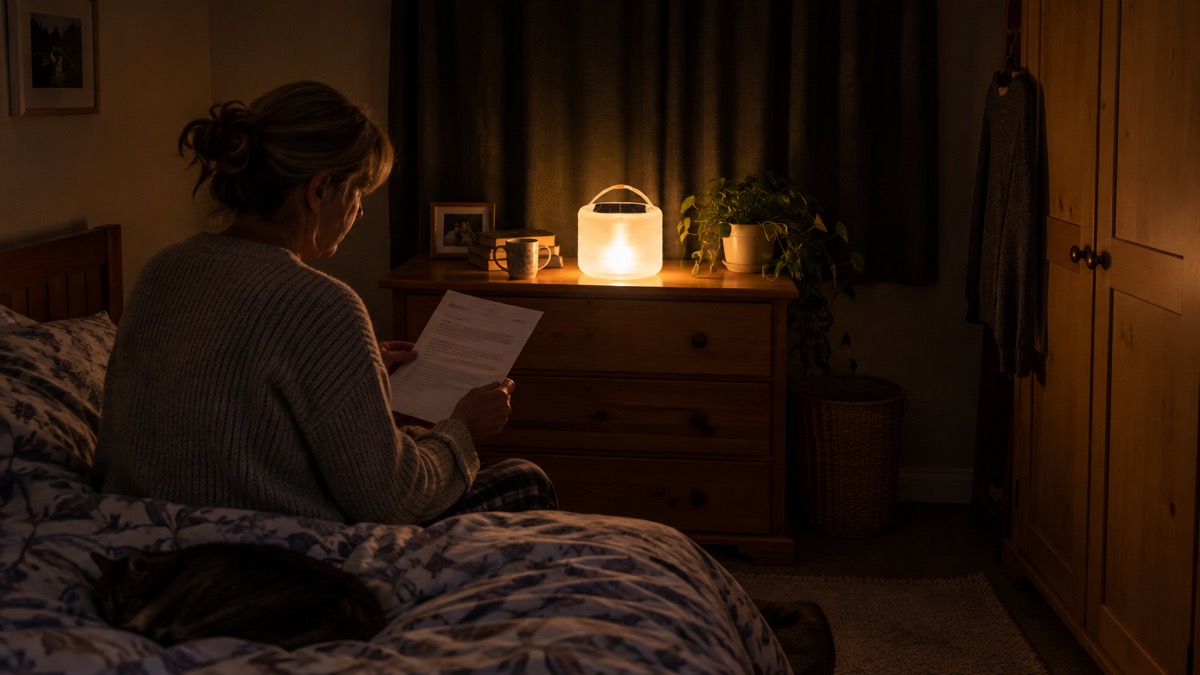
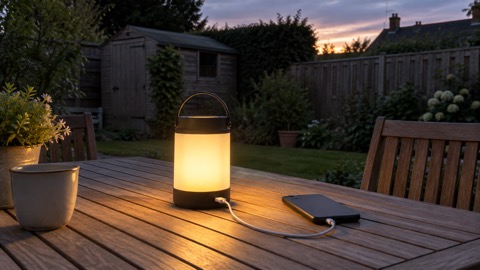
The MPOWERD Luci Charge 360 is a collapsible solar lantern that also works as a small power bank for a phone. The maker describes it as a "360 lumen solar lantern with mobile charging"1. It has 31 warm white LEDs, a 4,000 mAh (14.8 Wh) lithium-ion battery, and two outputs, one USB-C and one USB-A, so it can light a room and put a little charge back into a handset1.
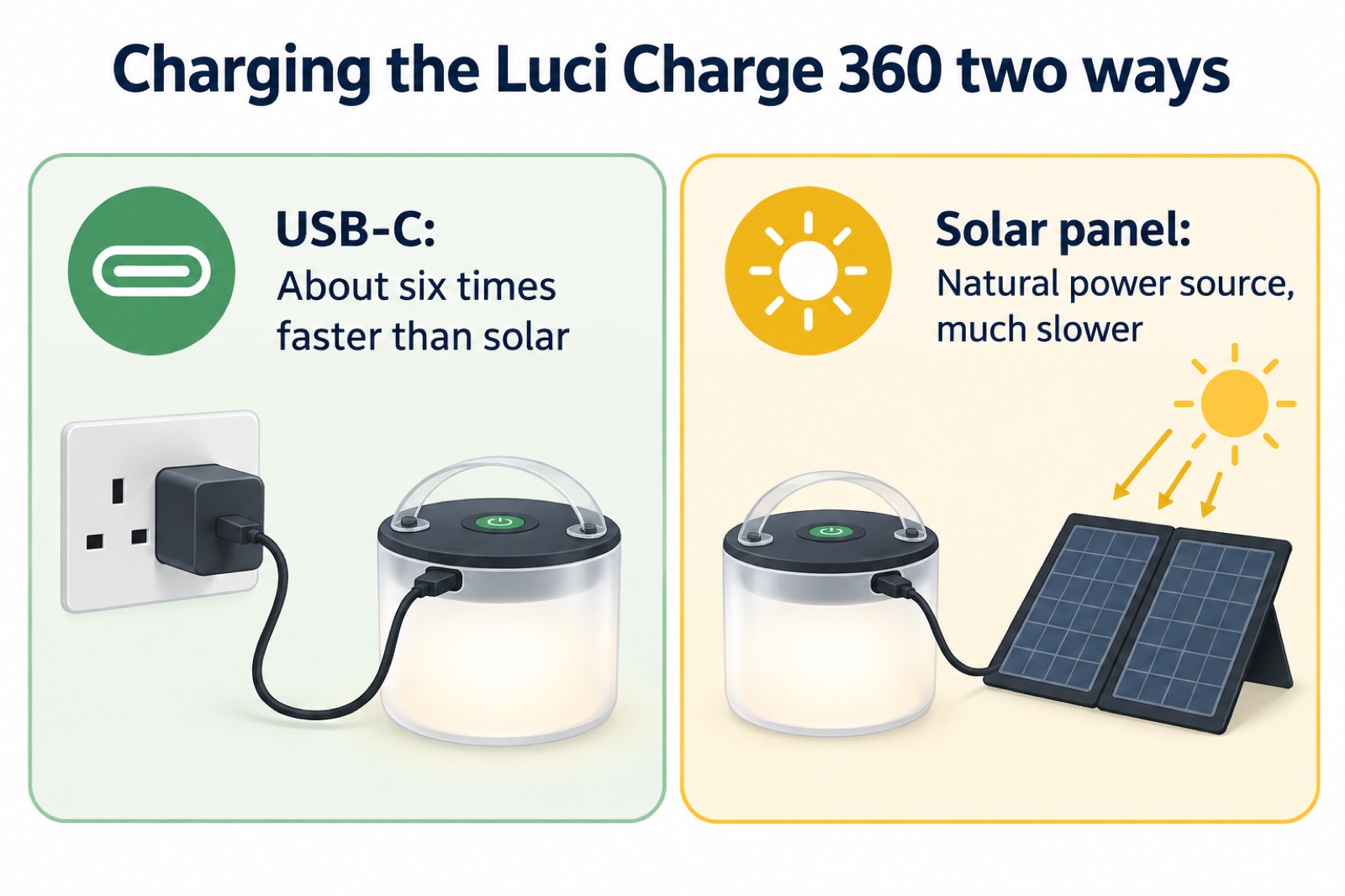
For a household preparing for a power cut, the useful facts are simple. It weighs 10.1 oz (286 g), collapses to 1.5 inches, and is rated IP67 for water resistance, so it can sit in a kit bag or be used outdoors1. It charges by USB-C or by its own solar panel, and the maker states that USB-C charging is about six times faster than solar1.
This page sets out what the lantern is, what its specifications mean in practice, how to charge it, how to use it safely and how to store it between emergencies. It does not compare it with other lanterns or recommend it over any other product.
What the Luci Charge 360 is and what it suits
The Luci Charge 360 is a lantern first and a phone charger second. Its 360 lumens come from 31 warm white LEDs, and it has four lighting modes: Low, Medium, High and Flashing1. Warm white light is easier to live with in a room than a harsh white beam, which is why lanterns of this kind are often chosen for lighting a space rather than for picking out a path.
The phone charging side is deliberately modest. The battery is 4,000 mAh (14.8 Wh), and the outputs are one USB-C and one USB-A1. That is enough to top up a phone in an emergency, not to run appliances. The maker's wider Luci range is described as solar powered and rechargeable, with no batteries needed, so there is nothing to buy and store separately2.
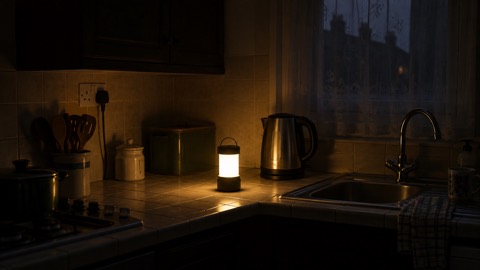
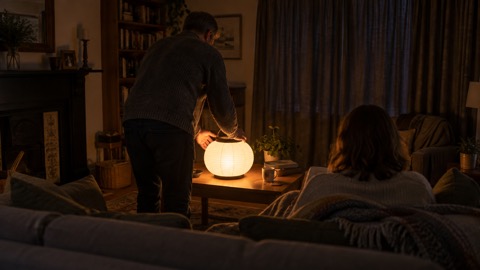
It suits a household that wants one object that does two jobs: a light for a room during a power cut and a small reserve of power for a mobile phone. That matters because official guidance on the digital landline switchover advises keeping a mobile phone charged and topped up so you have another way to call for help3. A lantern that can put charge back into that phone earns its place in a kit.
It is less suited to anyone who needs a focused beam for walking or checking a fuse box. A lantern spreads light around a room; a torch throws it where you point it. If you are choosing between the two, our guide to lanterns and torches sets out which lights a room better.
Specifications: 360 lumens, 31 LEDs and a 14.8 Wh battery
The maker's product page gives the full specification. The figures below are the maker's own, and they are the ones to use when deciding whether the lantern fits your kit.
| Specification | Maker's figure |
|---|---|
| Brightness | 360 lumens1 |
| LEDs | 31 warm white1 |
| Battery | 4,000 mAh (14.8 Wh) lithium-ion1 |
| Inputs | USB-C, solar panel1 |
| Outputs | 1x USB-C, 1x USB-A1 |
| Lighting modes | Low, Medium, High, Flashing1 |
| Water resistance | IP671 |
| Pressure tolerance | Up to 150 lbs1 |
| Weight | 10.1 oz (286 g)1 |
| Dimensions | 5.4 x 6 in (137 x 152 mm) diameter1 |
| Collapsed height | 1.5 inches1 |
| Solar panel | High efficiency mono-crystalline1 |
| Finish | Matte1 |
| Straps | Adjustable base strap, fixed top strap1 |
| In the box | Solar lantern, USB to USB cable1 |
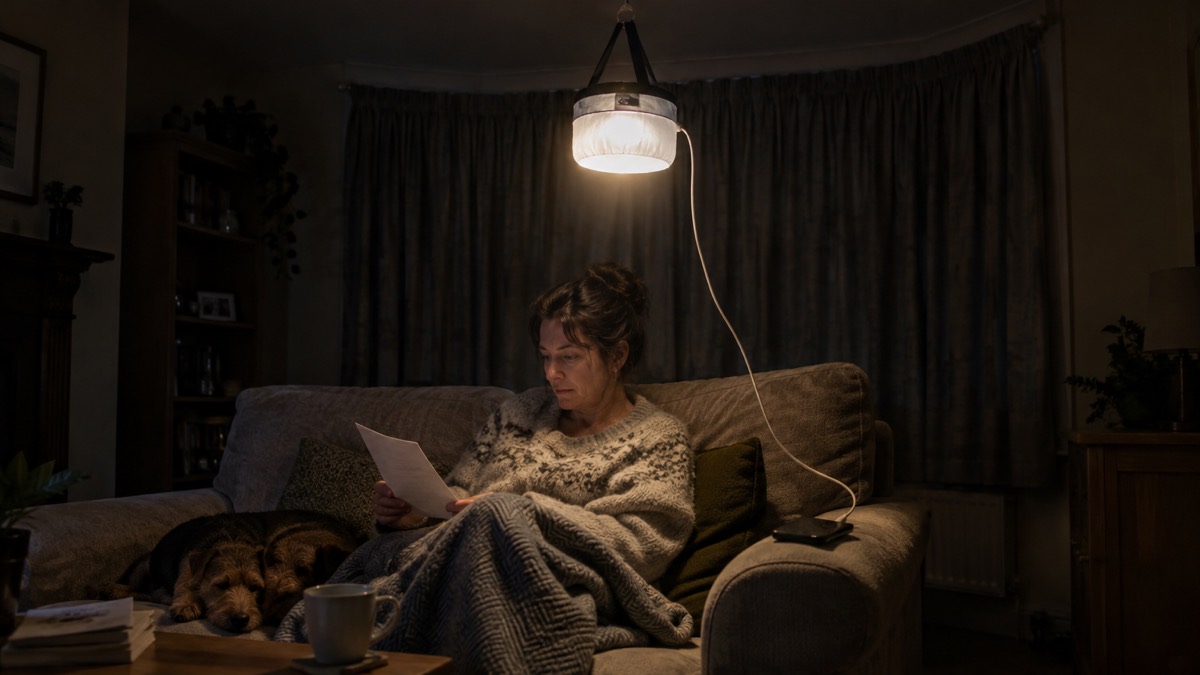
Two of these figures decide how you use it. The 14.8 Wh battery is small, so treat the phone charging as a top-up rather than a full recharge of a modern handset. The 360 lumens is a room-lighting output, not a searchlight, so place it high and let it spread.
If you want to understand how lumens translate into usable light, our explainer on lumens, beam distance and run time covers the basics. The maker does not give a run time for each mode on this page, so plan on recharging rather than on a stated number of hours.
Charging by USB-C or solar: USB-C is about six times faster
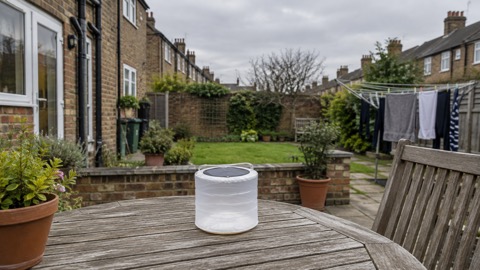
The lantern takes power two ways: through its USB-C port or through its built-in mono-crystalline solar panel1. The maker's advice is to charge via solar for a natural source of power, but if you are in a pinch, charge via USB2. The maker also states plainly that charging via USB-C is about six times faster than via solar due to the input power1.
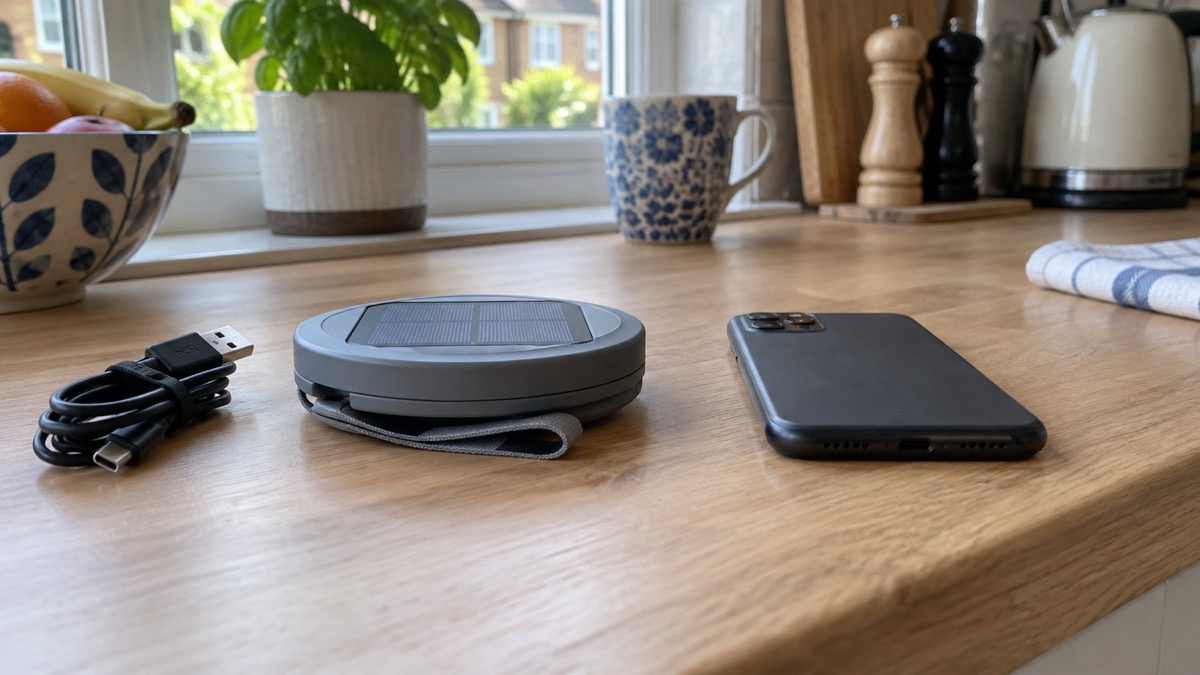
That single figure should shape how you keep it. Solar is the fallback that keeps the lantern alive when there is no socket, and USB-C is what you use when you want it full before an emergency. A USB-C charger can safely provide more power than older USB connectors even without advanced features, which is why the cable matters4.
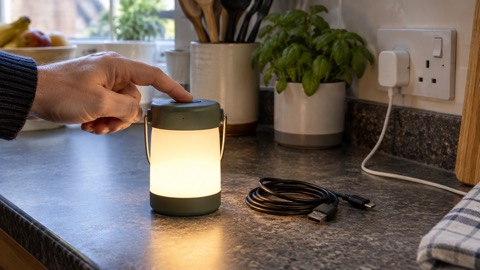
The box contains the lantern and a USB to USB cable1. There is no mains plug, so you will need your own USB charger. Any charger you use should be in good condition; our page on whether the wrong USB charger can damage a torch battery explains what to check.
Outdoors and in a flood: IP67 and 150 lbs crush tolerance
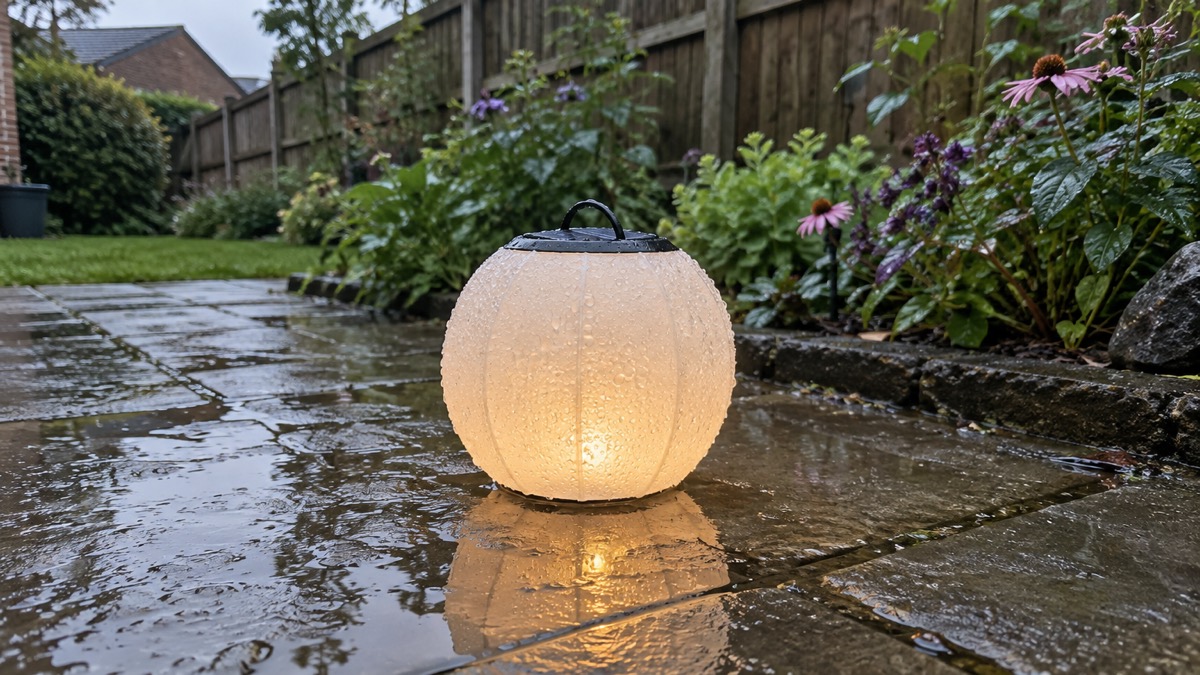
The lantern is rated IP67 for water resistance and the maker states it can withstand up to 150 lbs of pressure1. The same figures appear across the Luci range, described as fully waterproof and able to withstand up to 150 lbs of pressure2. In plain terms, it is built to survive rain, a dunking and being stood on in a kit bag.
That matters in a flood. The British Red Cross advises that your emergency kit could contain a mobile phone charger, medication, drinking water, emergency contact and support numbers, something to wear, and waterproof clothing5. A lantern that keeps working when wet is more useful in that situation than one that has to be kept dry.
It does not make the lantern a diving light, and it does not mean you should charge it wet. The maker's care advice for its range is to wait until a unit is dry before charging it, to blow dust out of the USB-C port before charging, not to put it in a washing machine or dryer, and to avoid adjusting the band when wet6. Follow those instructions as the maker's own.
Using it safely: charging, heat and wet hands
The lantern has a lithium-ion battery, so the fire service advice on charging applies. North Wales Fire and Rescue Service advises charging your device in a room that has a working smoke alarm, which does not compromise your escape route, keeping the door closed while it is charging and away from any heat source7. That is the instruction to follow whenever the lantern is on charge.
Keep it away from flames and heaters. Do not charge it on a soft furnishing where heat cannot escape, and unplug it when it is full.
On wet hands, the safe answer is to dry your hands before handling the cable and the port. The maker's care advice is to wait until the unit is dry before charging6. If a battery is wet or covered with a white powdery substance, the maker says to limit your handling of the battery, handle it only as required for proper removal and disposal, and immediately wash any exposed body surfaces and clothing with soap and water8.
When the battery reaches the end of its life, do not put it in household waste or normal recycling. Fire and rescue services warn that damaged or end-of-life batteries, when punctured or crushed, can cause fires in bin lorries and at recycling and waste centres9. Take it to a proper battery recycling point.
Storing it collapsed in an emergency kit
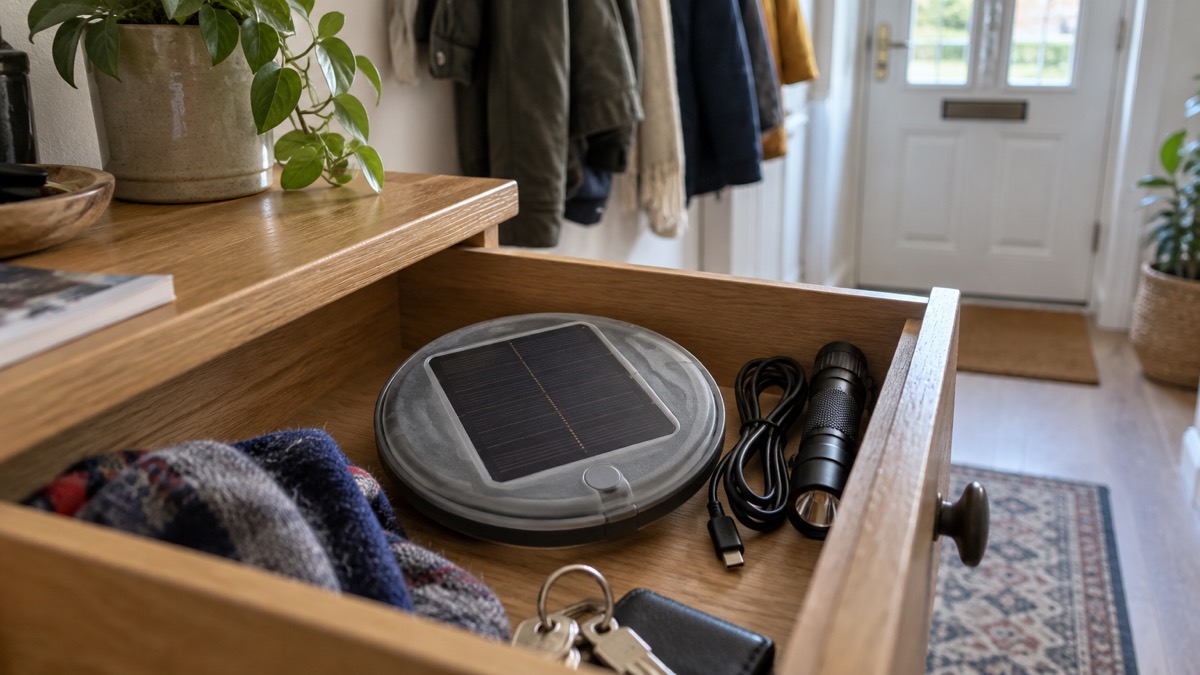
The lantern collapses to 1.5 inches and weighs 10.1 oz (286 g), so it stores flat1. Keep it somewhere you can reach in the dark. The Isle of Anglesey County Council advises storing a battery or wind-up torch somewhere you can access easily, so you can use it to check the fuse box and make your way around the house safely10. A collapsed lantern in a known drawer does the same job.
Build it into a kit rather than leaving it loose. The Scottish Government's emergency kit guidance lists a mobile phone charger among the items to include11. Wiltshire and Swindon Prepared advises keeping your kit in an easy-to-reach place and checking it is filled with the essentials12. Their list includes emergency contact numbers on paper, a battery or wind-up torch, a battery or wind-up radio, a small first aid kit and essential medication, bottled water and long-lasting snacks, copies of key documents, and spare glasses13.
Electricity North West advises regularly charging emergency medical and communications equipment and devices, and says a back-up battery pack will provide extra power if possible14. A charged lantern and a charged phone belong together in that routine.
- Store it where you can find it without a light10.
Where to get help and what to do if something goes wrong
If the lantern will not charge or the battery looks swollen, stop using it and do not charge it. Take it to a battery recycling point rather than household waste, because damaged batteries can cause fires in bin lorries and recycling centres9. If you are unsure whether a charger or cable is safe, our page on recalled and unsafe torches and chargers explains how to check and report.
For fire safety advice at home, your local fire and rescue service offers free home fire safety visits. Our guide to free home fire safety visits explains what they involve and how to ask for one. If you have a concern about a product's safety, report it to the retailer and to the relevant authority.
For general power cut preparation, our power cut guide and the emergency lighting section cover torches, lanterns and safe candle use. If you are choosing lights for an older or disabled household member, our page on lights for older and disabled people sets out what helps.
Sources (14)
- Luci Charge 360 product page, BioLite, 2026-10-25
- Luci Original 3-pack, BioLite, 2026-10-25
- Landlines, National Grid, 2026-10-26
- Chargers guidance, Electrical Safety First, 2026-10-26
- How to prepare for floods and flooding, British Red Cross, 2026-10-25
- Range Series Kit care advice, BioLite, 2026-10-25
- Lithium-ion batteries at home, North Wales Fire and Rescue Service, 2026-10-25
- Battery handling advice, Duracell, 2026-10-26
- E-bike and e-scooter fire safety, Scottish Fire and Rescue Service, 2026-10-25
- Winter ready, Isle of Anglesey County Council, 2026-10-25
- Emergency kit, Scottish Government, 2026-10-22
- Power cut plan.pdf, Northern Powergrid
- At home, Wiltshire and Swindon Prepared, 2026-10-26
- Tips to prepare for a power cut, Electricity North West, 2026-10-25
 NEBO Galileo Tempest 350
 NEBO Leo 800 Flex
 NEBO Poppy Puck Light
 Fenix CL20R V2.0 Lantern
 Fenix CL26R Pro Lantern
 Fenix CL28R Lantern
 Fenix CL30R Power Lantern
 Ledlenser ML4
 Ledlenser ML6
 BioLite AlpenGlow Mini
 MPOWERD Luci Emergency
 MPOWERD Luci Original