MPOWERD is the maker behind the Luci range of solar lights: inflatable lanterns, string lights and lights that can also charge a phone. For a UK household getting ready for emergencies, the range sits in one clear place in the plan: lighting that does not depend on mains power, spare batteries or candles. The maker states that all of its products are solar powered and rechargeable, so no batteries are needed1, which removes the most common failure point in an emergency kit, the flat or missing battery.
The core product for prepping is the Luci inflatable lantern. The Luci Original charges by solar or USB-C, is fully waterproof to IP67 and, the maker states, can withstand up to 150 lbs of pressure1. That combination, waterproof, tough and flat when deflated, is what makes it practical to store in a grab bag or emergency kit and to use outdoors in British weather. This page sets out what each type of MPOWERD light does in an emergency, how to charge and store it, and how to use it safely, alongside the wider emergency lighting and power cut guides.
What MPOWERD makes for UK households
MPOWERD's range falls into three types that matter for emergency preparedness: inflatable solar lanterns, solar string lights, and solar lights with phone charging. All three do the same basic job in different sizes: they turn daylight into stored light you can use after dark, without mains power.
That matters because official advice across the UK consistently puts battery or wind-up lighting at the heart of a home emergency kit. Neath Port Talbot's emergency preparedness checklist calls for a torch, battery or wind-up, at home in the event of an emergency3. Cornwall Council's fire and rescue service advises keeping torches and any batteries to hand in case lighting fails or you need to switch off power5. North Yorkshire Fire and Rescue Service says the same: keep a torch and spare batteries at home6. A solar lantern answers that advice while removing the spare-battery problem, because the light recharges itself from daylight and tops up from a USB-C charger.
The range also covers lighting beyond the single torch. String lights light a whole room or pathway from one solar charge, and lights with phone charging keep a mobile phone alive, which matters because the Met Office's thunderstorm advice is to charge mobile phone devices ahead of severe weather7. Where a household needs more than light, a solar lantern is not a substitute for the bigger kit in our backup power guide, but it covers the two things most households need first in a power cut: seeing, and calling.
Luci solar inflatable lanterns
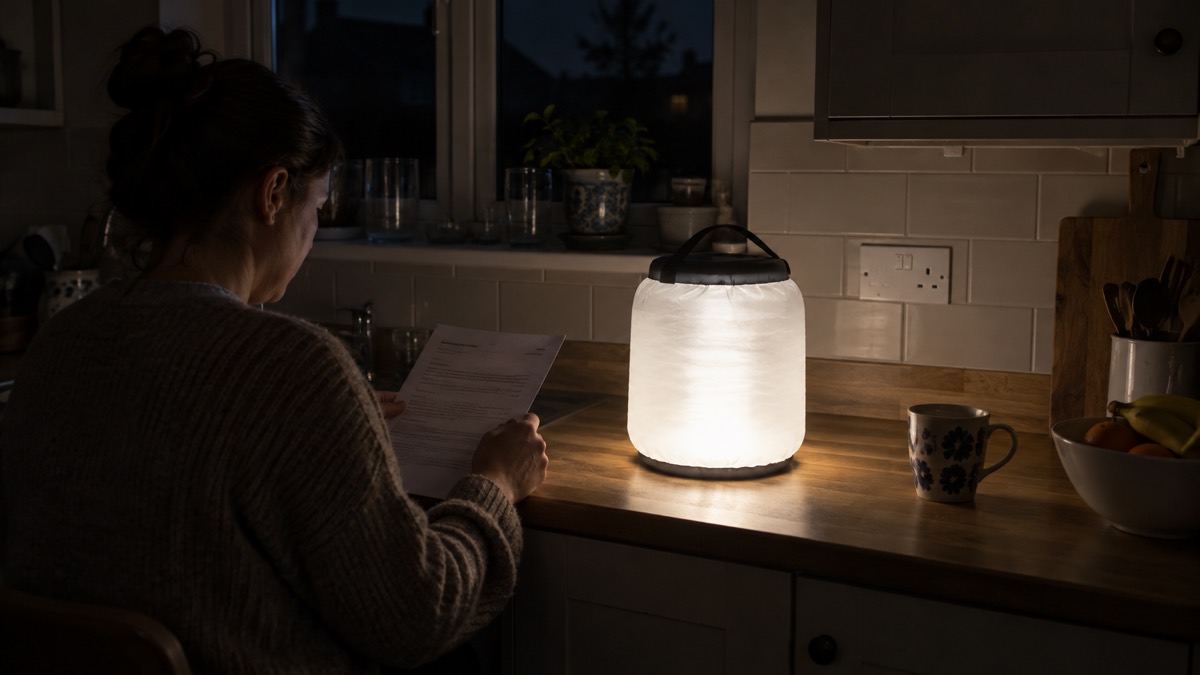
The Luci Original is the range's core lantern, and the one most worth having in an emergency kit. It is an inflatable light: deflated it packs flat, inflated it stands as a room lantern. The maker lists its charging methods as solar or USB-C recharge1, so you can fill it from daylight in the days before a storm and top it up from a wall socket or power bank at any time.
Two specifications do the practical work in an emergency. First, the Luci Original is fully waterproof, IP67 rated1. IP67 means the light keeps out dust and survives immersion, so rain, wet grass, a dropped lantern in a puddle or use around flooding will not stop it. Second, the maker states Luci can withstand up to 150 lbs of pressure1, so it can be packed under other kit, sat on, or knocked about in a grab bag without the fragility of a glass-bodied lantern.
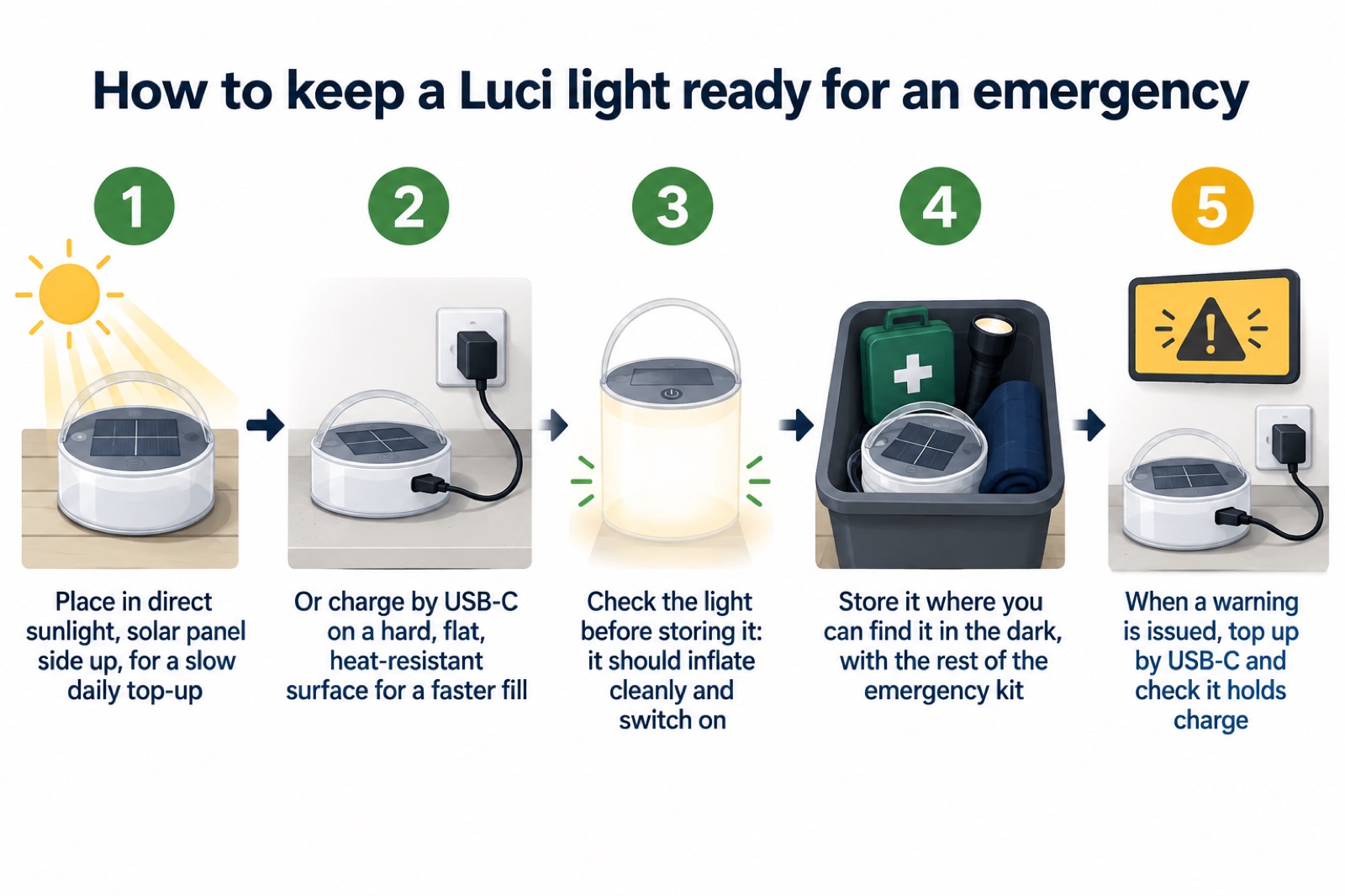
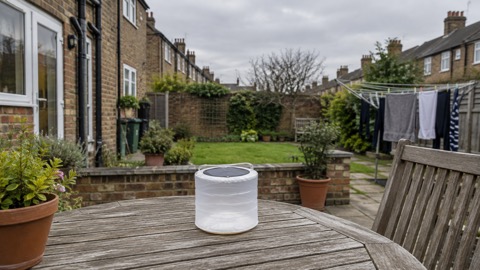
The maker's charging instruction is simple: place in direct sunlight, solar panel side up, or charge via USB-C1. The panel side faces up because that is where the photovoltaic cell sits; face it away from the sun and you gather almost nothing. In a power cut, an inflatable lantern is safest placed on a stable surface rather than hung over a doorway, and it can be carried room to room or outdoors without heat or flame, which is the key difference from candles. Scottish Fire and Rescue Service power cut guidance notes that if you do use candles, lit candles must be kept in candle holders8; a solar lantern removes that risk entirely.
For where a lantern fits a full household kit, see the emergency lighting guide and the emergency kit checklist.
Solar string lights
MPOWERD also makes solar string lights: a run of lights powered from a solar panel and battery rather than the mains. In prepping terms they solve a different problem from a lantern. A lantern lights one spot; string lights spread light along a hallway, staircase, tent or outbuilding, which is exactly where you need to see to move safely in a dark house, and they can mark a path outdoors in a storm or flood without any wiring.
Solar-powered lights work by using photovoltaic (PV) cells to absorb sunlight into a battery for powering the lights at night, as Electrical Safety First explains9. The practical consequence is that the panel placement decides everything: it needs the most daylight you can give it, and the battery holds whatever the panel gathered that day. Independent guidance from The Caravan Club on solar generation shows how much output varies with panel size: a 100W panel produces around 600 to 700Wh over a summer day, while a 25W panel produces around 150 to 175Wh10. A string light's small built-in panel gathers far less than either, so treat it as fair-weather lighting that tops itself up daily, not as kit you can rely on after several dark days.
Keep the panel clear of leaves and snow, and angle it toward the sun rather than leaving it flat in shade. Because string lights are often run outdoors, check the manufacturer's marking for water resistance before relying on them in prolonged rain, and route them so they never cross a trip hazard on stairs or an escape route. For lighting a whole home through a longer outage, combine them with lanterns and torches as set out in the emergency lighting guide.
Solar lights with phone charging
Some lights in the range combine lighting with the ability to charge a phone. For emergency preparedness this is the most valuable pairing, because a working mobile phone is how you call for help, receive flood warnings and check on family, and phone batteries drain fast when networks are busy.
A solar light with phone charging gives you a second way to keep a phone topped up before or during an outage: the light's battery, filled by its solar panel or by USB-C, can then push charge back into a phone. Charging phones and other small devices before the mains fails is standard power cut preparation, and a light that can recharge itself from daylight extends that readiness for as long as the outage lasts.
Two things set expectations. First, a small solar panel charges slowly, so the light's phone-charging function is for topping up a phone for essential calls, not for running it all day. Second, the charging side follows the same rules as any USB charger. Electrical Safety First describes USB Power Delivery over USB-C as the most powerful and flexible option, because the charger and device "talk" to each other to agree on the safest and fastest charging level11. Use a cable and charger in good condition, and see our staying informed guide for how to keep phones useful for as long as possible in an outage.
Charging from sunlight: what to expect
Solar charging is slow and weather-dependent, and planning around that is what makes the kit dependable. The maker's instruction is to place the light in direct sunlight, solar panel side up, or charge via USB-C1. Direct sunlight means the panel sees the sun itself, not light filtered through cloud, shade or an indoor room. For indoor charging, the maker recommends putting the light directly in the sunlight from a windowsill or, for the best results, outside1.
The reliable habit is to top up by USB-C whenever a warning is issued, and let solar keep the light maintained the rest of the time. When you charge by USB, follow the fire and rescue services' lithium battery advice. Manchester Fire and Rescue Service advises charging on a hard, flat, heat-resistant surface, away from extreme heat, cold, direct sunlight and flammable materials12, and its electrical fire safety leaflet gives the same instruction for small electrical items such as phones13. Taunton and Somerset's guidance adds: charge in ventilated areas and avoid enclosed spaces14, and London Fire Brigade advises charging batteries in a cool, dry area out of direct sunlight15. Electrical Safety First adds that USB chargers should be kept away from heat sources and liquids, especially direct sunlight, humidity and water11.
Using solar lights safely in a power cut
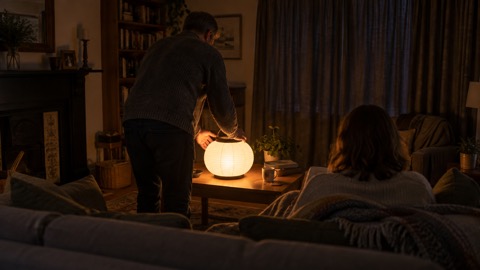
When the power goes, a solar lantern is one of the safest lights you can pick up. It gives off no flame, no significant heat and no carbon monoxide, so it can be used in a sealed room, near children or pets, or in a tent, where a candle never should be. Official power cut guidance is to use safe lighting such as torches rather than candles, and a charged solar lantern means you are not reaching for flames at all.
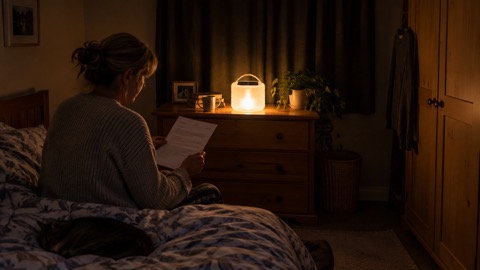
A few habits make the light work well through an outage. Keep the lantern where you can find it in the dark: North Devon Council's emergency planning advice is to keep useful items in one easy-to-find place, ideally somewhere accessible if the lights are not working2. If you need your hands free for care tasks, an NHS letter to families of technology-dependent children ahead of possible power shortages noted that chargeable lamps and headtorches are useful to allow hands to be free for care, and advised getting them before an outage is announced because shops can sell out17.
For households that rely on electrical medical equipment, a solar light is lighting only, and the arrangements that matter are in our extra help guide, including joining your supplier's priority services register. And if the power cut comes with a flood, remember the lantern is waterproof but you are not: official Orkney flood guidance is to wear rubber boots and gloves in and around an affected property18.
Storing your light so it is ready for an emergency
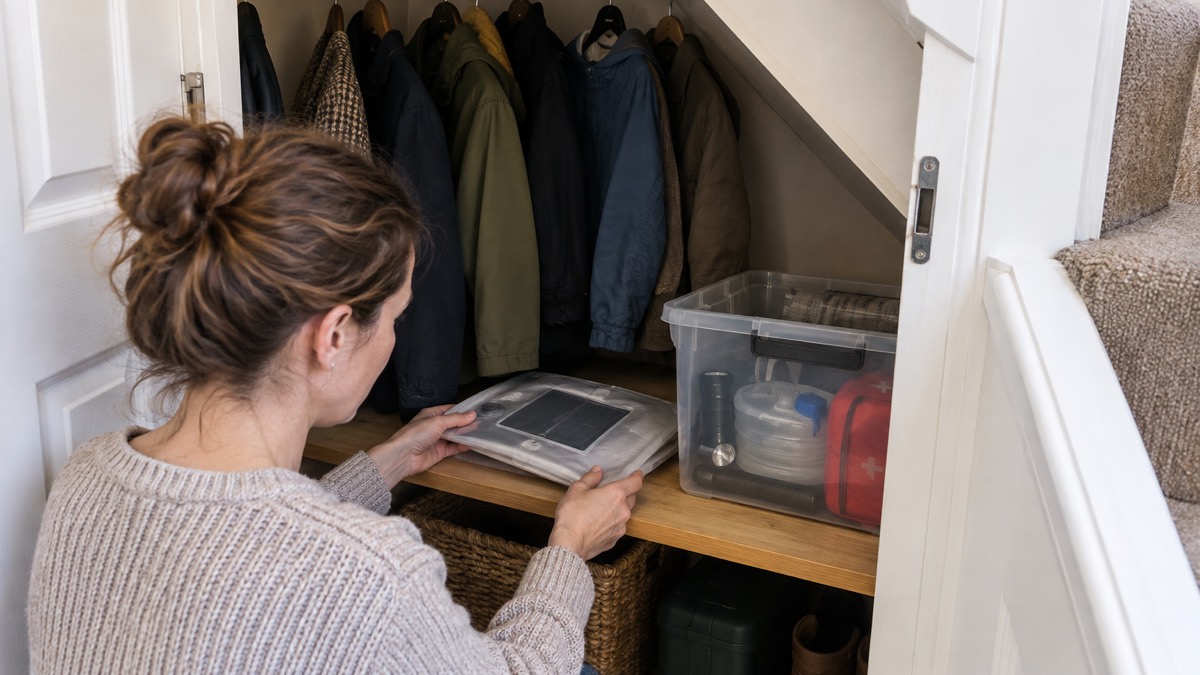
An emergency light only works if it is charged, findable and undamaged when you need it. Store Luci lanterns deflated and flat, which is the point of the inflatable design, and keep the whole household's emergency lighting in one place. Official kit checklists are consistent on this: keep a torch, battery or wind-up, at home in the event of an emergency3, keep torches and batteries to hand in case lighting fails5, and keep useful items in one easy-to-find place, accessible if the lights are not working2.
Check the light periodically rather than assuming it is ready. Inflate it, switch it on, and top it up by USB-C if the battery has drained, since lithium batteries slowly lose charge in storage. Keep it away from heat sources and out of long direct sunlight while stored, following the same cool, dry storage advice the fire and rescue services give for lithium batteries14. Before putting it away, let it dry fully if it has been wet, and check it still inflates cleanly and holds its shape.
Support, warranty and safety notices
MPOWERD's Luci lights are inflatable solar lanterns with a built-in rechargeable battery. If a light is dropped, punctured or its battery is damaged, do not keep using or charging it. Because the battery is sealed inside the unit, a damaged light cannot be repaired by swapping in a new cell: stop using it and replace the light itself.
For safety notices and recalls, the same principle the fire and rescue service applies to portable heaters applies to any electrical product: register your product with the manufacturer, so you can easily be contacted if a safety notice or recall is issued4. Surrey County Council's fire and rescue advice also applies when you buy in the first place: only purchase electrical items from reputable retailers which have the CE or UKCA mark4. If a MPOWERD light is recalled, stop using it and follow the notice.
For faults, contact the retailer you bought it from or the maker directly, keeping your proof of purchase. The pack for this page carries no MPOWERD warranty terms, so check the warranty period stated with your product at the time of purchase rather than relying on a general figure.
Where MPOWERD kit fits a household plan
A solar lantern is the lighting layer of a household emergency kit, not the power layer. It will not run a fridge, a heater or medical equipment, and for those needs see backup power, heating and cooking and extra help. What it does is cover the first hours of almost any emergency, a power cut, a storm, a flood, a night without heating, with safe light you can carry anywhere, recharge from a window of daylight, and store flat for years without buying a single battery.
If you are starting from nothing, read getting started first, then build the emergency kit around whatever lighting you choose, and keep the lantern where the whole household knows to find it in the dark.
Sources (18)
- Luci Original 3-Pack product page, BioLite, 2026
- Be prepared for emergencies, North Devon Council, 2026
- NPT Prepared emergency kit checklist, Neath Port Talbot Council, 2026
- Fire safety at home, Surrey County Council Fire and Rescue Service, 2026
- Snow and ice in Cornwall, Cornwall Council, 2025
- Staying safe in the snow, North Yorkshire Fire and Rescue Service, 2023
- Stay safe in a thunderstorm, Met Office, 2026
- Power cuts: safety at home, Scottish Fire and Rescue Service, 2026
- Outdoor lighting safety advice, Electrical Safety First, 2026
- Solar power technical advice, The Caravan Club, 2026
- Chargers: product safety guidance, Electrical Safety First, 2026
- Battery safety, Manchester Fire and Rescue Service, 2026
- Electrical fire safety leaflet, Manchester Fire and Rescue Service, 2026
- Lithium battery fire safety, Taunton and Somerset Council, 2026
- Extreme weather summer guide, London Fire Brigade, 2024
- Electrical safety: causes of fires, Devon and Somerset Fire and Rescue Service, 2023
- Parental letter re power shortages, NHS, 2022
- What to do during a flood, Orkney Islands Council, 2026
 MPOWERD Luci Emergency
 MPOWERD Luci Original
 MPOWERD Luci Charge 360