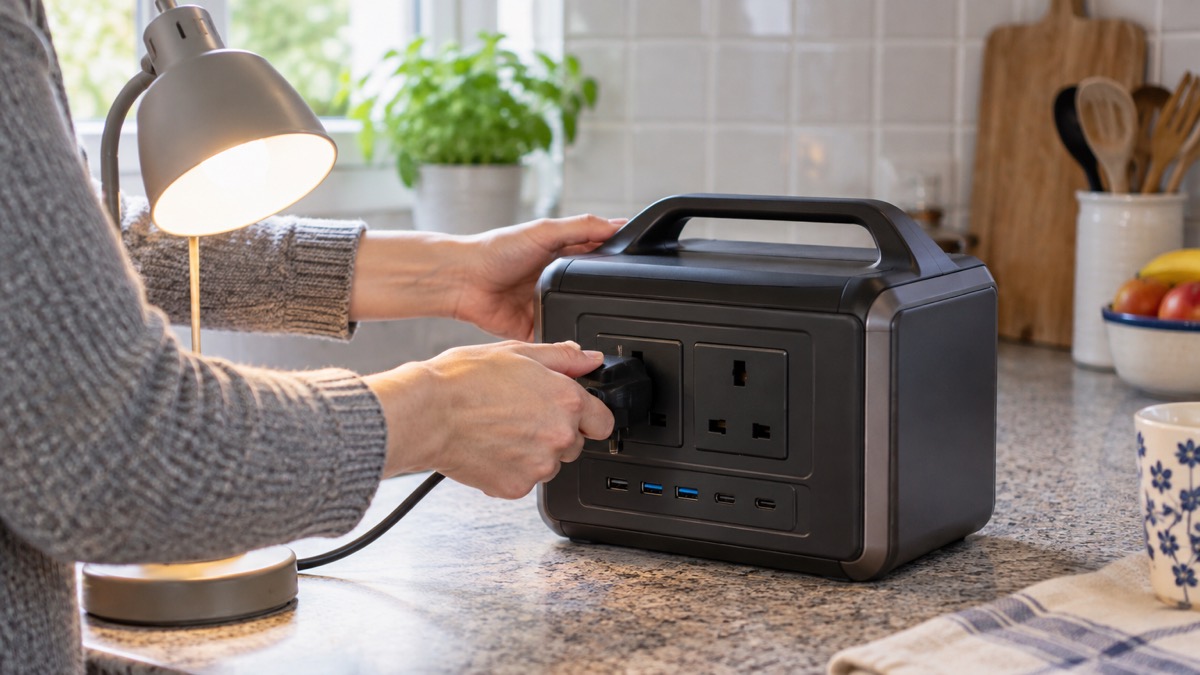
The Hyundai HPS-300 is a small portable power station with a 270Wh battery and two 230V UK sockets, rated at 300W continuous and 600W maximum for short bursts1. In a power cut it will run an electric light for about 11 hours, a laptop for 5 hours or a heated blanket for 4 hours, and it can jump start a car with an engine under 4 litres if you buy the EC5 cable separately2. It weighs 6.2kg, so one adult can carry it between rooms2.
The HPS-1100 is the larger version in the same range: a 1080Wh battery, 1000W continuous and 2000W peak, with the same two 230V sockets and the same jump-start capability3. It weighs 13kg and takes 18.5 hours to charge from the mains3. Both are charged from a 13 amp plug at home or from a foldable solar panel blanket sold separately2.
Neither unit is a substitute for a generator or a home battery. They are quiet, fume-free boxes of stored electricity for lights, phones, a router, a laptop and a few small appliances, and they run out. This page sets out what each model can do, how long it lasts, how to charge it, how to use it safely in cold weather and how to get support in the UK.
HPS-300 and HPS-1100: the two versions and how they differ
The two models share a shape and a set of features, and differ mainly in how much energy they store and how much power they can deliver at once. The HPS-300 holds a rechargeable lithium-ion battery of 25Ah2, and the HPS-1100 holds a rechargeable lithium-ion battery of 100Ah1. The HPS-300 has a built-in LCD display and starts with a switch button2; the HPS-1100's LCD display shows the battery level indicator, output watts, AC/DC ON/OFF indicators and charging time, and it too starts with a switch button1.
| HPS-300 | HPS-1100 | |
|---|---|---|
| Battery capacity | 270Wh, 25Ah lithium-ion2 | 1080Wh, 100Ah lithium-ion3 |
| Continuous power | 300W2 | 1000W3 |
| Maximum (surge) power | 600W, short periods only1 | 2000W peak3 |
| AC sockets | 2 x 230V, pure sine wave2 | 2 x 230V, pure sine wave3 |
| DC outputs | 4 USB, Type-C, 2 DC, 12V port, 1 car jump starter2 | 4 USB, Type-C, 2 DC, 12V port, 1 car jump starter3 |
| Weight | 6.2kg net2 | 13kg net3 |
| Charging time from mains | 5.6 hours2 | 18.5 hours3 |
| Operating temperature | -10 to 40°C2 | -10 to 40°C3 |
| Warranty | 2 years home use, 1 year commercial, 90 days hire2 | 2 years home use, 1 year commercial, 90 days hire3 |
The practical difference is what each will run. The HPS-300 suits lights, phones, a router and a laptop. The HPS-1100's 1000W continuous output brings larger appliances into reach: the maker lists a washing machine for 2.6 hours, an electric kettle for 2.2 hours and a thermal blanket for 15.6 hours3. If you are weighing up which size of unit fits your household, our guide to what capacity power station you need sets out the sums.
What the HPS-300 is: a 270Wh power station with two UK sockets
The HPS-300 is a power station: a battery, an inverter and a set of sockets in one case2. The inverter turns the battery's stored direct current into mains electricity, and the maker specifies a pure sine wave output through two 230V sockets, one 3 pin and one 2 pin1. Pure sine wave is the same shape of supply as the mains in your home, which suits laptops, routers and other electronics.
Around the AC sockets sit the low-voltage outputs: four USB ports for phones, tablets and cameras, a Type-C port, two DC outputs, a 12V port and a car jump starter connection2. The maker describes the USB ports as ideal for smartphones, mp3 players, digital cameras, tablets and notebooks2. A built-in LCD display shows power use, battery remaining and time to full charge1.
The battery is rechargeable lithium-ion, 25Ah at 10.8V, and the unit accepts AC input charging power of 100 to 240V, so it will charge from a standard 13 amp socket at home2. It is not a generator: it makes no electricity of its own and holds only what you put into it. That is why the run times matter more than the headline wattage. For the wider picture of what these units can and cannot do, see portable power stations.
Outputs: 300W continuous, 600W surge on the HPS-300
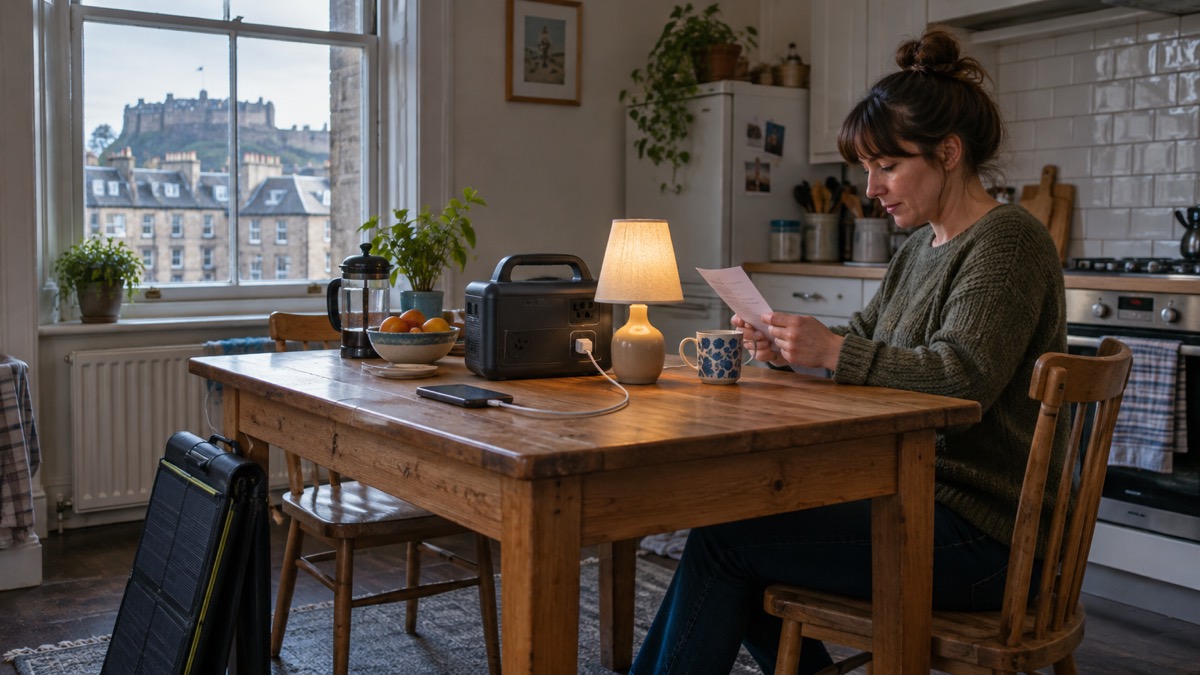
The figure that decides what you can plug in is the continuous rating: 300W on the HPS-3002. Anything that draws more than that for more than a moment will trip the unit's overload protection. The 600W maximum is a surge rating, and the maker is explicit that it is for short periods only1. Motors in fridges and fans draw a burst of extra power as they start, which is what the surge figure is for.
To judge an appliance, look at the wattage on its label or rating plate. Electrical Safety First publishes typical ratings, and they show how quickly a power station's limit is reached: a heated clothes airer of the heated wire type uses 300 watts, a heat pump tumble dryer 800 watts, and a heated air "pod" type airer up to 2300 watts4. The HPS-300 can run the first at its limit and neither of the others. A central heating pump is listed at 300 watts running5, which is the same ceiling.
The HPS-1100 changes the picture: 1000W continuous and 2000W peak3. That covers the tumble dryer and the heated wire airer with room to spare, though not the 2300W pod airer at full draw. For the arithmetic behind these figures, see watts, watt-hours and surge.
Run times in a power cut: about 11 hours of light from the HPS-300
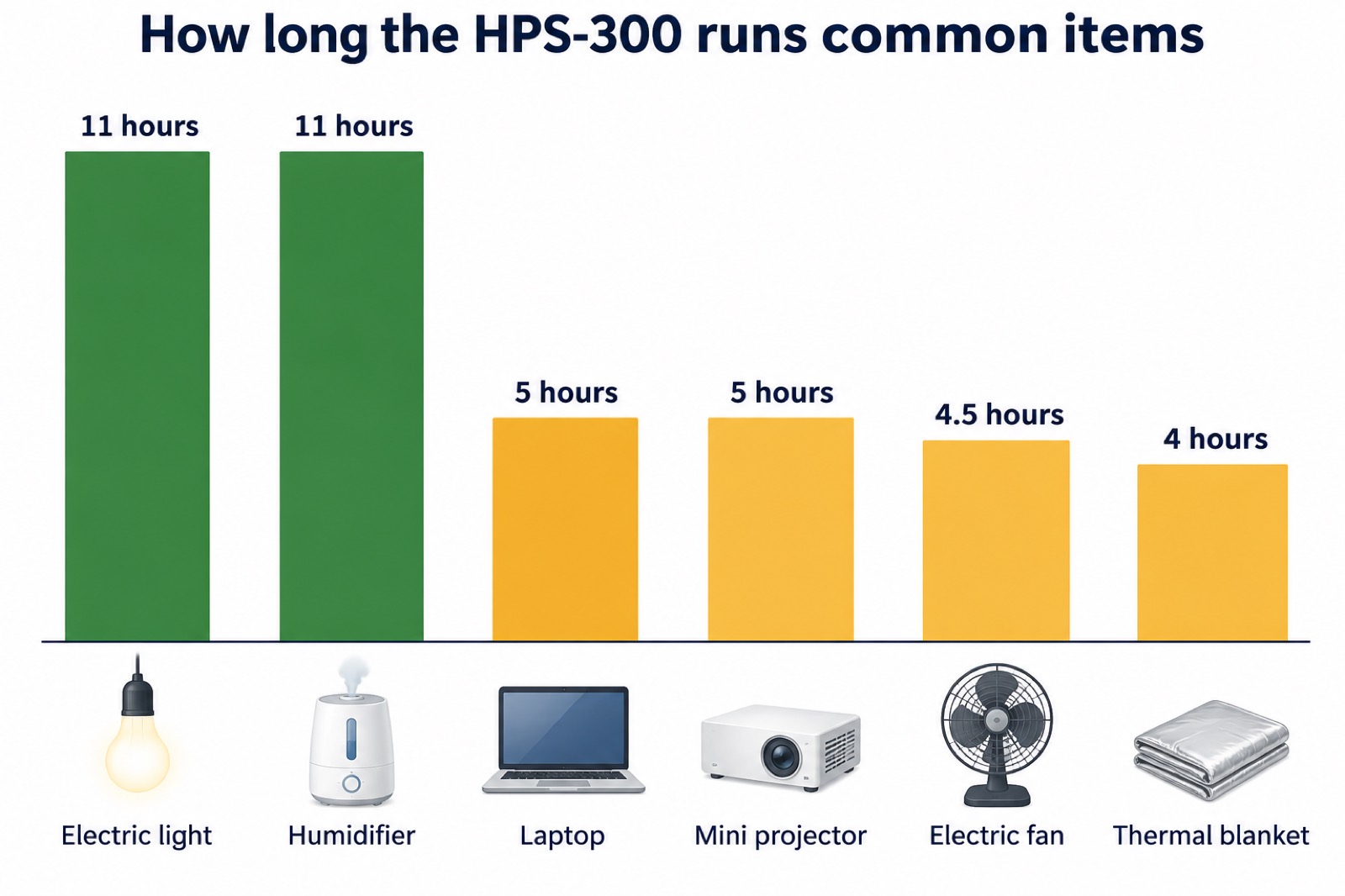
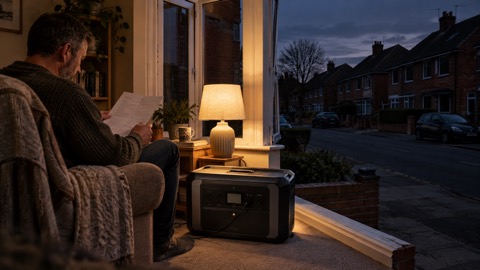
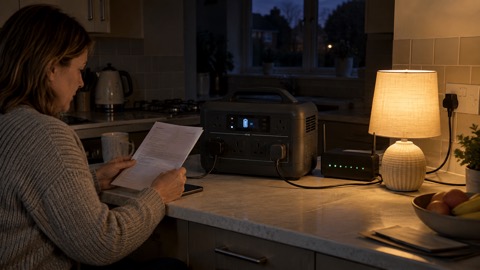
The maker publishes run times for common household items, and they are the most useful guide to what a power cut will feel like with one of these units in the house. On the HPS-300, an electric light runs for 11 hours, a humidifier for 11 hours, a laptop for 5 hours, a mini projector for 5 hours, an electric fan for 4.5 hours and a thermal blanket for 4 hours2. A tablet charges 8 times2.
The HPS-1100's larger battery stretches all of this. The maker lists a mobile phone charged 80 times, a tablet 34 times, an electric light for 42 hours, an electric fan for 16 hours, a laptop for 19 hours, a humidifier for 40 hours, a thermal blanket for 15.6 hours, a mini projector for 22 hours, a washing machine for 2.6 hours, a drone 110 times and an electric kettle for 2.2 hours3.
Two cautions on these figures. They are the maker's own estimates for particular appliances, and a different lamp or laptop will draw a different amount. And they assume a new, fully charged battery: capacity falls with age and with cold. In a long outage, the realistic plan is to run the essentials in turns rather than everything at once. Our guide to how long a power station runs a fridge or laptop explains why the fridge is usually the hardest item to keep going.
Charging from the mains or a solar panel blanket
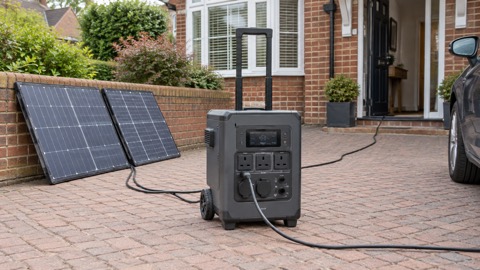
Both models charge from a 13 amp plug at home, and both accept a foldable solar panel blanket sold separately2. The HPS-300 takes 5.6 hours to charge from the mains2; the HPS-1100 takes 18.5 hours3. The HPS-1100 can charge from the mains and from solar at the same time3.
The solar input on both is 5 to 24V at 30W maximum2. That is a small panel input, and it sets expectations: a solar blanket will top the battery up over a sunny day rather than refill it quickly. If you are buying a panel for this purpose, match it to that voltage and wattage range. Our guide to portable solar panels for charging in a power cut covers panel choice, and how long solar charging takes in the UK covers what the weather does to it.
Charging is the point where lithium batteries need care. Fire and rescue services advise registering appliances so that you can be contacted if a fault is found, and note that you will typically need the model name or number, the serial number and the purchase date6. Keep the unit on a hard, non-flammable surface while charging, away from soft furnishings, and follow the maker's instructions in the manual. Our safe battery charging at home checklist sets out the routine.
Safe use and storage between -10 and 40°C
The maker gives an operating temperature of -10 to 40°C for both models1. That is the range in which the unit is designed to work, and it covers a British winter and a British summer. It is not a recommendation to leave the unit in a shed through a frost or in a car on a hot day.
Battery makers are more conservative about storage. Panasonic advises that the ideal storage temperature range for its rechargeable cells is 10 to 25°C7. The two figures are not in conflict: the Hyundai range is what the unit will operate in, the Panasonic range is where a battery lasts best. Store the unit indoors, in a dry place, within the moderate band where you can.
Cold weather brings two practical points. First, a cold battery holds less usable charge, so a unit left in an unheated garage will not deliver its full run time. Second, charging a very cold battery is best avoided: bring the unit indoors and let it reach room temperature before plugging it in. Our guide to charging lithium batteries below freezing goes into the detail, and what temperature batteries should be stored at covers the storage side.
The unit also carries a set of built-in protections: over voltage, overload, over temperature, short circuit, low temperature, low voltage and overcurrent protection1. These are safeguards, not a licence to overload the unit. For the wider risks of lithium batteries at home, see lithium-ion battery safety at home.
Jump starting a car: engines under 4 litres only
Both models can be used as a vehicle jump starter, but only on vehicles with engines under 4 litres, and only with an EC5 connector cable, which is sold separately2. Without the cable the function cannot be used at all, so if you plan to keep the unit in the car through winter, buy the cable with it.
The jump-start function is a winter convenience rather than a substitute for proper vehicle preparation. The Met Office advises drivers to take a fully charged mobile phone with an in-car charger or battery pack, and to check wipers, tyres and screen wash before setting out8. The RAC, in Met Office reporting, advises a warm waterproof coat, sturdy footwear and gloves, a blanket and a power bank to keep your phone charged9. A power station in the boot covers the phone-charging part of that list and, with the EC5 cable, the flat battery part.
Vehicle preparation matters more than the jump pack. The Met Office advises topping up screenwash with a product effective down to at least -15 degrees Celsius10, and Northern Ireland's nidirect service advises topping up anti-freeze and screenwash and using at least dipped headlights in poor visibility11. The Met Office's winter car kit advice includes an ice scraper12, and the Scottish Government's emergency kit guidance lists one too13. Our backup power checks before winter covers the household side.
Warranty, support and stock in the UK
Both models carry the same warranty: 2 years for home use, 1 year for commercial use and 90 days for hire2.
Stock moves. At the time the product pages were checked, the HPS-300 was listed as sold out, as was the HPS-1100, and the HPS-300 bundle with the shoulder bag was also sold out1. That is a snapshot, not a permanent state, so check the maker's page before planning around a particular model. The HPS-300's EAN is 5056275755829 and the HPS-1100's is 5056275755843, which helps confirm you have the right model when it arrives2.
The HPS-300 sits below the HPS-600 in the same range: the maker describes the HPS-300 as offering approximately half the power of the HPS-60014. If your needs are larger than the HPS-300 can meet but the HPS-1100 is more than you want, that middle model is worth a look. For the wider choice across makers, see portable power stations: what they do and how to choose, and for the HPS-1100 on its own, see Hyundai HPS-1100.
Sources (14)
- Hyundai 600W Portable Power Station HPS-300, Hyundai Power Equipment, 2026-10-25
- Hyundai HPS-300 Portable Power Station with Protective Carry Shoulder Bag, Hyundai Power Equipment, 2026-10-25
- Hyundai 2000W Portable Power Station HPS-1100, Hyundai Power Equipment, 2026-10-25
- Ratings of electrical appliances, Electrical Safety First, 2026-10-25
- Power chart, Just Generators, 2026-10-25
- Electrical safety at home, Scottish Fire and Rescue Service, 2025-02-27
- eneloop FAQ, Panasonic, 2026
- Met Office weather ready tips for snow and ice, Met Office, 2025-11-19
- Disruptive snow possible next week, Met Office, 2024-01-11
- 6 things to do to prepare your vehicle for winter weather, Met Office, 2026-10-25
- Ice weather warning: information and advice, nidirect, 2026-02-16
- Winter car kit, Met Office, 2026-10-25
- Emergency kit, Ready Scotland, 2026-10-22
- Hyundai 1000W Portable Power Station HPS-600, Hyundai Power Equipment, 2026-10-25
 BLUETTI Apex 300 Power Station
 BLUETTI Elite 100 V2
 Anker SOLIX C2000 Gen 2
 Anker SOLIX C1000 Power Station
 EcoFlow DELTA Pro
 BLUETTI Elite 400
 Anker SOLIX C300 Power Station
 EcoFlow DELTA 3
 EcoFlow DELTA 2 and DELTA 2 Max
 EcoFlow DELTA and DELTA Max
 EcoFlow RIVER 3 and RIVER 3 Plus
 EcoFlow RIVER 2 and RIVER 2 Max