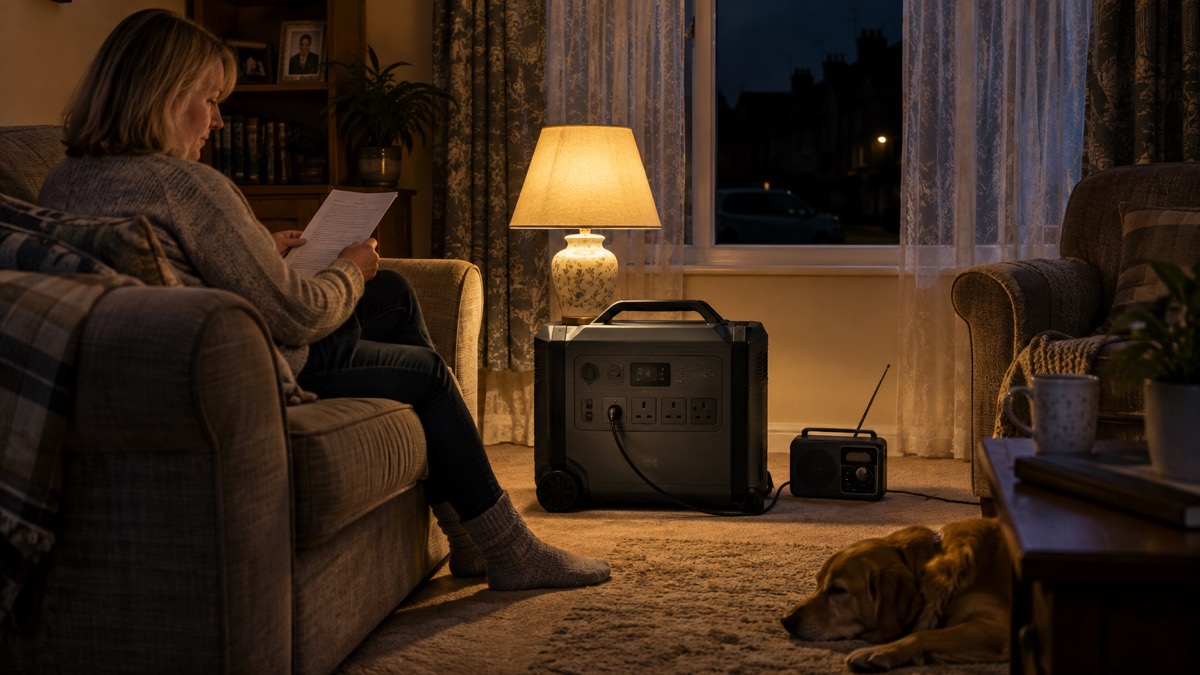
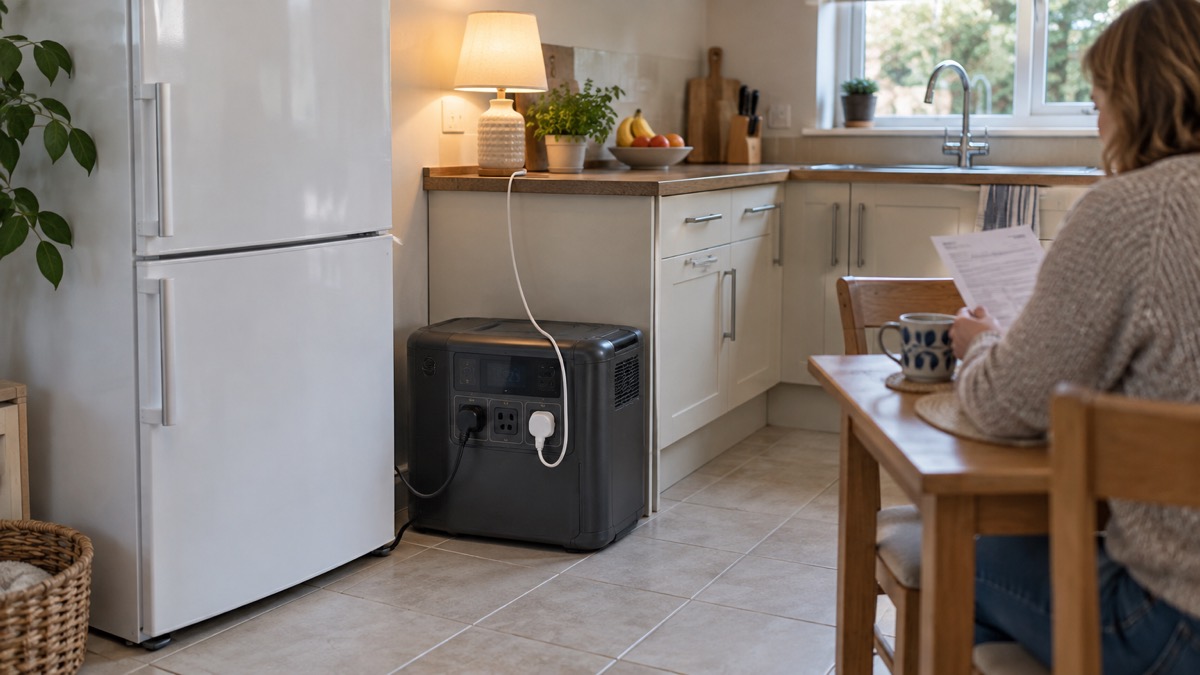
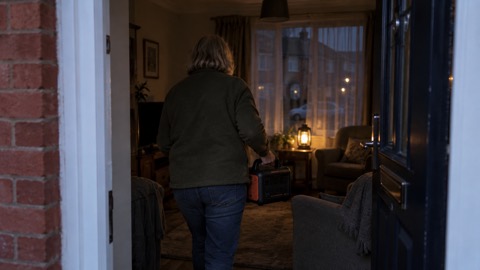
The BLUETTI AC200L is a portable power station with a 2,048Wh battery, four 230V sockets delivering 2,400W in total, and a 7,200W surge for appliances that draw a burst of power when they start1. For a household, that means it can run a fridge, a microwave, lights, a router and phone chargers through a power cut, provided you plan what goes on it and for how long.
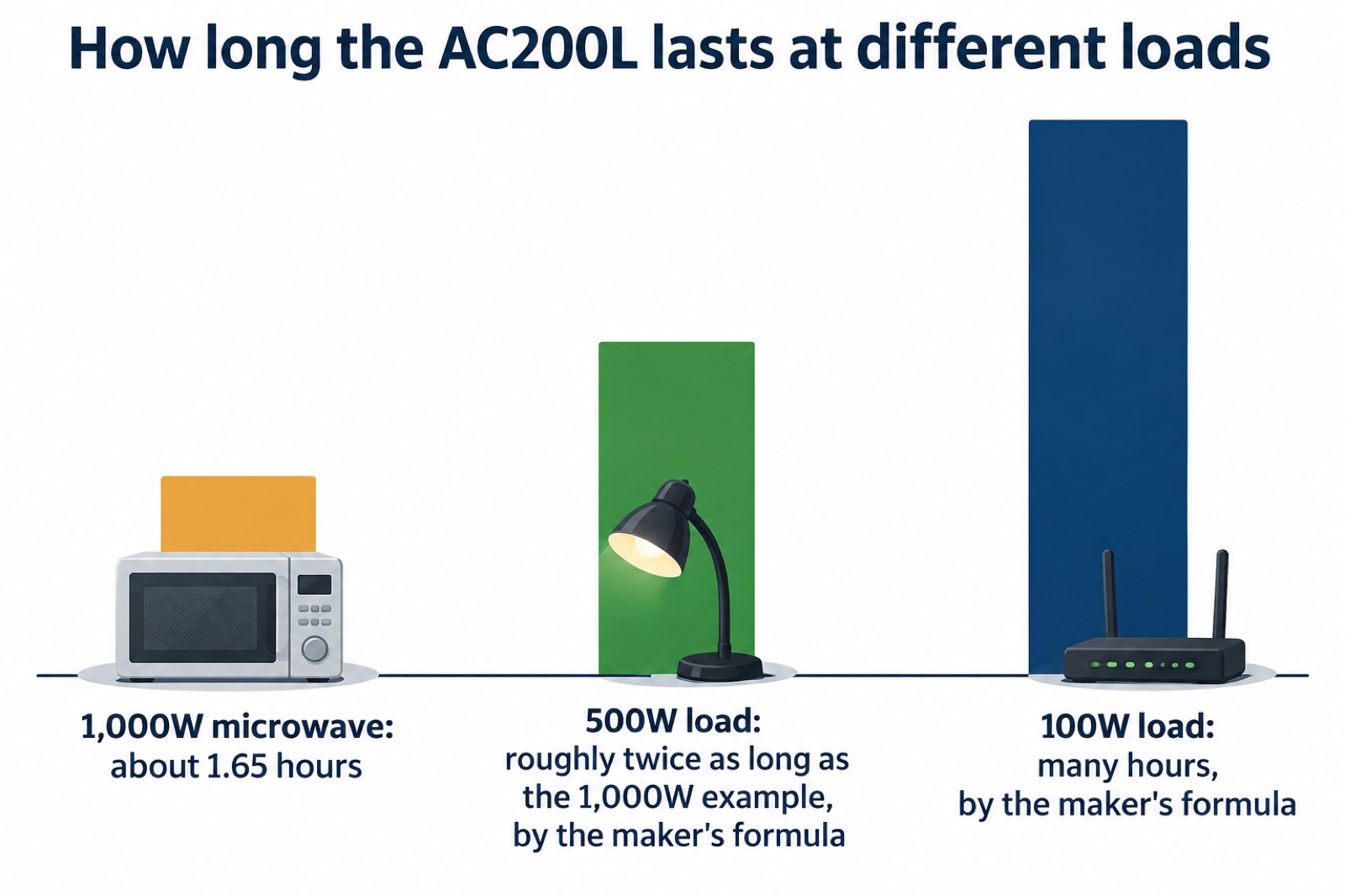
The headline limit is run time. BLUETTI's own worked example puts a 1,000W microwave at about 1.65 hours from a full battery, using the maker's formula of capacity times depth of discharge times efficiency, divided by the appliance's rated power1. Lower-draw items stretch much further. The unit weighs 28.3kg, so it is a move-once, leave-it-in-place piece of kit rather than something you carry up stairs1.
This page sets out what the AC200L can and cannot do, how to charge it from the mains, solar or a car, how to store it between emergencies, and the safety rules that come with it. It is a named product page: the specifications are the maker's own, and where the maker gives an instruction, it is quoted as the maker's instruction.
What the AC200L is and who it suits
The AC200L sits in the middle of the portable power station market: big enough to carry a household through a short outage, small enough to wheel or carry into position once. Its battery is LiFePO4, lithium iron phosphate, which BLUETTI notes it was among the first to adopt in portable power stations2. The maker rates it for 3,000 or more cycles to 80% of original capacity, so occasional emergency use will not wear it out quickly1.
It suits a household that wants a single unit to keep the fridge, the router, some lighting and a few small appliances going for a few hours, and that is prepared to plan what runs on it. It does not suit someone who wants to run the whole house, including an electric shower or an oven, for days: the capacity and the 2,400W output will not stretch to that, and the unit is not designed to be wired into the home's circuits.
The unit has a pure sine wave inverter, which matters for anything with a motor or a sensitive power supply, and it offers pass-through charging, so it can sit between the mains and a device and keep running while it charges1. BLUETTI also lists a UPS switchover of 20ms, which is fast enough for many devices to ride through a brief interruption1. For more on what that means in practice, see Using a Power Station as a UPS: Switchover Times.
Specifications at a glance
The table below collects the maker's figures. Where a retailer lists a different figure, the maker's figure is given here.
| Specification | Figure |
|---|---|
| Battery capacity | 2,048Wh (51.2V, 40Ah)1 |
| Battery chemistry | LiFePO41 |
| AC output | 2,400W total, 4 x 230V/10.5A sockets1 |
| Surge power | 7,200W1 |
| Power lifting mode | 3,600W1 |
| AC input | 2,400W maximum3 |
| Solar input | 1,200W maximum, 12V to 145V DC, 15A3 |
| Car input | 12V or 24V from a cigarette lighter port1 |
| USB outputs | 2 x 100W USB-C, 2 x 18W USB-A1 |
| DC outputs | 1 x 48VDC/8A RV outlet, 1 x 12V/10A car outlet, all regulated1 |
| Inverter type | Pure sine wave1 |
| UPS switchover | 20ms1 |
| Noise | 50dB or less1 |
| Weight | 28.3kg (62.4lbs)1 |
| Dimensions | 42 x 28 x 36.65cm1 |
| Warranty | 5 years1 |
| Certifications | UL2743, UKCA, TELEC, RCM, FCC ID, CE, PSE, NTC1 |
The UKCA marking in that list is the one that matters for a UK buyer: it is the marking the unit carries for the UK market, alongside the CE marking used in the EU1. For what the markings mean, see UKCA, CE and Battery Safety Markings Explained.
What it can power, and for how long
The maker's formula is the key to planning: running time equals battery capacity times depth of discharge times inverter efficiency, divided by the appliance's rated power, and for the AC200L both the depth of discharge and the efficiency are 90%1. That is why a 1,000W microwave gets about 1.65 hours rather than the two hours a simple division of 2,048 by 1,000 would suggest1.
The practical consequence is that low-draw items last a long time and high-draw items do not. A fridge, a router, a lamp and a phone charger together might draw a few hundred watts, so the unit will run them for many hours. A kettle, a heater or a microwave will flatten it in a couple of hours or less. Plan the outage around the low-draw items and use the high-draw ones in short bursts.
The 7,200W surge matters for appliances with motors, such as a fridge compressor starting up, because the start-up draw can be several times the running draw1. The 2,400W continuous output is the figure to check against the appliance's label: add up everything you plan to run at once and keep it below that. For the arithmetic behind this, see Watts, Watt-Hours and Surge Explained.
Adding expansion batteries
The AC200L's capacity can be increased with BLUETTI's own expansion batteries, and the maker gives the resulting totals. With two B300 packs the system reaches 8,192Wh; with two B210 packs it reaches 6,348Wh; with one B230 it reaches 4,096Wh1. The maker lists the supported combinations as up to two B210, one B230 or two B3001.
| Expansion | Total capacity |
|---|---|
| AC200L alone | 2,048Wh1 |
| AC200L + 1 x B230 | 4,096Wh1 |
| AC200L + 2 x B210 | 6,348Wh1 |
| AC200L + 2 x B300 | 8,192Wh1 |
The maker also states that the system can hold two batteries at once and that packs can be swapped for continuous power use1. That is useful if you want to run a long outage in shifts: one pack in use, one charging. A combined AC200L and B300K setup is listed by the maker at 2,200W output and 4,812.8Wh capacity4, which is a different configuration from the AC200L alone and worth checking against the maker's page if you are considering it.
Third-party expansion batteries cannot be connected1. That is a firm instruction from the maker, and it matters for safety and warranty: the system is designed around BLUETTI's own packs and their management electronics.
Charging it: mains, solar and car
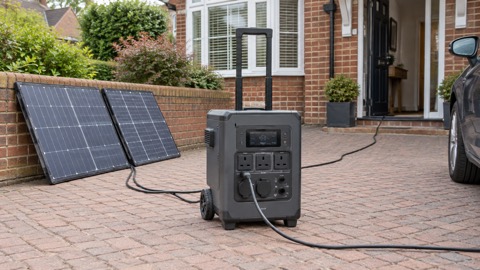
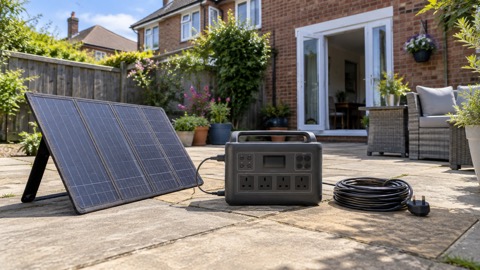
The AC200L can be charged from the mains, from solar panels, from a car outlet, or from a combination. From the mains at 2,400W it reaches 80% in about 45 minutes and a full charge in about 1.5 hours, and it needs no external charging adapter for AC charging1. From solar at 1,200W the maker gives about 2 hours in prime sunshine with ideal orientation and low temperature, and AC plus solar together gives about 1.5 hours under the same conditions1.
The solar input accepts 12V to 145V DC at up to 15A, with MC4 connectors1. The maker's own panel suggestions are 6 x PV120S at about 3.5 hours, 4 x PV200 at about 3 hours, or 2 x PV350 at about 3.5 hours, marked for reference only1. Those times assume good sun; a UK winter will be slower. For more on panel choice, see Portable Solar Panels for Charging in a Power Cut.
From a car, the input is 12V or 24V from a cigarette lighter port, and the maker gives about 10 or 20 hours at 100W or 200W1. That is a top-up, not a fast charge. For the practicalities, see Can You Charge a Power Station from Your Car?.
Using it safely outdoors and in the cold
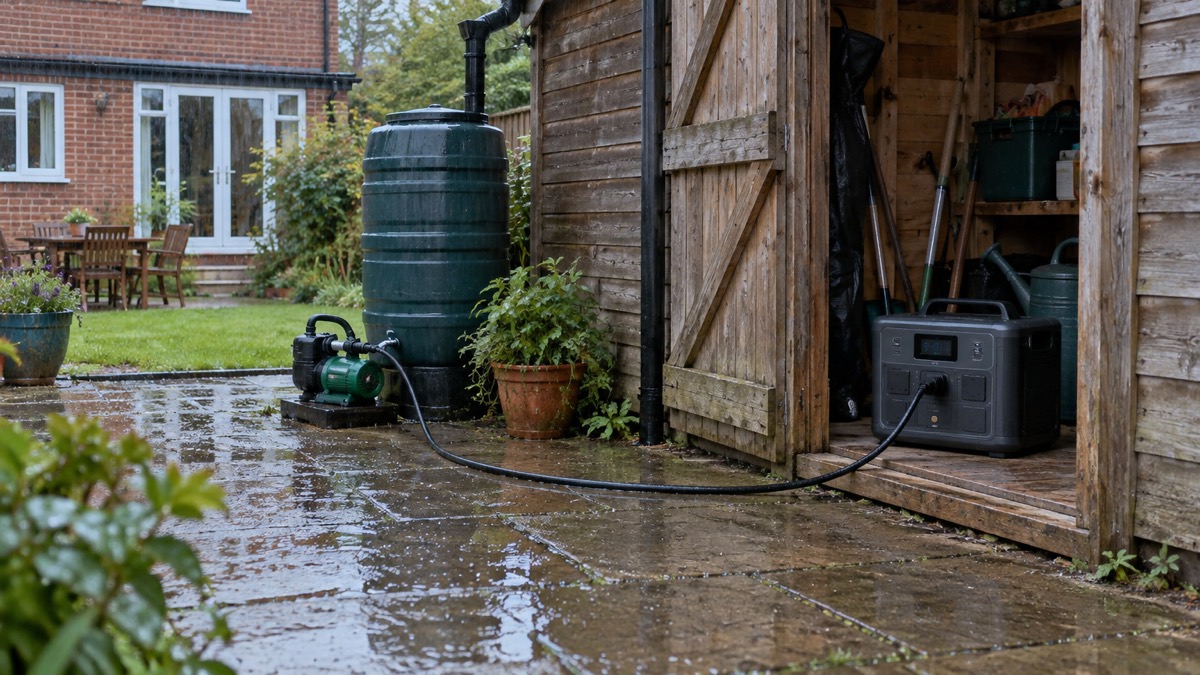
The AC200L is not waterproof, and BLUETTI says so directly1. Keep it out of rain, away from splashes and off wet ground. If you need power in the garden or at a campsite in wet weather, site the unit under cover and run an extension lead to the appliance, rather than exposing the unit itself. The maker's own product page gives no water-resistance rating for the AC200L, so treat it as an indoor and dry-shelter unit only1.
Cold weather is the other limit. The maker says the unit can power devices in cold weather but should not be recharged below freezing1. That means the unit can run in a cold garage, but it should not be charged there if the temperature is at or below freezing. If you keep it in a shed or garage, bring it indoors to charge, then return it once charged if you need it there.
Storing it between emergencies
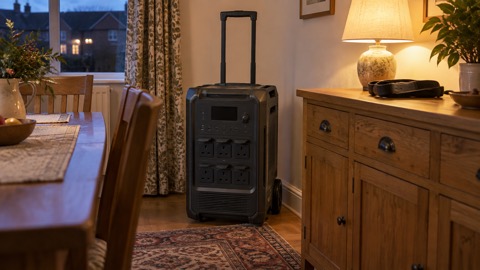
Store the AC200L where you can reach it easily and where it will stay dry. Official emergency kit guidance for Northern Ireland says the kit should be kept somewhere in the house where everyone can get to it5, and Carmarthenshire council's guidance says to keep it in a safe place at home where you can reach it easily, in a waterproof bag6. Those principles apply to a power station as much as to a torch: a unit buried at the back of a shed is no use in a cut.
The maker's shelf-life instruction is to recharge to 80% every 3 to 6 months1. That keeps the battery healthy and means the unit is ready when you need it. Store it away from damp, somewhere it will not be knocked or have things stacked on it, and somewhere it will not sit below freezing if you plan to charge it there1.
- Keep it dry and under cover, in a place everyone in the household knows5.
- Recharge to 80% every 3 to 6 months1.
- Do not store it below freezing if you plan to charge it there1.
For more on this, see How to Store a Power Station When Not in Use and What Temperature Should Batteries Be Stored At?.
Warranty, app and support
BLUETTI gives the AC200L a 5-year warranty1. That is longer than the maker's general 2-year figure for portable power stations, which appears on a separate BLUETTI warranty page alongside 5 years for the EP500Pro and 4 years for the AC300 and B3007. The AC200L's own product page states 5 years, and that is the figure to rely on for this model1.
The BLUETTI app connects over Bluetooth and WiFi and lets you control the unit remotely, including switching the working mode, and apply firmware upgrades1. The unit's management system includes an MPPT controller and a battery management system1. If something goes wrong, support runs through BLUETTI, and the warranty is the route for a failed battery, since the built-in battery is not replaceable by the owner1.
The unit carries a range of certifications including UKCA and CE1. For a UK buyer, the UKCA marking is the relevant one. For what to check on the box and the label, see UKCA, CE and Battery Safety Markings Explained.
Where it fits in a household plan
A power station is one option among several for a power cut, and it suits some households better than others. It is quiet, it produces no fumes, and it can be used indoors, which a petrol generator cannot. It is also heavy and finite: 28.3kg and 2,048Wh will not run a house for days1. A generator has more endurance but brings fuel storage, noise and carbon monoxide risks. For the comparison, see Portable Power Station or Petrol Generator for a Power Cut.
Before buying, decide what you want to keep running. The Deciding What to Keep Running When the Mains Fails page walks through that, and What Capacity Power Station Do I Need? helps size the unit. If you already have the AC200L, the Power Cut Backup Power Checklist is a practical list to work through before winter.
BLUETTI is the maker, and its UK pages carry the specifications and instructions quoted here. For the brand's wider range, see BLUETTI. For the general subject, see Backup Power at Home: A Household Guide.
Sources (6)
- BLUETTI AC200L product page, BLUETTI, 2026-10-25
- Home backup, BLUETTI, 2026-10-25
- Elite 200 V2 500W comparison page, BLUETTI, 2026-10-25
- AC300 and B300K page, BLUETTI, 2026-10-25
- Household emergency kit, nidirect, 2026-07-06
- Get prepared, Carmarthenshire County Council, 2026-10-25

 BLUETTI Apex 300 Power Station
 BLUETTI Elite 100 V2
 Anker SOLIX C2000 Gen 2
 Anker SOLIX C1000 Power Station
 EcoFlow DELTA Pro
 BLUETTI Elite 400
 Anker SOLIX C300 Power Station
 EcoFlow DELTA 3
 EcoFlow DELTA 2 and DELTA 2 Max
 EcoFlow DELTA and DELTA Max
 EcoFlow RIVER 3 and RIVER 3 Plus
 EcoFlow RIVER 2 and RIVER 2 Max