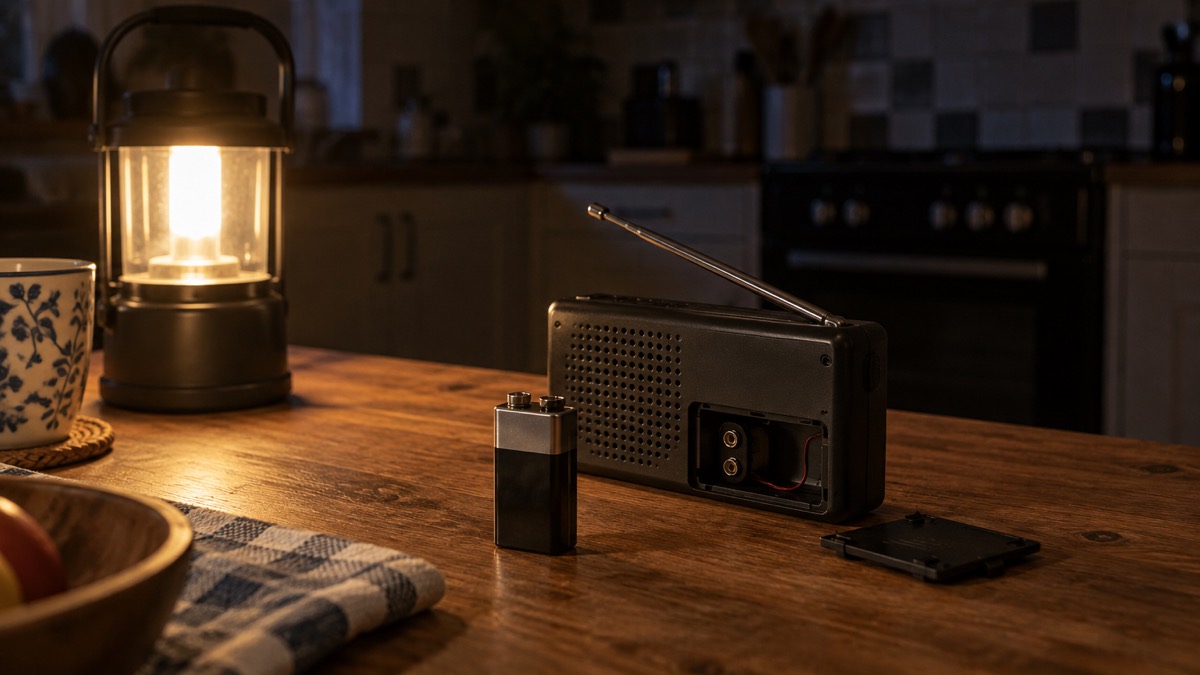
The GP1604S is a 9 volt carbon zinc battery that the maker, GP Batteries, describes as giving good performance on moderate to low-drain devices1. In a household emergency kit that means the sort of job a 9V cell usually does: a battery radio, a torch that takes a 9V block, a telecare pendant or a small meter. It is not a battery for power-hungry equipment, and the maker's own test figures show why.
Those figures are the thing to know before you buy. On a light load, drawing through 620 ohms for 2 hours a day, the GP1604S ran for 26.5 hours down to a 5.4V end point1. On a heavier load, 180 ohms for 30 minutes a day, it ran for 7 hours down to 4.8V1. Same battery, very different running time, because the device decides how fast the energy goes.
For a household getting ready for a power cut, a storm or a winter outage, that makes the GP1604S a sensible spare to hold rather than a battery to build a kit around. Keep a couple where you can find them in the dark, check the date on them, and know which of your devices they fit.
GP1604S: a 9V carbon zinc battery for moderate to low-drain devices
The chemistry is the first thing to understand, because it sets what the battery is for. The GP1604S uses carbon zinc chemistry and the maker's own description is that it gives good performance on moderate to low-drain devices1. Carbon zinc is the traditional general-purpose cell: it does steady, modest work well and is not built for the sudden heavy current that motors or cameras demand.
In practice, that means thinking about what you are asking the battery to do during an emergency. A battery radio left on for news bulletins through a long power cut is a moderate load, and a 9V block is a common fitment for small sets. A torch used in short bursts is similar. A device that runs a motor, a pump or a bright lamp draws far more, and the maker's heavier test is the honest guide to how quickly the cell will give out under that sort of demand.
The battery is a 9 volt block, the rectangular shape with two terminals on top that has been standard in UK homes for decades. It is not rechargeable, so it is a store-and-replace item rather than something you top up. That matters for planning: your stock of 9V cells is a finite resource during an outage, and the way to manage it is to know how many devices need one, how long each runs, and how many spares you hold.
Where the GP1604S fits a household plan is therefore narrow but useful. It is the spare that keeps a radio or a small torch going when the mains is off, and it is the sort of item official guidance expects you to have already checked and stored2. It is not the battery that runs a pump, a power tool or anything with a motor, and treating it as one will leave you short.
GP1604S and 1604S: how the names differ
You will see the battery written both ways. The maker's datasheet titles the product GP1604S1. The shorter 1604S is the same product with the prefix dropped, the sort of shorthand that appears on retail listings and in conversation.
The number itself is worth recognising. The 1604 family is the long-standing designation for a 9V block, so a device that asks for a 1604, a 6F22 or a 6LR61 is asking for the same shape and voltage. If your radio's battery compartment is stamped with any of those, a GP1604S will physically fit. What differs between one 9V battery and another is the chemistry inside and therefore the running time, not the size.
That is the practical point for a household: match the shape and the voltage first, then think about the chemistry. A carbon zinc cell and an alkaline cell of the same size will both power the same device, but they will not last the same number of hours, and the maker's figures for the GP1604S apply to the GP1604S only. Do not carry a service life figure across from one chemistry to another.
If you are comparing what is available, the site covers other 9V blocks separately, including the GP1604A 9V battery, the Duracell MN1604 9V alkaline battery, the Energizer 9V alkaline battery, the Energizer 9V lithium battery and Raymax 9V batteries. Each has its own datasheet and its own figures; read them side by side rather than assuming they are interchangeable in performance.
Specifications: 9 volts, carbon zinc, about 35g
The headline specification is simple. The GP1604S is a 9 volt battery with carbon zinc chemistry and an average weight of 35g1. The weight is the figure that matters most for a grab bag or a car kit, because it tells you a spare 9V block costs you almost nothing to carry.
| Specification | GP1604S |
|---|---|
| Voltage | 9 volts1 |
| Chemistry | Carbon zinc1 |
| Average weight | 35g1 |
| Best suited to | Moderate to low-drain devices1 |
| Light-load service life | 26.5 hours (620 ohms, 2 hours a day, 5.4V end point)1 |
| Heavier-load service life | 7 hours (180 ohms, 30 minutes a day, 4.8V end point)1 |
| Test temperature | 20 degrees Celsius1 |
| Test timing | Within 30 days of manufacture1 |
Read the table as a set of conditions rather than a promise. Every service life figure on it was produced under a stated load, a stated end point voltage and a stated temperature, and change any of those and the number changes with them. The 35g weight, by contrast, is a straightforward physical fact and the one figure you can rely on without qualification.
For kit planning, the useful comparison is with the other things in your bag. A 9V block at 35g is lighter than most torches and far lighter than a power bank, so there is little argument for leaving a spare out on weight grounds1. The argument for limiting how many you carry is about how many devices you actually own that take one, not about the burden of carrying them.
Service life: 26.5 hours on a light load, 7 hours on a heavier one
The two service life figures are the heart of the datasheet, and they are best understood as a pair. On the lighter test, 620 ohms at 2 hours a day, the battery delivered 26.5 hours before reaching a 5.4V end point1. On the heavier test, 180 ohms at 30 minutes a day, seven days a week, it delivered 7 hours before reaching a 4.8V end point1.
The gap between 26.5 and 7 is the whole lesson. The heavier test draws more current, so the same store of energy is spent faster and the battery reaches its cut-off sooner. If you know roughly where your device sits between those two loads, you can estimate whether a spare will see you through a single evening or a couple of days of bulletins.
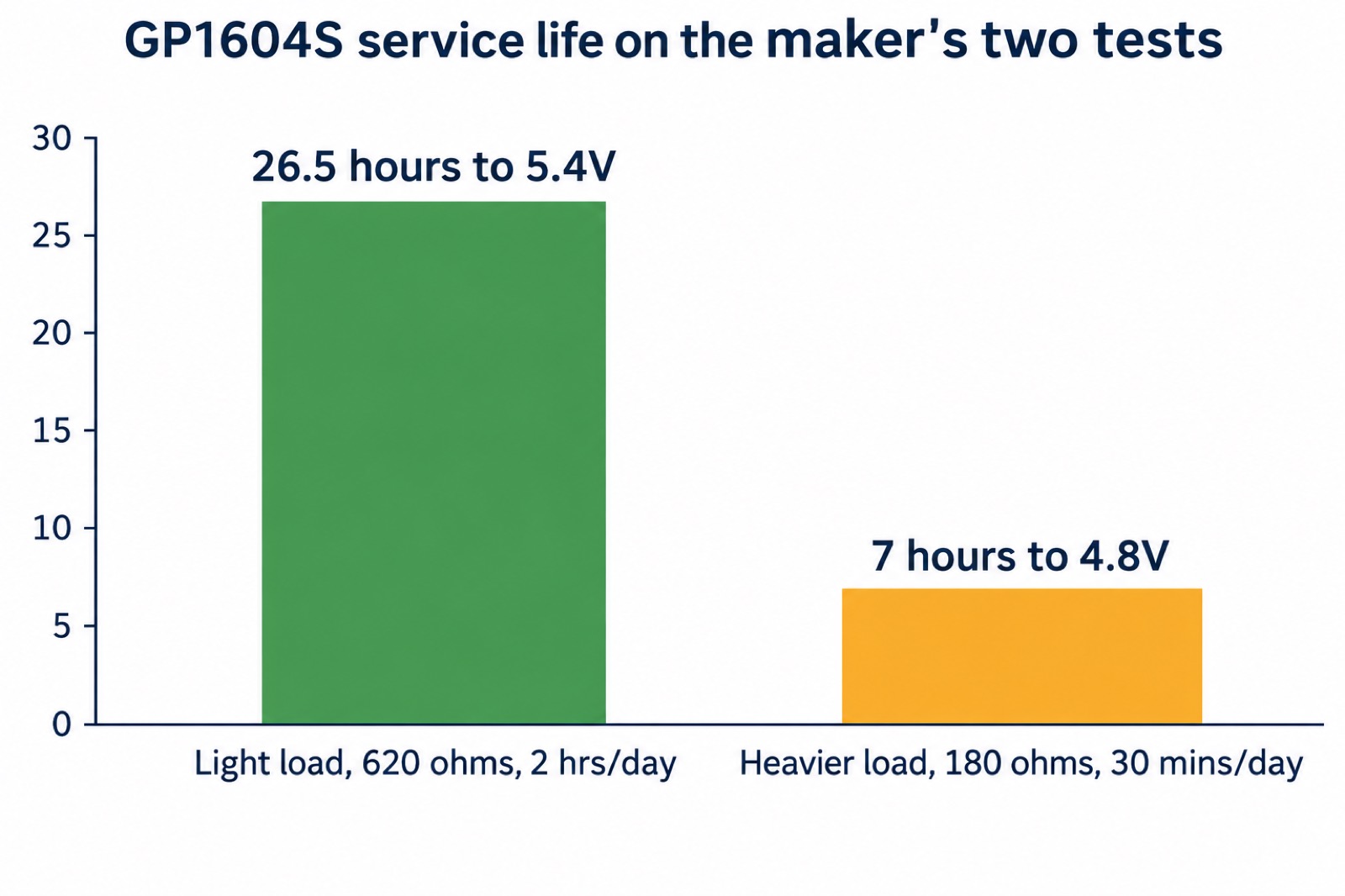
Two cautions sit alongside those numbers. First, they are hours of actual discharge, not hours of clock time: the light-load test ran 2 hours a day, so 26.5 hours of running is spread across many days of ownership. Second, the end point voltages differ between the tests, so the two figures are not measuring the battery down to the same finishing line. The maker reports both as measured, and both are worth knowing.
For a household, the practical translation is to keep more spares than you think you need for anything you would rely on in an emergency, and to test the device before the emergency rather than during it. A radio that runs for a few evenings on one cell is fine; a radio you have never switched on is a gamble whatever battery is inside it.
How the service life figures were tested
The test conditions are stated plainly on the datasheet, and they tell you how much weight to put on the figures. The discharge tests were carried out at 20 degrees Celsius, within 30 days of manufacture1. That is a mild indoor temperature and a nearly new cell, which is the best case for any battery.
Both conditions matter for a household. Temperature affects how a battery performs, so a cell kept in a cold shed or a hot loft is not being used in the circumstances the maker measured. And the 30-day condition means the figures describe a fresh battery, not one that has been in a drawer since you last moved house. Age and heat are the two things most likely to leave you with a cell that does not match the datasheet.
The independent guidance on battery storage makes the same point in general terms: the typical lifespan of a battery is about 10 to 12 years5. That is a broad statement about batteries as a class, not a figure for the GP1604S specifically, but it sets the outer limit. A 9V block you have kept for a decade is at the end of its reasonable life whatever the label says, and one kept somewhere damp or hot will fall short of that.
What the battery suits in a household emergency kit
Official emergency kit lists across the UK are consistent on one point: spare batteries belong in the bag. Dumfries and Galloway's household plan lists spare batteries among the things to pack2. Northern Ireland's household emergency kit asks for a battery or wind-up radio, a battery or wind-up torch and spare batteries3. The Scottish Government's ready campaign asks for spare hearing aids with batteries, and for battery jump leads in a car kit6.
The pattern repeats from council to council. Wiltshire's kit list includes a battery torch with spare batteries or a wind-up torch7. Argyll and Bute asks for a battery or wind-up radio and spare batteries8. North Devon suggests a charged portable power bank and charging cables alongside the rest4. Carmarthenshire's top ten includes a battery torch with spare batteries or a wind-up torch9. West Northamptonshire's grab bag asks for a torch, wind-up or battery powered with spare batteries10. North Hertfordshire's basics list names spare batteries outright11, and the Gavinton, Fogo and Polwarth resilient community plan asks for a battery radio and torch with spare batteries or wind-up equivalents12.
What that means for the GP1604S is that it earns its place as one of the sizes in your battery stock, not as the centrepiece. Check which of your devices take a 9V block: a radio, a torch, a small alarm, a telecare base unit. The TalkTalk guide to telecare personal alarms notes that built-in backup batteries typically give 24 to 36 hours13, which is a reminder that some of the equipment relying on a battery is equipment someone's safety depends on.
- Radio: a battery or wind-up radio with spare batteries appears on list after list8.
- Torch: a battery torch with spares, or a wind-up alternative, is equally standard7.
- Hearing aids: spare hearing aids with batteries are specifically named in Scottish guidance6.
- Car kit: battery jump leads are named for the car6.
- Telecare: backup batteries in personal alarms typically last 24 to 36 hours13.
Keep the spares where you will find them in the dark, in a waterproof bag as the Gavinton plan suggests12, and check them before winter rather than during a storm. For the wider picture of what a kit should hold, see the emergency kit guide, and for the devices these batteries keep running, the pages on emergency lighting and staying informed and in touch.
Storing and disposing of 9V batteries safely
Storage is simple but not optional. Keep spares dry and at a moderate temperature, away from damp sheds and hot cupboards, and keep them in their packaging or with the terminals covered so they cannot touch metal in a drawer. The Energy Saving Trust's general guidance puts the typical lifespan of a battery at about 10 to 12 years5, which is long enough that a spare can quietly go past its best if you never look at it.
Disposal is the other half of the routine. Retailer battery recycling bins in the UK accept AA, AAA, 9V, button cells, rechargeable batteries and battery packs from devices where they are removable15. That means a spent GP1604S goes in the bin at the shop, not in the household waste. Make a habit of taking the old cell out with you when you fit the new one.
The fire risk from batteries is a subject in its own right, and the guidance on lithium battery fire safety is aimed at the rechargeable cells in devices rather than at a carbon zinc block15. Even so, the habit of keeping cells tidy, covered and out of the waste stream is the same habit that keeps a household safe with every battery it owns.
Where the GP1604S fits your plan
The GP1604S is a modest, dependable 9V block for the low-demand jobs an emergency kit actually asks of it: a radio, a torch, a small alarm. Its maker's figures are honest about the limits, with 26.5 hours on a light load and 7 hours on a heavier one1, and its 35g weight makes it easy to carry a spare1. Buy it for the devices that take a 9V cell, store it dry and dated, and check it before the winter.
For the wider stock of cells a household should hold, the GP AA GN15A alkaline batteries and Duracell AA MN1500 alkaline batteries pages cover the other common size, and the GP Batteries brand page sets out the maker's range. If you are planning backup power for a longer outage, the backup power guide explains what a power station can and cannot do, and the power cuts guide covers what to do when the mains goes off.
Sources (15)
- GP1604S datasheet, GP Batteries, 2026
- Create a household emergency plan, Dumfries and Galloway Council, 2026
- Household emergency kit, nidirect, 2026-07-06
- Be prepared for emergencies, North Devon Council, 2026-10-29
- Battery storage, Energy Saving Trust, 2026-10-06
- Emergency kit, Ready Scotland, 2026-10-22
- Planning for an emergency kit, Wiltshire Council, 2026-10-29
- Winter weather: be prepared, Argyll and Bute Council, 2026
- Get prepared, Carmarthenshire County Council, 2026-10-25
- Protecting yourself, West Northamptonshire Council, 2024-05-31
- Preparing for emergencies, North Hertfordshire Council, 2015-01-12
- Gavinton, Fogo and Polwarth Resilient Community Plan, Scottish Borders Council, 2018
- Telecare personal alarms, TalkTalk, 2026-06
- Winter preparedness, NHS Lanarkshire, 2023-11-23
- Lithium battery fire safety, Tandridge District Council, 2026-10-29

 FireAngel FA3313 CO Alarm
 FireAngel FA3322 CO Alarm
 FireAngel FA3820 CO Alarm
 FireAngel FA6812 CO Alarm
 FireAngel FA6813 CO Alarm
 FireAngel FA6829S CO Alarm
 FireAngel CW1-PF CO Alarm
 FireAngel W2-CO-10X CO Alarm
 FireAngel FP1820W2-R CO Alarm
 FireAngel FP2620W2-R Alarm
 FireAngel ST-632 Smoke Alarm
 FireAngel ST-750 Smoke Alarm