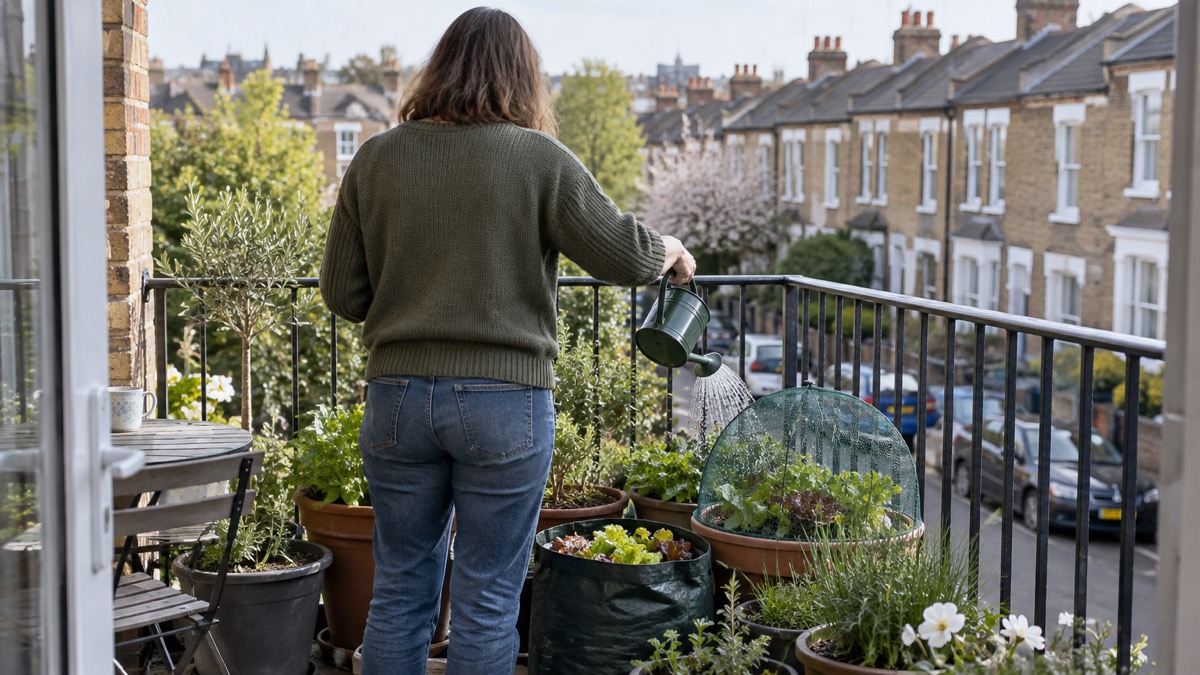
You do not need a garden to grow food. The Royal Horticultural Society's advice is that vegetables can be grown in a plot of any size, from a large sunny plot down to a few containers on a patio, in a separate plot or integrated into flowerbeds1. A windowsill, a balcony, a doorstep or a shared yard will all carry a crop if you choose the right plants and give them light, water and drainage.
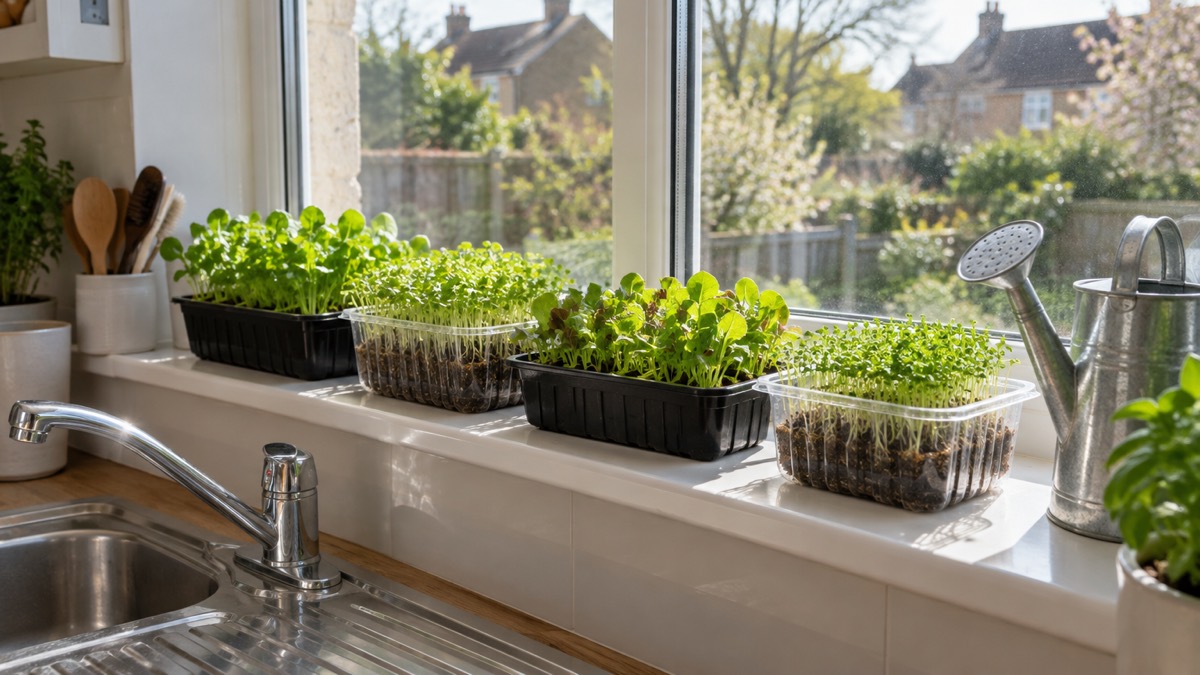
Start with the easiest things. Microgreens such as cress, radish, chard, turnip, mustard or beetroot can be sown in seed trays or clean fruit punnets and kept on a warm, sunny windowsill2. Salad leaves will grow indoors in a yogurt pot or fruit punnet with holes punched in the bottom3. Potatoes grow well in bags, and you harvest them by tipping the bag out4. As a guide to how much to attempt, up to four different vegetables is a good number for a group to grow, depending on the space available5.
The point of a small crop is not self-sufficiency. It is a modest, reliable supply of fresh food that you control, plus the habit of growing that pays off when shop supplies are disrupted. This page sets out what to grow, what to grow it in, how to protect it, and where the limits lie.
What you can grow in a small space
The choice of crop matters more than the size of the space. Quick, compact crops give you a harvest in weeks rather than months, and they forgive a small container. Mini-vegetable varieties are ready to harvest sooner than large size varieties, which is particularly helpful if you have a short growing season further north, and they crop well at close spacing7. That makes them a sensible default for a balcony or a windowsill.
Herbs are another good small-space crop. Many herbs are good choices for a dog-friendly garden and can be grown in containers as well as in beds8.
A useful way to think about the space you have is by what each crop needs from it.
| Crop | Where it suits | What it needs | Source |
|---|---|---|---|
| Microgreens (cress, radish, chard, turnip, mustard, beetroot) | Windowsill, bright indoor space | Warmth, moist compost, at least four hours of natural light a day | 2 |
| Salad leaves | Windowsill or container | A container with drainage holes, peat-free compost | 3 |
| Herbs | Containers or beds | Light, drainage, pet-safe placement | 8 |
| Potatoes | Growing bags | Room for roots, soil mounded up as shoots grow | 4 |
| Mini-vegetables | Containers, small beds | Close spacing, earlier harvest than large varieties | 7 |
| Mushrooms | Indoors, from a kit | Mushroom spawn and the kit's own instructions | 9 |
If you have more room than a windowsill, a raised bed lets you plant a little closer than the spacing recommended on seed packets and in gardening books, because there is a greater depth of soil so plants grow well in a smaller space10. That is a useful way to get more from a small plot, provided you keep the soil fed and watered.
For a fuller treatment of which vegetables to start with, see Growing Your Own Vegetables: Where to Start.
Containers, pots and growing bags: getting set up
Almost anything that holds compost and lets surplus water drain can grow a crop. The RHS lists chimney pots, bricks for making raised beds, wooden pallets, old sinks and baths, fruit and vegetable crates, large cooking oil tins and dustbins among the containers schools use1. For a household, the principle is the same: clean containers, drainage holes, and a compost that holds moisture.
For microgreens you need seed trays or similar containers, such as clean fruit punnets or juice cartons, peat-free seed compost or sieved multi-purpose compost, plant labels and pencils, and a watering can with a fine rose2. That is a short and cheap list, and most of it is already in a kitchen.
Once sown, put containers in a sheltered place with good light such as a sunny windowsill, greenhouse or cold frame11. Shelter matters as much as light: a windy balcony dries compost out and batters young plants.
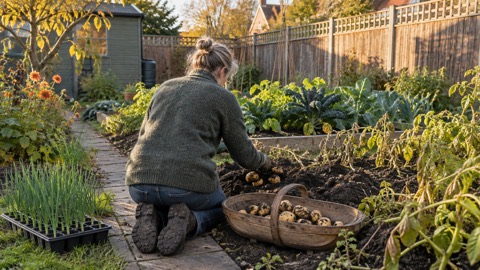
For small seeds, sprinkle them on top of the compost, allowing space between them, then sieve a thin layer of compost over them11. If seeds are very small, use a seed sower to help sow them11. For potatoes in bags, earth up by mounding soil around the plants as they grow: with potato plants this protects early shoots from frost and ensures new tubers are not exposed to light, which can make them green and poisonous4.
If you want to grow under cover, a greenhouse or polytunnel extends what you can do. You can grow outdoor crops such as potatoes and peas in greenhouse beds, using the extra protection to bring them forward several weeks, and by July and August the space is clear for winter salads and veg7. For more on this, see Polytunnels and Greenhouses: Growing Under Cover All Year.
Protecting crops with a fruit cage
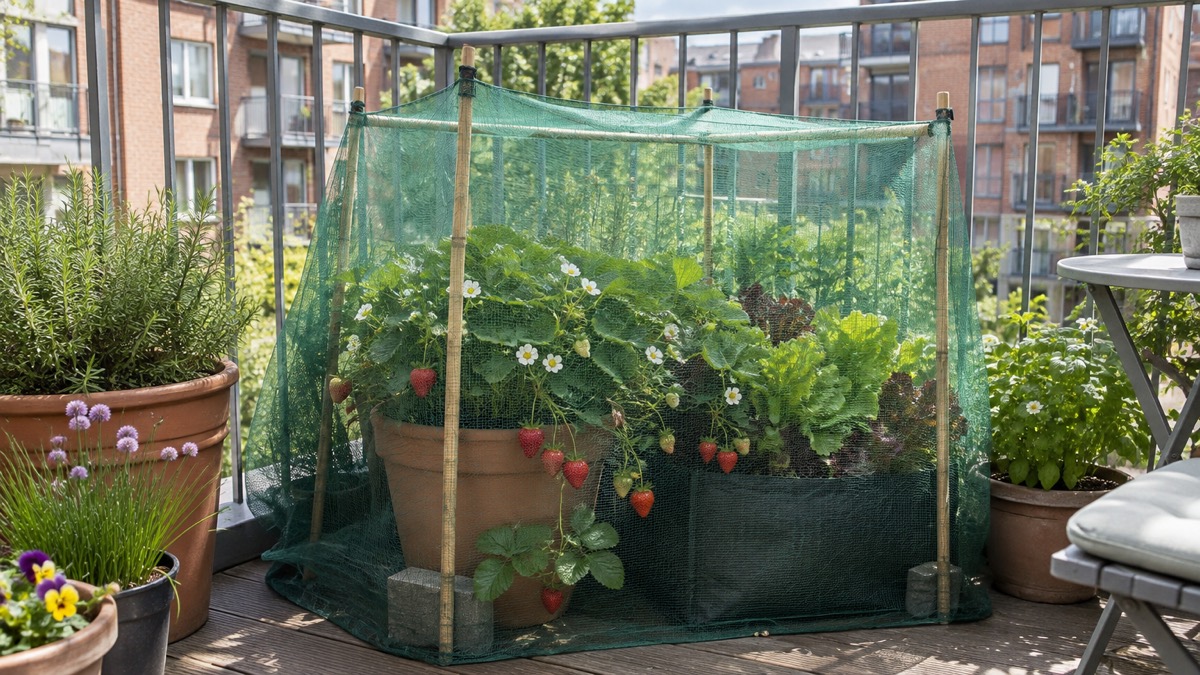
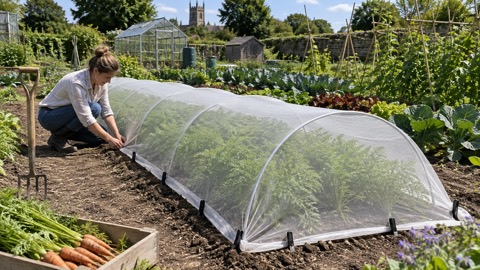
A crop you have raised for weeks can disappear in an afternoon. Netting is needed to keep birds from eating all the fruit when it is ready, and temporary fencing is one option6. Whatever you use, ensure the netting allows bees to pass through it for pollination6. A fine mesh that excludes pollinators will cost you the fruit it was meant to save.
Growing fruit organically, with minimal inputs and without pesticides, fungicides or herbicides, will ensure the food you grow is healthy, delicious and perfectly safe to eat12. That is a good fit for a small space, where a heavy spray regime is neither practical nor desirable.
Fruit in containers and small plots still needs routine attention. The RHS fruit calendar gives thinning advice by apple type: thin dessert apples to 10 to 15cm apart in June for larger, tastier crops, and culinary apples to 15 to 20cm13. Thinning is easy to skip and easy to regret: crowded fruit stays small.
For trees, bushes and canes more generally, see Growing Fruit at Home: Trees, Bushes and Canes, and for pests and diseases see Vegetable Pests and Diseases: Prevention and Control.
Why home-grown food helps when supply chains fail
A small crop is not a food store, but it is a buffer. Official guidance on gas supply failures notes the risk of food shortages as restaurants and food production facilities shut down14. A household with something growing, and the skill to grow more, has a little more room to manoeuvre than one without.
The wider case for growing is well established. Community food growing can bring communities together, provide skills that can improve employability, and enhance wellbeing15. Those are real benefits, and they are the reason many people start.
There is a food safety point that catches people out. Freezing food does not kill some harmful bacteria in food; bacterial growth can be paused at low temperatures but can start to grow again at higher temperatures16. So a glut you freeze is only as safe as the handling before it went in, and a freezer that has warmed and refrozen is not a freezer you can trust. For the detail, see Freezing Home-Grown Fruit and Vegetables.
Home growing also has a place in official thinking about disruption. After a nuclear emergency, the limits on radioactivity in food are deliberately low to reduce radiation dose to minimal levels, and this may result in a wide area being subject to food controls17. In that situation, follow official advice on what to do with your own produce rather than assuming a garden crop is unaffected. Our guide to Major Incidents covers the general approach.
Where home growing has limits
Be clear about what a windowsill or a balcony can and cannot do. It will give you fresh herbs, salad and microgreens, and a useful amount of potatoes or fruit in season. It will not feed a household through a long disruption, and it is not a substitute for a stored food supply. For that, see Emergency Food: A Household Guide to Stores, Safety and Meals Without Power.
Space is the obvious constraint, but not the only one. Forest gardens, despite the name, can be created in modest home gardens, including urban settings, and in containers and tubs on tower block balconies18. That is encouraging, but it describes what is possible, not what is easy: a container forest garden needs more watering and feeding than one in open ground.
Keeping livestock is a different scale of commitment. The British Beekeepers Association says a reasonably sized site of at least half an acre is required, with a continual supply of food for the bees throughout the year19. It adds that there are generally fewer problems in rural gardens, and more care will be needed in built up areas to avoid causing nuisance to neighbours20. If you want to help bees without keeping them, plant flowers for honey bees, bumblebees and solitary bees in any size of space from balcony to open green space, right throughout the year21. Creating a mini meadow on your lawn is one of the best and easiest ways to encourage wildlife into your garden, helping not just honey bees but all pollinators22.
There are also safety and security limits worth knowing before you plant. The Police Service of Northern Ireland advises growing prickly plants close to vulnerable areas such as windows, fences, boundary walls and drainpipes23. In dry weather, fire services advise having a hosepipe or water easily available and trimming back your own hedges, plants and grass to create more space between your home and the problem area24, and to keep grass and weeds short, remove dead vegetation, and regularly trim trees and bushes near buildings and fences25. A garden that is a fire risk is not a resilience asset.
Growing indoors, on a balcony and in the smallest spaces
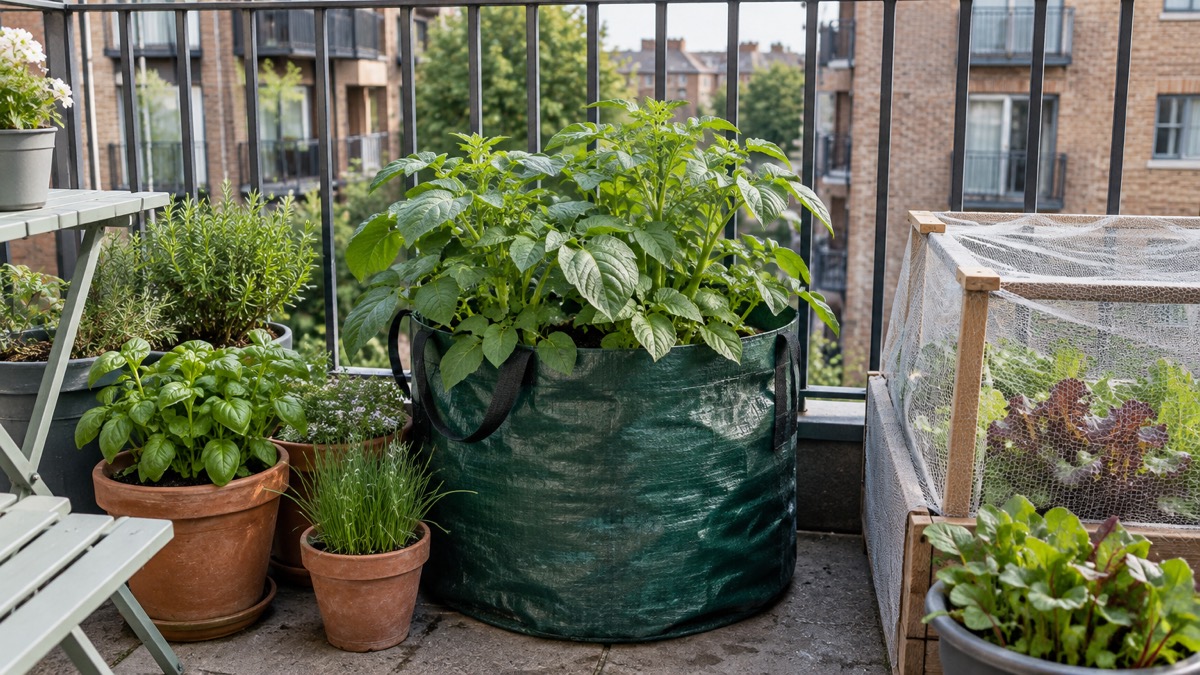
Indoors, light is the limiting factor. Microgreens are best grown indoors on a windowsill that gets at least four hours of natural light a day3. Keep the compost moist but not soggy while the seeds germinate2. Salad leaves follow the same logic: fill your chosen container with a peat-free compost, and a yogurt pot or fruit punnet with holes punched in the bottom works perfectly3. For radish indoors, spread the seed out roughly to the size you want the radish to be, and find a bigger pot if needed for room to grow3.
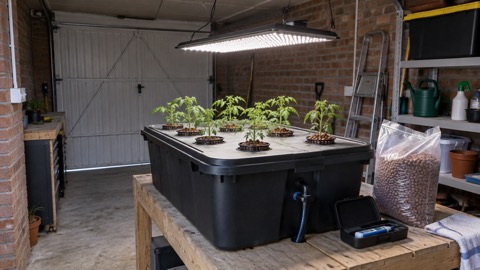
If you have more light and space, hydroponics is an option. Hydroponic crops are grown under cover, either in a glasshouse or polytunnel, and the growing season can be extended with extra heat and light26. A simple build-your-own system can use 8cm aquatic pots, one plant each, spaced 15cm from hole to hole in a plastic or polystyrene lid26. For the parts and the method, see Indoor Hydroponics: Grow Tents, Lights and Nutrient Systems and Simple Hydroponic System Parts List.
If you buy in young plants rather than sow, you are buying plug plants: seedlings or young plants grown singly in small modules, with the advantage that they can be transplanted with minimal root disturbance, usually needing potting up and growing on indoors until large enough to plant outside27. That is a quick route to a crop on a balcony, at a higher cost than seed.
For the sowing method itself, see Sowing Seeds Indoors and Outdoors: Timing, Depth and Germination and the Seed Sowing Equipment Checklist.
Storing what you grow
A small harvest still needs storing well, or the effort is wasted. Root crops other than potatoes keep best placed in shallow crates or boxes, separating layers with slightly damp packing material such as leaf mould, sand, sieved soil, sawdust from untreated wood only, and coir28. That is a method that works in a shed, a garage or a cool corner, and it turns a autumn glut into winter meals.
For the full picture, see Storing the Harvest: Roots, Onions, Squashes and Apples and How Long Do Pumpkins and Squashes Keep?.
Sources (28)
- Growing vegetables in schools, Royal Horticultural Society, 2026
- Growing microgreens, Royal Horticultural Society, 2026
- Quick growing food, Garden Organic, 2026-10-29
- How to grow potatoes in containers, Royal Horticultural Society, 2026
- What shall we grow?, Royal Horticultural Society, 2026
- Planning a fruit garden, Royal Horticultural Society, 2026
- Vegetables all year round, Garden Organic, 2026-10-29
- Toxic items for dogs, Dogs Trust, 2026
- Mushrooms, Garden Organic, 2026-10-29
- Vegetable crop planner / RHS Schools, RHS (Royal Horticultural Society)
- Sowing in pots, Royal Horticultural Society, 2026
- How to grow fruit, Garden Organic, 2026-10-29
- Fruit gardening calendar, Royal Horticultural Society, 2026
- Utility failure, Essex Prepared, 2026-10-29
- Growing our own, Sustain, 2026-11-04
- Chilling, Food Standards Scotland, 2026-10-25
- Nuclear emergencies: information for the public, GOV.UK, 2026-09-28
- Forest gardening, Permaculture Association, 2026-11-04
- Becoming a beekeeper, British Beekeepers Association, 2026-11-04
- Offer land to bees, British Beekeepers Association, 2026-11-04
- Gardening for bees, British Beekeepers Association, 2026-11-04
- Planting for pollinators, British Beekeepers Association, 2026-11-04
- Garden security, Police Service of Northern Ireland, 2026-11-02
- Reducing risk of wildfires during hot and dry weather, Devon and Somerset Fire and Rescue Service, 2026
- LFRS issues fire prevention advice to rural communities, Lancashire Prepared, 2026-10-29
- Growing crops with hydroponics, Royal Horticultural Society, 2026
- Plant out young plants, Royal Horticultural Society, 2026
- Harvesting and storing vegetables, Garden Organic, 2026-10-29
 Hydroponic System Parts List
 Year-Round Sowing Calendar
 Preserving Equipment Checklist
 Blanching Vegetables
 Carrot Fly Protection
 Knowing When Chutney Is Ready
 Clubroot in Your Soil
 Drought-Resistant Vegetables
 Edible Flowers Safety
 Extending the Growing Season
 Freezing Fruit Without Sugar
 Garden Fleece Frost Protection
 Avoiding the Hungry Gap
 Keeping Varieties Pure for Seed
 Making Leafmould