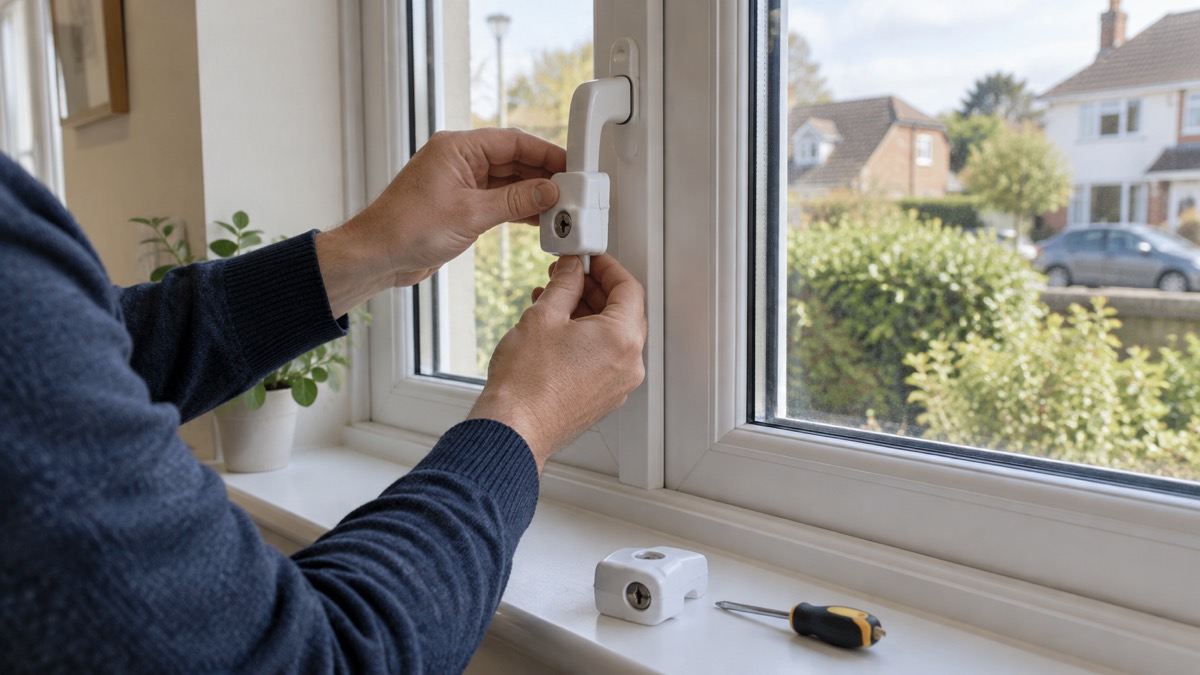
There is no single number for a house, because the answer depends on the window. The police advice is to fit locks to all downstairs windows, or any window that is easy to reach, and to your accessible windows generally1. For a casement window, the minimum is one lock in each opening frame, and two locks opposite each hinge if you live in a high-crime area or the opening casement is bigger than one metre2.
That is the short answer. The longer one is about matching the lock to the window and to the room behind it, because a lock that keeps a burglar out but stops you getting out in a fire is not a good trade. This page sets out what the police and fire services advise, what a BS7950 rating tells you about a window, and how to add film or whitewash for heat and privacy without wrecking either your security or your escape route.
Start with the windows someone can actually reach
The police approach to window locks is about access, not about counting every pane in the house. The guidance is to fit mortise locks to all front and back doors and locks to all downstairs windows, or windows which are easy to reach4. Fitting window locks to your accessible windows reduces the chances of being burgled, slows an intruder down and makes it much more difficult if they target your home2.
For casement windows, which open on a hinge rather than sliding, the police give a specific minimum: at least one casement window lock in each opening frame2. Where the risk is higher, that goes up. Two locks opposite each hinge are advised if you live in a high-crime area or the opening casement is bigger than one metre2. On windows with a scissor-type hinge fit, the locks go to the opening or leading edge of the window2.
The wider point is that locks work as part of a set. Police in Gloucestershire report that installing a combination of security devices gives 49 times more protection against burglary compared with no devices being installed5. Locks on their own are one device in that combination, alongside door locks, lighting and alarms. Our guide to how burglars choose a home explains what else puts them off.
| Window | What the police advise | Source |
|---|---|---|
| Downstairs or easy to reach | Fit a lock | 6 |
| Casement, opening frame | At least one lock in each opening frame | 2 |
| Casement over one metre, or high-crime area | Two locks, opposite each hinge | 2 |
| Scissor-type hinge fit | Locks to the opening or leading edge | 2 |
| Upstairs with a low sill | Safety catch that adults can open in an emergency | 7 |
What a BS7950 rating tells you about a window
If you are buying new windows rather than locking old ones, the standard to ask about is BS7950. The government's home security guidance lists BS7950 for windows, alongside other standards for doors and locks1. In plain terms, it is a mark that the window has been tested as a security product, not just a pane of glass in a frame.
It is not the only mark worth knowing. Police Scotland advise buying new windows and doors certified by Secure by Design, making sure any glass is laminated, and looking for PAS24 doors and windows because they are harder to break3. Our page on what PAS 24 means for your doors and windows goes into that standard in more detail.
A rating is only useful if you can find it. Check the glass, the frame and the paperwork that came with the window, and ask the company that made or fitted it if nothing is marked. When you are buying, ask the fitter directly whether the product is tested to BS7950 and ask to see the certificate or test report. A written answer in the quote is worth more than a verbal one.
Locks and your escape route
Every lock decision has a second audience: the fire service. The advice from Warwickshire Fire and Rescue is to consider installing locks or security features on windows that balance security and ease of opening8. That balance is the whole design problem. A window that cannot be opened from the inside is a security feature and a hazard at the same time.
The fire services are specific about keys. In high-rise living, keep door and window keys accessible9. Sepa's flooding guide for older communities makes the same point for houses: if you live in a house and have window locks, always keep a key upstairs10. The reason is simple. If a fire starts downstairs, the stairs may be the last place you want to go, and an upstairs window may be your way out or your way to call for help.
Windows upstairs with low sills should have safety catches on them that adults can open in an emergency7. That is the standard to hold yourself to: a child should not be able to open it easily, and an adult should.
If you cannot get out, get everyone into one room, ideally with a window, and choose a room whose window opens easily and, if possible, has a phone for calling 99913. Open the window for fresh air and call for help13. In a high-rise flat, if the hallway and stairs are filled with smoke, stay inside the safest room, dial 999, keep the door closed and pack blankets or clothes around the door14. Our guide to leaving your home locked when you have to evacuate covers the same tension between security and escape.
Window film or whitewash you can put up yourself
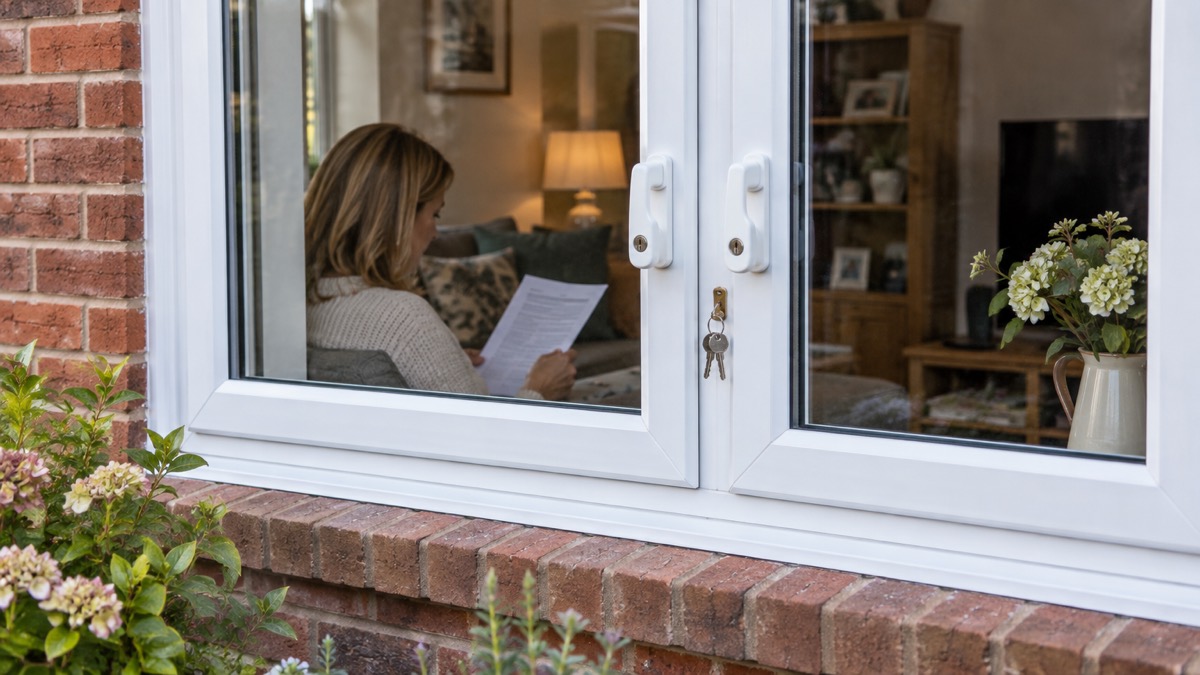
Locks are not the only thing that goes on a window. In hot weather, the public health advice is to stick up simple, removable window films or whitewash paint yourself, or to hire someone to install permanent reflective solar films on the glass15. These are heat measures rather than security measures, but they change how a window behaves, so they belong in the same plan.
The do-it-yourself options are the removable film and the whitewash. Both are described as things you can put up yourself15. The permanent option, a reflective solar film bonded to the glass, is the one the guidance separates out as a job to have installed15.
There is a security angle too. Police advice on door glazing says glazing can be reinforced by using special film or by installing laminated glass panels16. That is a different product from a solar film, and it is worth being clear with a supplier which one you are asking for: a film to keep heat out, or a film to make glass harder to break.
Reflective film and daylight
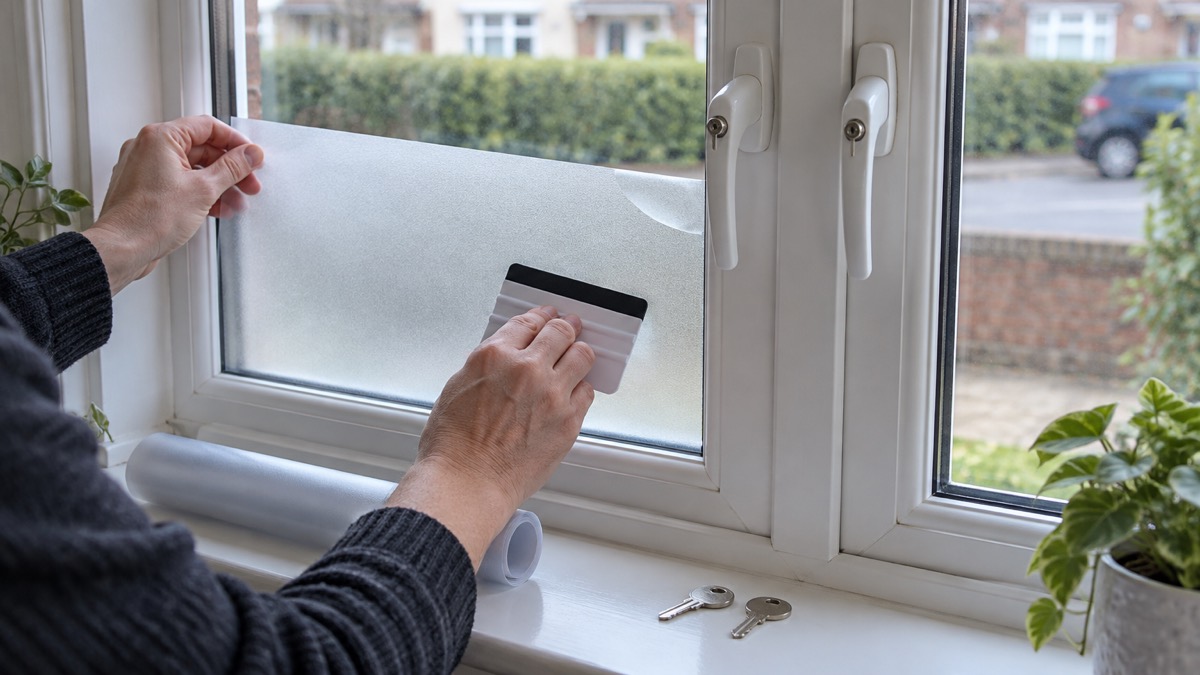
Reflective solar film does a job the guidance names: it keeps heat out15. What the guidance does not give is a figure for how much daylight it costs you. Films vary, so ask the supplier what light transmission a product has before you commit, and think about which rooms you use most in the day.
The same principle applies outdoors. Reflective materials can be seen up to three times as far away as non-reflective materials17, which is why the fire service suggests adding reflective tape or glow sticks to a costume if you are out after dark18. That is about being seen, not about keeping heat out, but it shows how much a reflective surface changes what happens at a window or on a person.
If a room is already dim, a removable film you can take down in winter may suit you better than a permanent one. If the room is a bedroom you need to escape from, check the film does not stop the window opening or obscure the catch.
When to hire someone to fit permanent film
The dividing line in the official guidance is between films and paint you stick up yourself and permanent reflective solar films, which are installed on the glass15. If you are going for the permanent option, that is the point to bring in someone who does it for a living.
The wider official approach to work on a home is consistent: where electrical work is required, use a qualified and competent installer19. Permanent outdoor lighting displays or socket-outlets should be installed by a registered electrician20, and linked alarms should be fitted by a qualified electrician21. Window film is not electrical work, but the same logic applies to any permanent change to the fabric of the building: use someone competent, and get the specification in writing.
Ask any fitter two questions. First, what the film does to the window's operation and to the light. Second, get both answers in the quote.
Whitewash, film and rented homes
If you rent, the do-it-yourself options need a conversation first. The heat guidance suggests whitewash paint as something you can put up yourself15, but it does not say whether a tenant needs the landlord's permission. Whitewash on glass is a change to the property, so ask your landlord or letting agent before you start, and get the answer in writing.
The same applies to permanent film. Keep the instructions that came with it so you know how to remove it.
Renting also brings other safety duties into play that are the landlord's, not yours. Landlords of privately rented homes must have a registered engineer do an annual gas safety check on each appliance and flue22, and gas appliances and flues in rented homes must be safety checked every 12 months23. Those are not window matters, but they are the same conversation with a landlord about what you may and may not change. Our page on smart locks in rented and shared homes covers the equivalent questions for door hardware.
Upstairs and hard-to-reach windows
Upstairs windows are where the counting question gets interesting. The police advice is framed around accessible windows and downstairs windows or windows which are easy to reach6, and around accessible windows generally2. A first-floor window above a flat roof, a wheelie bin or a drainpipe is easier to reach than one with a sheer drop below it.
For upstairs windows with low sills, the fire service advice is a safety catch that adults can open in an emergency7. That is a different fitting from a key lock, and it is the right one where the main risk is a child falling rather than a burglar climbing.
If you are moving into a new home, Police Scotland suggest changing your locks if you want to3. Our moving into a new home locks and keys checklist sets out what to check first.
Where to get help and advice
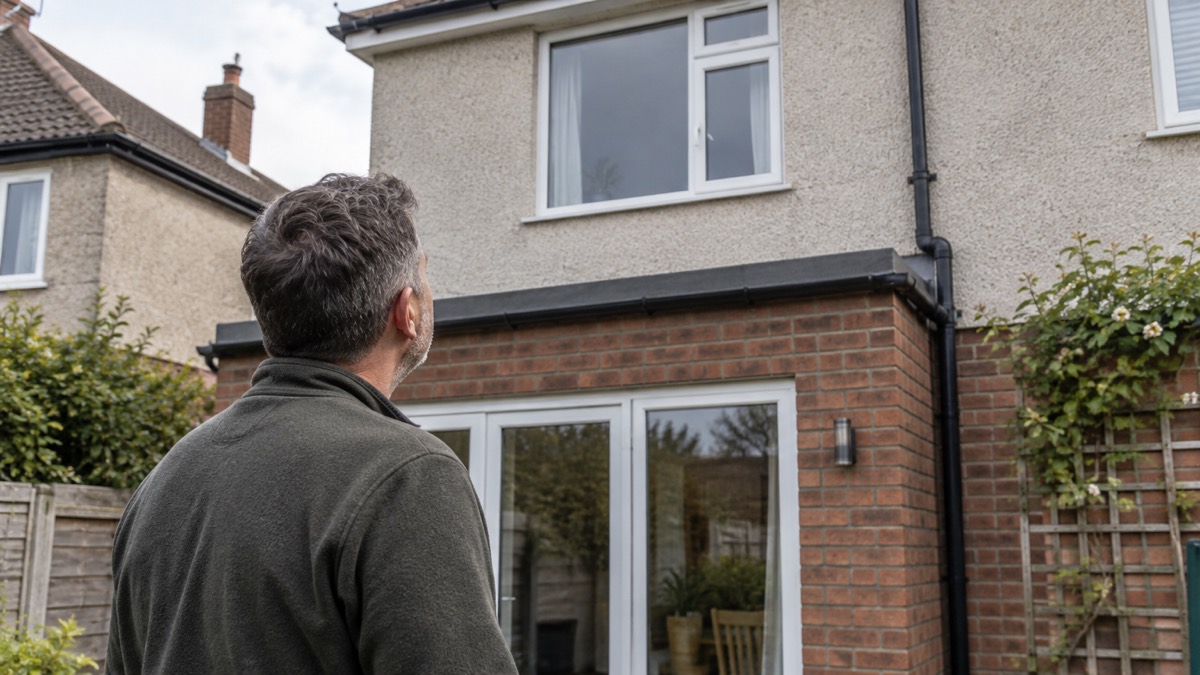
For most households the practical next step is a walk round the outside of the house, noting which windows can be reached from the ground or from anything climbable, and which have no lock. Then check that every key is where an adult could find it in the dark.
If you want to go further, the police service for your nation publishes home security advice: Police Scotland3, the Police Service of Northern Ireland4, and your local force in England and Wales2. For the standards, ask the fitter or the manufacturer for the BS7950, PAS24 or Secure by Design certificate1. For fire safety in flats and houses, your local fire and rescue service publishes escape plan guidance8.
If you have already had a break-in, our guide to coming home to a break-in sets out what to do first, and after a burglary covers crime numbers, insurers and support. For the wider picture, start with Home Security: A Household Guide.
Sources (23)
- Securing doors and windows, nidirect, 2024-08-27
- Window security, Avon and Somerset Police, 2026-11-02
- Break-in and housebreaking, Police Scotland, 2026-11-02
- House security, Police Service of Northern Ireland, 2026-11-02
- Burglary, Gloucestershire Constabulary, 2026-11-02
- Home security, West Yorkshire Police, 2026-11-02
- Slips, trips and falls, Cornwall Council, 2025-06-19
- Fire escape plan, Warwickshire County Council, 2026-10-29
- High-rise living, North Wales Fire and Rescue Service, 2026-10-25
- Flooding guide for older communities, Scottish Environment Protection Agency, 2026-10-29
- Know your escape plan, Greater Manchester Fire and Rescue Service, 2026-10-29
- Know your escape plan, Greater Manchester Fire and Rescue Service, 2026-10-29
- If you have a fire, Devon and Somerset Fire and Rescue Service, 2026
- Home fire safety, Northern Ireland Fire and Rescue Service, 2026-10-14
- Beat the heat, Oxfordshire County Council, 2026
- Door security, Avon and Somerset Police, 2026-11-02
- Safe driving in winter, Nottinghamshire County Council, 2026-10-29
- Fancy dress costumes, London Fire Brigade, 2026-10-25
- Plug-in solar panels: safety advice for residents and homeowners, London Fire Brigade, 2026-10-25
- Christmas light safety tips for a safe festive season, NICEIC, 2025-11-26
- Fire safety for people with hearing difficulties, Devon and Somerset Fire and Rescue Service, 2026
- Your landlord's safety responsibilities, GOV.UK, 2026-11-03
- Gas safety for tenants, London Assembly, 2026-10-25
 Moving Home Locks Checklist
 After a Break-In Checklist
 Holiday Security Checklist
 Fitting an Anti-Snap Cylinder
 British Standard Door Locks
 Double Locking a uPVC Door
 Garage to House Door Safety
 Police Preferred Key Safes
 Where to Fit a Key Safe
 Letterbox Guards
 Measuring a Euro Cylinder
 PAS 24 Doors and Windows
 Securing Patio Doors
 Smart Lock Battery Life
 Smart Locks in a Power Cut