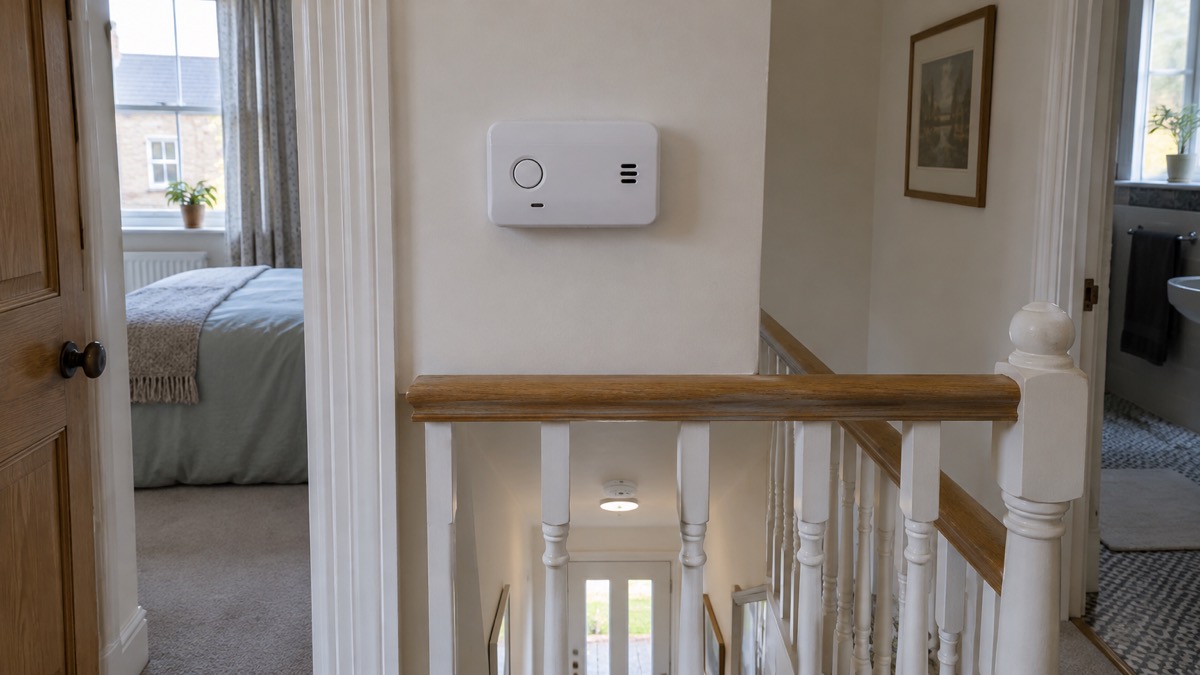
The BLACK+DECKER RF Interlink Carbon Monoxide Alarm is a battery-powered carbon monoxide (CO) alarm for the home. The distributor lists it as sounding a loud 85dB alarm from 50ppm of carbon monoxide, running on a sealed lithium battery with a 10 year lifespan, and linking wirelessly with up to 20 devices from the same BLACK+DECKER RF Interlink range at a stated indoor range of 30m1. It needs no wiring, so it can be wall mounted with the fixings supplied or stood on a shelf1.
What it does is give an early warning of carbon monoxide, the colourless, odourless gas produced by faulty or poorly ventilated fuel-burning appliances. Official guidance is consistent: fit a CO alarm in every room that contains a fuel-burning appliance, make sure it can be heard throughout the home, and consider one in the bedroom2. The alarm is certified to BS EN 50291-1 for domestic use and is CE marked, Kitemarked and UKCA marked1, which is the standard the Health and Safety Executive tells people to look for before buying3.
This page sets out what the alarm does, its specifications, how the radio interlink works, where to fit it, how to test and read it, and how it fits the CO alarm rules in Scotland, Wales and Northern Ireland. It does not compare it with other products or give a price.
What the alarm does and who it suits
Carbon monoxide gives no warning of its own: you cannot see it, smell it or taste it, which is why fire and rescue services call it the silent killer and urge households to fit an alarm approved to BS EN 502915. The BLACK+DECKER unit watches the air in the room and raises an audible alarm when carbon monoxide reaches 50ppm, at a sound level of 85dB1. The distributor describes the sensor as suitable for kitchens, boiler rooms and areas with open fires1, which are the rooms where fuel is burned.
It suits a household that wants a CO alarm without an electrician, and one that wants a warning in one room to be heard in another. Because it links by radio, an alarm triggered in a boiler room can set off the other alarms in the same range elsewhere in the house, provided they are within range and from the same range1. It also suits a home that already has, or plans to add, other BLACK+DECKER RF Interlink alarms, since the range includes mains and sealed battery smoke alarms, heat alarms and a control unit1.
It is a domestic alarm, certified to BS EN 50291-1 for domestic use1. It is not a substitute for maintaining appliances: the Health and Safety Executive advises that CO alarms are a backup, and that appliances should be serviced and flues checked3. If you rent, your landlord has duties too, and alarms should be fitted in every room used as living accommodation that contains a fixed combustion appliance, at head height, roughly 1 to 3 metres from the potential source4.
Specifications
The table below sets out the figures the distributor publishes for the alarm. Where a maker and a retailer disagree, the maker's figure should be preferred; here the figures come from the distributor's product page1.
| Specification | Detail |
|---|---|
| Sensor type | Electro-chemical1 |
| CO alarm level | From 50ppm1 |
| Sound level | 85dB1 |
| Power | Battery powered, sealed lithium battery, 10 year lifespan1 |
| Standard | BS EN 50291-1 (Domestic)1 |
| Markings | CE marked, Kitemarked to BS EN 50291-1, UKCA marked1 |
| Radio linking frequency | 868MHz1 |
| Radio frequency range | 30m indoors1 |
| Maximum linked devices | 20 devices from the same range1 |
| Fixing | Freestanding or wall mounted, fixings included1 |
| Installation position | Mount at head height1 |
| Controls | Combined test and hush button1 |
| Indicators | LED lights for operation, fault and alarm1 |
| Operating temperature | 0°C to +40°C1 |
| Relative humidity | 0% to 90%1 |
| Dimensions | Height 75mm, width 40mm, depth 32mm1 |
| Weight | 66g1 |
| Material | ABS plastic1 |
| Warranty | 5 year manufacturer's warranty1 |
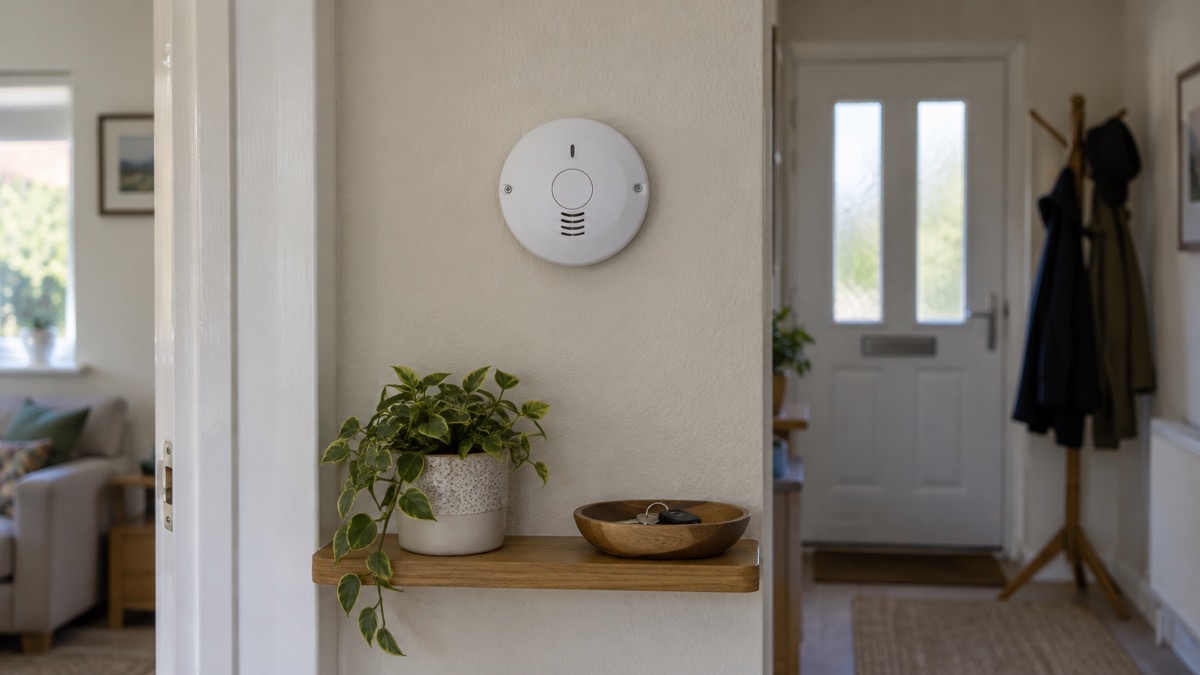
The distributor also lists the alarm as suitable for the Welsh and Scottish updated 2022 legislation and for Northern Ireland legislation (2024)1. The certification entry on the same page gives the standard as BS EN 50291-1 (Domestic) and, in a second entry, as BS EN 50291-1: 2018 for domestic use only; the two entries on the page do not match exactly, so check the marking on the unit itself7.
Radio interlink: how it works and what it can link to
The alarm connects to others by radio frequency rather than by cable. The distributor gives the radio linking frequency as 868MHz and the indoor range as 30m, with a maximum of 20 linked devices from the same range1. Radio linking of this kind is used so that alarms can be interconnected wirelessly, avoiding the time and disruption of running cabling between them8. Official guidance for Scottish homes makes the same point: interlinked alarms are linked by radio frequency and do not need WiFi9.
That matters in a real emergency. If carbon monoxide builds up in a boiler room while the household is asleep, a linked alarm in the hallway or bedroom can sound too, so long as it is in the same range and within range. Fire services describe interconnecting alarms as useful in larger properties and for people who are deaf or hard of hearing, because when one alarm senses a danger, every alarm goes off10.
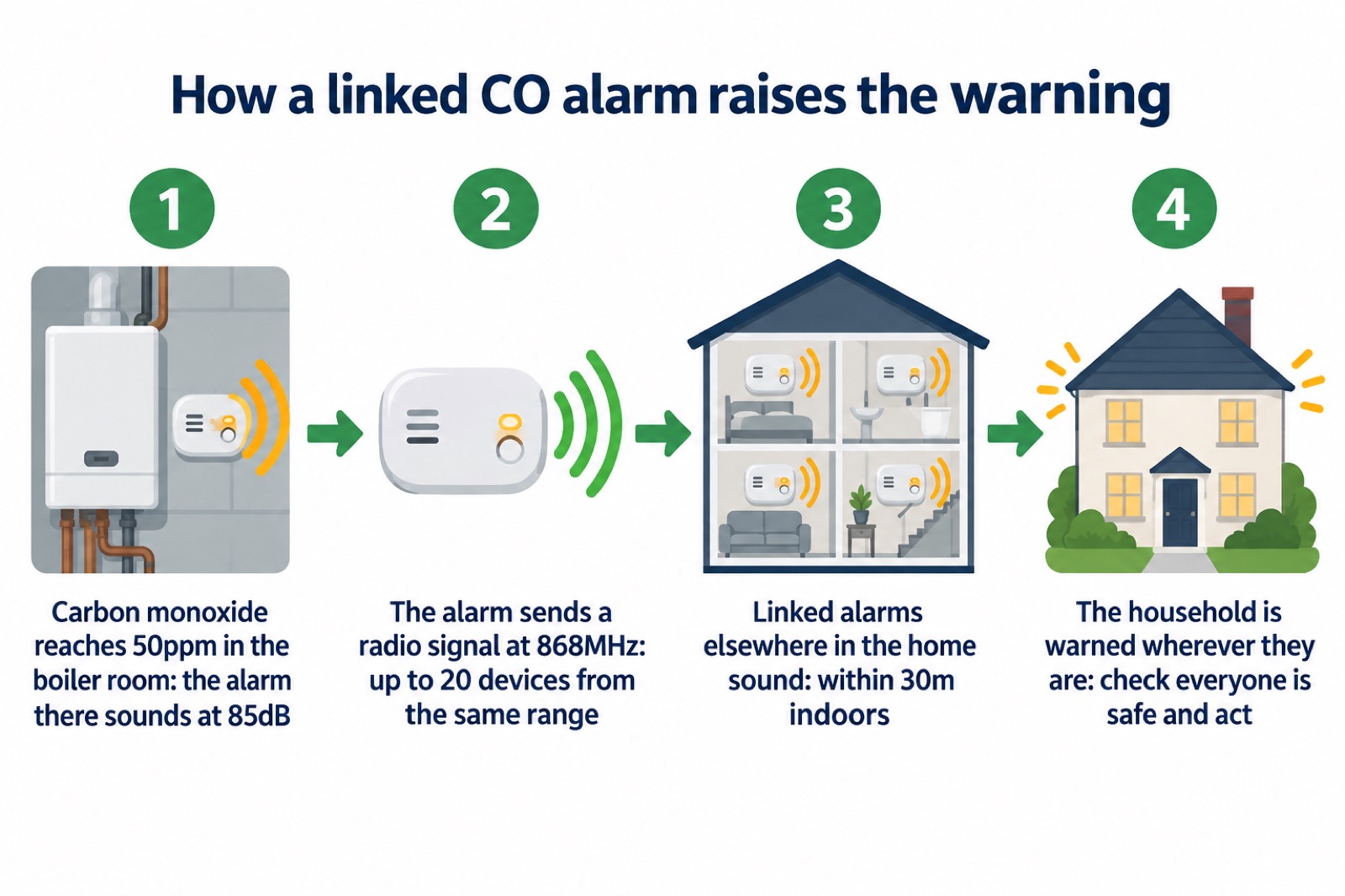
The range is a limit, not a guarantee. Walls, floors and the fabric of the building reduce radio range, so a device at the far end of a large house may not hear the signal. Test the link when you fit each alarm, and if a linked alarm does not respond, move it or add a device between the two. The alarm is not stated to link with other makers' alarms, so if you want one warning across smoke, heat and CO alarms, plan to stay within the BLACK+DECKER RF Interlink range1. For a wider look at how linking works across brands and standards, see Interlinked Alarms: How Linking Works.
Where to put it
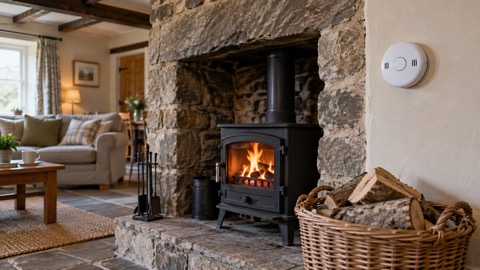
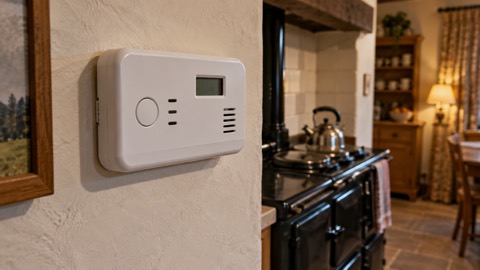
Official guidance is consistent on placement: fit a CO alarm in every room that contains a fuel-burning appliance, make sure it can be heard throughout the home, and consider keeping one in the bedroom2. The maker's own instructions for this alarm say to mount it at head height, and list kitchens, boiler rooms and areas with open fires as suitable locations1.
The distributor's own installation position is to mount at head height1. In practice that means:
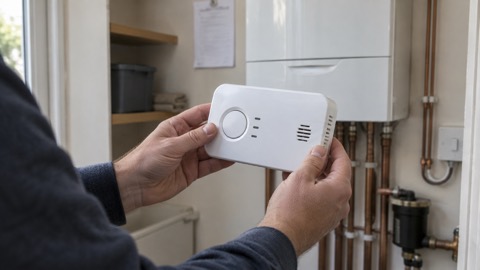
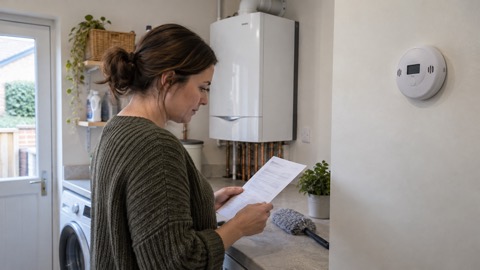
- Boiler room or cupboard: one alarm, at head height, within about 1 to 3 metres of the boiler4.
- Kitchen with a gas cooker or hob: a CO alarm in the room, though rented homes are not required to have one for a gas cooker alone4.
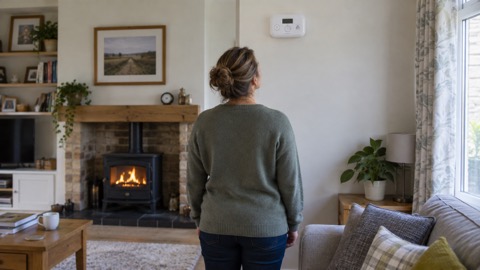
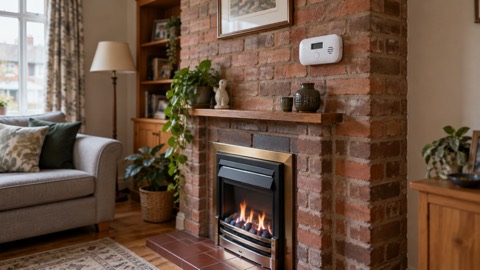
- Living room with a gas fire, log burner or open fire: one alarm in the room12.
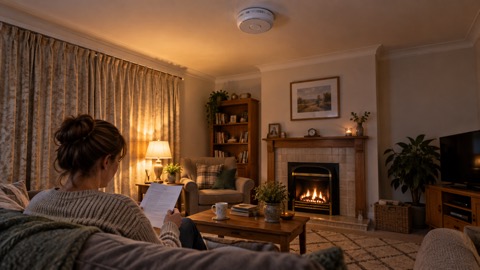
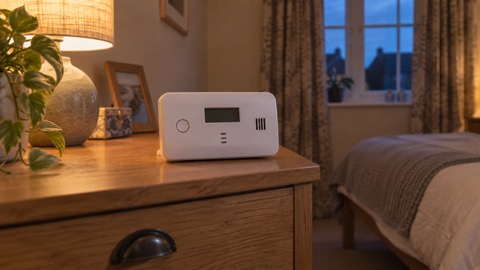
- Bedroom: consider one, so a warning is heard at night2.
- Hallway or landing: a linked alarm here helps the warning carry through the house1.
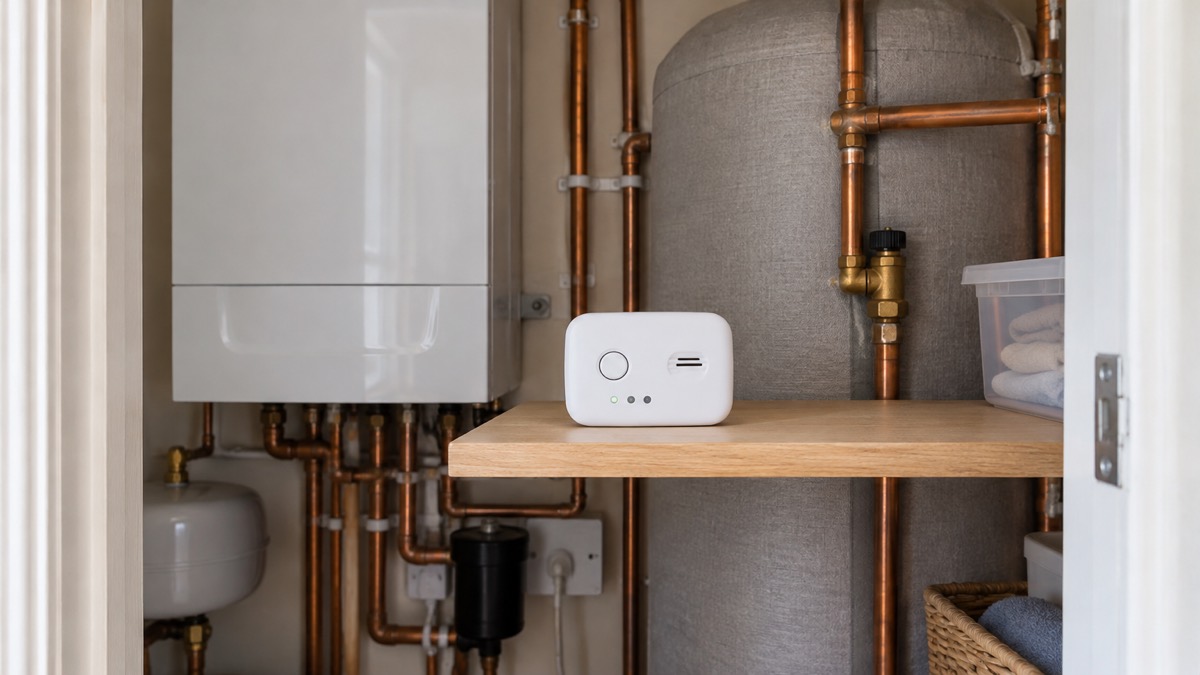
Do not fit it in a dead air space, behind furniture or in a cupboard where air does not circulate, and do not fit it right next to the appliance where it may be affected by draughts or steam. If you are unsure, the fire and rescue service will give home fire safety advice, and many offer a home visit. For more on choosing positions room by room, see Where to Put a Carbon Monoxide Alarm.
Fitting without wiring: wall mount or freestanding
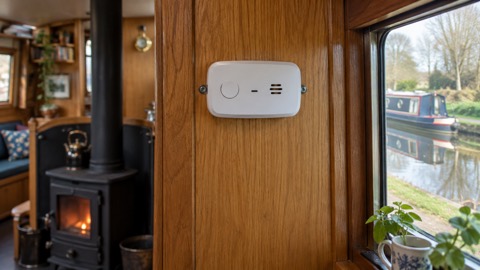
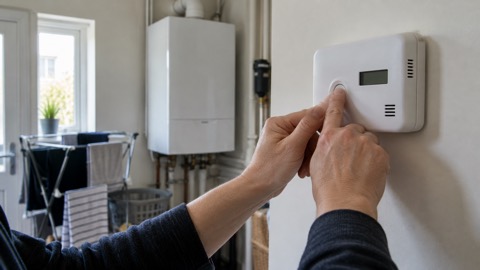
The alarm needs no wiring. The distributor lists it as easy to install with no wiring required, and as either freestanding or wall mounted with fixings included1. That makes it a practical choice for a rented home, a home with no spare mains circuit, or a room where running a cable would be disruptive.
To fit it:
- Choose the position. Head height, in a room with a fuel-burning appliance, about 1 to 3 metres from the source4.
- Decide wall or shelf. Wall mount with the fixings supplied, or stand it on a shelf where it will not be knocked1.
- Activate the battery. Follow the maker's instructions to pull the battery tab or activate the sealed battery, then check the LED shows operation1.
- Test it. Press the combined test and hush button and confirm the alarm sounds1.
- Link it. Put the other alarms in the same range into linking mode and confirm each one responds1.
- Record the date. Note the fitting date on the unit so you know when the 10 year life ends1.
If you are fitting several alarms, do it in one session so the linking is done while you are thinking about it. Keep the instructions with the alarm, and write the fitting date somewhere you will see it, such as inside a cupboard door.
Testing, hushing and reading the LED lights
The alarm has LED indicators to show operation, fault and alarm1. Test it regularly, following the maker's instructions, and at least as often as your fire service advises. Fire services recommend testing alarms weekly or monthly depending on the source, and the general principle is the same: press the test button and confirm the alarm sounds14.
The LED lights tell you what the alarm is doing:
- Operation: a regular flash or steady light shows the alarm is powered and working1.
- Fault: a different pattern shows a fault, which means the alarm needs attention or replacement1.
- Alarm: the light and the 85dB sounder together show carbon monoxide has been detected1.
If the alarm sounds and you suspect carbon monoxide, do not ignore it. Open doors and windows, turn off fuel-burning appliances, get everyone out into fresh air, and call the gas emergency number or the fire and rescue service. Do not re-enter until you are told it is safe. For the full sequence, see What to Do If Your CO Alarm Sounds or You Suspect Carbon Monoxide.
The hush button silences a false alarm temporarily, but it does not fix the cause. If the alarm keeps sounding, treat it as real until you know otherwise. For beeping patterns and what they mean, see Why Is My Carbon Monoxide Alarm Beeping?.
Alarms for deaf and hard of hearing households
The 85dB sounder is loud, but sound alone is not enough for everyone. Fire services advise that people who are deaf or have hearing loss should have a system of interlinked smoke and heat alarms with an interlinked strobe light and vibrating pad, so they receive a visual and vibrating alert if any alarm activates, with the vibrating pad placed under the pillow at night15. Carers are advised to check whether the person can hear a sounding alarm from where they usually sleep, and if not, to arrange interlinked alarms with a strobe and vibrating pad15.
The BLACK+DECKER alarm is a CO alarm with an audible sounder1. It is not described as having a strobe or vibrating pad, so a household that needs a visual or vibrating alert should look at a system designed for that purpose. For more, see Smoke and CO Alarms for Deaf and Hard of Hearing People.
The CO alarm rules in Scotland, Wales and Northern Ireland
The legal position differs across the UK, and the distributor lists the alarm as suitable for the Welsh and Scottish updated 2022 legislation and for Northern Ireland legislation (2024)1. Here is how the rules stand:
| Nation | CO alarm requirement |
|---|---|
| Scotland | A CO alarm where there are fixed combustion appliances such as boilers and wood burners16; a detector in any room with a carbon-fuelled appliance, which does not need to be linked to the fire alarms17 |
| Wales | The distributor lists the alarm as suitable for the Welsh 2022 legislation1 |
| Northern Ireland | A mandatory requirement for all homes where a new fossil fuel appliance is installed, after a change to the Building Regulations (Northern Ireland) 2012 came into operation on 31 October 201219 |
| England | No single national rule in the same form; official guidance still advises a CO alarm in every room with a fuel-burning appliance2 |
In Scotland, the law requires a carbon monoxide alarm where there are fixed combustion appliances such as boilers and wood burners16. The Scottish Government's guidance is that if you have a carbon-fuelled appliance such as a boiler, fire, heater or flue in any room, you must also have a carbon monoxide detector in that room, but it does not need to be linked to the fire alarms17. That is a useful point for anyone choosing this alarm: the interlink is a convenience, not a legal requirement in Scotland.
In Northern Ireland, carbon monoxide alarms are a mandatory requirement for all homes where a new fossil fuel appliance is installed, following the change to the Building Regulations that came into operation on 31 October 201219. Alarms sold there are marked as meeting Northern Ireland legislation from 2024, alongside Scottish and Welsh legislation from 2022, so check the packaging for the rules that apply where you live1.
In Wales, the distributor lists the alarm as suitable for the Welsh 2022 legislation1. For the detail of the Welsh and Northern Irish rules, see Wales and Northern Ireland: Alarm Rules and Fire Services.
End of life, replacement and warranty
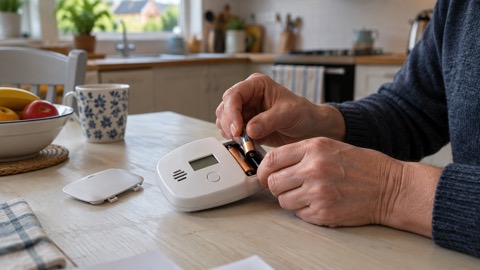
The alarm has a lifespan of 10 years, matching its sealed lithium battery1. Fire service guidance is that when a sealed battery alarm reaches the end of its life, you replace the full alarm as per the manufacturer's guidelines20. That is different from older alarms with a removable battery, which fire services say should be replaced annually21.
The distributor gives a 5 year manufacturer's warranty1. Keep your receipt or order confirmation, and note the fitting date, so you can claim within the warranty period if the alarm develops a fault. At the end of the 10 year life, replace the whole unit; do not try to open the case or change the battery.
Some alarms give a warning when they reach the end of their life. One fire service describes alarms that bleep once every minute for a minimum of one month at the end of their life14. If your alarm starts beeping and you cannot silence it, check the fitting date before assuming it is a fault. For more, see When to Replace a Smoke, Heat or CO Alarm.
The distributor lists the alarm as covered by Valpak's WEEE Distributor Take-back Scheme1, so ask the retailer how to return the old unit when you replace it.
Sources (21)
- BLACK+DECKER RF Interlink Carbon Monoxide Alarm product page, Safelincs, 2026-10-29
- Fire alarms and carbon monoxide detectors, Lincolnshire County Council, 2026-10-29
- Gas appliances: frequently asked questions, Health and Safety Executive, 2026
- Housing standards, Cherwell District Council, 2026-10-29
- Carbon monoxide, Cornwall Fire and Rescue Service, 2026-10-29
- Carbon monoxide: the silent killer, Wiltshire and Swindon Prepared, 2026-10-25
- BLACK+DECKER RF 10-Year Battery 2 Smoke, 1 Heat, & CO Alarm Kit, Safelincs
- Alarm types, Aico, 2026-10-28
- Where and what to buy, Scottish Government, 2024-08-14
- Smoke alarms, Devon and Somerset Fire and Rescue Service, 2026-02-17
- Hearing and sight difficulties, Devon and Somerset Fire and Rescue Service, 2025-11-19
- Carbon monoxide, Greater Manchester Fire and Rescue Service, 2026-10-25
- Fire safety, Greater Manchester Fire and Rescue Service, 2026-10-29
- Smoke alarm maintenance and problems, Mid and West Wales Fire and Rescue Service, 2026-10-29
- Additional advice for carers, Greater Manchester Fire and Rescue Service, 2026-10-29
- Home fire safety, Scottish Government, 2026-10-29
- Keep Safe Keep Well winter safety campaign, NHS Western Isles, 2024-12
- Fire alarms standard campaign evaluation report, Scottish Government, 2022-01-17
- Carbon monoxide alarms, Health and Safety Executive for Northern Ireland, 2026
- Smoke alarms, Cheshire Fire and Rescue Service, 2026-07-27
- Safer Together fire risk identification and management, Northern Ireland Fire and Rescue Service, 2021-02
 FireAngel FA3313 CO Alarm
 FireAngel FA3322 CO Alarm
 FireAngel FA3820 CO Alarm
 FireAngel FA6812 CO Alarm
 FireAngel FA6813 CO Alarm
 FireAngel FA6829S CO Alarm
 FireAngel CW1-PF CO Alarm
 FireAngel W2-CO-10X CO Alarm
 FireAngel FP1820W2-R CO Alarm
 Kidde K7DCO CO Alarm
 Kidde K5DCO CO Alarm
 Kidde K10LLDCO CO Alarm