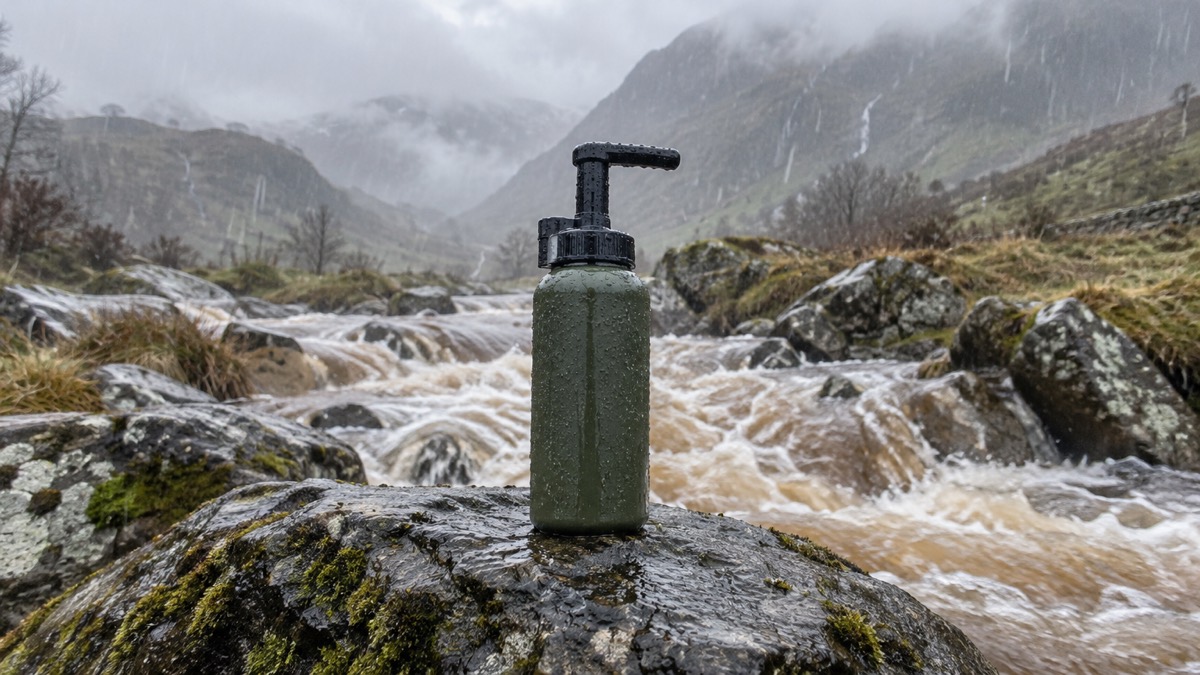
The LifeSaver Bottle Starter Pack is a 750 ml filter bottle with a hand pump built into it, sold with spare carbon filters, spare sponges, chew-proof nozzles, a strap and a protection pouch. Its ultrafiltration cartridge is rated to purify up to 6,000 litres, and the maker states it removes 99.99% of viruses, bacteria, parasites and microplastics1. For a household, that means one bottle can turn collected water from a pond, stream or lake into drinking water through a long interruption, rather than covering a single afternoon.
It is not a substitute for stored water. The bottle holds 750 ml at a time and needs a source to fill from, so the sensible arrangement is stored tap water for the first days and the bottle as the tool that keeps working once those containers are empty. The maker's own framing is simple: fill, pump, drink1.
This page sets out what the Starter Pack contains, what the filter does and how it was tested, how to use it, which water to avoid, how to keep it ready between emergencies, and what the warranty covers. It is written for a UK household building or checking an emergency water plan, not for a backpacker.
What the Starter Pack contains and who it suits
The Starter Pack is the bottle plus the consumables a household will actually get through. The maker lists the contents as one LifeSaver Bottle, four activated carbon filters, two pre-filter sponges, two chew-proof nozzles, a bottle strap and a protection pouch3. The bottle itself arrives with its ultrafiltration cartridge pre-installed, along with one activated carbon filter, a scavenging sponge, the pump, a carrying strap and a paper manual4.
That mix tells you who it suits. A household that wants one bottle ready in a cupboard, with enough spare carbon filters and sponges to last, is the natural buyer. The carbon filters are the parts that deal with taste and chlorine, and the sponges are the parts that get lost or dirty, so having four and two respectively means fewer reorders in the years between emergencies. The protection pouch and strap matter less at home than they do in a rucksack, but they cost nothing to keep.
The bottle is also sold on its own, and the maker points buyers towards a Solo Emergency Preparedness Pack as an alternative bundle5. If you already hold a filter bottle, the LifeSaver Bottle page covers the bottle by itself. For a wider look at how bottle filters compare with gravity and pump types, see Filter Bottles and Straw Filters for One Person.
| What you get | How many | What it does for the household |
|---|---|---|
| LifeSaver Bottle with ultrafiltration cartridge | 1 | Holds 750 ml, filters up to 6,000 litres1 |
| Activated carbon filters | 4 | Removes chlorine, taste, smell and odour1 |
| Pre-filter sponges | 2 | Soaks up water from shallow sources3 |
| Chew-proof nozzles | 2 | Spare drinking nozzle |
| Bottle strap | 1 | Carrying |
| Protection pouch | 1 | Storage and transport |
Specifications
The figures below are the maker's own, published on the Starter Pack product page and in the bottle manual. Where the maker gives a figure in two forms, both are shown.
| Specification | Figure |
|---|---|
| Bottle storage capacity | 750 ml (25 oz)1 |
| Volume of water filtered per cartridge | 6,000 litres (1,585 US gallons)1 |
| Dry weight | 635 grams (22 oz)1 |
| Initial flow rate | 2.5 litres a minute at 0.25 bar1 |
| Pore size | approximately 15 micron1 |
| Virus reduction | more than 99.99% (Log 4)1 |
| Bacteria reduction | more than 99.9999% (Log 6)1 |
| Cyst reduction | more than 99.99% (Log 4)1 |
| Filter media | Ultra Filtration (UF)1 |
| Replaceable cartridge | Yes1 |
| Warranty | 2 years1 |
| Manufactured in | UK2 |
Two footnotes sit under those figures and both matter to a household. The maker states that volume filtered and flow rates depend on the composition and turbidity of the water you put in1. And all the quoted reduction figures are taken from the stressed challenge phase of a test imitating sewage-contaminated water1, which is a harder test than a clear stream.
The manual gives flow rates by cartridge model: 2.5 litres a minute for the 6000UF and 2 litres a minute for the 4000UF6. The Starter Pack uses the 6,000 litre cartridge.
What the filter removes, and how it was tested
The maker's headline claim is that the filter removes 99.99% of viruses, bacteria, parasites and microplastics1. The supporting log reductions are more than 99.99% for viruses, more than 99.9999% for bacteria and more than 99.99% for cysts1. The maker also states that the filter removes chemicals and heavy metals, leaving safe drinking water7.
The test behind those numbers is specific, and worth reading before you rely on it. The maker states the units were tested by BCS Laboratories, with results issued on 16 June 2020, based on an adaptation of NSF Protocol P248, and that the figures come from the stressed challenge phase of the test imitating sewage-contaminated water2. The Starter Pack page also states the product was tested by an independent test house to meet an adaptation of NSF Protocol 2482.
"Tested by BCS laboratories issued 16/06/2020 based on an adaptation of NSF P248 Protocol. These units are tested with the stressed challenge phase of the test imitating sewage-contaminated water."
That is a maker's claim about an independent laboratory's test, not a certification statement from a UK regulator. If you want to understand what log reduction figures mean and how NSF protocols work, Filter Claims and Certification: NSF Standards and Log Reduction explains the conventions. For what different filter media remove, see Ceramic, Carbon, Hollow-Fibre and RO: What Each Removes.
The carbon stage is separate. The maker lists an optional activated carbon filter that removes chlorine, taste, smell and odour1, and the Starter Pack includes four of them3. If your tap water is chlorinated and you are filtering it for taste during a boil notice, the carbon filter is the part doing that job. If you are filtering pond water, the ultrafiltration cartridge is doing the safety work.
How to use it: fill, pump, drink
The maker's instruction is deliberately short: fill, pump, drink1. In practice, the sequence is to unscrew the base, remove the pump, fill the bottle with water, replace the pump and start pumping to pressurise the water through the filter8. The maker describes it as unscrewing the bottom, filling it with water, screwing it back on and using the inbuilt manual pump9.
- Unscrew the base of the bottle and lift out the pump10.
- Fill the body with the water you want to treat10.
- Replace the pump and screw the base back on10.
- Pump to pressurise the water through the filter10.
- Drink from the top, or decant into a clean container.
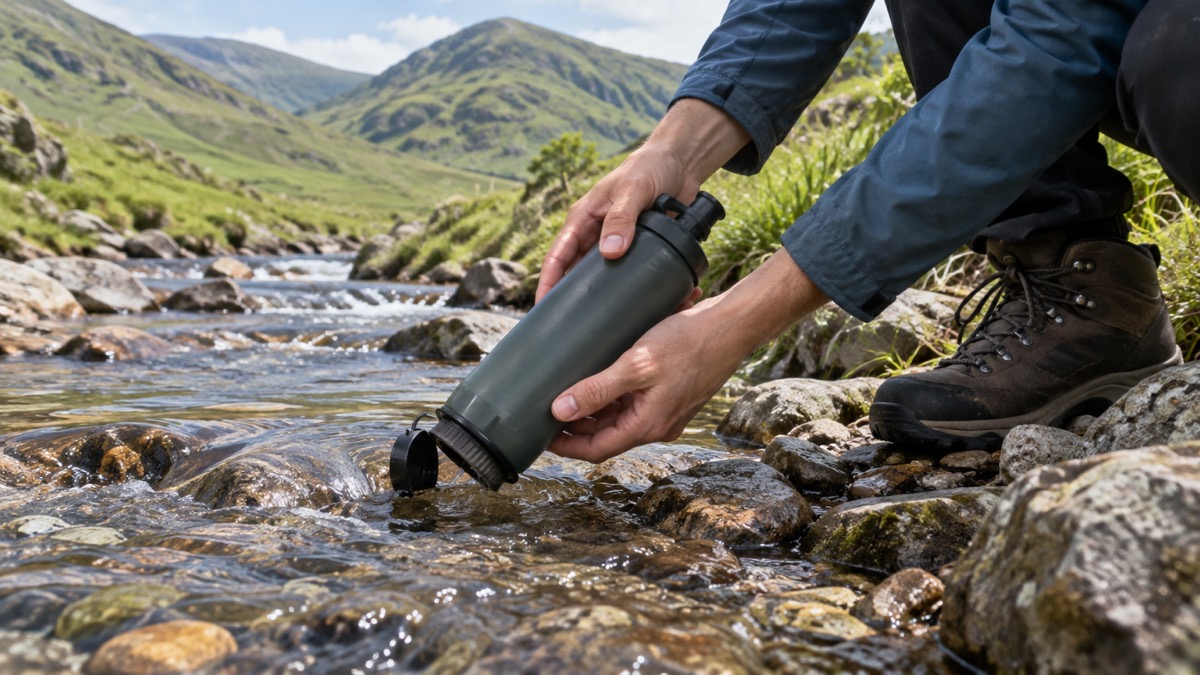
The design has one practical advantage a household will notice. A reviewer describes the bottom-fill design as preventing filtered water from being contaminated, unlike traditional top-fill bottles2. Because the dirty water goes in at the bottom and the clean water comes out at the top, you are not pouring untreated water past the drinking end.
The maker describes the bottle as a pressure vessel11. Treat a pressurised bottle as you would any sealed container under pressure: do not over-pump beyond what the maker describes, do not open it while it is pressurised, and do not expose it to heat.
Flow rate: 2.5 litres a minute when new, slower in dirty water
A new cartridge flows at 2.5 litres a minute at 0.25 bar1. That is the maker's figure for a clean cartridge and a defined pressure, and it is the number to hold in your head when you are deciding whether the bottle can keep a family supplied.
It will not stay at that rate. The maker states plainly that flow rates depend on the composition and turbidity of the water you put in1. Cloudy, silty or muddy water means more pumping for less water, and the filter is doing more work. The maker does state that the filter reduces turbidity in glacial, cloudy or muddy water1, so it is built for imperfect sources, but the effort goes up.
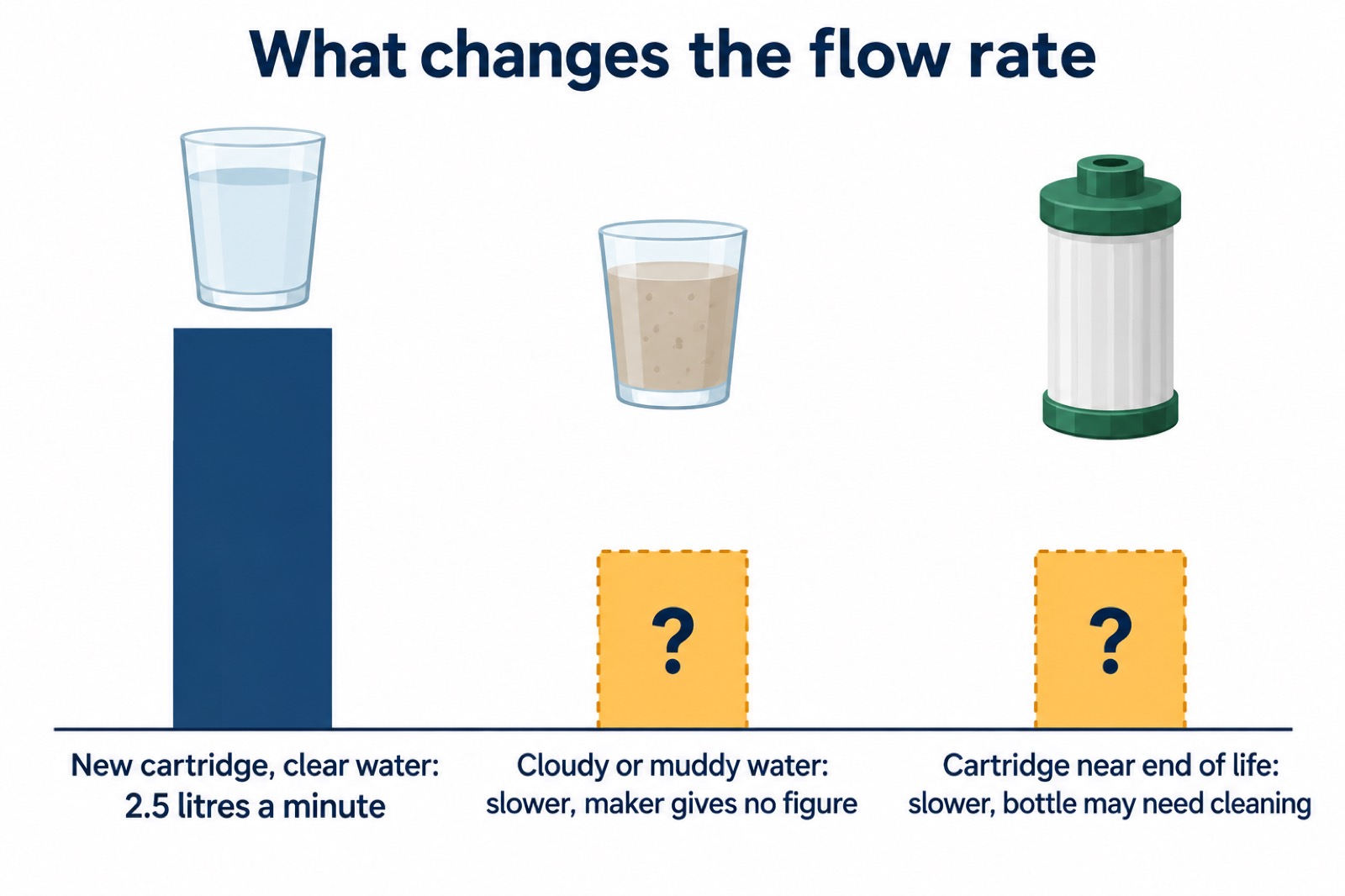
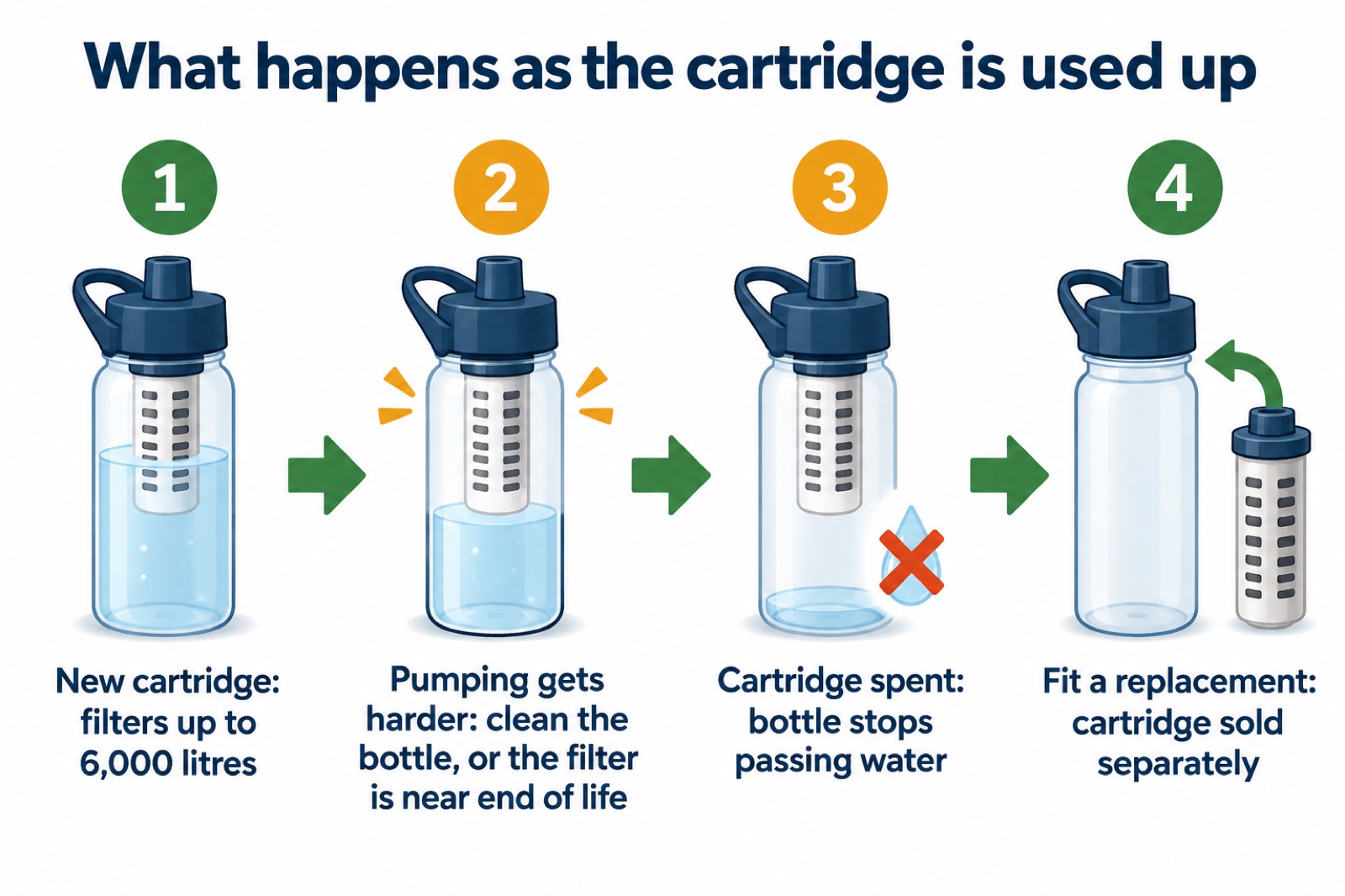
If pumping becomes noticeably harder than it was, the maker's manual gives two explanations: the bottle may need cleaning, or the filter may be reaching the end of its service life11. Clean the bottle first, then judge. A cartridge that has filtered a lot of dirty water will reach its 6,000 litre rating sooner in practice than the headline figure suggests, because the rating is a maximum, not a promise.
Which water sources to avoid or treat with care
The bottle is designed for natural sources. The maker states it allows you to use water from ponds, lakes and rivers while protecting you from waterborne viruses, bacteria and protozoa12. That is the use case: a household that can reach a pond, stream or lake during an interruption.
It is not a licence to treat anything wet. The maker is explicit about what the product will not safely purify: sea water, coffee or wine, grey water from baths, sinks and washing machines, microcystin (blue-green algae toxin) and urine, the last because of salt levels13. The maker also states you cannot use it on small stagnated pools or canals, adding that even the best filter would not take that on5.
For a household in the UK, the practical reading is this: a river, a lake, a pond or a standing water butt fed by rain is within the bottle's remit; a canal in a city, a stagnant puddle or anything with an algal bloom is not. If you are unsure whether a source is safe, Drinking From Streams, Rivers and Other Sources Safely sets out how to judge it, and How to Make Water Safe to Drink in an Emergency covers the alternatives, including boiling and tablets.
The same caution applies to storing water for the bottle to treat later. The maker advises against containers that previously held chemicals, cleaning products, milk or fruit juice, because residues can remain or encourage bacterial growth even after washing14. For storage generally, see Storing Tap Water Safely at Home and Containers and Jerrycans for Drinking Supplies.
Collecting water with the sponge
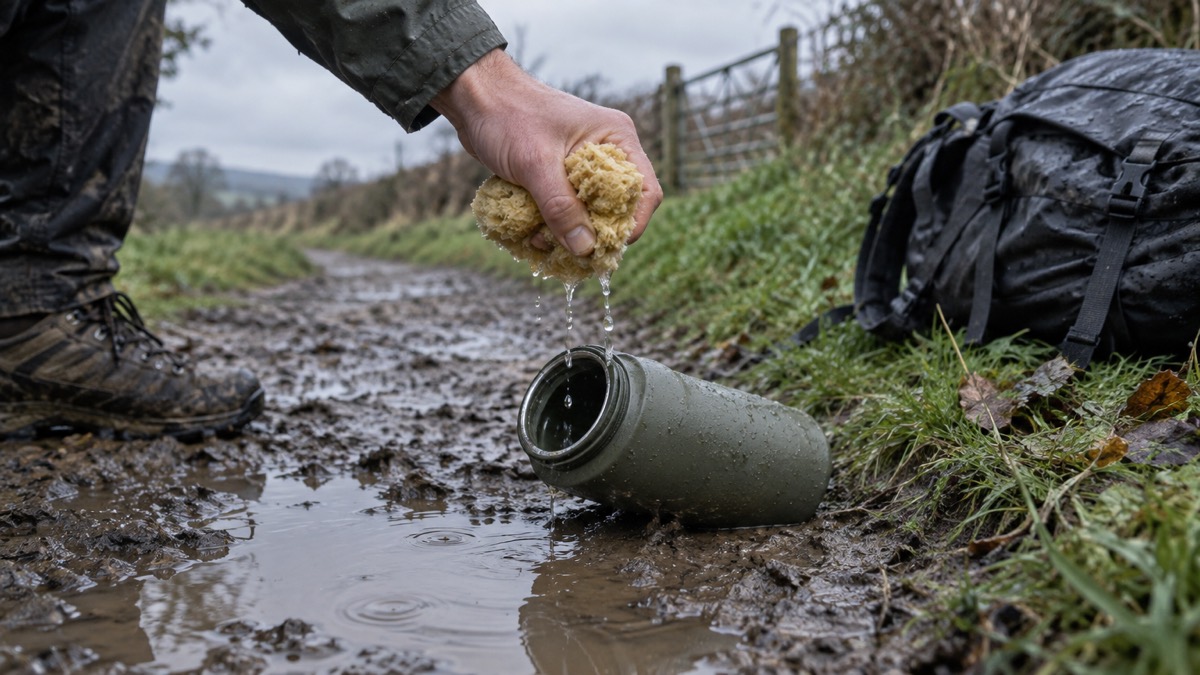
The sponge at the bottom of the bottle is a small but genuinely useful piece of the kit. The maker suggests that if you cannot get water into the bottle easily, you can use the sponge to soak up water and then squeeze the contents into the bottle4. A reviewer describes dipping the sponge into a shallow puddle and squeezing it into the bottle before following the pressurisation steps15.
The maker frames this as an emergency measure. One product page describes it as advice for desperate situations with no other water source2. That is the right way to think about it: the sponge lets you harvest water from a source too shallow to fill from, but it is a last resort, not a routine collection method, and the water still has to go through the filter.
The Starter Pack includes two pre-filter sponges3, and replacements are sold separately16. Keep them clean and dry between uses, and replace one that has been used on genuinely foul water rather than trying to wash it back to new.
The bottle stops working when the filter needs replacing
This is the feature that matters most for emergency planning. The maker states the bottle has a failsafe: it stops working when the filter needs replacing1. The maker's failsafe technology page puts it directly: the LifeSaver Bottle will safely purify up to 6,000 litres of water, and when the cartridge is spent the bottle stops passing water rather than passing contaminated water17.
A reviewer describes the same behaviour from the user's side: the membrane will clog entirely and will not pass any fluid, so you are never left wondering about the efficacy2. In an emergency, that is exactly what you want. A filter that quietly degrades and keeps dripping is worse than one that refuses.
The consequence for a household is that a spent cartridge is a hard stop. Keep a spare. Replacement cartridges are sold separately18, and a foil-sealed version is also listed19. The maker also sells a maintenance pack20, which is the sensible thing to hold alongside a spare cartridge if the bottle is going to sit in a cupboard for years between uses.
Keeping it ready between emergencies
A filter bottle that has sat dry in a cupboard for three years is not automatically ready. The maker's own guidance on storing emergency water is a good starting point for the wider plan: store water in food-grade containers, keep it out of sunlight and heat, and rotate it14. The bottle itself needs less attention, but a few habits keep it usable.
- Store the bottle clean and dry, with the cartridge fitted and the cap off so air can move.
- Keep the spare carbon filters and sponges in the protection pouch so they do not go missing.
- Note the date you first used the bottle, so you can judge how much of the 6,000 litre rating you have spent1.
- Check the pump action before an emergency, not during one.
- Keep a spare cartridge and a maintenance pack in the same box.
For the wider question of how much water a household should hold, How Much Drinking Water to Store per Person does the arithmetic, and the Home Drinking Supply Storage Checklist is a printable list. The Supply Interruption Checklist covers the first hours of a cut-off.
Warranty and support: 2 years
The Starter Pack carries a 2 year warranty1. The bottle manual sets out what that means: LifeSaver provides a 2-year limited warranty for defects in materials and workmanship for all products purchased directly or via authorised partners11. Buy through an authorised route and the warranty applies; buy grey-market and it may not.
Support runs through the maker, Icon LifeSaver, whose UK base is covered on the Icon LifeSaver page. The maker publishes a set of frequently asked questions covering what the products will and will not purify13, and the bottle manual is available as a PDF for anyone who has lost the paper copy11.
For a household, the warranty matters less than the spares chain. A two-year warranty on a bottle you expect to keep for a decade is a backstop for a manufacturing fault, not a maintenance plan. The maintenance plan is the spare cartridge, the spare carbon filters and the spare sponges, all of which the maker sells separately18.
Where it fits in a household water plan
The bottle is one layer of a plan, not the plan. Stored water covers the first days of an interruption, when the taps may still run or the containers are still full. The bottle covers the period after that, when you are collecting water from outside the home and need to make it safe. Boiling and tablets cover the same ground by different means, and Purification Tablets or a Gravity Filter? sets out the trade-offs.
For a household with a water butt, a nearby stream or a pond, the bottle is a sensible single purchase that turns an unreliable source into a drinkable one. For a household in a flat with no outdoor water source, stored water and a supply interruption plan matter more. The Water in an Emergency: A Household Guide section page sets out the whole picture, and Emergency Filters: Gravity, Pump, Bottle and Straw Types explains where bottle filters sit among the alternatives.
Sources (20)
- LifeSaver Bottle Starter Pack product page, Icon LifeSaver, 2026
- LifeSaver Bottle Starter Pack (MENA), Icon LifeSaver, 2026
- LifeSaver Bottle Starter Pack (North America), Icon LifeSaver, 2026
- LifeSaver Bottle product page, Icon LifeSaver, 2026
- LifeSaver Bottle (North America), Icon LifeSaver, 2026
- LifeSaver Bottle Manual 2023, Icon LifeSaver, 2023
- LifeSaver Bottle (EU), Icon LifeSaver, 2026
- LifeSaver Bottle Desert Pouch | Icon Lifesaver, Icon Lifesaver
- LifeSaver Bottle Maintenance Pack (MENA), Icon LifeSaver, 2026
- LifeSaver Bottle (MENA), Icon LifeSaver, 2026
- LifeSaver Bottle User Manual (Multilingual), Icon LifeSaver, 2026
- LifeSaver Bottle | Icon Lifesaver, Icon LifeSaver
- LifeSaver FAQs (North America), Icon LifeSaver, 2026
- How to store emergency water safely at home, Icon LifeSaver, 2026
- LifeSaver Replacement Cartridge (foil sealed), Icon LifeSaver, 2026
- LifeSaver Bottle Pre-filter Sponges, Icon LifeSaver, 2026
- LifeSaver Failsafe Technology, Icon LifeSaver, 2026
- LifeSaver Replacement Cartridge, Icon LifeSaver, 2026
- LifeSaver Replacement Cartridge (foil sealed, MENA), Icon LifeSaver, 2026
- LifeSaver Bottle Maintenance Pack, Icon LifeSaver, 2026

 LifeSaver Bottle
 LifeSaver Liberty
 LifeSaver Jerrycan
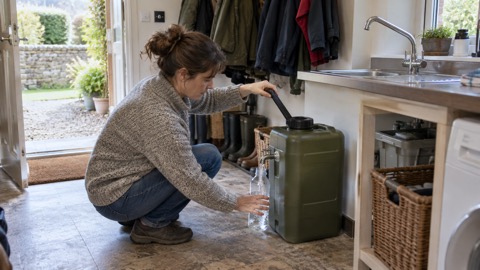 LifeSaver Jerrycan Graphene
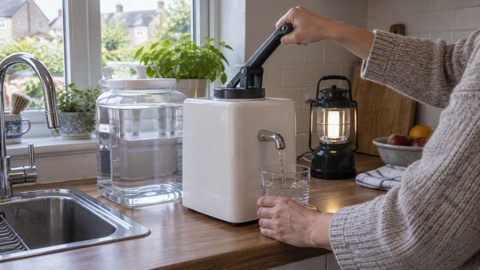 LifeSaver Cube
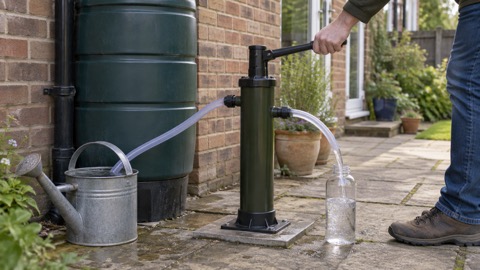 LifeSaver Wayfarer
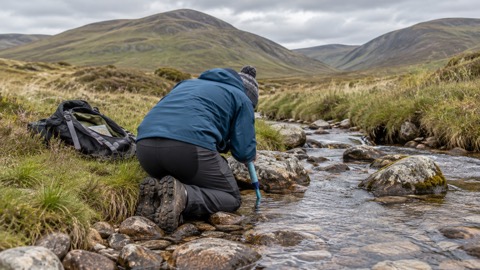 LifeSaver Lifeline
 LifeSaver C1
 LifeSaver C2
 Katadyn Micropur Classic
 Katadyn Micropur Forte
 Katadyn Micropur Antichlor