The Aqara Smart Lock U600 is a battery-powered smart lock built for standard UK multipoint doors, and the thing a household most wants to know about any smart lock is what happens when the power or the battery fails. Aqara's answer is that the lock runs on four AA batteries for up to 10 months, warns you in the app at 20% and 10%, and has a USB-C port so a power bank or a USB-C phone can wake it if the batteries do run flat1. It also takes a mechanical key, and two come in the box2.
For a household preparing for emergencies, that combination matters more than the app features. A lock that needs mains power, a hub and a working internet connection to let you in is a liability in a power cut. The U600 keeps its access methods on the door itself: fingerprint, code, card, key and phone, with the smart-home parts as extras rather than requirements2. The maker states that Aqara smart locks are standalone devices that do not require a subscription3.
Before you buy, two checks decide whether it suits your door. The first is the door itself: Aqara gives the applicable door thickness as 40 mm to 80 mm, and warns that if lifting your existing handle does not engage the deadbolt, the U600 cannot operate that deadbolt2. The second is your insurance. Fitting the lock requires removing the existing cylinder, and Aqara advises checking with your insurer whether that affects your cover1.
Does the U600 fit a UK multipoint door?
Aqara states that the U600 is built to fit standard UK multipoint doors and is weather-tested for British conditions1. That is the market it was designed for, and it is the first thing to confirm, because a smart lock that does not fit your door is no use whatever its features.
The measurements decide it. Aqara gives the applicable door thickness as 40 mm to 80 mm2. Measure your door before ordering, at the point where the lock will sit, and include any trim. A door outside that range will not take the lock.
There is a second mechanical check that catches people out. Aqara warns that if lifting your existing door handle does not engage the deadbolt, the U600 will not be able to operate that deadbolt2. On a multipoint door, the handle lift is what throws the bolts; if your door does not work that way, the lock cannot do the job the handle does. Try it before you buy: lift the handle with the door open and watch whether the bolts move.
| Check | What Aqara states | Why it matters |
|---|---|---|
| Door type | Built to fit standard UK multipoint doors1 | The lock is designed around this mechanism |
| Door thickness | 40 mm to 80 mm2 | Outside this range it will not fit |
| Handle and deadbolt | If lifting the handle does not engage the deadbolt, the U600 cannot operate it2 | The lock relies on the door's own bolt mechanism |
| Cylinder | Installing requires removing the existing cylinder1 | Changes what is protecting the door |
If your door passes these checks, the lock replaces the cylinder and the handle furniture rather than the whole door, which is why the cylinder question comes next. If it does not, a conventional lock on a well-fitted door remains a sound choice, and our guide to doors and locks sets out the standards that matter.
Before you fit it: the cylinder comes out, so check with your insurer
This is the step households most often skip, and it is the one Aqara itself flags. The maker states that installing the lock requires removing the existing cylinder, and that because requirements vary by insurer, you should check with your insurance provider to confirm whether installing the product may affect your coverage1.
The reason is straightforward. The cylinder is the part of a euro-profile lock that a burglar attacks, and insurers often specify the standard it must meet. Removing it and fitting a smart lock changes the specification of the door, and whether that is acceptable is a question for your insurer, not for the lock's maker. Our page on home insurance conditions explains how locks, alarms and unoccupancy clauses typically work, and what British Standard a door lock should meet covers the cylinder standards themselves.
On durability, Aqara states that the lock has passed 100,000 open-and-close cycle tests1. That is the maker's own test figure, and it speaks to the mechanism lasting, not to whether your insurer will accept it.
Batteries last up to 10 months, with warnings at 20% and 10%
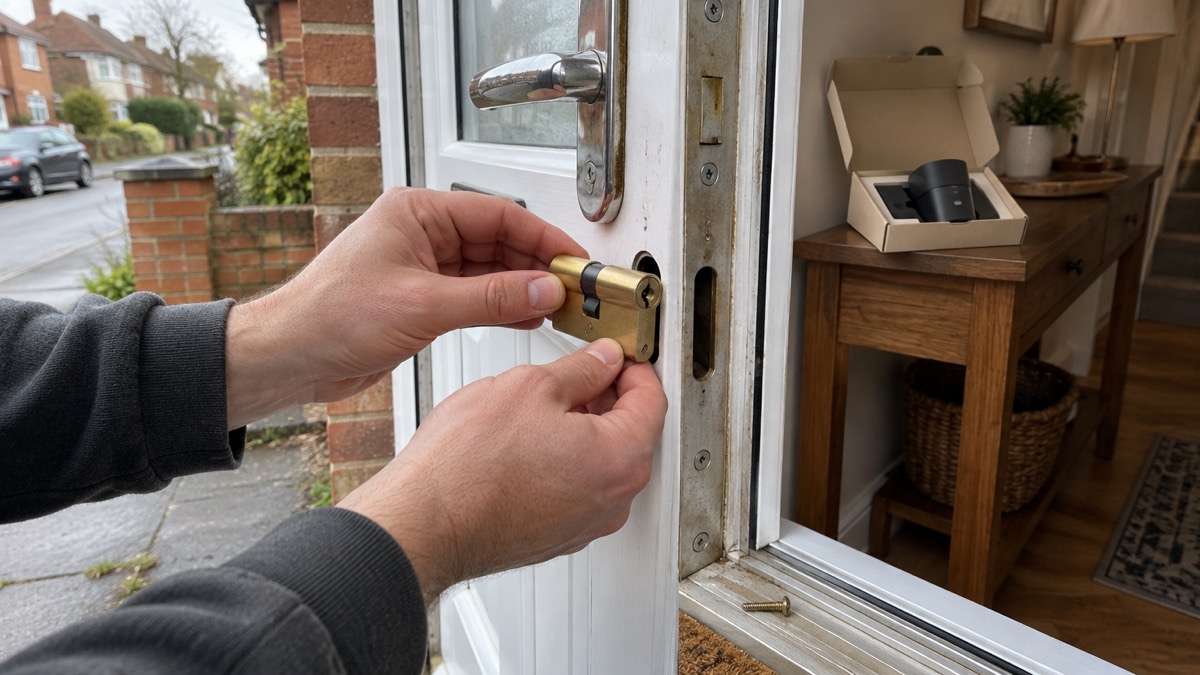
The U600 runs on four AA batteries, and Aqara states they last up to 10 months and are easily replaceable1. That is the figure for this model. Aqara's wider lock range is quoted at a maximum of 8 to 18 months, shortened by cold temperatures and frequent use3, so treat 10 months as the U600 figure and expect a cold front door in winter to sit at the shorter end.
The lock gives you warning well before it stops. Aqara states that the app sends push notifications when the remaining battery reaches 20% and 10%, and a reminder tone plays each time the door is opened1. The tone is the useful part: it reaches everyone in the household, not just whoever has the app installed.
For a household plan, the sensible routine is simple. Keep a spare set of four AA batteries in the house, note roughly when you fitted the last set, and act on the 20% warning rather than waiting for the tone. The maker states that the U600's four AA batteries last up to 10 months and are easily replaceable1, and that the app sends push notifications when the remaining battery reaches 20% and 10%, with a reminder tone each time the door is opened1. Across Aqara's smart locks the maker gives a maximum battery life of 8 to 18 months, shortened by cold temperatures and frequent use3, so the U600's own figure is the one to plan around.
| Signal | What it means | What to do |
|---|---|---|
| App notification at 20% | Battery is getting low | Put a fresh set of AA batteries by the door |
| App notification at 10% | Battery is nearly flat | Change them now, before the tone becomes the only warning |
| Reminder tone on opening | Warning is active | Change the batteries the same day |
| No response at the keypad | Battery may be flat | Use USB-C emergency power, then the mechanical key if needed1 |
Our guide to how long smart lock batteries last covers the wider picture across models, and do smart locks work in a power cut explains why a battery lock behaves differently from a mains-powered one.
A flat battery does not lock you out: USB-C emergency power
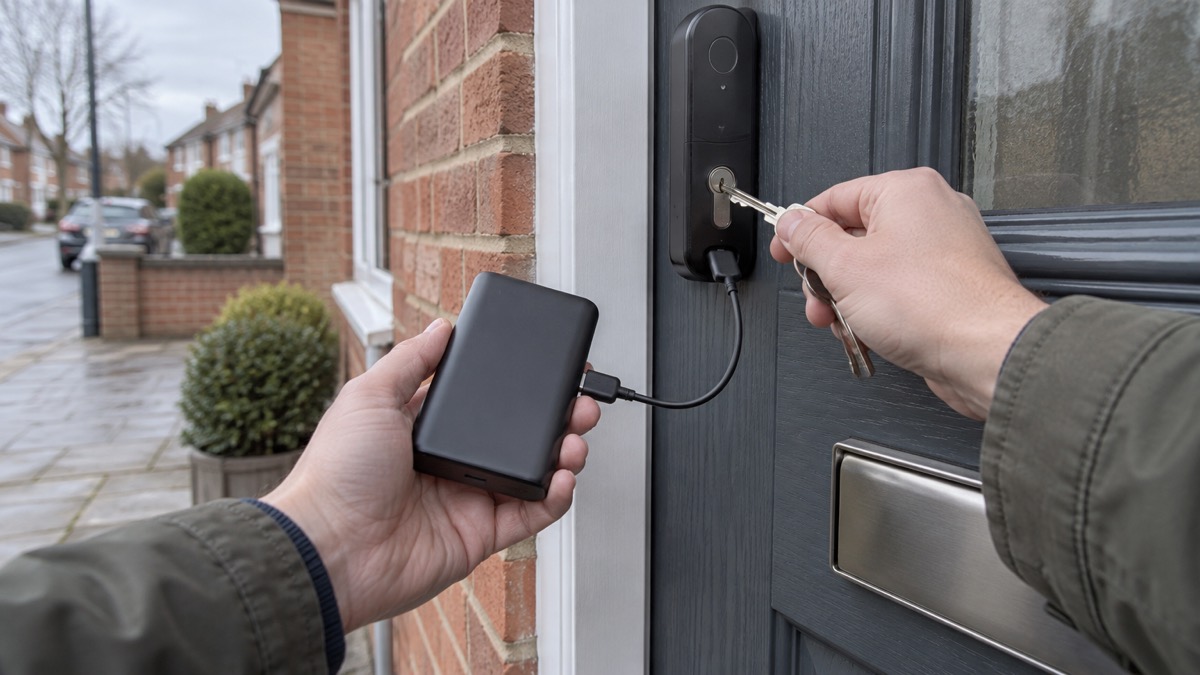
The question every household asks about a battery lock is what happens on the morning the battery dies with you on the wrong side of the door. Aqara's answer is a USB-C charging port on the lock, which lets you power it up with a power bank or a phone that supports USB-C to USB-C power supply1. The specification lists the emergency power supply as Type-C2.
That makes a charged power bank a piece of door kit as well as emergency kit. If you already keep one in the house for power cuts, as our guide to backup power at home suggests, the same bank can wake the lock. A phone that supports USB-C to USB-C power supply can do it too, which is worth knowing if the power bank is flat as well.
The mechanical key is the second line of defence. Two come in the box2, and they work independently of the battery. Keep one somewhere outside the house that you can reach without tools, and give the other to someone you trust. Our page on keys, spares and hiding places covers where not to leave them.
Ways to unlock, from fingerprint to mechanical key
The U600 offers more ways in than most households will use, and the point of listing them is to see which ones still work when the power, the internet or your phone does not. Aqara lists permanent password, offline password, scheduled password, app control, voice, mechanical key, NFC card, automation, fingerprint, Apple Home Key and Samsung Wallet Digital Home Key2.
The fingerprint reader is the everyday method for most people. Aqara states it can match a print in less than half a second and stores up to 50 fingerprints, covering multiple household members1. The offline and scheduled passwords are the ones to set up for a household emergency plan: an offline password does not depend on the network, and a scheduled password can be set to work only in a window you choose, which suits a carer or a cleaner.
Apple Home Key needs the right hardware. Aqara states it is supported on iPhone XS or later running iOS 18.6 or later, and Apple Watch Series 6 or later running watchOS 11.5 or later1. It also needs an Apple Home hub in the house, such as a HomePod, HomePod mini or Apple TV2. Without the hub, the feature will not work even on a supported phone.
| Method | Works without internet? | Best suited to |
|---|---|---|
| Fingerprint | Yes, stored on the lock1 | Everyday entry for the household |
| Code (permanent, offline, scheduled) | Offline code does not depend on the network2 | Visitors, carers, a backup for everyone |
| Mechanical key | Yes2 | The fallback when electronics fail |
| NFC card | Yes, held at the door2 | Household members who prefer not to use a phone |
| Apple Home Key | Needs the Apple Home hub2 | Apple households already set up with a hub |
| Samsung Wallet Digital Home Key | Aqara states it works even with the phone powered off2 | Android households wanting a phone fallback |
| App and voice | Depends on the smart-home setup2 | Remote checking and convenience, not the primary way in |
The lock is compatible with Apple Home, Home Assistant, Alexa, SmartThings, Google Home and Aqara1, and Aqara states the range uses 128-bit encryption3. For the wider question of what a smart lock should do before you buy one, see our guide to smart locks and the comparison of a smart lock or a traditional key lock.
Night latch and auto-lock: keeping the door secure overnight
Two settings do most of the work of keeping the door secure without you thinking about it. The first is the auto-lock timer: Aqara states that with an adjustable auto-lock timer, the lock secures itself after your set countdown1. That closes the gap where a door is pulled to but not locked, which is the state burglars look for. Our guide to how burglars choose a home explains why an unlocked door is the easiest target there is.
The second is night latch mode. Aqara states that when it is enabled, the door can be unlocked normally from inside, but from outside only administrators, mobile Bluetooth and emergency keys can unlock it1. That is the setting for overnight: the household can still get out, and the people who need to get in still can, but a code shared with a visitor does not open the door at two in the morning.
The lock can also drive other things. Aqara states you can set up "when, if, then" rules to trigger automations based on real-time actions, for example setting the lights to turn on automatically when the door opens1. A light coming on as the door opens is a small thing that makes an empty-looking house look occupied, which our guide to making your house look occupied covers in more detail.
Alerts are the other half of the overnight picture. Aqara states that do not disturb mode mutes all general alerts during the time you set, while still notifying you about forced entry, a door left ajar, or other critical events1. Set the window to cover the hours you sleep, and check that the critical alerts still arrive, because those are the ones worth waking for.
Built for the outside
A front door lock lives in the worst conditions the British weather can offer, and the U600 is rated for it. Aqara gives the outer panel an IP65 weatherproof rating1, and the operating temperature range as -20℃ to 55℃1. The operating humidity is given as 0 to 93% relative humidity, with no condensation2. For context, Arlo rates its outdoor cameras at IP65 for the same reason, describing them as built for all-weather protection against heat, cold, rain, snow and sun4.
The rating applies to the outer panel, which is the part exposed to the weather. The inner panel sits inside the house and does not face rain. That is worth knowing when you read the specification, because it tells you which half of the lock the figure covers.
| Specification | Aqara figure |
|---|---|
| Model | EL-D11E2 |
| Power supply | Four AA batteries2 |
| Battery life | Up to 10 months1 |
| Emergency power | USB-C port1 |
| Outer panel rating | IP651 |
| Operating temperature | -20℃ to 55℃1 |
| Operating humidity | 0 to 93% RH, no condensation2 |
| Door thickness | 40 mm to 80 mm2 |
| Fingerprint capacity | Up to 50 prints1 |
| Fingerprint match time | Less than half a second1 |
| Cycle testing | 100,000 open-and-close cycles1 |
| Wireless protocols | Bluetooth and Thread2 |
| Box contents | Lock, manual, four AA batteries, two keys, accessories kit, fixed plate2 |
Cold is the one condition that bears on the battery. Aqara states that cold temperatures and frequent use can shorten battery life across its lock range3, so a north-facing door in a hard winter is where the 10-month figure is most likely to fall short. The 20% warning gives you time to act before it matters.
What the lock needs from your smart home
The U600 runs on Matter over Thread, and Aqara states that to use it with a particular Matter ecosystem, a Thread-enabled Matter Controller for that ecosystem is required1. The ecosystems listed are Apple Home, Home Assistant, Google Home, Amazon Alexa, Samsung SmartThings and others2. The wireless protocols are Bluetooth and Thread2.
In plain terms, the lock works on its own at the door. Fingerprint, code, card and key do not need a controller, a hub or an internet connection. The controller is what lets the lock talk to your smart-home system, so you can see its status in an app, unlock it remotely or use it in automations. If you have no Thread-enabled Matter controller, the lock still does its main job; you simply do not get the connected features.
That distinction is worth holding on to in an emergency. A power cut or a broadband outage takes out the hub and the router, and with them the app and the remote unlock. It does not take out the fingerprint reader, the keypad or the key. Our guide to keeping your home protected in a power cut covers the wider preparations, and alarms and cameras on a weak signal covers what happens when the connection is poor.
The lock also works with the Aqara Doorbell Camera Hub G410, which Aqara states lets you see who is at the door and unlock it directly from the app2. That is a convenience for the everyday case of a delivery or a visitor, and it pairs with the guidance in our video doorbells guide on checking who is there before you open the door.
Support, warranty and keeping it ready
Aqara lists a hassle-free warranty, a 30-day money-back guarantee and lifetime customer support for the U6001. The maker's UK product page showed the item in stock when it was checked1. The page also listed four certifications1, and two customer reviews, both five stars1; two reviews is a very small sample, so treat them as anecdote rather than evidence.
Keeping the lock ready for an emergency is mostly about the battery and the fallback. A short routine covers it:
- Keep four spare AA batteries in the house, because the maker states the U600's four AA batteries last up to 10 months and are easily replaceable1.
- Act on the app's push notifications when the remaining battery reaches 20% and 10%, and on the reminder tone that plays each time the door is opened1.
- Check the app still sends alerts, and that do not disturb mode is set to the hours you sleep1.
- Check night latch mode is still on if you rely on it overnight, because one normal unlock turns it off1.
- Note that cold temperatures and frequent use can shorten battery life across Aqara's smart locks3.
For the wider picture of how a smart lock fits a household security plan, start with our guide to home security, and for the maker's other products see Aqara. If you are weighing up whether a smart lock suits your door and your habits at all, the comparison of a smart lock or a traditional key lock sets out the trade-offs, and smart locks in rented and shared homes covers the cases where permission is needed before anything is changed.
Sources (4)
- Smart Lock U600 UK, Aqara, 2026-11-03
- Smart Lock U600, Aqara, 2026-10-26
- Smart Door Locks, Aqara, 2026-10-14
- Arlo home security, Arlo, 2026

 ABS Ultimate Series Cylinder
 Aqara Smart Lock U200 Lite
 Aqara Smart Lock U200
 igloohome Deadbolt 2S
 Keyguard Digital XL Key Safe
 Nuki Smart Lock Go
 Nuki Smart Lock Pro
 SwitchBot Lock Ultra
 Ultion ALPS Cylinder
 Ultion Nuki Smart Lock