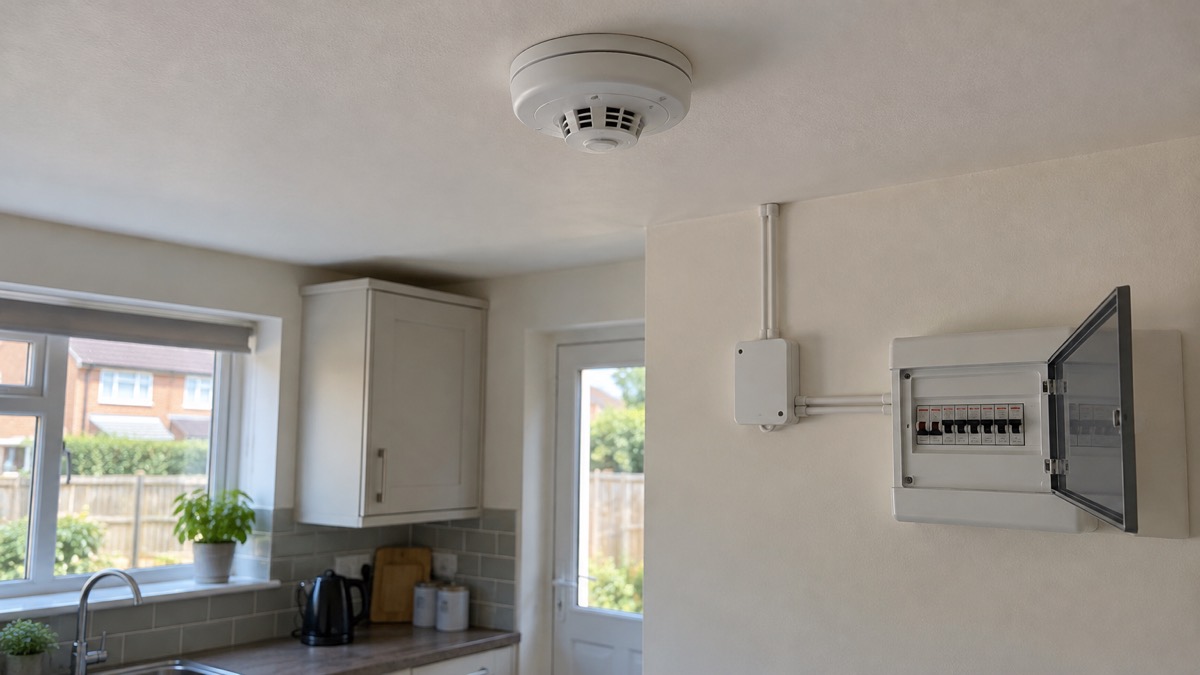
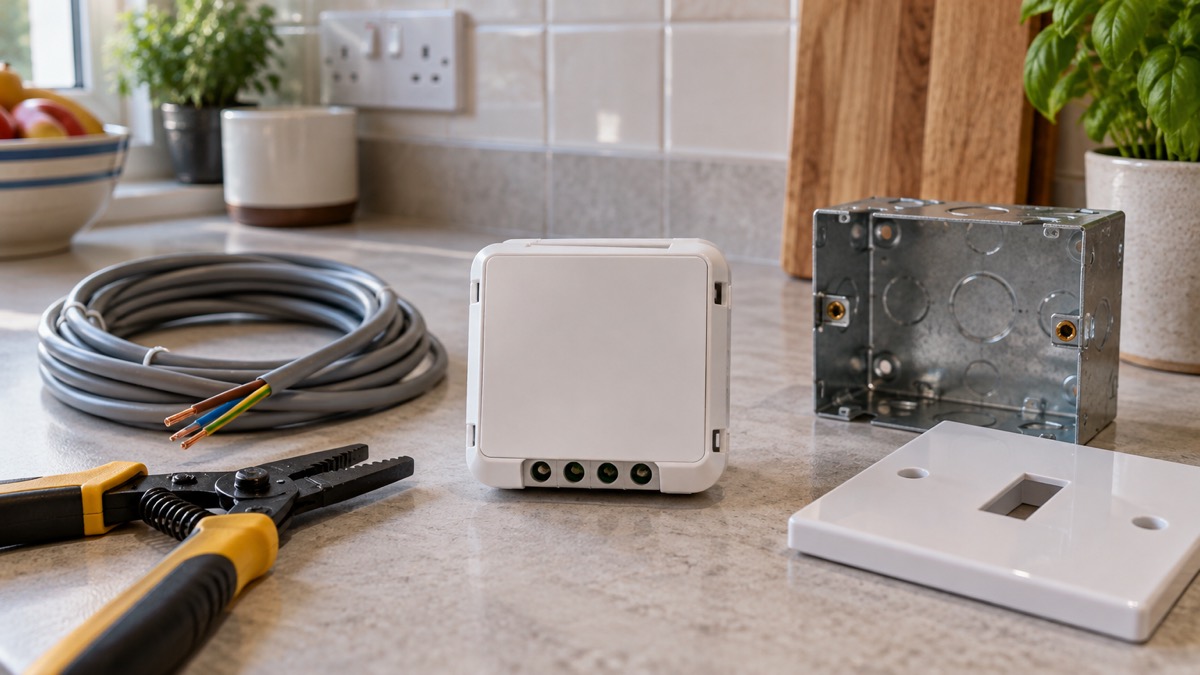
The Ajax WallSwitch is a mains relay: a switched contact that sits on a circuit and can turn the power to that circuit on or off under the control of an Ajax alarm system. For a household preparing for emergencies, its clearest use is fire. If a smoke detector registers an alarm, the relay can be set to de-energize the circuit it controls, so that electrical equipment on that circuit is no longer live while people are getting out and the fire service is on its way.
It is not a whole-house switch and it is not a substitute for a smoke alarm, an escape plan or a call to 999. It is one device in a wider system, and the part that matters most for safety is the wiring: the Health and Safety Executive is clear that electrical installations must be installed by someone with the necessary training, skills and experience to carry out the work safely1. Plan the relay as part of a fire plan, not as a gadget on its own.
What the Ajax WallSwitch does in a household
A relay is a switch that is operated by a signal rather than by hand. In an Ajax system, that signal comes from the hub, which is the control unit that ties the detectors, sirens and other devices together. The WallSwitch is one of the devices that can be added to that system, alongside the sensors and keypads covered in the Home Security: A Household Guide. Its job is to make or break a mains circuit.
That makes it useful in two ways for a household thinking about emergencies. The first is fire: cutting power to a circuit reduces the chance of electrical equipment continuing to feed a fire, and it means anyone escaping is not moving past live appliances. The second is the everyday one that matters in a power cut or a storm: knowing which circuit is which, and being able to isolate part of the house deliberately rather than in a rush.
It is worth being precise about what a relay is not. It does not generate power, store power or keep anything running. It does not detect smoke. It does not call the fire service. It switches a circuit, and only the circuit it is wired to. Everything else in the house carries on as before.
In a fire alarm, WallSwitch de-energizes the house
The fire scenario is the reason most households look at this device. Ajax states that all its residential fire detectors at a property simultaneously turn on their built-in sirens if at least one of the detectors registers an alarm4. That interconnection is the trigger: one detector sees smoke, the whole system sounds, and the relay can be set to act on that alarm.
What the relay then does depends entirely on how it is wired and configured. It can remove power from the circuit that feeds, say, the kitchen sockets, or a circuit serving equipment in a utility room. It cannot remove power from circuits it is not connected to. So the practical question is not "does the WallSwitch cut the power?" but "which circuit do I want dead when the alarm sounds, and what else is on it?"
That question is best answered before anything is installed. Walk the house with the circuit schedule and decide what you would want isolated in a fire, and what you would not. A freezer on the same circuit as a tumble dryer will lose power too. A router on that circuit will take your internet with it. The relay does exactly what it is told, which is why the planning matters more than the device.
Setting up the fire scenario so the relay switches off
Setting up the scenario is a configuration job done in the Ajax app by whoever commissions the system, and it should be tested before you rely on it. The logic is straightforward: when the fire detectors raise an alarm, the relay switches. The detail is in making sure the right detectors are in the scenario, that the relay is assigned to the right circuit, and that nothing else in the system accidentally triggers it.
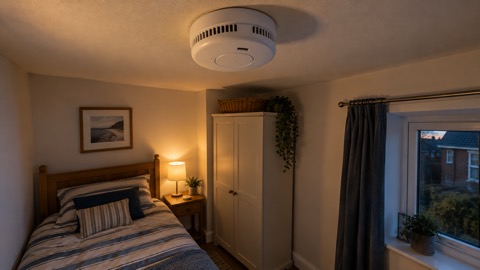
The detectors themselves need to be in the right places for the scenario to be worth anything. Official fire service guidance is consistent on this: use a heat alarm in the kitchen rather than a smoke alarm, because cooking fumes set smoke alarms off7. If your alarm sounds because of cooking fumes, steam or dust from DIY, ventilate the room and reset it once the air is clear7. A smoke alarm that keeps going off for toast will keep cutting your power if the relay is set to act on every alarm.
That is the argument for a heat alarm in the kitchen and for siting detectors away from bathrooms and dusty work areas. It is also the argument for testing the scenario deliberately, with the electrician present, rather than discovering on a Sunday morning that burnt toast takes out the freezer.
| Detector or device | Where it belongs | Why it matters for the relay |
|---|---|---|
| Heat alarm | Kitchen | Cooking fumes set smoke alarms off; a heat alarm avoids that7 |
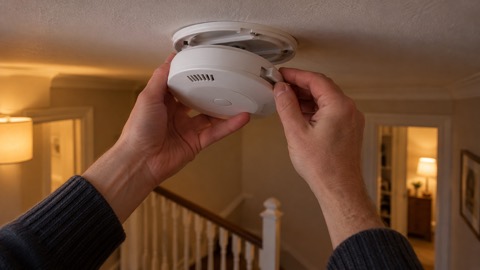
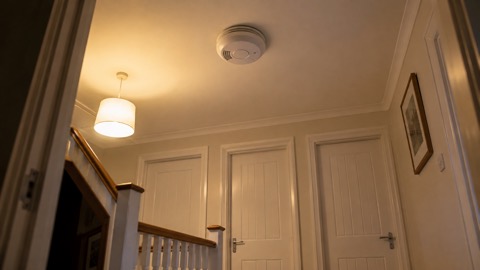
| Smoke alarm | Hallways and landings on the escape route | Gives the earliest warning while people are still able to leave8 |
| Interconnected Ajax detectors | Across the property | All sound together when one registers an alarm4 |
| Relay | On the circuit you want isolated | It switches only what it is wired to1 |
What losing power in a fire means for the household
Cutting the power is not a neutral act, and it is worth thinking through what the household loses at the moment it happens. The most obvious loss is light. The Fire Service in Scotland notes that if a fire starts during a power cut, the lack of light in a smoke filled home makes escape far more difficult9. A relay that switches off the lighting circuit in a fire creates exactly that condition, so the escape plan has to assume darkness.
The second loss is heat and hot water, and in a longer outage, refrigeration. Guidance on utility failure is blunt about the knock-on effects: without electricity we lose the ability to heat our homes as the gas will go off and the water may slowly stop from our taps10. Loss of heating, lighting and refrigeration for homes and businesses is the standard description of what a power cut means11. A relay that isolates a circuit in a fire is a short, deliberate version of the same problem.
The third is communication. If the circuit feeding your router or your phone charger goes dead, you lose the ability to look things up or call for help from a landline handset. That is why the household plan should include a battery or wind-up radio12, a charged phone and a torch kept somewhere you can find it in the dark.
Installing a mains relay safely: a job for a qualified electrician
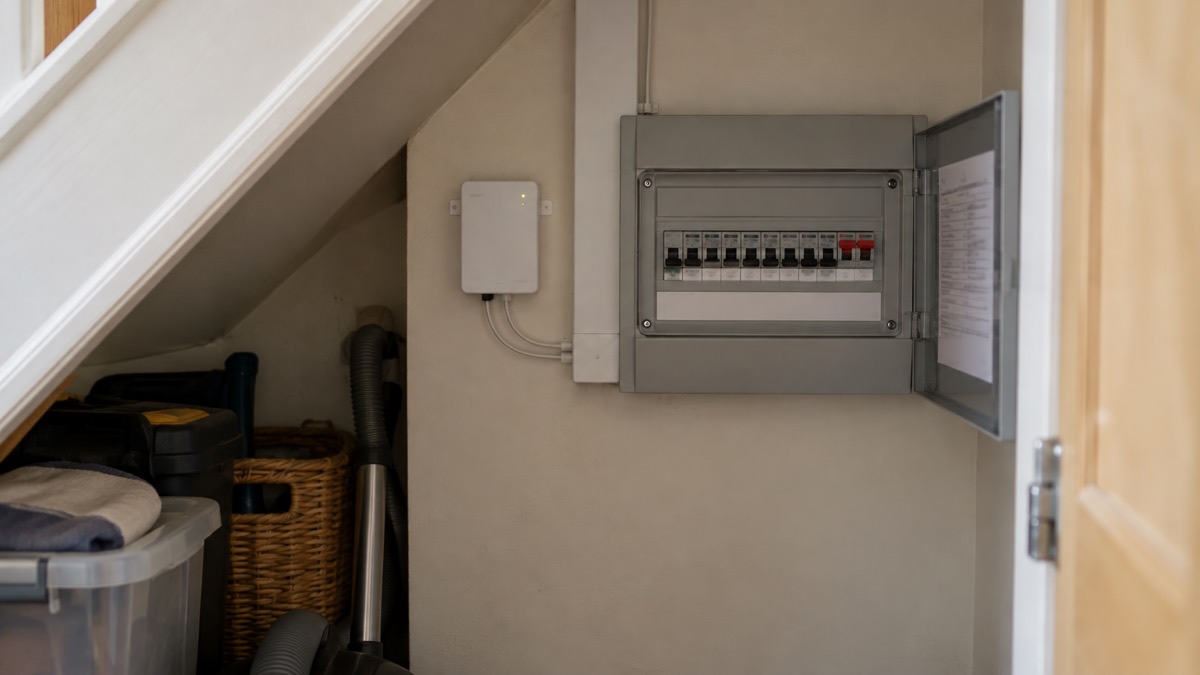
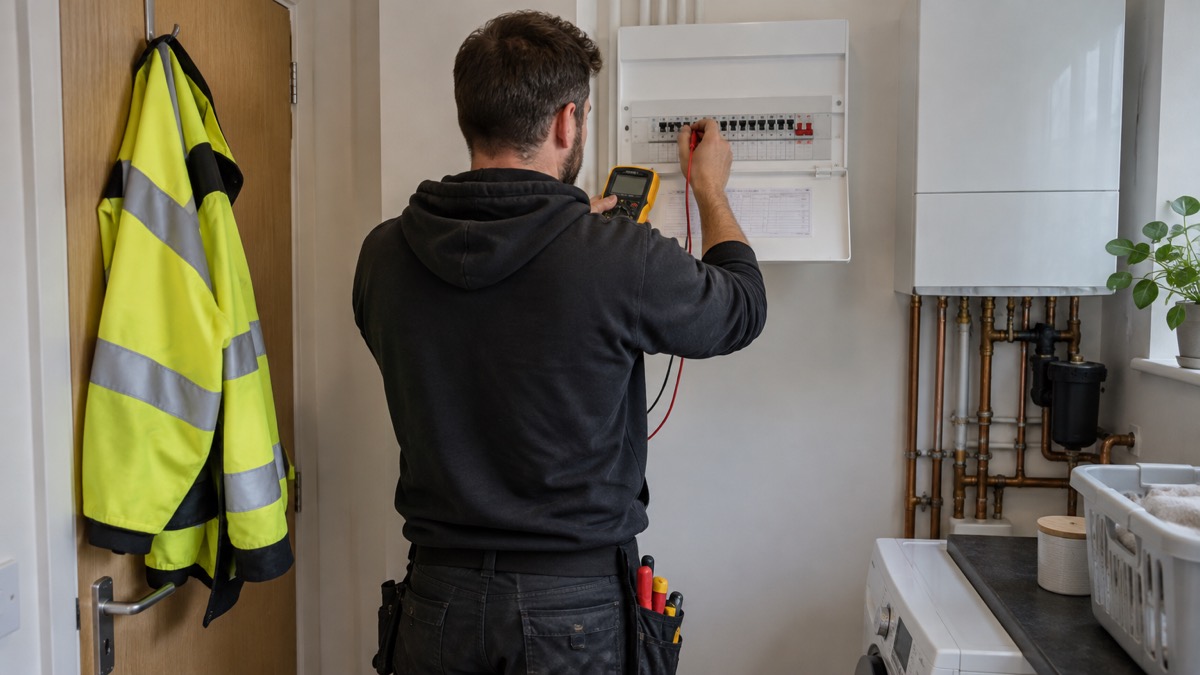
This is the part of the page that matters most. A mains relay is fixed wiring. The Health and Safety Executive advises arranging inspection and testing of fixed wiring installations to minimise deterioration leading to danger, covering circuits from the meter and consumer unit supplying light switches, sockets and wired-in equipment, and says the work should normally be carried out by a competent person, usually an electrician1. It also states plainly that electrical installations must be installed by someone who has the necessary training, skills and experience to carry out the work safely1.
In Scotland, the Fire Service adds that a registered electrician works to the BS7671 safety standard, their work is regularly assessed, they are insured, and registration is a legal requirement for certain electrical work3. Ask for that registration before anyone opens your consumer unit.
The consumer unit, sometimes called the fuse box, is where the trip switches live14. That is the box the relay will be associated with, and it is not a place for a householder with a screwdriver. If a trip switch has operated, it will remain off until the fault is fixed, although once a faulty appliance is unplugged you can try switching the trip switches back on14. That is the limit of what most of us should do at the board.
| Step | Who does it | What to check |
|---|---|---|
| Decide which circuit to isolate | You and your electrician | What else is on that circuit, and what you would lose |
| Check the installer's registration | You | Registered electrician, BS7671 standard, insured3 |
| Fit and wire the relay | Registered electrician | Fixed wiring inspected and tested by a competent person1 |
| Configure the fire scenario | Installer, with you | Right detectors, right relay, tested trigger |
| Test and record | Installer | Confirm the relay operates and the alarm clears |
Where WallSwitch must not be relied on
A relay is a single point of control, and it fails in the ways any single point fails. If the hub loses its connection, the scenario may not run. Ajax's own manual for its hub describes the indicator behaviour on its recorder range: the LED lights up yellow and turns white after the connection to the internet, and lights up red if the connection to the Ajax Cloud server fails15. That is a reminder that these devices depend on a network, and a network can fail.
The second limit is medical equipment. Official guidance for airflow pressure-relieving equipment is to plug it directly into a wall socket and avoid multi-socket adapters13. If that socket is on a circuit your relay controls, a fire alarm will remove power from a device someone depends on. That is a conversation to have with the installer and, where relevant, with the equipment supplier, before the relay goes in.
The third limit is standby power. Appliances left plugged in, in sleep mode or on standby still have power flowing through them even though they look like they are off3. A relay that isolates a circuit removes that, which is the point, but it also means anything relying on standby power, such as a router or a smart speaker, goes down with it.
Support and help from Ajax
Ajax states that its AI-powered chatbot and professional technical support team are available 24/716. For a household, that matters most in the days after installation, when a scenario is not behaving as expected or a device has dropped off the hub. The maker's advice is to contact support first rather than to start changing wiring16.
Keep the paperwork together: the installer's details and registration, the circuit the relay controls, the scenario settings, and the date of the last test. If you move house, that record is what tells the next owner what the relay does and which circuit it isolates. It belongs with the rest of your home security documents, alongside the alarm codes and the insurance schedule.
For the wider system, the Ajax brand page covers the hubs, sensors and keypads that the relay works with. If you are building the fire side of the plan from scratch, the Home Emergencies: Fire, Carbon Monoxide, Gas Leaks and Burst Pipes guide sets out the alarms, escape routes and checks that come before any relay, and Keeping Your Home Protected in a Power Cut covers what to do when the lights go out for reasons other than a fire.
Sources (16)
- Electricity and electrical equipment, Health and Safety Executive, 2026
- Ajax FireProtect 2 RB (Heat/Smoke) UL is a next-gen fire detector, Ajax Systems
- Electrical safety, Scottish Fire and Rescue Service, 2025-02-27
- What is interconnected fire alarms?, Ajax Systems, 2026-05-05
- After fire or flood, Devon and Somerset Fire and Rescue Service, 2020-12-01
- Escape plan, Scottish Fire and Rescue Service, 2026-10-26
- Smoke alarms, Cheshire Fire and Rescue Service, 2026-07-27
- Smoke alarms and heat alarms, London Fire Brigade, 2026-10-25
- Heating and gas, Scottish Fire and Rescue Service, 2024-11-21
- Failure of national electricity, Wiltshire and Swindon Prepared, 2026-10-25
- Utility failure, Essex Prepared, 2026-10-29
- Types of power cut | UK Power Cut? Call 105 For Free | Find Your Electricity Provider, powercut105.com
- Medication and medical devices, West Yorkshire Fire and Rescue Service, 2026-10-29
- What are trip switches and where can I find them?, UK Power Networks, 2026-10-25
- NVR H manual, Ajax Systems, 2026-10-27
- Hub Plus manual, Ajax Systems, 2026-09-25

 FireAngel FA3313 CO Alarm
 FireAngel FA3322 CO Alarm
 FireAngel FA3820 CO Alarm
 FireAngel FA6812 CO Alarm
 FireAngel FA6813 CO Alarm
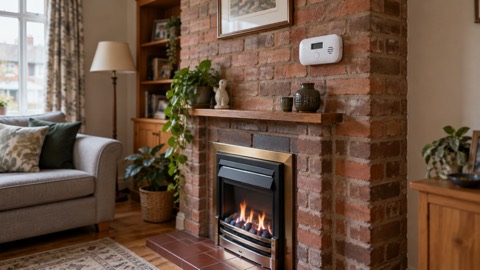 FireAngel FA6829S CO Alarm
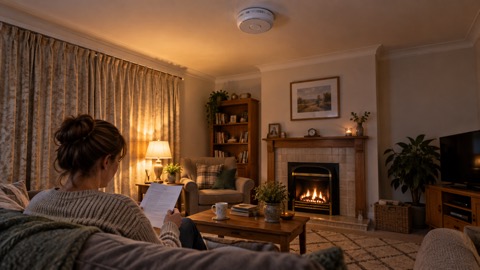 FireAngel CW1-PF CO Alarm
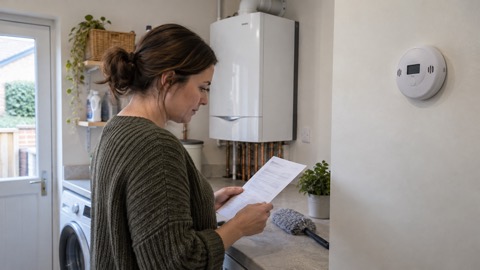 FireAngel W2-CO-10X CO Alarm
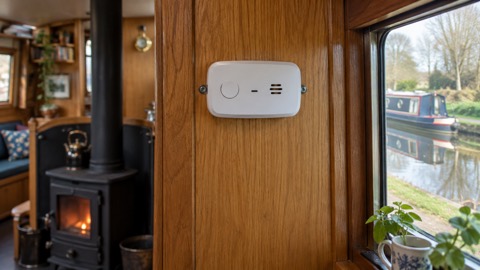 FireAngel FP1820W2-R CO Alarm
 FireAngel FP2620W2-R Alarm
 FireAngel ST-632 Smoke Alarm
 FireAngel ST-750 Smoke Alarm