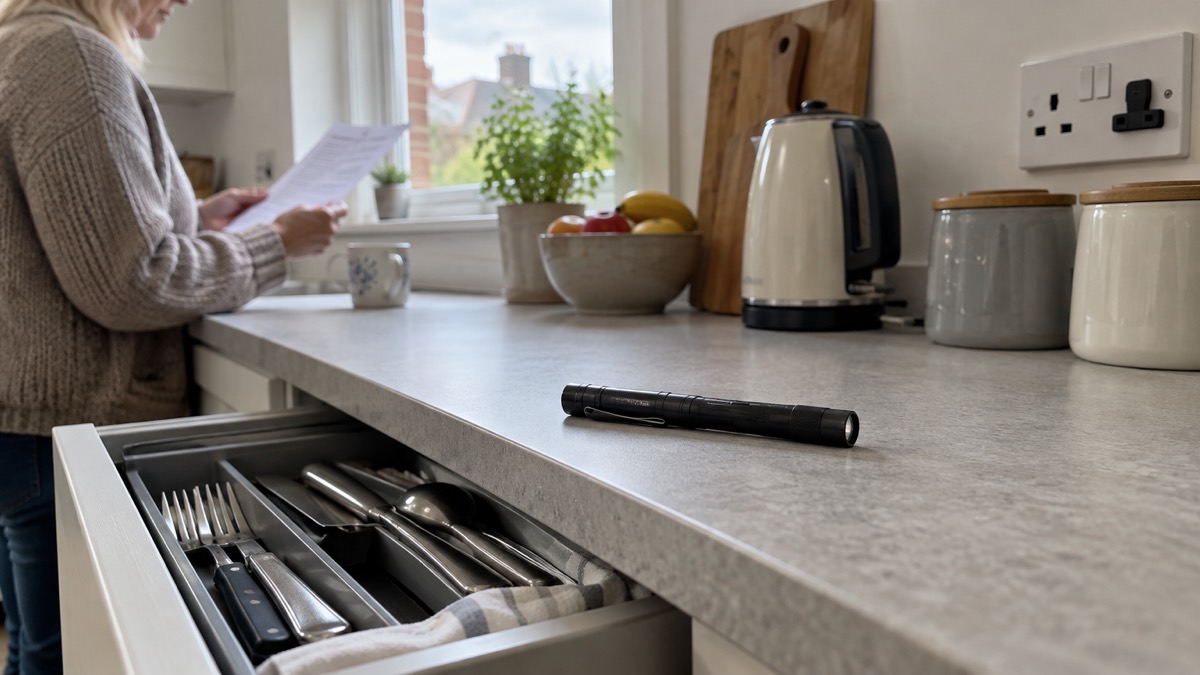
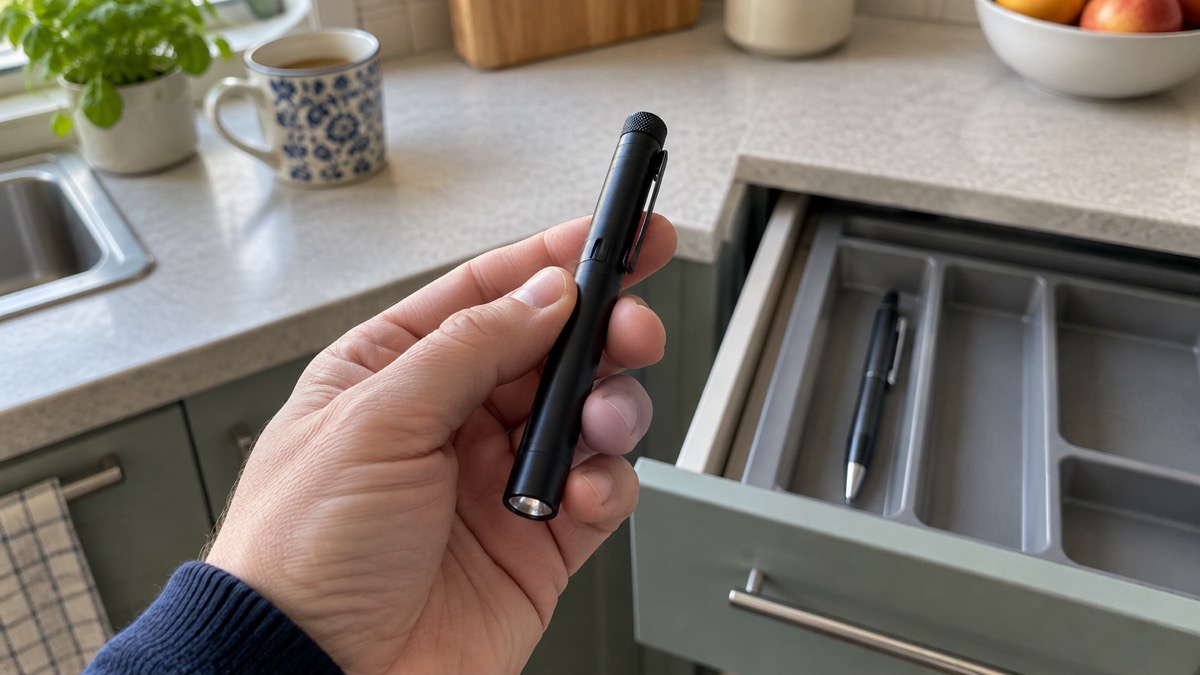
The Ledlenser P4R Core is a rechargeable penlight torch: a slim, pocket-sized light with a removable battery and a micro-USB charging port. The maker gives it a top output of 200 lumens reaching 90 metres on Standard Power for 1 hour, a middle setting of 90 lumens reaching 60 metres for 3 hours, and a low setting of 15 lumens reaching 15 metres for 25 hours1. It weighs 55g and comes with a pocket clip, so it lives in a drawer or a jacket pocket without being noticed until you need it.
For a household preparing for power cuts, the useful figure is the low setting. At 15 lumens for 25 hours, one charge covers a long evening and the night after it, at a brightness that is enough to move around a room, read or find your way to the fuse box. The 200 lumen setting is for a quick sweep of the garden or a look down a dark hallway, not for leaving on1.
Official preparedness guidance is straightforward on why a torch belongs in the house: keep a battery or wind-up torch, and spare batteries, at home, because torches are safer than candles2. A rechargeable penlight answers that advice only if it is charged before the power goes, so the routine matters as much as the specification. This page sets out what the P4R Core does, how long each setting lasts, how to charge and store it, and what to check before you depend on it.
Specifications at a glance
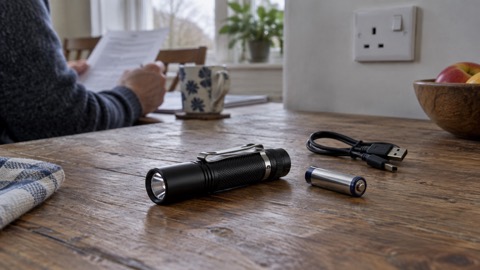
The P4R Core is a single-LED penlight with a removable lithium-ion battery rather than a sealed built-in pack. That matters for a household: a battery that can be taken out is a battery that can be replaced when it eventually stops holding charge, instead of writing off the whole torch. The maker lists the battery as a 10900 Li-ion cell at 3.7 volts with a capacity of 600mAh, and gives a full charge time of 150 minutes through the micro-USB port1.
| Specification | Maker's figure |
|---|---|
| Type | Rechargeable penlight torch1 |
| LEDs | 11 |
| Brightness | 15 to 200 lumens across three modes1 |
| Beam distance | 15 to 90 metres across three modes1 |
| Battery | 1 x 10900 Li-ion, 3.7v, 600mAh, removable1 |
| Charging | Micro-USB port, 150 minutes to full1 |
| Length | 150mm defocused, 154mm focused1 |
| Weight | 55g1 |
| Switch | End cap switch1 |
| Water and dust | IP541 |
| Drop test | 2 metres1 |
| Warranty | 2 years, extendable to 7 with online registration1 |
Two of these figures decide how the torch fits into a household. The 55g weight and 150mm length mean it carries like a pen, so it can sit in a kitchen drawer, a glovebox or a coat pocket and be there when the lights fail1. The 600mAh capacity is modest, which is why the low setting, not the high one, is the setting to plan around.
Run time: up to 25 hours on Low Power
The P4R Core has three light modes, and the run time falls sharply as brightness rises. On Low Power it gives 15 lumens at a beam distance of 15 metres for 25 hours. On Mid Power it gives 90 lumens at 60 metres for 3 hours. On Standard Power it gives 200 lumens at 90 metres for 1 hour1. Those are the maker's figures for a fully charged battery, and they are the numbers to use when you decide which setting to leave the torch on during an outage.
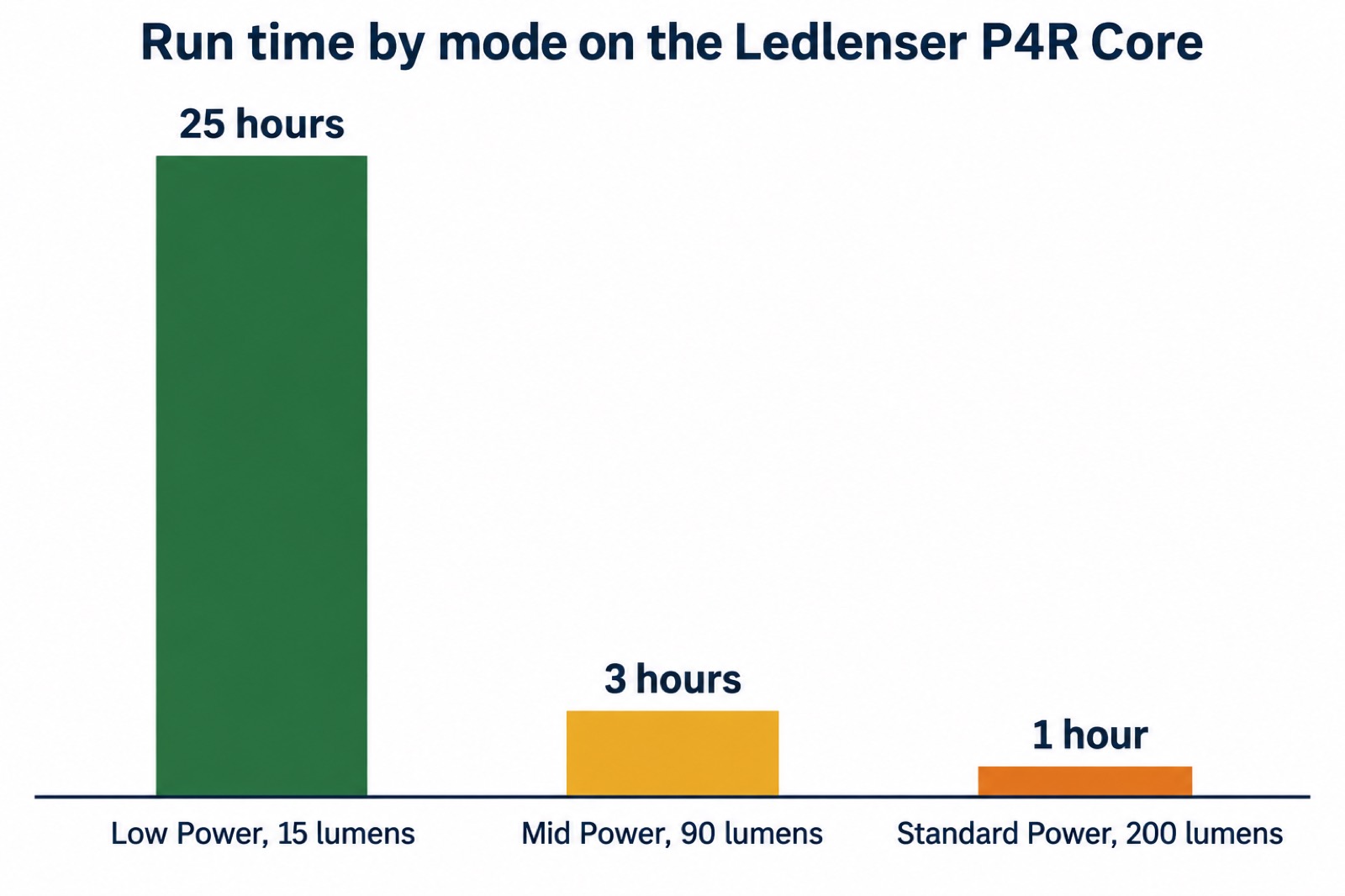
The practical reading is that the brightest setting is for seconds or minutes at a time, not for lighting a room through an evening. A 1 hour run at 200 lumens will not see you through a night, but 25 hours at 15 lumens will see you through several evenings if you use it in short bursts and switch it off between them. If you want to understand how lumens, beam distance and run time relate to each other more generally, our guide to lumens, beam distance and run time explains the trade-off.
The maker also lists an optional backup mode that conserves light once the battery drops below 25 per cent1. That is a useful safety net if you have been using the torch heavily and have not noticed the battery falling, because it stretches whatever charge is left rather than leaving you in the dark without warning. The exact way to switch modes, including backup mode, is set by the maker's own instructions for the torch, so read them before an outage rather than during one.
Brightness and beam: 15 to 200 lumens, spot or flood
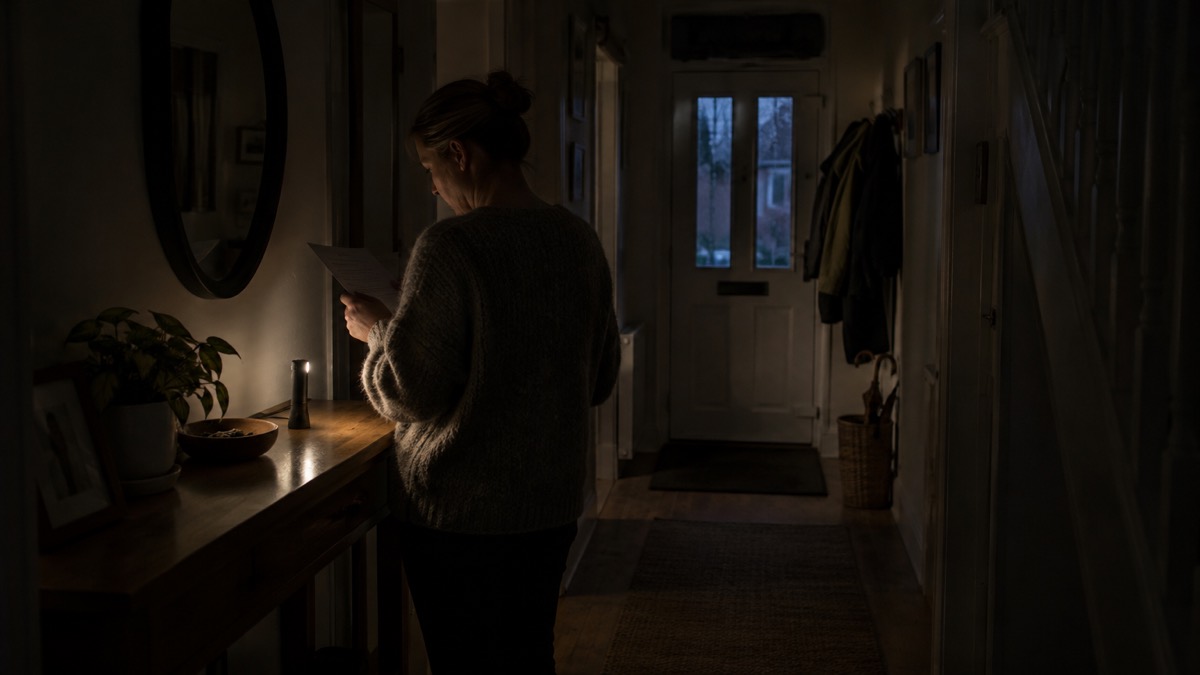
The three modes are not just three brightness levels; they also change how far the light carries. Low Power reaches 15 metres, Mid Power 60 metres and Standard Power 90 metres1. For indoor use in a power cut, 15 metres is more than the length of most rooms, so the low setting is not a compromise indoors. The longer distances matter outdoors, for checking a path, a gate or a garden after dark.
The beam itself is adjustable. The maker's Advanced Focus System lets you focus the light as a spot or a flood without losing quality of light1. A spot throws a narrow beam a long way, which suits looking down a garden or along a street. A flood spreads light across a wider area, which suits lighting a table, a staircase or a room where several people are sitting. Twisting the head changes between the two, and the maker gives the torch's length as 150mm defocused and 154mm focused, so the head moves as you adjust it1.
| Mode | Brightness | Beam distance | Run time |
|---|---|---|---|
| Low Power | 15 lumens | 15 metres | 25 hours |
| Mid Power | 90 lumens | 60 metres | 3 hours |
| Standard Power | 200 lumens | 90 metres | 1 hour |
All figures are the maker's1.
For a household, the sensible default is Low Power with the beam set to flood for indoor use, switching to spot and a higher mode only when you need to see something at a distance. That keeps the long run time available for the hours when you actually need light, rather than spending it in the first ten minutes. If you are choosing between a torch like this and a head torch for hands-free work, our comparison of torch or head torch for a power cut sets out the trade-offs.
Toughness: IP54 and a 2 metre drop test
The P4R Core is built for ordinary handling rather than heavy outdoor work. The maker gives it an IP54 rating and a 2 metre drop test1. Each of those figures tells you something specific about where it will and will not cope.
IP54 means protection against dust and against splashing water. It is not a claim that the torch can be submerged, so treat it as a light for wet weather and accidental splashes rather than one for use in water. Our explainer on what IPX ratings mean for torches and lanterns covers what the digits mean in more detail. The maker fits an end cap switch, a switch at the end of the light1.
The maker's figures describe a torch for the house, the car and the garden rather than for caving or mountain work. If you store a torch in a shed or a car, our guide to charging and storing rechargeable torches safely sets out what to check.
Charging the P4R Core safely
The P4R Core charges through a micro-USB port on its removable battery, and the maker gives a full charge time of 150 minutes1. Charge it before an expected outage, and top it up after any long period in a drawer, because a lithium-ion battery left flat for months is a battery that may not take a charge when you need it. The maker's standard warranty runs for 2 years and can be extended by a further 5 years with online registration, up to 7 years, covering defects in manufacturing1.
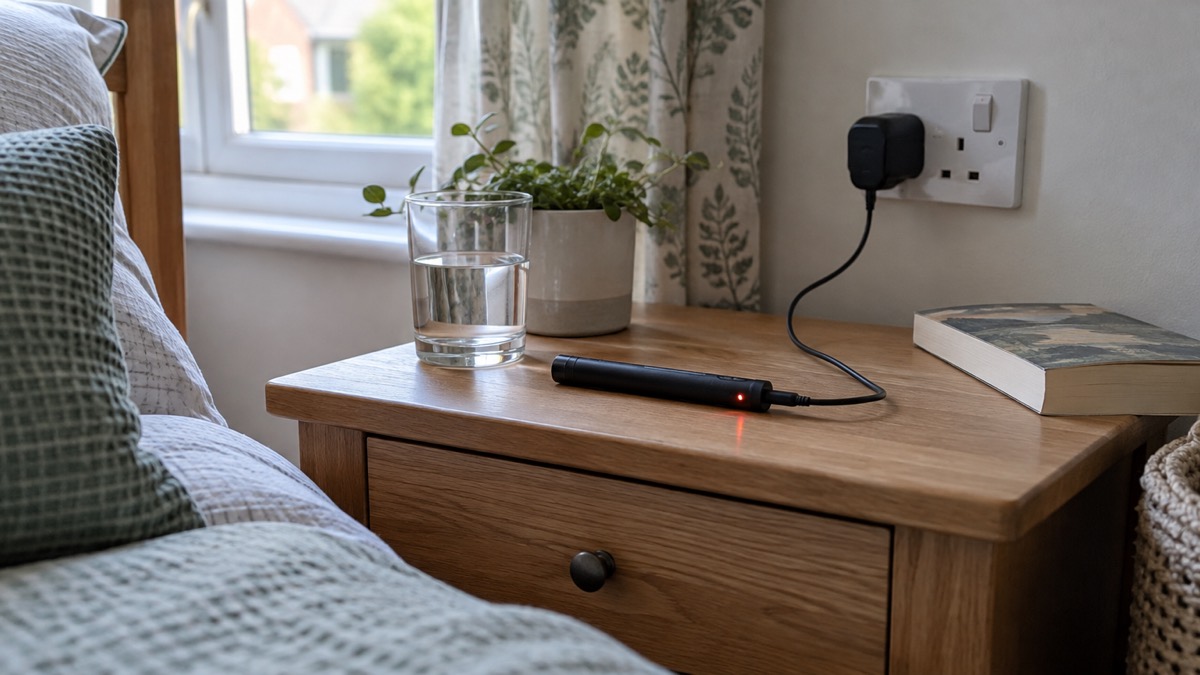
The maker's own instructions for the torch are the authority on charging it, including which charger to use and whether it can be used while charging. Follow them rather than a general rule. If you are unsure whether a particular USB charger is suitable for a torch battery, our guide to whether the wrong USB charger can damage a torch battery explains what to look for, and can you use a torch while it is charging covers that question directly.
Because the battery is removable, replacement is possible when the cell eventually wears out. The maker lists the battery as a 10900 Li-ion cell at 3.7 volts with a capacity of 600mAh1. When you replace it, use the maker's own battery type and charge it through the torch's own port, following the maker's instructions. Do not substitute a different cell size or chemistry on the assumption that it will fit.
Using it in rain, cold and the dark
The P4R Core carries an IP54 rating, which covers protection against dust and against splashing water1. In practice, that means it is fine for checking a fence in the rain or walking to a shed, and it should not be dropped in a puddle or left out overnight. Dry the torch and the charging port before you plug it in, because water in a charging port is a problem whatever the torch's rating.
A torch left in a cold car will feel cold in the hand, and its battery will perform less well until it warms up. Bring it indoors before you rely on it for an evening. The maker fits an end cap switch, a switch at the end of the light, which is easy to find by feel1.
The colour of the light is worth knowing before you buy. The maker lists a white LED with a colour temperature of 6000K to 7500K and a colour rendering index of 701. That is a cool white beam, at the bluer end of white rather than a warm yellow, and a colour rendering index of 70 is a mid-range figure, so colours look reasonable but not as true as under daylight. For finding your way around a dark house, that is fine. For reading a map or judging a colour in poor light, it is a limitation to be aware of.
Keeping a torch instead of candles
The case for a torch over a candle is not a matter of preference. Official preparedness guidance tells households to keep a battery or wind-up torch, and spare batteries, at home, and says plainly that torches are safer than candles2. A candle is an open flame in a room where the power has failed, often with children or pets moving around in the dark, and it is the kind of risk that a torch removes entirely.
A rechargeable penlight like the P4R Core fits that advice with one condition: it has to be charged. A torch with a flat battery is no better than a matchbox in a drawer. The routine that makes it work is simple. Charge it to full, check it before winter, keep it somewhere you can find in the dark, and use the low setting so the charge lasts. Our guide to where to keep torches so you can find them in the dark covers the storage question, and our power cut checklist lists what to have ready.
| What you need | Why it matters |
|---|---|
| A battery or wind-up torch | Torches are safer than candles1 |
| Spare batteries | Keep a battery or wind-up torch and spare batteries at home1 |
| A known storage place | You need to find it in the dark |
| A plan for children and pets | Keeps flames and cables out of reach |
If you want to compare a rechargeable torch with a battery-powered one before you commit, our guide to rechargeable or battery torches for emergencies sets out the trade-offs, and our section on emergency lighting at home covers the wider picture.
Support, warranty and where to get help
The P4R Core carries a standard warranty of 2 years, which the maker says can be extended by a further 5 years with online registration, up to 7 years, covering defects in manufacturing1. Register the torch when you buy it if you want the longer cover, and keep the proof of purchase. The maker's product page is the place to check the current terms, and the Ledlenser brand page lists the maker's other lights.
If a torch or charger is recalled, stop using it and follow the recall notice. Our guide to recalled and unsafe torches and chargers explains how to check and report. For fire safety advice at home, including free home fire safety visits from your local fire and rescue service, see our guide to free home fire safety visits. If you need help preparing for a power cut because of age, disability or medical equipment, ask your energy supplier about the Priority Services Register, and read our guide to lights for older and disabled people in a power cut.
Sources (2)
- Ledlenser P4R Core, Ledlenser, 2026-10-25
- Power cuts, UK Government Prepare campaign, 2026-10-21

 NEBO Newton 500 Torch
 NEBO Davinci 800L
 NEBO Torchy 2K Torch
 NEBO Torchy 600 Flex
 NEBO Tac Slyde Torch
 NEBO Slyde King 4K
 NEBO Mycro 900+ Headlamp
 NEBO Edge 800
 NEBO Transport 400
 Fenix E04R Keyring Torch
 Fenix E05R Keychain Torch
 Fenix E06R Pro Pocket Torch