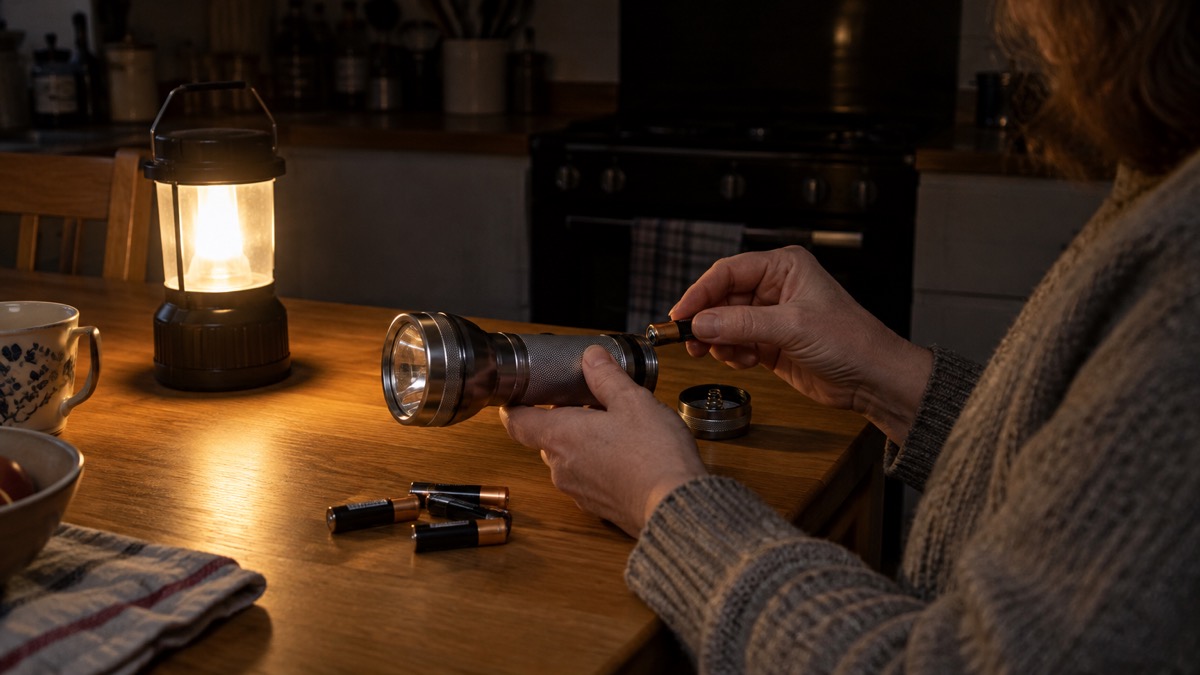
AA batteries are the workhorse of a household emergency kit. They are the cells most torches, radios and small devices take, and official emergency kit lists name a torch with extra batteries as standard, with a wind-up torch as the alternative if you would rather not depend on cells at all1. Raymax AA batteries (LR6) are one brand of the standard AA alkaline cell, sold under the Raymax name. What matters for a household getting ready for a power cut, storm or flood is simpler than the brand: how many spares you hold, where you keep them, how you stop them leaking in the drawer, and how you dispose of them so they do not start a fire.
This page covers what AA cells can power in an emergency, how to store and fit them safely, what to do if one leaks or is swallowed, and where to recycle used ones in the UK. It does not give a price, and it does not rank one brand against another: the safety advice below comes from fire and rescue services, the NHS and the makers' own instructions, and applies to any AA cell you buy.
What AA batteries can power in an emergency kit
The AA cell earns its place because so much emergency kit runs on it. Official household emergency kit lists put a torch and extra batteries near the top, alongside a wind-up torch as the no-battery option1. A battery or wind-up radio is the other classic use. Emergency kit lists also name chargers for any other phones you would want with you3, and a car kit list names battery jump leads for the vehicle2.
Think of AA cells as the layer of your kit that keeps working when the mains does not. A torch, a radio and a small lantern will see a household through an evening without power. What they will not do is run anything large: AA cells are for small devices, not for heating, cooking or running appliances. If you want to understand how a power cut unfolds and what else to have ready, the guide to power cuts sets out the sequence, and the emergency kit section covers the full list.
How long a set lasts depends on the device and on how hard you drive it. A torch used in short bursts lasts far longer than one left on all evening, and a radio on low volume draws less than one turned up. The practical answer for a household is to hold more spares than you think you need, keep them where you can find them in the dark, and test the torch before the winter rather than during the first power cut.
Storing spare batteries safely at home
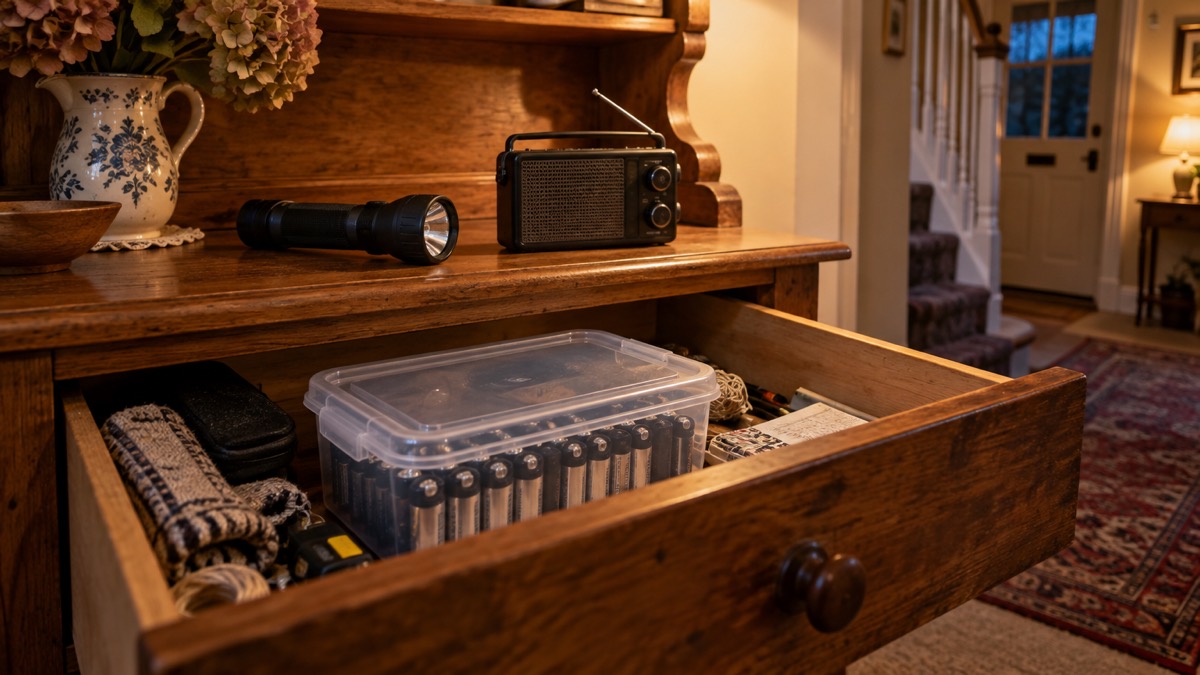
Storage is where most household battery problems start. Fire and rescue services are consistent: keep batteries in a cool, dry place and away from metal objects like keys or coins2. Single-use cells should always be stored in their original packaging and away from metal objects, because contact with metal can cause overheating and a fire6. A loose AA cell rolling around a drawer with a bunch of keys is exactly the situation that advice is written to prevent.
A few habits keep a stock usable:
- Keep cells in their packaging until they are needed, so the terminals stay covered and the date stays readable6.
- Use a sealed container for loose spares, out of the reach of children7.
- Choose a cool, dry spot away from direct sunlight and flammable materials8.
- Keep the stock away from heat and cold extremes, which reduce performance3.
- Check the stock regularly and replace anything that looks swollen, leaking or damaged9.
Where in the house you keep that container matters less than that it is consistent. A hall cupboard or a kitchen drawer that everyone knows is better than a shelf in the loft that nobody checks. If you keep a torch loaded and ready, check the cells every so often rather than waiting for the night you need it.
Fitting and using AA batteries safely
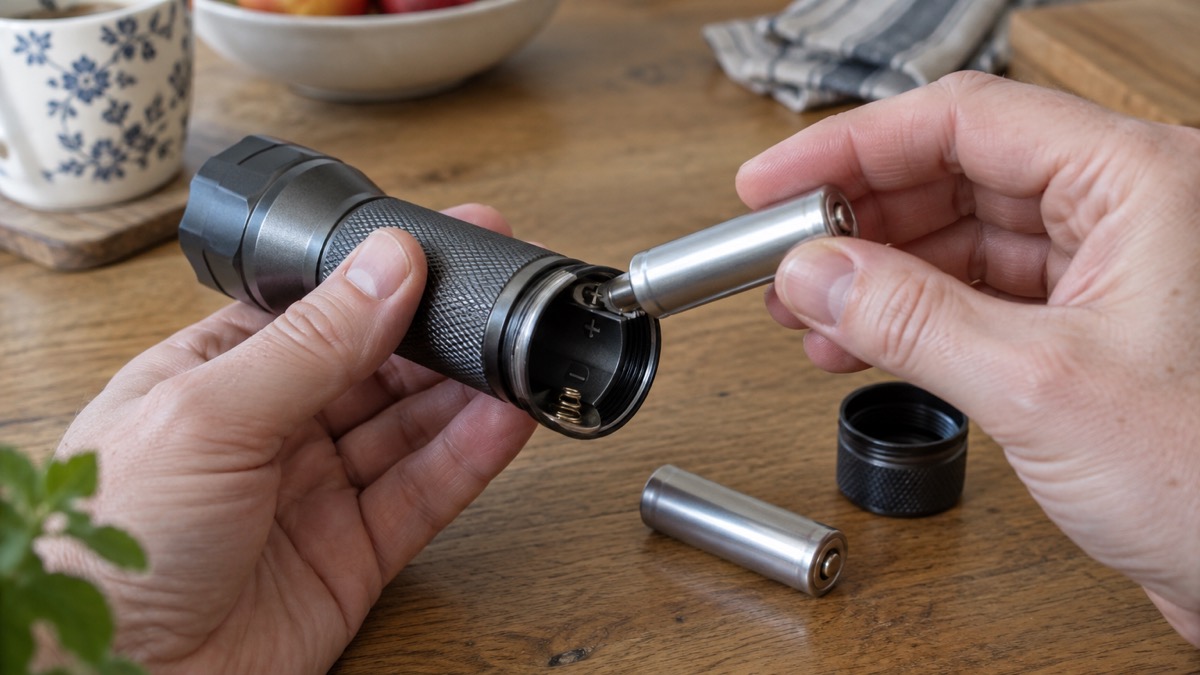
Fitting a cell correctly is the difference between a torch that works and a device that leaks in a drawer. Fire and rescue services advise buying the correct battery for the device: make sure batteries are suitable for the device they are intended for and meet the manufacturer's specifications2. Check the compartment for the size and polarity markings, and fit the cell the right way round.
The rules that matter most for a household:
- Match the cell to the device. Use the size and type the device asks for2.
- Replace the whole set at once. Do not mix old and new batteries: it reduces overall performance and may cause battery leakage or rupture3.
- Do not mix types. Do not mix lithium batteries with other types such as alkaline or NiMH8.
- Never force a cell. If it does not sit flush, it is the wrong way round or the wrong size.
- Keep contacts clean. Rub battery contact surfaces and compartment contacts with a clean pencil eraser or a clean cloth each time you replace batteries3.
On recharging, the maker's instruction is blunt: only batteries specifically labelled rechargeable should be recharged, and any attempt to recharge a non-rechargeable battery could result in rupture or leakage4. Standard LR6 alkaline cells are single-use. If you want to run a torch on rechargeables, buy cells sold as rechargeable and follow the manufacturer's instructions for using, charging, storing and disposing of them11. Rechargeable batteries are generally safe when used correctly, but misuse can lead to serious fire risks11.
Leaking or swallowed batteries: what to do
A leaking cell is a small household nuisance; a swallowed one is a medical emergency. Treat them differently.
If a battery leaks. Fire and rescue services advise checking regularly for signs of damage like swelling, leaks or strange smells, and stopping use of damaged batteries immediately6. To clean up, the maker's own steps are: work in a well-ventilated area, wear household gloves and glasses, remove the leakage from the electrical contacts with a toothbrush or cotton swab, and make sure the device is completely dry before trying a new battery3. Getting batteries wet is one cause of damage12. If a device is charging and the battery swells, stop charging immediately9.
If a battery is swallowed. Button cells are the greatest risk, especially to young children, and the NHS advises keeping small objects, including button batteries and small toys, well out of reach13. The same household habits protect against every size: store all spare batteries in a sealed container out of reach, make sure battery compartments on toys and devices are securely closed, and recycle used batteries safely so they are out of reach of children7. Before placing an item within a young child's reach, check that spare batteries are securely stored and the compartment is secured14. Keep new batteries in their original blister packaging out of the sight and reach of children15.
Recycling used batteries in the UK
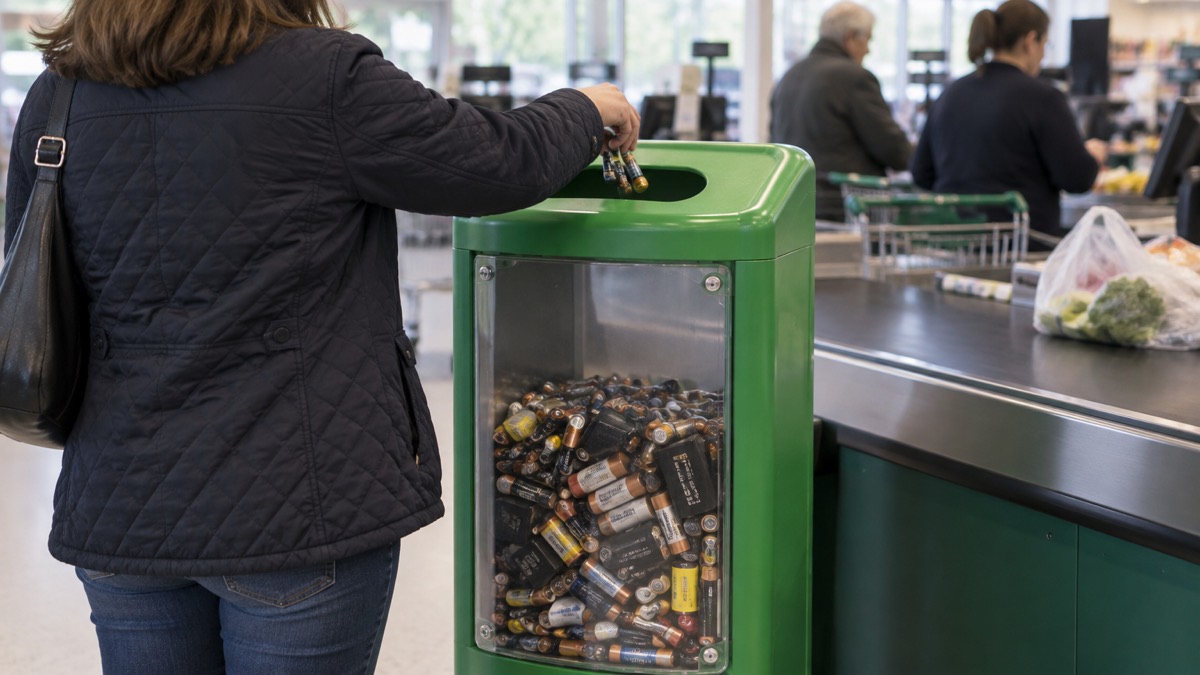
Used batteries do not belong in the general waste. Fire and rescue services warn that if hidden batteries in household items are not disposed of correctly, they can explode and cause huge blazes at recycling centres and waste transfer stations, or even at home16. The fix is simple: household batteries, including AA, AAA, button and rechargeable batteries, can be recycled at most leading supermarkets and household recycling centres5.
| Where to take them | What is usually accepted |
|---|---|
| Supermarket and hardware store collection bins | Regular household batteries including AA, AAA, C and D17 |
| Retailer battery bins | AA, AAA, 9V, button cells, rechargeable batteries and removable battery packs8 |
| Household waste recycling centres | Batteries and items containing batteries18 |
| Council collection schemes | Some councils collect batteries separately, with special bags or bookable small item collections17 |
Removable batteries should be recycled separately from the device and can be disposed of at a battery recycling point or household waste recycling centre7. If you are unsure where your nearest point is, check your council's website, which lists local arrangements17. The same principle applies to any device with a battery inside: take it to a recycling centre rather than putting it in the bin18.
Support, spares and keeping the kit ready
Raymax AA batteries are a consumable, not a device with a warranty to register. What a household needs from them is that they are there when the power goes, that they have not leaked in the drawer, and that the torch they sit in still works. Build the habit into your seasonal checks: before winter, test every torch and radio, replace any cell that is flat or damaged, and top up the spare stock.
If you are building out the rest of the kit, the lighting section covers torches, lanterns and why candles are a poor substitute, and the staying informed section covers radios and how to keep in touch. For the wider household plan, start with getting started. The Raymax brand page lists the other cells the maker supplies, including the Raymax 9V batteries that many smoke alarms and radios take.
Sources (18)
- Emergency advice: get help in an emergency, Lincolnshire County Council
- Battery safety, West Yorkshire Fire and Rescue Service
- How long do batteries last?, Duracell UK
- Can I recharge any battery?, Duracell UK
- Batteries, Devon and Somerset Fire and Rescue Service
- Battery safety, Greater Manchester Fire and Rescue Service
- Electrical safety, Lincolnshire County Council
- Lithium battery fire safety, Tameside Council
- Batteries and chargers, London Fire Brigade
- Batteries, The Caravan and Motorhome Club
- Rechargeable lithium-ion battery safety advice, Cheshire Fire and Rescue Service
- Lithium-ion batteries and chargers | Humberside Fire, Humberside Fire and Rescue Service
- Product safety campaigns, Peterborough City Council
- Child safety, Berkshire Healthcare NHS Foundation Trust
- Button batteries: using them safely, Great Ormond Street Hospital
- Hidden batteries could spark Christmas chaos, Suffolk County Council
- Recycling electricals and batteries, Electrical Safety First
- Recycle your electricals campaign, North Yorkshire Fire and Rescue Service

 FireAngel FA3313 CO Alarm
 FireAngel FA3322 CO Alarm
 FireAngel FA3820 CO Alarm
 FireAngel FA6812 CO Alarm
 FireAngel FA6813 CO Alarm
 FireAngel FA6829S CO Alarm
 FireAngel CW1-PF CO Alarm
 FireAngel W2-CO-10X CO Alarm
 FireAngel FP1820W2-R CO Alarm
 FireAngel FP2620W2-R Alarm
 FireAngel ST-632 Smoke Alarm
 FireAngel ST-750 Smoke Alarm