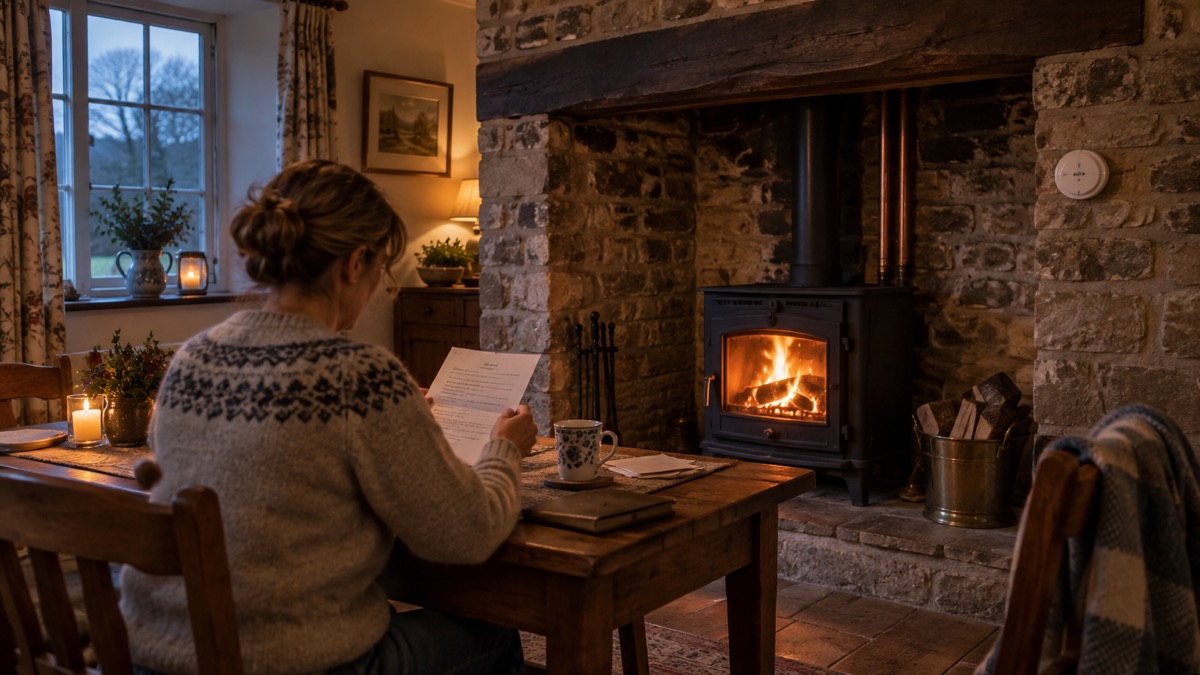
The Country 16B Woodburner is not a room stove with a hotplate on top. Charnwood describes it as a fully fledged biomass central heating boiler, and that is the right way to think about it: it is a wood-fired boiler that also gives off heat into the room it stands in1. For a household preparing for power cuts, gas failures or a long cold spell, that distinction matters. A boiler stove can keep radiators and a hot water cylinder warm when the mains gas and electricity are both off, provided the system has been installed to suit it and you have dry wood to burn.
The headline figures are these. The total output is 15.9kW, split between 8.6kW to the water and 7.3kW to the room, with a room range of 2 to 8kW1. Charnwood says it will run around seven radiators and supply all domestic hot water, and that it is also suitable for underfloor heating1. It burns wood only, and only dry, well seasoned wood3. It needs a 12mm non-combustible hearth to meet UK building requirements, and it must stand at least 300mm from any combustible material1.
A wood-burning central heating boiler, not just a room stove
Most wood burners are space heaters. The Country 16B is different in kind. Charnwood calls it a fully fledged biomass central heating boiler, and the water side is the larger part of what it does1. The independent guidance on solid fuel appliances sets out the same range of options: stoves are available with boilers, from small units that supply domestic hot water only up to large output units capable of heating radiators and domestic hot water4. The Country 16B sits at the larger end of that scale.
That changes what the stove is for in a household plan. A room stove keeps one room habitable when the central heating fails, which is the approach set out in our guide to keeping one room warm when the heating fails. A boiler stove is an attempt to keep the whole wet heating system running: radiators, hot water, and possibly underfloor heating loops. It is a bigger commitment in installation, flue, hearth and plumbing, and it only pays off if the system around it is designed for it.
The maker's control arrangement supports that role. Charnwood states that the model features a water-temperature-sensitive thermostatic control which enables the stove to be used alongside sophisticated central heating controls1. In plain terms, the stove regulates itself against the temperature of the water in the boiler rather than simply running flat out, which is what allows it to sit inside a modern heating system rather than fighting it.
There is a wider context for anyone weighing up a wood boiler as a backup. A 2025 report on Denbighshire's housing stock records 63 properties on Economy 7 storage heaters, a reminder that a good number of UK homes depend on electrically driven heating that stops entirely in a power cut5. A wood boiler is one of the few ways to keep radiators warm without mains electricity, but it is not a small job, and it is not a substitute for the simpler measures in our heating and cooking section.
Output: 15.9kW in total, with 8.6kW to water
The output figures are the ones to read carefully, because the maker's own documents give them in two slightly different ways. The current product page and datasheet give a total output of 15.9kW, made up of 8.6kW to the water and 7.3kW to the room, with the room output adjustable across a range of 2 to 8kW1. The manual, which dates from 2008, gives a rated output of 8.2kW to water and 7.7kW to the room, with a nominal heat output of 15.9kW3. The totals agree; the split does not quite. Treat the water and room figures as approximate and let an installer size the system.
| Specification | Maker's figure | Source |
|---|---|---|
| Total output | 15.9kW | 1 |
| Output to water | 8.6kW (manual: 8.2kW) | 1 |
| Output to room | 7.3kW, range 2 to 8kW (manual: 7.7kW) | 1 |
| Net efficiency | 75% (manual: 73.2%) | 2 |
| Boiler volume | 16.6 litres | 3 |
| Maximum water pressure | 1.5 bar | 3 |
| Flue outlet | Top or rear, 150mm diameter | 2 |
| Maximum log length | 400mm | 2 |
Two of those numbers decide how the stove behaves in an emergency. The boiler holds 16.6 litres of water, and the system must not exceed 1.5 bar3. That is a small volume, which is why the manual insists the system includes a gravity circuit: pipework that circulates hot water by convection alone, without a pump, so that heat can escape the boiler even when the electricity is off. The manual requires an unvalved radiator with an output of at least 1kW on that circuit, or at least 1.25kW where the stove is not connected to domestic hot water3. It also specifies that all pipework in the primary circuit must be 28mm diameter3.
Heating capacity: all hot water and around seven radiators
Charnwood's claim is straightforward: this model will run around seven radiators and supply all domestic hot water1. The datasheet adds that it is also suitable for underfloor heating2. For a household, that translates into a realistic picture of what the stove can carry. Seven radiators is roughly the downstairs of a typical house plus a landing and a bathroom, or a smaller house throughout. It is not a large, draughty period property with twenty radiators.
The manual gives a sizing recommendation that is worth knowing before anyone quotes you for an installation. It advises using a boiler output of 10kW when working through the sizing example in the manual3. That is lower than the 8.6kW to water plus a margin might suggest, and it reflects the fact that a wood boiler is sized against the heat load of the house and the hot water demand, not against its own maximum. Oversizing a boiler stove is a common mistake: it then runs slumbering and cool, which is exactly when chimneys tar up and glass blackens.
The manual also sets out the standards an installation should meet, including BS.8303 and BS.6461 Pt 1&2 from 1984, BS:5449 part 1 for central heating, BS:1556 part 1 for the cylinder and BS.4543 for a prefabricated chimney3. You do not need to memorise these, but you should expect your installer to recognise them. The boiler tappings are 1 inch BSP female3.
How long the stove runs on a fill is not something the maker states, so plan on the basis that a wood boiler needs regular attention rather than a single load lasting the evening. That is the central practical difference between a boiler stove and a sealed electric system: someone has to be there to feed it.
Hearth requirement: 12mm non-combustible
The Country 16B meets UK building requirements for installation with a 12mm non-combustible hearth1. That is the minimum construction the maker states for the floor beneath it. The fire and rescue service makes the underlying point plainly: wood burning stoves and boilers require placement on a fire-resistant base, and placing one directly onto a hardwood floor or carpeted surface increases the risk of fire because of the extreme heat in the fire box6.
The clearances around the stove are just as important. The manual requires the stove to stand on a fireproof hearth and to be situated at least 300mm (12 inches) from any combustible material, with the hearth extending at least 300mm in front of the stove and at least 150mm to each side3. The datasheet gives minimum distances to combustibles of 150mm to the side and 150mm to the rear2. Where the two differ, the larger figure is the one to work to. A mantelpiece above the stove should be a minimum of 460mm (18 inches) away, and preferably 600mm (24 inches)3.
The flue and chimney have their own requirements. The internal dimensions of the chimney must not be less than 150mm (6 inches), square or round, and the chimney height must not be less than 4 metres measured vertically from the outlet of the stove to the top of the chimney3. The flue outlet on the stove itself is 150mm diameter, top or rear2. The manual notes that it is possible to pass a 16 inch diameter sweeps brush through the appliance, which matters for keeping the flue clear3.
Materials, Cleanburn Airwash and clean glass
Charnwood lists the stove body as plate steel, cast iron, fire brick and ceramic glass1. Each does a job. The steel forms the body and the water jacket, the cast iron parts cope with the direct heat of the fire, the fire brick lines the firebox and holds the heat, and the door glass is a zero expansion ceramic glass capable of withstanding the heat of the fire3. The stove is fitted with a multi grate to enable wood to be burned and ash to be cleared3.
The maker's Cleanburn Airwash Technology is listed as a feature, described on the datasheet as Charnwood's standard clean burn technology for ultra efficient burning1. In use, the airwash is the reason the glass stays clearer than on an older stove: air is drawn across the inside of the door to keep smoke off the glass. It only works if the stove is run at a sensible temperature with dry wood. Slumbering the stove for long periods defeats it.
The manual gives emissions figures that show how clean the appliance is meant to run: emission of CO in combustion products of 0.35%, and an energy efficiency of 73.2%3. The current datasheet gives a net efficiency of 75%2. The stove is certified to EN13240:2001, with EC Certificate of Conformity number CS44-CPD-20073.
Two operating points from the manual are worth knowing. On initial lighting, the stove may smoke and give off an odour as the silicon paint with which the firebox is painted reacts to the heat, so keep the room well ventilated3. And the stove must not be used in a shared flue3. If you live in a flat or a converted building where flues are shared, this appliance is not for you.
Colours and the optional canopy
Charnwood offers a choice of eight colours, with options listed as black, blue, bronze, brown, green, gunmetal and pewter1. Colour is a finish choice and has no bearing on output, efficiency or safety. It does bear on maintenance: a chipped enamel finish is harder to touch up than a plain one, so if you are buying a used stove, inspect the finish as carefully as the firebox.
An optional canopy is also available1. It is a finishing accessory rather than a performance one, and it does not change the heat output or the boiler's behaviour. Decide on it with your installer before the flue and surround are planned, because it affects the final height and look of the installation.
The manual lists further optional extras: a vertical rear flue connector (010/TW33), an ash carrier (010/BW51) and a low level pipe stat (008/TH02/L)3. The ash carrier is the one with the clearest safety value, since it lets you move ash out of the stove without carrying a hot shovel across the room. Our guide to disposing of ashes safely covers what to do with them once they are out.
For comparison within the maker's range, the Country 16B Multi-Fuel Boiler Stove is the multifuel version of the same idea, and the Haven Wood-Burning Stove and SLX 45 Wood Burning Stove are room heaters rather than boilers. The choice between a wood-only and a multifuel boiler is set out in our comparison of a wood burner or multi-fuel stove.
Keeping it ready for an emergency
A boiler stove is only a backup if it works on the night you need it. That means a routine, not a hope.
- Wood: burn only dry, well seasoned wood, as the manual requires3. Our guide to firewood explains how dry it should be and how to season logs.
- Servicing: the fire and rescue service advises that wood burning stoves and boilers should use only the right quality of wood and need to be properly installed, maintained and regularly serviced by a qualified and competent person8.
- The chimney: keep it swept and checked. Our guide to how often a chimney should be swept sets out the intervals, and chimney fires covers the warning signs.
- The system: check the water pressure and the gravity circuit before winter, and make sure the unvalved radiator is still unvalved3.
- The room: keep the clearances clear, and never stack fuel against the stove7.
A before-winter checklist for your heating and stove is the simplest way to hold all of this together, and a wood burner lighting and safety kit covers the tools you want beside the stove.
Using it safely, and where to get help
The safety rules for this stove are the safety rules for any solid fuel appliance, with the boiler adding a few of its own. The fire and rescue service's core advice is that stoves and boilers must be properly installed, maintained and regularly serviced by a qualified and competent person, and that only the right quality of wood should be burned8. Our guide to using a wood burner safely covers air controls, the door and fire guards in detail.
If you are in a smoke control area, what you may burn is restricted, and our guide to smoke control areas explains the rules. If you are weighing up whether a wood burner is the right backup at all, the wood burners and multi-fuel stoves in a power cut guide sets out what they can and cannot do, and the wider heating and cooking without mains power or gas section covers the alternatives.
For support, the maker's own documentation is the first place to look: the installation manual carries the certification details, the clearances and the system requirements3. Charnwood's page for the Charnwood range is where the maker's current product information sits. Because the model was discontinued from 31 December 20211, expect to rely on the manual you have and on a qualified installer or sweep who knows the appliance, rather than on a current retail listing.
Sources (9)
- Country 16B WB product page, Charnwood, 2026
- Country 16B WB specification datasheet, Charnwood, 2026
- Country 16B Woodburner installation and operating instructions, Charnwood, 2008
- Multi-fuel stoves, Solid Fuel Association, 2026
- Scrutiny Report: Housing Heating, Denbighshire County Council, 2025
- Chimneys, open fires and wood-burning stoves, Mid and West Wales Fire and Rescue Service, 2026
- Simneiau tanau agored a stofiau llosgi pren, Mid and West Wales Fire and Rescue Service, 2026
- Stay safe from fire when using wood burning stoves, North Wales Fire and Rescue Service, 2014
- Barbecue safety, Humberside Fire and Rescue Service, 2026
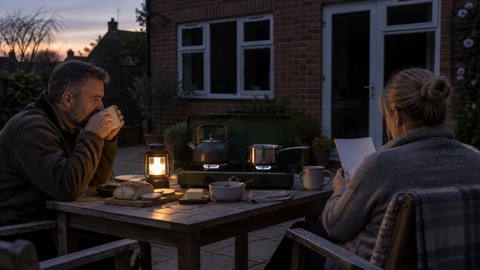 Campingaz Camping Kitchen 2 CV
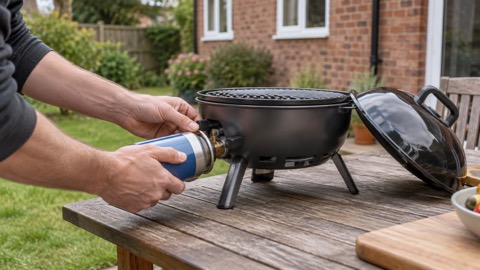 Campingaz Party Grill 200
 Campingaz Party Grill 400 CV
 Optimus Gemini II Stove
 Trangia 25 Large Stove
 Trangia 27 Small Stove
 Trangia Triangel Stove
 Trangia Mini Spirit Stove
 Flogas Gold Butane Cylinder
 Calor 4.5kg Butane Cylinder
 MSR Trail Lite Pot
 MSR Reactor Stove