If you own a Ring RPPL360 Fast Charge Lithium Jump Starter, the first thing to do is turn it over and read the batch number on the underside. Two batches, 38/21 and 05/23, were recalled on 27 March 2023 because the product presents a high risk of fire1. If your unit carries either number, stop using it immediately and store it outside, protected from water and rain, while you contact the retailer at ordering@ringautomotive.com for advice on a refund and disposal1.
If your unit carries a different batch number, it falls outside that recall. It remains a compact lithium jump starter that Ring describes as able to start motorcycles, cars, 4x4s and vans, and that also works as an LED torch and a power bank for phones and tablets1. For a household preparing for power cuts, storms or a breakdown away from home, that combination is the reason to keep one: a flat battery is one of the few emergencies a single small box can solve on its own.
This page sets out what the recall means for owners, how to identify your unit, what the RPPL360 can and cannot do for a household, and how to charge, use and store it so it is ready when you need it. It does not cover price, and it does not rank the RPPL360 against other jump starters; for that wider picture, see Portable Jump Starters: What They Do and How to Choose One.
Recall: what RPPL360 owners should do now
The recall notice is short and its instructions are direct. Consumers should immediately stop using the RPPL360 jump starter, and should store the product outside, protected from water and rain1. That is the whole of the immediate action: out of use, out of the house, and kept dry while you sort out what happens next.
The notice then points owners to the retailer. For further information, contact the retailer at ordering@ringautomotive.com for up-to-date advice for obtaining a refund and for disposing of the unit1. The wording matters: the notice does not itself set out a refund process or a disposal route, it directs you to the retailer for the current advice. Keep the unit, its batch number and the case reference to hand when you make contact.
A few practical points follow from those two instructions:
- Do not keep using it "just in case". The instruction covers the whole product, not only the jump-start function. A unit recalled over fire risk should not be left in a car boot or a kitchen drawer as a standby.
- Store it away from the house. Outside, protected from water and rain, is the notice's own wording1. A dry shed or garage away from living accommodation fits that description better than a hallway cupboard.
- Do not pass it on. Selling or giving away a recalled product moves the risk to someone else. The notice is addressed to consumers who own the unit.
- Keep the paperwork. The barcode is 5055175250151 and the country of origin is China1. Those details, with the batch number, identify your unit in any correspondence.
Why the recall was issued: a high risk of fire
The official notice describes a specific manufacturing fault rather than a general concern about lithium batteries. A manufacturing fault can lead to the sleeving on the battery cable being damaged by a solder pin of a component on the circuit board, which allows a short circuit, overheating of the printed circuit board and possible ignition of the lithium-ion battery1. In plain terms, an internal part can rub through the insulation on a cable, and the resulting short can heat the board enough to set the battery alight.
That chain of events explains why the advice is to stop using the unit rather than to use it carefully. A fault inside the casing is not something an owner can see, test or manage by handling the product gently. The notice classifies the product as presenting a high risk of fire1, and the response it asks for, stop using and store outside, is proportionate to that classification.
The battery chemistry is part of the picture. Ring's datasheet lists the RPPL360 battery as lithium cobalt, LiCoO22. Lithium batteries store a great deal of energy in a small space, which is exactly what makes a jump starter useful and also what makes a fault inside one worth taking seriously. The recall notice sets out the mechanism: a manufacturing fault can damage the sleeving on the battery cable, allowing a short circuit, overheating of the circuit board and possible ignition of the lithium-ion battery1. That is why the notice describes the product as presenting a high risk of fire1.
Ring maintains its own product recall page, which is the place to check whether a Ring product you own has been withdrawn3. It is worth a look whenever you are checking over the kit you keep for emergencies, because a recall can arrive years after purchase and the notice will not find you.
Identifying your unit: names, barcode and batch numbers
The recall notice identifies the product precisely, and matching your unit against those details takes a minute. The brand is Ring, the product is the RPPL360 Fast Charge Lithium Jump Starter, the barcode is 5055175250151, the country of origin is China, and the product type is listed as Hand Tools, Jump Starter1. The affected batches are 38/21 and 05/23, and the batch number can be found on the underside of the unit1.
| Detail | What to look for |
|---|---|
| Brand | Ring1 |
| Product name | RPPL360 Fast Charge Lithium Jump Starter1 |
| Barcode | 50551752501511 |
| Affected batches | 38/21 and 05/231 |
| Where the batch number is | Underside of the unit1 |
| Country of origin | China1 |
| PSD case number | 2303-01111 |
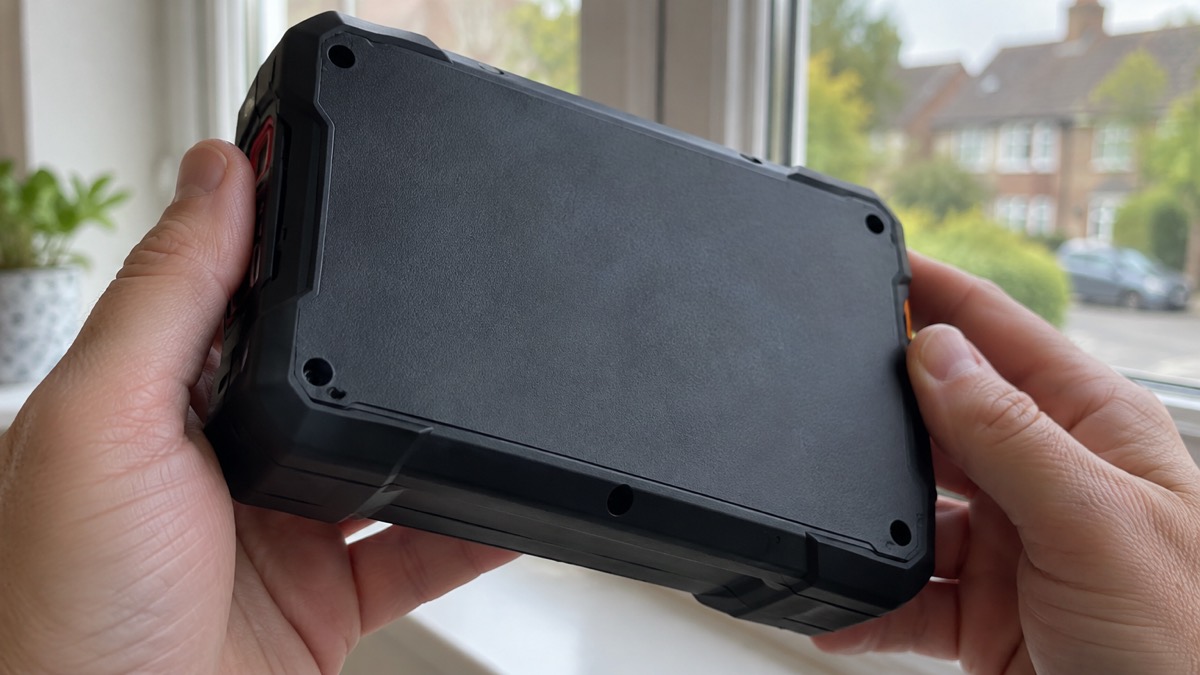
Work through it in this order. Turn the unit over and find the batch marking on the base. If it reads 38/21 or 05/23, the unit is affected and the recall instructions apply. If it reads something else, the unit is outside the batches named in this notice. If the marking is worn or unreadable, treat the unit as unidentified and ask the retailer to help you establish which batch it came from before you rely on it again.
The barcode is a second check. It confirms you have the right model, but it does not tell you the batch, because every RPPL360 carries the same barcode, 50551752501512. Only the batch marking distinguishes an affected unit from an unaffected one. The recall covers all RPPL260 and RPPL360 units3.
What the RPPL360 does: jump starter, LED torch and power bank
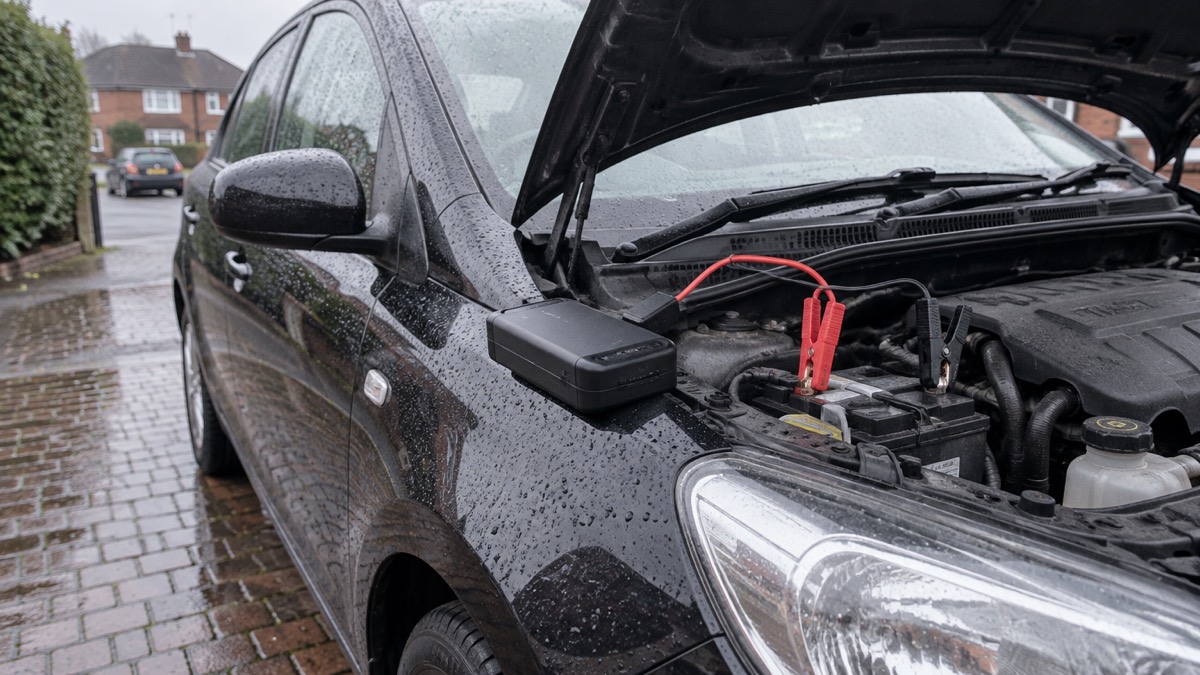
Ring describes the RPPL360 as a powerful, safe and compact lithium jump starter that also provides power to electronic gadgets2. The official notice sets out the intended use in the same three parts: a jump starter for motorcycles, cars, 4x4s and vans; a LED torch; and a power bank for phones and tablets1. For a household, each of those does a different job in an emergency.
Jump starting. The core function is to get a vehicle started when its own battery is flat. That matters in a winter storm, after a cold snap, or when a car has stood unused for weeks. A car that will not start is a car you cannot use to leave, to collect someone, or to charge a phone. The RPPL360 is rated at a starting current of 300A2, and Ring's intended-use description covers motorcycles, cars, 4x4s and vans1.
Torch. The built-in LED light works as an emergency torch1. Ring's earlier lithium jump starters were described in the same way, with a built-in LED light that can be used as an emergency torch4. A torch that lives in the car with the jump starter is one you have with you when the lights go out away from home; for lighting at home, see Emergency Lighting at Home: Torches, Lanterns and Candles.
Power bank. The RPPL360 charges phones and tablets, with up to 30W PD fast charge2. In a power cut, that is a way to keep a phone alive for calls and information. It is not a household electricity supply: it charges small devices, and the number of charges you get depends on the size of the device battery, which the datasheet does not state.
Ring's earlier lithium jump starters in the same family were described as having short circuit and anti-spike protection, to ensure that these starters are safe as well as easy to use4. That is the maker's description of its own product line, not a substitute for the recall instructions above.
Specifications: 300A starting output and 2.5A USB-C charging
The figures that decide whether the RPPL360 suits your household are the starting current, the charging rates and the recharge time. Ring's datasheet gives them as follows2.
| Specification | Figure |
|---|---|
| Starting current | 300A2 |
| Battery type | Lithium Cobalt, LiCoO22 |
| Type-C USB charging input | Fast charging at 2.5A2 |
| USB-C PD output | Up to 30W PD fast charge of phones and tablets2 |
| USB-C PD output voltages | 5V 3A, 9V 3A, 12V 2.5A, 15V 2A, 20V 1.5A2 |
| Recharge time, 30W PD charger | 1.5 hours2 |
| Recharge time, 5V 2A charger | 4.5 hours2 |
Two of those figures change how you keep the unit ready. The first is the recharge time. On a 30W PD charger the unit recharges in 1.5 hours; on an ordinary 5V 2A charger it takes 4.5 hours2. If the RPPL360 is part of your emergency kit, the faster charger is the one to keep with it, because a jump starter that is flat when you need it is no help at all. The second is the output. Up to 30W PD is enough to fast charge a phone or tablet2, which is the job it is being asked to do in a power cut.
The datasheet does not state a capacity in amp hours or watt hours, a number of jump starts per charge, or a shelf life before self-discharge. Those are the questions a household naturally asks, and the honest answer is that the maker's published figures do not answer them. Plan around the recharge time instead: check the unit at the same time you check the rest of your kit, and top it up on the fast charger so a top-up is a short job rather than an afternoon. Our guide to Checking and Restocking Supplies: Expiry Dates and Replacing Items sets out a routine you can fold this into.
Charging, using and storing it safely
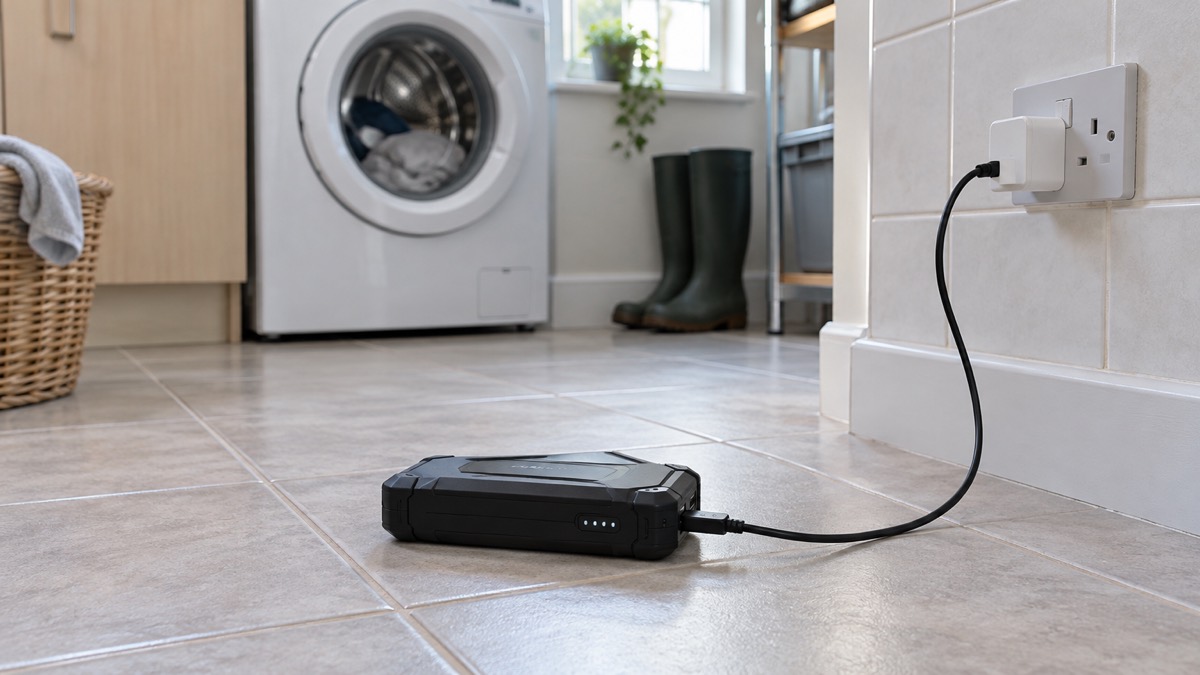
Ring's own instructions for its lithium jump starters are the place to start, and the recall notice overrides them for affected units. For a unit outside the recalled batches, the maker's figures give you a charging routine: 1.5 hours on a 30W PD charger, or 4.5 hours on a 5V 2A charger2. Charge it before you need it, not during the emergency, and charge it somewhere you would notice a problem.
A workable routine for a household looks like this:
- Check the batch number first. If it is 38/21 or 05/23, stop and follow the recall instructions above1.
- Charge on a hard surface. A kitchen worktop or a metal tray, not a carpet, a bed or a pile of paperwork.
- Stay in the room. Do not leave the unit charging while you sleep or go out.
- Use the fast charger. 1.5 hours on a 30W PD charger keeps the top-up short2.
- Store it dry and out of direct sun. Keep it dry and away from extremes of heat.
- Recharge on a routine. Add it to the same check you run on torches, radios and power banks.
For jump starting, connect the unit to the vehicle battery as the maker instructs, start the vehicle, and disconnect promptly. Keep the unit and its leads away from moving engine parts. It is not a substitute for a mains charger or for a vehicle battery that needs replacing.
Where the unit lives matters too. A jump starter kept in the car is there for a breakdown or a cold morning, which is the case for a car emergency kit. A unit kept at home is there for the same job plus phone charging in a power cut. If you are building out backup power more broadly, Backup Power at Home: A Household Guide sets out where a small battery product fits and where it does not.
Support, spares and where it fits your plan
Support for a recalled unit runs through the retailer. The notice directs owners to ordering@ringautomotive.com for up-to-date advice on obtaining a refund and on disposing of the unit1. Quote the PSD case number, 2303-0111, and your batch number when you write1. Ring also maintains a product recall page where you can check the status of Ring products you own3.
For a unit outside the recalled batches, the maker's datasheet is the reference for specifications and charging2. Ring is the maker, and its page on this site is Ring Automotive.
Where does the RPPL360 fit a household plan? It covers three jobs at once, which is why it earns space in a small kit: starting a vehicle, lighting your way, and charging a phone. It does not cover the jobs a household faces in a long power cut, such as keeping food cold, heating a room or running a fridge. For those, the wider Emergency Kit: What a UK Household Should Keep Ready and Power Cuts: A Household Guide are the places to start.
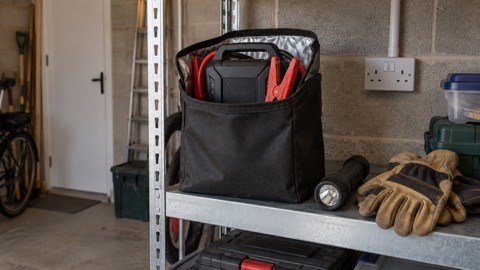
If you are weighing up a jump starter against other ways of keeping a phone charged, our pages on the NEBO Assist Air Jump Starter and the HaloLock Wireless Power Bank describe what those products do, so you can match the kit to your circumstances rather than to a label. Households that want a Ring unit with a different specification can read about the Ring RJS010T Ultraboost 500, the Ring RJS020T Ultraboost 1000 and the Ring RJS030T Ultraboost 1500, and the earlier Ring RPPL260 Fast Charge Jump Starter 260.
One last check belongs in any household routine: recalls are published long after purchase, and they do not come to you. The official product safety notices are worth a look each time you check your kit, alongside the Household Preparedness Checklist: Home, Grab Bag and Car.
Sources (4)
- Product recall: Ring RPPL360 Fast Charge Lithium Jump Starter (2303-0111), Office for Product Safety and Standards, 27 March 2023
- RPPL360 specification sheet, Ring Automotive, 2022
- Product recalls, Ring Automotive
- Safe and easy: RPPL200 and RPPL300, Ring Automotive, 19 November 2018
 Lifesystems Survival Bag
 Blizzard 3 Layer Survival Bag
 Blizzard EMS Survival Blanket
 Heatshield Thermal Blanket
 Steroplast Foil Blanket
 NEBO Assist Air Jump Starter
 Ring Ultraboost 500
 Ring Ultraboost 1000
 Ring Ultraboost 1500
 Ring RPPL260 Jump Starter
 Ring RTC6000 Tyre Inflator
 Aquapac Heavyweight Drybag