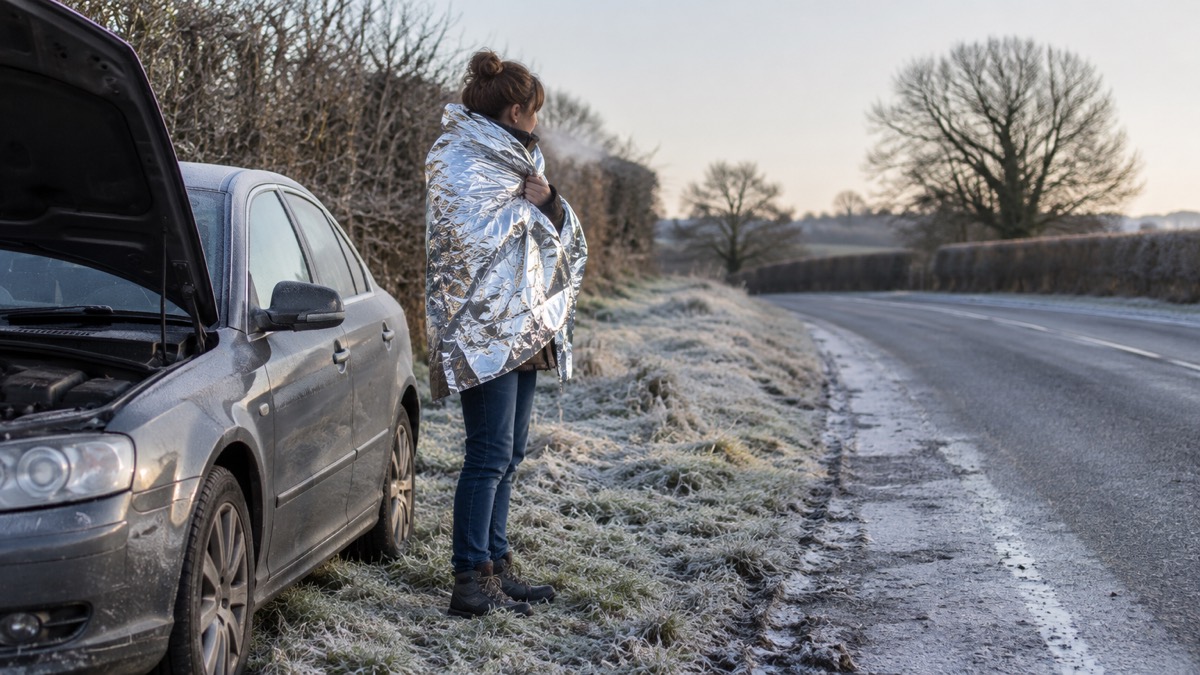
The Blizzard EMS Survival Blanket is a reusable thermal blanket made by Blizzard Survival, the company behind the Reflexcell material it is built from1. It is a two-layer Reflexcell blanket rated at 5 Tog, waterproof and windproof, that opens to 2.3m by 1.56m and weighs 242 grams1. Packed, it measures 12cm by 11cm by 5cm, so it fits in a grab bag pocket or a car glovebox1.
For an ordinary household, that makes it a warm layer you can keep ready for the moments when the heating fails, the car stops, or someone gets cold outdoors. Official advice is consistent on this point: keep blankets in the home emergency kit, in the grab bag and in the car2. A blanket like this one does the same job as a wool blanket in a smaller, lighter package, and it is the kind of item that is easy to forget until the night you need it.
This page sets out what the blanket is, its specifications, how the Reflexcell material works, how to use it to stay warm and dry, and how to pack, clean and reuse it. It does not cover prices or compare it with other products.
What the Blizzard EMS Survival Blanket is
The maker describes the blanket as a thermal protection survival blanket and says it is produced by Blizzard Survival, which it calls a leader in thermal protection technology and the innovator behind the Reflexcell material1. In plain terms, it is a lightweight sheet that reflects body heat back to the person wrapped in it, in the same family as the foil blankets that official first aid guidance recommends for retaining body heat in emergencies5.
The maker also states that the blanket is endorsed by the US Army Medical Center Directorate of Combat and Doctrine Development and is used exclusively in training Army medics for treating hypothermia1. That is the maker's own claim about its product, and it tells you the blanket was designed for cold, wet casualties rather than for camping comfort.
For a UK household, the practical question is where it fits. Official guidance for emergency kits asks households to include blankets: the Scottish Government's emergency kit advice lists blankets2, Nottinghamshire County Council suggests a change of clothes per person or an emergency blanket6, and Lincolnshire County Council advises a sleeping bag or warm blanket for each person, with extra bedding in winter7. A compact blanket like this one is a way of meeting that advice without taking up a cupboard.
Specifications: 242 grams, 2.3m by 1.56m open
The maker's product page gives the full set of figures. They are worth knowing before you buy, because they decide whether the blanket suits your bag, your car and the person you might wrap in it.
| Specification | Figure | What it means for you |
|---|---|---|
| Open size | 2.3m by 1.56m1 | Long enough to wrap an adult from shoulders to feet, with room to tuck in |
| Weight | 242 grams1 | Lighter than most water bottles, so it adds little to a bag |
| Packed size | 12cm by 11cm by 5cm1 | About the size of a small paperback |
| Material | Ultra-light 2 layer Reflexcell1 | Two reflective layers rather than one |
| Thermal quality | 5 Tog1 | A measure of warmth, comparable to a light duvet |
| Waterproof | Yes1 | Sheds rain and spray |
| Windproof | Yes1 | Stops wind stripping heat from the body |
| Closure | Self-adhesive strip1 | Presses closed around the body, no ties needed |
| Reusable | Yes1 | Can be folded away and used again |
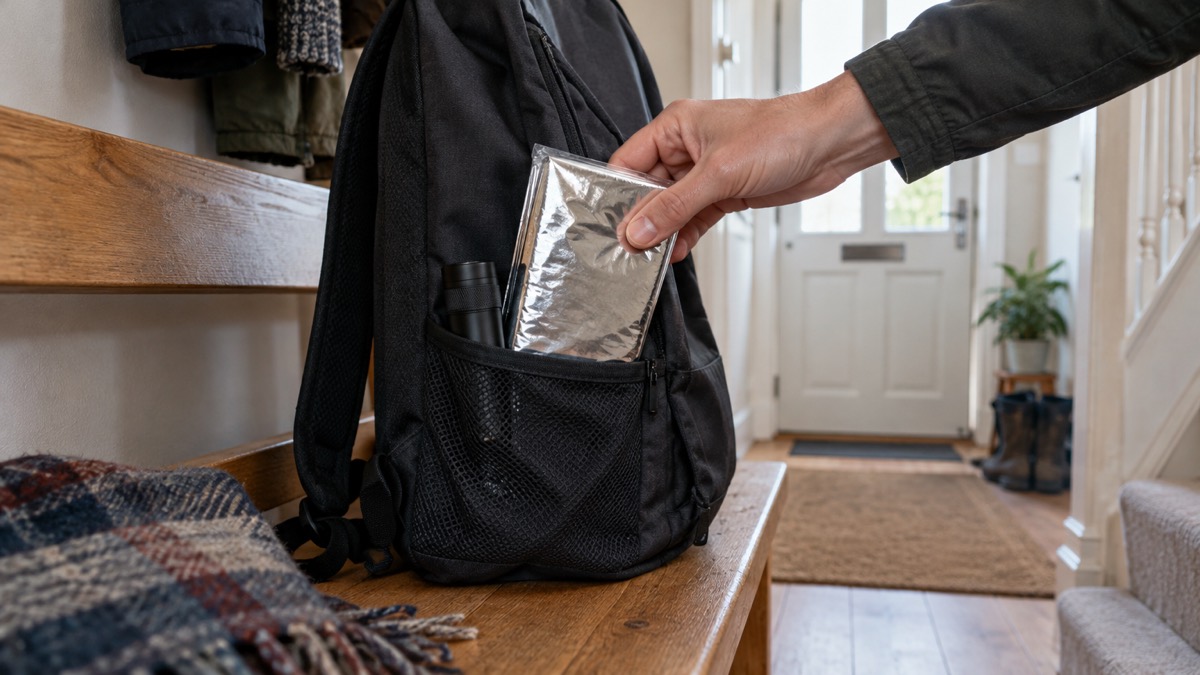
The 5 Tog rating is the figure that matters most for warmth. Tog is the unit used for duvets and blankets, and a higher number means more insulation. The maker does not give a temperature rating for the blanket, so treat 5 Tog as a guide to how much warmth it adds, not as a promise that it will keep you comfortable at any particular temperature.
The open size of 2.3m by 1.56m is generous for one person. That length lets you pull the blanket over the head and shoulders and still have material to tuck under the feet, which is where cold bites first.
Reflexcell material: 5 Tog warmth from two layers
Reflexcell is the maker's name for the material the blanket is made from, and the maker describes it as an ultra-light two-layer construction1. The principle is the same as any reflective blanket: the shiny surface bounces body heat back towards the body instead of letting it escape, and the layers trap a little air between them.
Official guidance on keeping warm in cold weather explains why this matters. The West Midlands Ambulance Service advises wrapping up warm in several layers of clothing, a hat, gloves and a scarf, and keeping dry to prevent loss of body heat8. A blanket works as an outer layer over clothing, holding the warmth your clothes have already trapped. It is not a substitute for clothing, and it works best over dry layers.
The 5 Tog figure puts the blanket in the same warmth band as a light duvet. That is enough to take the edge off a cold room or a cold car, and enough to slow heat loss in someone who is already chilled, but it is not a sleeping bag. The maker describes Reflexcell™ as more effective than traditional plastic bivvy bags and lighter than conventional sleeping bags, providing thermal efficiency in challenging conditions9.
"Wrap up warm by wearing several layers of clothing, a hat, gloves and a scarf and keep dry to prevent loss of body heat."
The maker's two-layer construction is the reason the blanket packs so small for its warmth. A single foil sheet reflects heat but traps little air; two layers with air between them insulate better, which is why the maker can claim 5 Tog from a blanket that weighs 242 grams1.
Waterproof and windproof: how it keeps a person warm and dry
Wet and windy conditions are what turn a cold day into a dangerous one. The maker lists the blanket as both waterproof and windproof1, and those two properties are what make it useful outdoors as well as indoors.
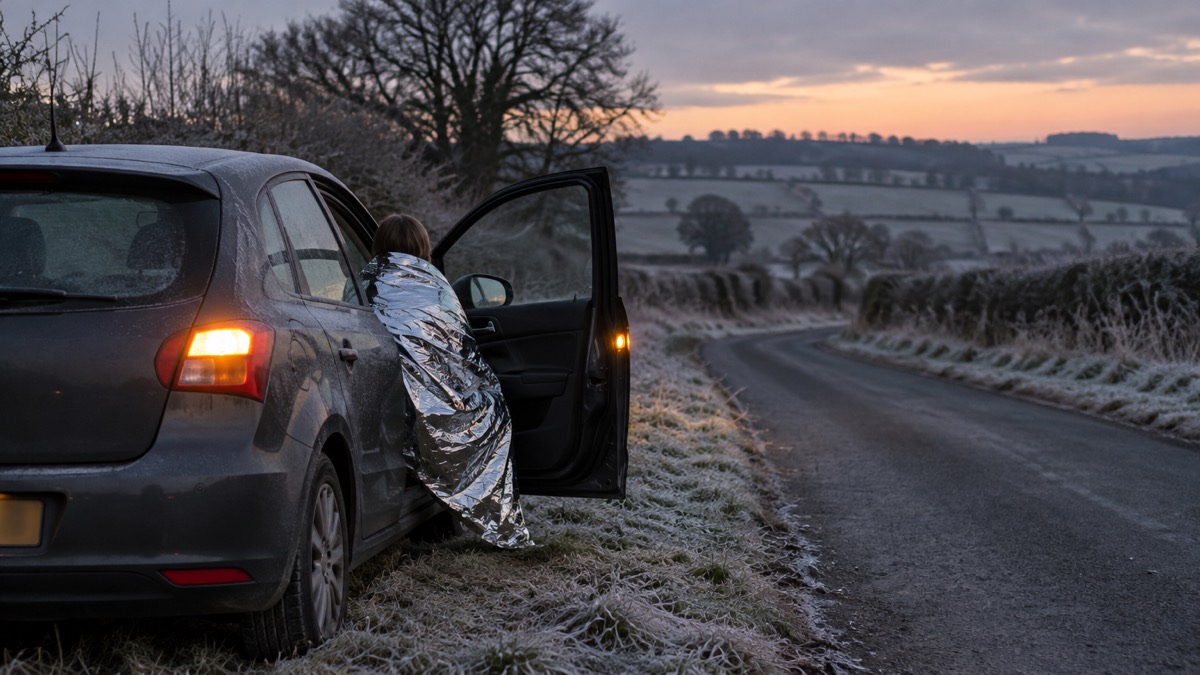
Wind strips heat from the body by constantly replacing the warm layer of air next to the skin. A windproof outer layer stops that. The maker lists the blanket as windproof and waterproof8. A waterproof blanket over the top of clothing keeps the rain off and keeps the insulation underneath working.
This is where the blanket earns its place in a car. Official guidance for drivers advises packing an emergency kit including blankets, a first aid kit, de-icer and snacks in case of a breakdown3. Transport Scotland's vehicle emergency kit lists a blanket alongside spare warm clothes, a high-visibility jacket, a torch and spare batteries10. West Yorkshire Prepared's winter driving checklist goes further, saying a foil or emergency blanket with 90% heat reflectivity or higher is ideal11. The Blizzard blanket's maker does not quote a reflectivity percentage, so if that figure matters to you, check the maker's own data before relying on it.
In the home, the blanket does a different job. During a power cut, official advice is to keep warm with blankets and layered clothing, to keep doors of unused rooms closed and to close curtains to keep the heat in9. A blanket you can wrap around your shoulders while you sit in one room is exactly what that advice describes. The same applies if the heating fails: the blanket buys you comfort while you wait for the problem to be fixed.
Packing and reusing it after an emergency
The blanket is designed to be used more than once. The maker lists it as reusable1, and the self-adhesive strip means you can open it, wrap it, and later fold it back into its packet. That is different from a single-use foil blanket, which often tears the first time it is used.
To open it, the maker's instruction is to find the red pre-cut slit at the base of the packet and tear there1. Do that before you need the blanket, so you know how it opens in the dark or with cold hands.
After use, the practical routine is:
- Shake off loose dirt and water.
- Let the blanket dry fully, away from direct heat.
- Check the reflective surface for tears and the adhesive strip for grip.
- Fold it loosely and return it to its packet.
- Put it back in the grab bag or car kit so it is there next time.
If the blanket has been used on someone who was bleeding, vomiting or otherwise unwell, treat it as soiled and do not put it back into your kit. The maker does not give washing instructions on its product page, so if in doubt, replace it rather than risk contaminating your kit.
Where to keep it matters as much as how to pack it. Official guidance suggests a foil blanket for each household member in the emergency bag14, and blankets in the home kit2, the grab bag3 and the car15. A household of four might therefore keep four in the grab bag, one or two in the car and one in the home kit. Store them somewhere dry: the maker lists the blanket as waterproof, but the packet and the adhesive strip are better kept away from damp.
For more on building the rest of the kit around it, see what to keep in a household emergency pack at home and what to pack in a grab bag.
Using it safely: cold, shock and first aid
A blanket is a simple piece of kit, but how you use it around a cold or injured person matters. Official first aid guidance gives clear direction.
If someone is in shock, NHS Inform advises helping them to lie down on a blanket or rug if there is one nearby, to protect them from the cold16. If someone has been burned, the same service advises keeping them warm with a blanket or layers of clothing, avoiding the injured area, to prevent hypothermia17. In both cases the blanket is doing a supporting job: it keeps the person warm while you get help, and it should not be pressed onto a burn or a wound.
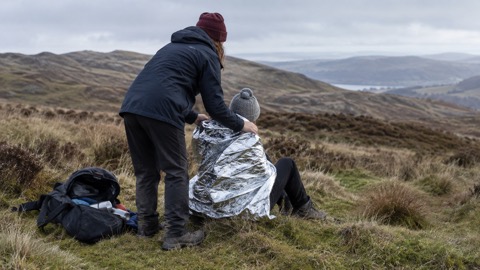
For an older person who has fallen, the North West Ambulance Service advises reaching for something warm, such as a blanket or dressing gown, to put over the legs and feet while waiting for help18. That is a good use for a blanket kept in the home kit: it is light enough to hand to someone on the floor, and it covers the parts of the body that lose heat fastest.
If you are wrapping a child, keep the blanket loose enough that they can move, and check on them often. Children lose heat faster than adults and may not say they are cold. For an older person, the same applies in reverse: they may not feel the cold as sharply, so check rather than wait to be told.
For more on cold weather and keeping warm, see storms, snow and ice and power cuts.
Where it fits in a household kit
The Blizzard EMS Survival Blanket is one item among several that official guidance asks households to keep. It is not a replacement for warm clothing, a sleeping bag or a proper first aid kit, and it is not a substitute for getting help when someone is seriously cold or injured.
What it does well is sit in a bag or a car without taking up space, and be ready when the heating fails, the car stops or someone gets wet and cold outdoors. The maker lists it as in stock1, and it is produced by Blizzard Survival, the company behind the Reflexcell material1.
If you are building a kit from scratch, start with the emergency kit section and the household preparedness checklist. If you are choosing between a blanket and a bag, the comparison of a survival bag or foil blanket sets out the difference. For the car, see what to keep in your car in case of a breakdown or storm.
Sources (18)
- Blizzard EMS Survival Blanket, Steroplast, 2026-10-28
- Cold, snow and ice, Ready Scotland, 2026-03-25
- Winter travel and driving safety advice, South Western Ambulance Service, 2026-10-29
- Be Ready Household Emergency Plan, Be Ready, 2026
- What should I keep in my first aid kit?, NHS
- Emergency kit, Ready Scotland, 2026-10-22
- Preparing for an emergency, Nottinghamshire County Council, 2026-10-29
- Cold weather advice, West Midlands Ambulance Service, 2026-05-20
- Power cuts, Be Ready, 2026-10-21
- How to prepare a car emergency kit for the winter | Traffic Scotland, Traffic Scotland
- 2399-WYP-Winter-Driving-Checklist-A4-1.pdf, West Yorkshire Prepared
- Personal resilience, Wiltshire and Swindon Prepared, 2026-10-25
- Loss of essential services, Greater Manchester Combined Authority, 2026-10-29
- Emergency home emergency plan, Royal Borough of Windsor and Maidenhead, 2025-10
- Get help and advice in an emergency, Lincolnshire County Council, 2026-10-29
- Shock first aid, NHS Inform, 2026-07-24
- Burns and scalds, NHS Inform, 2026-07-31
- Handling falls, North West Ambulance Service, 2024-10-22
 Heatshield Thermal Blanket
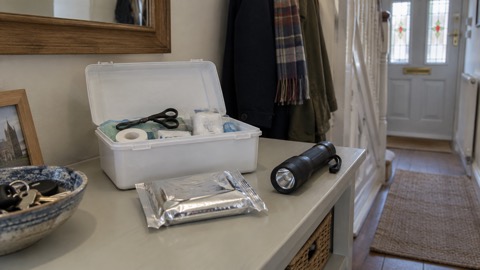 Steroplast Foil Blanket