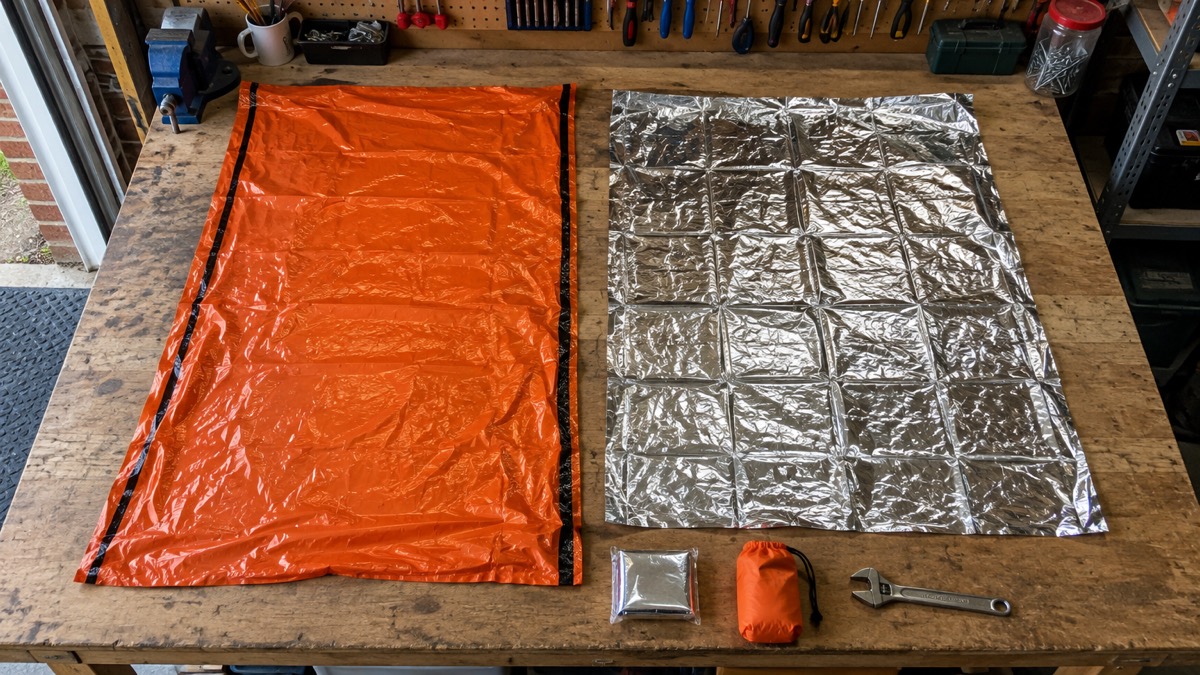
If you are packing a grab bag or a car kit and wondering whether to add a survival bag or a foil blanket, the short answer is that both do the same basic job: they trap the heat your body makes and block the wind, so you stay warmer than you would in wet or cold clothing alone. A foil blanket is a thin reflective sheet, cheap and light enough to keep one per person. A survival bag is a polyethylene bag with an aluminium coating, shaped like a sleeping bag, that you climb into fully clothed1.
Which you carry depends on the job. For a car, a home kit or a grab bag, a foil blanket is the practical default, and official winter driving guidance says a foil or emergency blanket with 90% heat reflectivity or higher is ideal2. For walking, skiing or mountaineering, where you may have to sit out a night or wait for help in exposed ground, a survival bag gives you more coverage and a bright colour that is easier to spot1.
Neither is a substitute for proper clothing, a warm layer and a way to call for help. They buy you time while you wait, and they work best when you know how to use them before you need them.
How each one keeps you warm
Both items work on the same principle. Your body loses heat to the air around it, and it loses it faster when the air is moving or when your clothes are damp. A reflective layer close to the body bounces some of that radiant heat back, and a windproof outer layer stops cold air stripping the warmth away. The NHS lists an aluminium blanket among first aid kit contents because it retains body heat in emergencies, which is essential for first aid and survival6.
A foil blanket is a single thin sheet. The Lomo maker describes its emergency foil blanket as protecting the user from the wind and helping retain some body heat, which is useful for treating or preventing hypothermia3. That is the whole mechanism: wind block plus reflection. It is light, folds small and costs little, which is why it turns up in so many kit lists.
A survival bag adds enclosure. The Lomo Lightweight Orange Foil Survival Bag is made of polyethylene with an aluminium coating, so it is very lightweight and easy to carry, and its reflective foil lining helps reflect body heat and maximise heat retention1. Because you climb inside it, your legs and torso are covered, not just your shoulders. The Lifesystems Survival Bag is described by its maker as a durable, lightweight emergency bag designed to provide vital protection5.
The difference matters most when you are stationary. A foil blanket over the shoulders helps while you are moving or sitting briefly. A bag you are inside keeps more of you covered for longer, which is why it suits the hill and the roadside wait.
What a foil blanket does well, and where it falls short
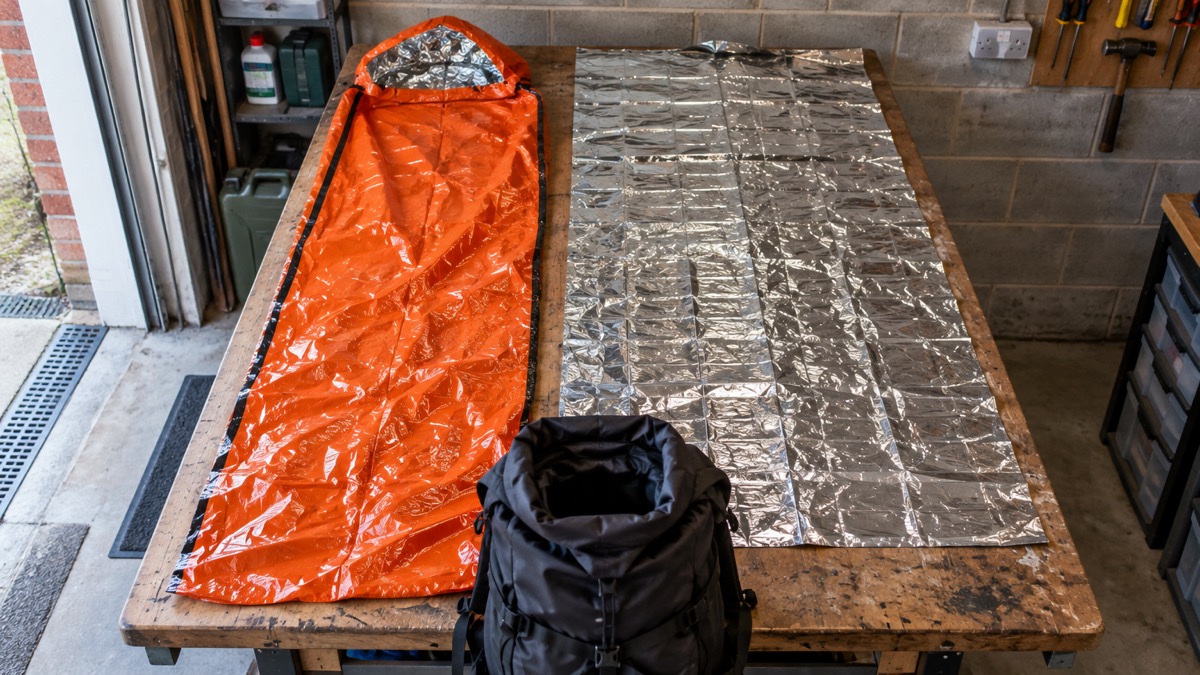
A foil blanket earns its place because it is small, light and cheap enough to keep several. It goes in a first aid kit, a glovebox, a rucksack pocket or a grab bag without adding noticeable weight. The Lomo maker notes that carrying an emergency foil blanket is compulsory in some trail racing type events, which tells you how seriously organised outdoor events take a few grams of reflective sheet3.
Its limits are just as clear. It is a sheet, so it does not enclose you, and wind can get under the edges. It tears and creases, and a torn blanket loses much of its windproofing. It offers no padding against cold ground, and it does nothing for your legs unless you wrap it around them. It is also easy to lose in the dark.
A survival bag answers some of that. It encloses the body, so there are fewer edges for wind to catch, and the material is more robust than a foil sheet. The trade-off is bulk and weight, and the fact that you have to get inside it, which is harder if you are injured or panicking.
| Feature | Foil blanket | Survival bag |
|---|---|---|
| Form | Thin reflective sheet | Bag shaped like a sleeping bag1 |
| Coverage | Shoulders and torso, or wrapped around | Whole body, climbed into fully clothed1 |
| Wind protection | Protects against the wind, but edges lift | Encloses you, so wind protection comes from the bag itself1 |
| Weight and pack size | Very small and light | Lightweight but bulkier1 |
| Suits | Car, home kit, grab bag, first aid kit | Walking, skiing, mountaineering, exposed waits1 |
| Visibility | Silver, unless a coloured version | Hi-Viz orange for maximum visibility1 |
Which to carry for walking, driving and home kits
The right choice changes with where you are and what you are doing. The table above sets out the differences; here is how they apply to the three situations most households face.
Walking and the outdoors. The Lomo maker recommends its orange survival bag as a useful addition to your backpack, in case of first aid incidents and emergencies, on trips involving activities such as hiking, skiing and mountaineering1. If you walk in hills or mountains, a survival bag is the more capable item, and its bright colour helps rescuers see you. The Lifesystems Survival Bag is bright orange, which the maker says improves visibility in poor conditions and can be used as a signalling aid when assistance is required, and it carries SOS instructions printed on the bag5. It is also listed as DofE Recommended Kit5.
Driving. For the car, a foil blanket is a sensible item to keep. West Yorkshire Prepared's winter driving checklist says a foil or emergency blanket with 90% heat reflectivity or higher is ideal2. Several councils list a blanket in the car emergency kit, and Wiltshire and Swindon Prepared advises keeping a spare jumper, blanket and bottle of water in the car to stay comfortable while waiting for recovery after a breakdown7. A survival bag is worth adding if you drive in remote areas or in severe winter conditions, but the blanket is the minimum.
Home and grab bags. Official household plans suggest foil blankets, one per household member4. Nottinghamshire's emergency guidance lists a change of clothes per person or an emergency blanket8, and the government's flooding advice suggests a grab bag with warm waterproof clothing and other essentials9. A foil blanket per person is the practical way to meet that, with a survival bag as an extra for anyone who might have to leave on foot.
How to use a survival bag or foil blanket properly
Getting it out is the easy part. Using it well is what decides whether it helps.
- Get out of the wind first. Move behind a wall, a vehicle or a rock, or into the lee of the land, before you unwrap anything.
- Put the reflective side towards your body. The metallised face bounces your heat back to you; the plainer side faces out.
- Keep it loose. A layer of trapped air insulates better than a tight wrap.
- Cover your head. Heat is lost from the head, so pull a hood up or wrap the blanket over it.
- Climb into a survival bag fully clothed. The Lomo maker says that in emergency situations the fully clothed user should climb inside the survival bag, which is shaped like a sleeping bag1.
- Sit on something dry. Cold ground pulls heat out of you, so sit on a mat, a bag or a coat.
If someone is injured or in shock, help them lie down on a blanket or rug if there is one nearby, which protects them from the cold10. If someone has fallen and cannot get up, cover them with anything you can reach, such as a towel, coat, rug or blanket, while you wait for help11. For frostbite, the NHS advises wrapping yourself in something warm like a blanket, sleeping bag or dry towel12.
Where neither one is enough on its own
A foil blanket and a survival bag are both short-term measures. They slow heat loss; they do not generate heat, and they cannot replace food, drink, shelter or a way to raise the alarm.
For a start, they do nothing for the ground you are sitting on. Cold seeps up through a thin sheet, so a mat or a layer of dry clothing underneath matters as much as the blanket on top. They also do nothing for wet clothing, which conducts heat away far faster than dry fabric. If you are soaked, get out of the wet layers before you wrap up.
They are also no substitute for calling for help. A survival bag's colour helps rescuers find you, but only if someone knows to look. Carry a charged phone, tell someone your route and expected return time, and if you are in a remote area, consider a whistle or other signalling device.
At home, a foil blanket is a backup, not a heating system. ScotBorders' personal resilience advice suggests having additional blankets or duvets to hand to help keep you warm sitting or in bed13, and NHS Lanarkshire's winter preparedness advice points to an emergency kit in the car including a blanket14. For a power cut at home, the heating and cooking guide covers the wider picture, and the power cuts guide explains what to expect.
For babies, a foil blanket is not a substitute for safe bedding. The Lullaby Trust advises that if a room is slightly colder than 16 to 20°C, you can add an extra lightweight blanket or layer of clothing, or with a sleeping bag add an extra layer of clothing or choose a higher tog15. It also says not to add extra blankets on top of a baby sleeping bag15, and the NHS advises against pillows or duvets for babies under the age of 1 because they can suffocate if their face gets smothered16.
Storing and checking them so they work when needed
A foil blanket that has been crushed at the bottom of a bag for years may still work, but a torn one will not work well. Check both items before you rely on them.
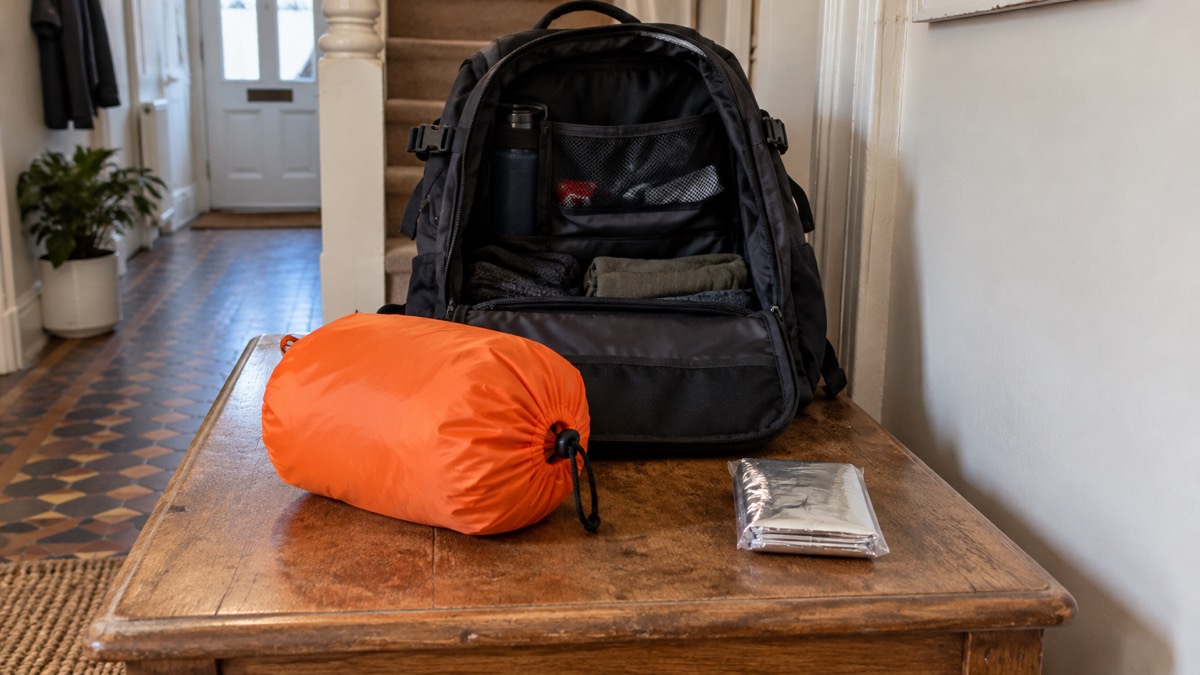
- Keep them dry. Store foil blankets and survival bags somewhere dry so they are ready when needed.
- Keep them accessible. Store the grab bag somewhere you can easily get to, as the government's flooding advice says9.
- Check them each season. Unfold, inspect for tears and holes, and refold loosely. Replace anything that has split.
- Keep one per person. Official plans suggest foil blankets, one per household member4.
- Store electric blankets properly if you use one at home. The fire service advises loosely folding or rolling the blanket in a towel or plastic bag and storing it in a cool, dry place14.
For a full list of what to check and when, see the checking and restocking guide. For the wider kit picture, the emergency kit section sets out what a household should keep ready, and the grab bag guide covers what to pack if you have to leave home.
Sources (16)
- Lightweight Orange Foil Survival Bag, Lomo, 2026
- Winter Driving Checklist, West Yorkshire Prepared, 2020
- Emergency Foil Blanket Silver Bulk 100 Pack, Lomo, 2026
- Household Emergency Plan, West Yorkshire Prepared, 2020
- Lifesystems Survival Bag, Lifesystems, 2026
- What should I keep in my first aid kit?, NHS, 2026
- Yourself, Wiltshire and Swindon Prepared, 2026
- Preparing for an emergency, Nottinghamshire County Council, 2026
- Flooding, Prepare campaign, 2026
- Shock first aid, NHS Inform, 2026
- Falls, NHS, 2025
- Frostbite, NHS, 2025
- Be more resilient in 30 simple ways in 30 days, Scottish Borders Council, 2026
- Electric blanket safety, Mid and West Wales Fire and Rescue Service, 2019
- Safer sleep in cold weather, The Lullaby Trust, 2025
- Baby and toddler safety, NHS, 2026