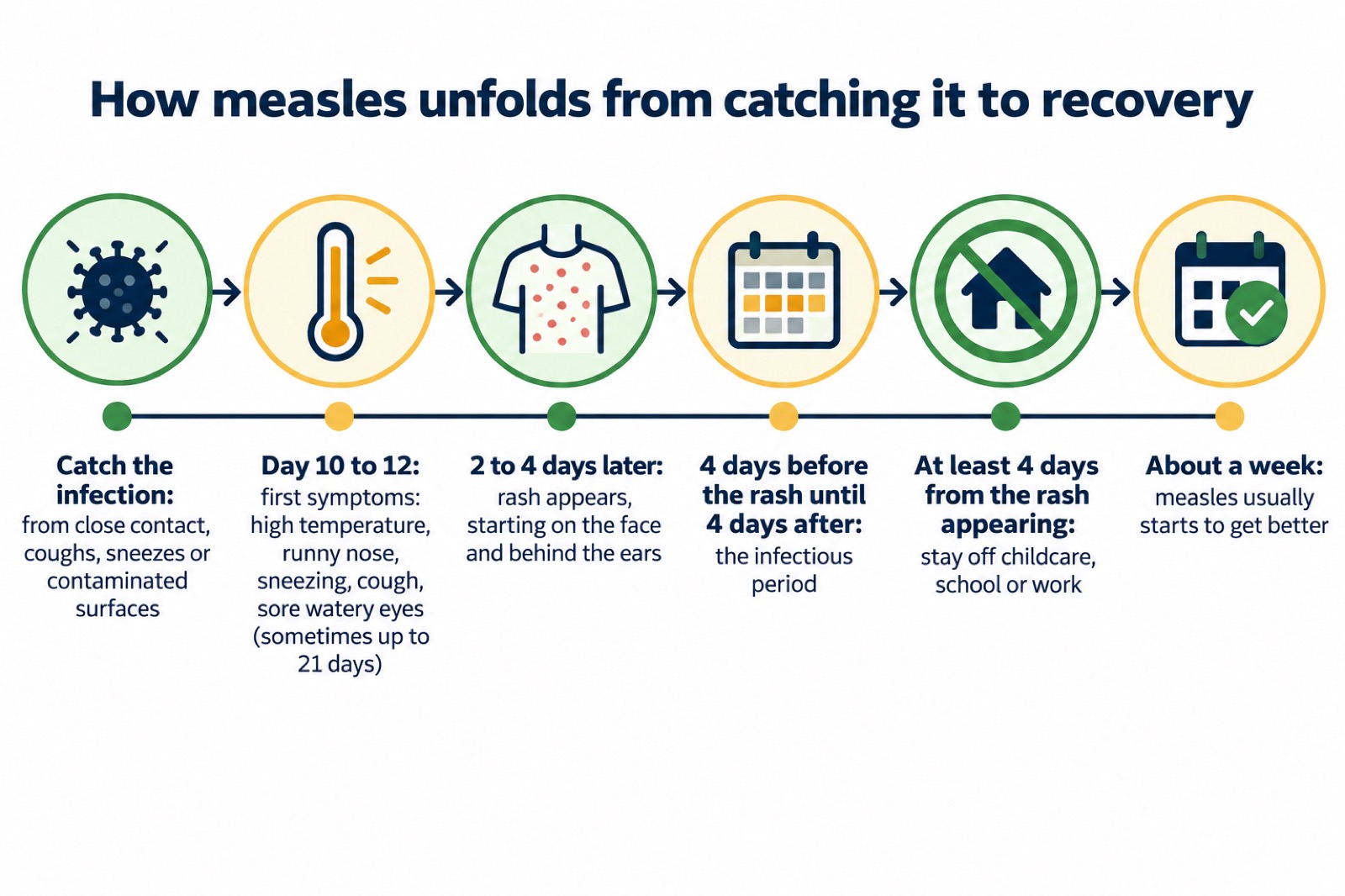
Measles is one of the most infectious diseases the UK deals with, and cases are increasing here after years of low vaccine uptake1. It starts like a bad cold, with a high temperature, runny or blocked nose, sneezing, a cough and red, sore, watery eyes, and a rash follows 2 to 4 days later, beginning on the face and behind the ears2. Symptoms usually appear 10 to 12 days after catching the infection, and sometimes up to 21 days2.
The single most important thing to know is timing: a person with measles can spread the infection from 4 days before the rash appears until 4 days after it develops2. That means people pass it on before they know they have it. Anyone with measles should stay away from childcare, school or work for at least 4 days from when the rash first appeared, and can return after 4 days if they feel well and no longer have a temperature2.
Measles is vaccine preventable1. Two doses of the MMRV or MMR vaccine, or having had the infection before, protects against measles2. The MMRV vaccine replaced the MMR in the routine childhood vaccination schedule in January 2026, with doses at 12 months and 18 months2, and anyone who missed a dose can catch up at any age1.
What measles looks like: cold-like signs first, then a rash
Measles arrives in two stages, and the first stage is easy to mistake for an ordinary cold or flu. The first symptoms are a high temperature, a runny or blocked nose, sneezing, a cough, and red, sore, watery eyes2. Because these are also the opening signs of flu and other winter viruses, a household often does not suspect measles at all in the first day or two.
The rash is what changes the picture. It usually appears 2 to 4 days after the cold-like symptoms started, and it starts on the face and behind the ears before spreading to the rest of the body2. That pattern, face first and body afterwards, is what distinguishes it from rashes that appear scattered across the body at once. If someone in your home has had a fever and cold-like symptoms for a couple of days and then develops a rash that begins at the face and ears, treat it as possible measles and contact your GP practice.
The timing of the whole illness is also distinctive. Symptoms usually start between 10 and 12 days after catching the infection, and sometimes it can take up to 21 days2. This long gap matters in an outbreak: if a child is exposed at school, the household may wait two weeks or more before anyone shows signs, so a case that seems to come from nowhere usually has a traceable contact. Measles usually starts to get better in about a week2.
The rash on brown and black skin
The rash looks brown or red on white skin, but it may be harder to see on brown and black skin2. This is a real safety issue, not a small detail: a fainter rash can delay recognition at home and in healthcare settings. Check the face and behind the ears carefully, in good light, and look at the whole body as the rash spreads. The other symptoms, especially the high temperature combined with cough and sore watery eyes, carry just as much weight as the rash itself, so do not wait for an obvious rash before seeking advice if the rest of the picture fits measles.
The same caution applies to other serious rashes. For sepsis, blue, grey, pale or blotchy skin, lips or tongue may be easier to see on the palms of the hands or soles of the feet on black or brown skin3, and a meningitis rash can be more difficult to see on dark skin4. If you are unsure whether a rash is fading under pressure, do the glass test and get medical help rather than waiting.
How long measles is contagious
Measles is contagious for longer than most infections people are used to, and crucially it is contagious before the rash exists. A person with measles can spread the infection in the 4 days before they get the rash until 4 days after they develop the rash2. Someone in the cold-like first stage, who seems to have nothing worse than a snuffle, is already infectious.
The practical rule that follows from this is the exclusion period. You should stay away from childcare, school or work for at least 4 days from when your rash first appeared, and you can return after 4 days if you feel well and no longer have a temperature2. The same advice applies to staying off work, school or nursery for at least 4 days from when the rash first appears5. During that time, avoid close contact with babies, pregnant women and anyone with a weakened immune system1.
For comparison, here is how measles stacks up against two other common infections:
| Infection | Most infectious period | Typical onset |
|---|---|---|
| Measles | From 4 days before the rash until 4 days after it develops2 | Usually 10 to 12 days after catching it, sometimes up to 21 days2 |
| Flu | More likely to pass it on in the first 5 days after getting infected6 | Fever, chills, headaches and aching muscles, often with a cough and sore throat6 |
| Norovirus | From the start of symptoms until 48 hours after all symptoms have stopped7 | Symptoms appear 1 to 2 days after infection and typically last up to 2 or 3 days7 |
The table shows why measles outbreaks grow so fast: the infectious window opens days before the illness is recognisable, and the incubation period is long enough that exposed people disperse widely before falling ill.
How measles spreads and how to cut the risk at home
Measles infection is caused by a virus, and it spreads between people very easily2. You can catch it through close contact with someone who has measles, from the air when they cough or sneeze, or by touching things they have coughed or sneezed on2. Droplets containing the germ leave the body when someone carrying measles speaks, breathes, coughs or sneezes, and are passed on by breathing them in or by touching contaminated surfaces and then your eyes, nose or mouth1. It is a very infectious disease and can spread very quickly if people are not vaccinated against it1.
Measles is also known to be transmissible by aerosols, meaning tiny particles that hang in the air, not just heavier droplets that fall within a short distance8. UK advice from the time of a 2020 official review was that respiratory etiquette when coughing or sneezing, and keeping at least 2 metres apart, should give sufficient protection against viruses carried in droplets that evaporate or fall to the ground within that distance8. For a household with a case of measles, that combination of distance, fresh air and surface cleaning is the practical defence.
If someone at home has measles, take these steps to cut the risk to the rest of the household:
- Wash your hands often with soap and warm water1
- Use tissues when you cough or sneeze, throw used tissues in the bin and wash your hands afterwards1
- Do not share cups, cutlery, towels, clothes or bedding1
- Keep frequently touched surfaces clean1
- Keep your distance from the person who is ill where possible, and open windows to improve ventilation for at least 10 minutes after they leave a room9
- Wear a well-fitted face mask if someone at home has a long-term condition or a weakened immune system9
- Tell visitors that someone in the house has symptoms before they arrive9
Our page on stopping infections spreading at home covers the handwashing and cleaning habits in more detail, and staying at home when ill explains how to manage a household where one person is isolated.
How serious measles is, and who is most at risk
Around 1 in 15 people with measles can become seriously unwell2. The more serious complications can include ear infections, lung infection (pneumonia), diarrhoea, dehydration, and fits, which are less common2. Measles usually starts to get better in about a week2, but complications can extend the illness well beyond that, and pneumonia in particular can turn a home-managed illness into a hospital admission.
Some groups are much more likely to become seriously unwell: younger children, pregnant women and people with weakened immune systems2. Unborn babies, infants and those with weakened immune systems are particularly at risk of serious health problems if they become infected1. Measles infection during pregnancy can result in the loss or early birth of the baby2. You can get measles at any age, but it is often young children who catch it2.
This is why the isolation advice is aimed so specifically. If you have measles, avoid close contact with babies, pregnant women and anyone with a weakened immune system, as well as staying off work, school or nursery for at least 4 days from when the rash first appears1. If your household includes someone in these groups and someone else has measles, the mask and ventilation measures above matter most, and you should tell your GP about the contact early. Our page on people at higher risk in an outbreak has more on protecting vulnerable relatives.
Caring for someone with measles, and when to get urgent help
There is no specific medicine for measles itself, so care at home is about supporting the body while it recovers. It can help to rest and drink plenty of fluids, such as water, to avoid dehydration, and antibiotics may be given to treat other illnesses that measles causes, such as the ear infections and pneumonia listed above. Contact your GP if more serious health effects develop2.
Watch for dehydration, which is one of the listed complications2. Signs include feeling thirsty, dark yellow strong-smelling pee, peeing less often than usual, feeling dizzy or lightheaded, feeling tired, a dry mouth, lips and tongue, and sunken eyes10. Babies, children and older adults are more at risk of dehydration10. Our page on treating dehydration at home explains what to do.
Some warning signs need urgent medical attention, whether or not measles is confirmed. In adults, sepsis warning signs include confusion or slurred speech, uncontrollable shivering, muscle pain, difficulty breathing, blue, pale, grey or blotchy skin, lips or tongue, a high or low temperature, and not peeing all day or peeing very little in the past 18 hours3. A high temperature is less common in older adults with sepsis3. In adults or older children, look for acting confused, slurred speech or not making sense, difficulty breathing, breathlessness or breathing very fast, and a rash that does not fade when you roll a glass over it, the same as meningitis11. In children under 5, not having a wee or a wet nappy for 12 hours is a warning sign12.
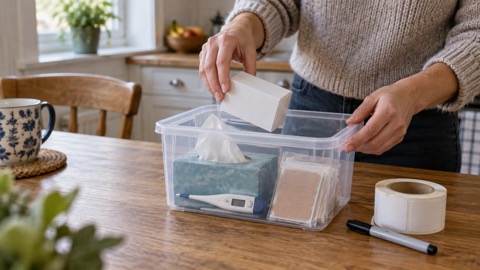
For less urgent worries, NHS 111 can advise when your GP practice is closed, and our page on when to call 111 and when to call 999 sets out the difference. If you are caring for someone ill at home for several days, the checklist for caring for someone ill lists the supplies worth having ready.
The MMRV vaccine: the childhood schedule changed in January 2026
The MMRV vaccine replaced the MMR in the routine childhood vaccination schedule in January 20262. It protects against measles, mumps, rubella and varicella (chickenpox), and it is usually given to children in 2 doses2. The first dose is given to children aged 12 months old, and the second dose is given when they are aged 18 months old2.
This is a recent change, so families with children of different ages will have different histories. Under the previous MMR schedule, the first dose was given at 1 year old and the second dose at around 3 years and 4 months old1. If your child was vaccinated before January 2026, they will have had MMR on the older timetable; children vaccinated after that point follow the new one. Both routes lead to the same protection: 2 doses of MMRV or MMR vaccine, or having had the infection before, protects against measles2, and having the 2 doses gives you the best protection1.
A doctor may recommend the vaccine is given earlier than the scheduled doses to a close contact of someone with measles2. This is the "early dose" that families ask about when a case appears at a nursery or school. If a dose is given to an infant aged under 12 months, then the usual 2 doses of MMRV still need to be given at the usual times, with a minimum 1 month gap between any doses2. So an early dose is an extra protective step, not a replacement for the routine schedule.
Missed a dose? Catching up at any age, and checking your records
Children and adults can catch up on any missed vaccines1. If someone has missed a dose or is unsure whether they have had any vaccinations, the vaccine can be given at any age, and you will be offered either MMRV or MMR depending on your date of birth2. This applies to adults who were never vaccinated as children, to children who missed a dose during illness or a house move, and to anyone whose family simply cannot remember.
The first step is checking the record. You may find your vaccination status on your online GP records, or in your red book1. Parents and guardians can check their child's red book for their vaccination records2. If nothing is recorded, or the record is incomplete, contact your GP practice and ask about a catch-up appointment. Uncertainty is not a barrier: the vaccine can be given at any age if a dose has been missed or vaccination status is unsure2.
One question families often raise is the vaccine's ingredients. There are 2 different types of MMR vaccine available in the UK, and one of them does not contain pork gelatine. It can be requested from the GP and it is free5. If this matters to your household, say so when you book.
Pregnancy, weakened immune systems and the vaccine
Pregnant women and people with weakened immune systems should not have the MMRV or MMR vaccine2. If you are pregnant or have a weakened immune system and you think you have had contact with someone with measles, speak to your GP or midwife straight away2. This matters because measles infection during pregnancy can result in the loss or early birth of the baby2, so a known contact needs prompt professional advice rather than a wait-and-see approach.
The absence of the measles vaccine in pregnancy does not mean no vaccines are recommended. It is recommended that all pregnant women have a flu, RSV, and whooping cough vaccine13. You can get your flu vaccine at your GP surgery, pharmacies that offer NHS flu vaccinations, and some maternity services if you are pregnant13. If you have any questions about vaccinations in pregnancy, discuss them with your midwife or GP14. Anyone hoping to become pregnant and unsure of their measles protection can use the catch-up route above before conception.
Why measles cases are rising in the UK
Due to years of low vaccine uptake, measles cases are increasing across the UK5. This is not a change in the virus and not a mystery: when fewer people in a community are vaccinated, an infection this contagious finds the gaps. It is a very infectious disease and it can spread very quickly if people are not vaccinated against it1.
For an ordinary household, the rise in cases changes two things. First, the chance of a contact, at school, at a nursery, at a family gathering, is higher than it was, so knowing your household's vaccination status is worth doing now rather than after a case appears. Second, local outbreaks bring public health advice, and you may hear about cases through your school or nursery before you hear anything official. Our pages on infectious disease outbreaks near you and the UK Health Security Agency explain how outbreak information reaches households and what local teams do.
The fix is the same at every level: 2 doses. Having the 2 doses of MMR vaccine gives you the best protection1, and children and adults can catch up on any missed vaccines1. Our wider page on vaccines that protect against outbreaks covers the other immunisations worth checking at the same time.
Sources (14)
- Measles: disease control guidance, Derbyshire County Council, 2026
- Measles factsheet, national measles guidelines, UK Health Security Agency, 2026
- Sepsis: symptoms and when to get help, NHS, 2026
- Poisoning and accidental swallowing: when to get help, Healthier Together, 2026
- Measles: symptoms, vaccination and staying off school, Derbyshire County Council, 2026
- Flu, NHS, 2026
- Norovirus, NHS inform Scotland, 2026
- Rapid review of face masks and aerosol transmission, Scientific Advisory Group for Emergencies, 2020
- Guidance for people with symptoms of a respiratory infection, Welsh Government, 2020
- Summer Safety :: Cheshire and Wirral Partnership NHS Foundation Trust, Cheshire and Wirral Partnership NHS Foundation Trust
- Sepsis: spotting the signs, NHS 111 Wales, 2026
- Sepsis, NHS inform Scotland, 2026
- Staying well in winter: vaccinations in pregnancy, Derbyshire County Council, 2026
- Flu - Derbyshire County Council, Derbyshire County Council
 Medicine Cabinet Checklist
 Sick at Home Supplies Kit
 Caring for Someone Ill at Home
 Pandemics and UK Household Plans
 Outbreaks Near You
 UK Health Security Agency
 Staying Home When Ill
 Stopping Infections at Home
 Caring for a Sick Person at Home
 Keeping Prescription Medicine
 Medicine Shortages Explained
 Storing Medicines Safely
 Urgent Care and A&E
 Vaccines Against Outbreaks
 Flu Symptoms and Getting Help