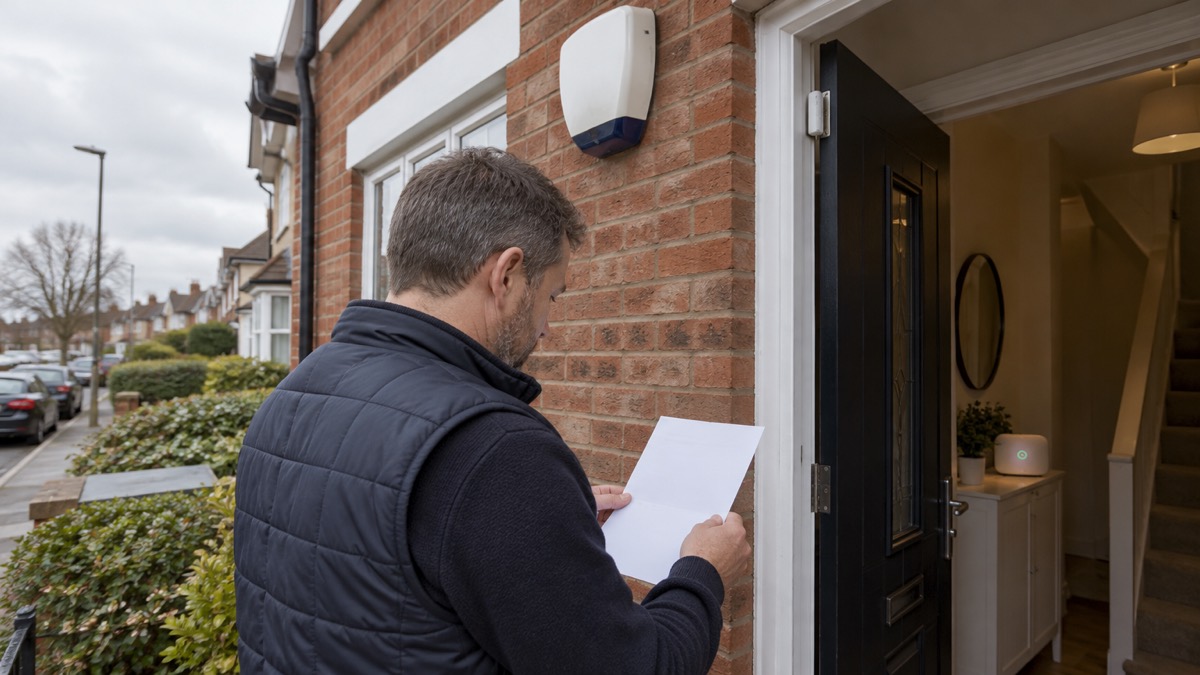
The Yale Sync Smart Home Alarm is a do-it-yourself wireless burglar alarm that you control from a keypad and a phone app. Yale describes the range as app-enabled, controllable remotely and fully customised to fit your lifestyle, with alerts and notifications sent to your phone if a device is triggered1. It is sold as a kit you fit yourself, and Yale says there are no subscriptions or monthly fees to worry about1.
For an ordinary household the appeal is straightforward: a siren that sounds at home, a notification on your phone, and no engineer visit. The trade-offs matter just as much. Alerts depend on your internet connection, the siren is loud but not silent, and the system is only as good as where you put the sensors. This page sets out what the kit contains, how loud it is, how far it reaches, what happens in a power cut, and how to fit and use it safely.
What the Yale Sync Smart Home Alarm does for your home
The Sync range is a wireless intruder alarm. Sensors talk to a hub by radio frequency rather than by cable, which is what makes a DIY fit possible: a wireless system uses radio signals to connect sensors, cameras and the control panel without hardwiring4. When a device is triggered, the siren sounds and the app sends an alert, so you are "always in the loop" in Yale's words1.
Yale positions the range around three ideas. The first is pre break-in detection, where you receive alerts before an intruder reaches your home, for example when an outer door contact opens1. The second is multi-property support: Yale says you can protect more than one home, which it suggests for keeping an eye on elderly parents or a rental property1. The third is integration with other smart home kit, covered below.
What it cannot do is guarantee a response. A self-monitored alarm tells you and your household; it does not summon anyone. If you want an alarm that contacts a monitoring centre, that is a different arrangement, and Yale notes that professional monitoring is available on subscription only1. Our guide to monitored alarms explains how receiving centres and keyholders work, and Monitored or Self-Monitored Alarm? sets the two side by side.
It also does not replace basic security. Locks, doors and windows do the physical work of keeping someone out; an alarm tells you when someone is trying. Our guides to doors and locks and windows cover the fabric of the building, and How Burglars Choose a Home explains what puts them off before they reach a sensor.
What comes in the 5 piece kit
The retail listing for the Yale Smart Alarm Core Kit sets out the box contents plainly. It is sold as a six-piece kit containing one alarm hub, one siren, one keypad, one motion detector and two door contacts, plus fixtures and fittings including all batteries, an Ethernet cable, a security sticker and a quick start guide5.
| Item | What it does for the household |
|---|---|
| Alarm hub | The brains of the system, connecting sensors to the app5 |
| Siren | The visual deterrent and audible alarm5 |
| Keypad | Arming and disarming without the phone5 |
| Motion detector | Picks up movement inside the home5 |
| Two door contacts | One for the front door and one for a second entry point5 |
| Fixtures, batteries, Ethernet cable, sticker, guide | Everything needed to fit and start up5 |
The listing describes the kit as a 5 piece kit4. The Ethernet cable matters: it is how the hub reaches your router, which is what allows app alerts to leave the house.
Before you buy, think about coverage. A motion detector and two door contacts will cover a hallway and a front and back door in a flat or a small house. A larger home, a house with a garage, or a property with outbuildings will need more sensors, which is where the accessory range comes in.
Sirens: 94dB inside, 104dB outside
Yale's comparison table gives siren figures across its alarm ranges: 100dB, 130dB, 104dB and up to 100dB1. The 104dB figure is the one attached to the Sync range in that table, and it is the outdoor siren. The internal siren is quieter: the Sync kit's tamper alarm is protected by a 94dB internal siren2.
For context, an independent review of a Yale bells-only kit recorded a 96dB alarm volume6. That is the order of magnitude you are dealing with: loud enough to be painful in a small hallway and to be heard by neighbours, not loud enough to be relied on as the only thing protecting your home.
A few practical points follow from the volume:
- Warn the household. A 104dB siren at close range is startling and can be painful for young children, pets and anyone with hearing sensitivity. Tell everyone when you plan to test it.
- Tell the neighbours. A siren that goes off while you are out will be heard. Neighbours who know you have an alarm are less likely to worry and more likely to look.
- Do not rely on sound alone. The app alert is what tells you; the siren is what tells everyone else.
If someone in the household is Deaf or has hearing difficulties, sound alone is not enough. The fire and rescue service advises making sure alarms are interlinked so that when one detects a fire they all go off together, giving the person early warning, and checking that amplified phones, flashing alerts, care alarms and pendant alarms will still function7. The same principle applies to a burglar alarm: pair it with visual alerts and a phone that vibrates or flashes.
Range and accessories: up to 40 devices within 200m
Yale's comparison table lists the number of accessories and the wireless range for each alarm range: N/A, up to 20, up to 40 and up to 100 accessories, with wireless ranges of 12m, 70m, 30m, 200m and 1,000m1. The Sync range sits at up to 40 accessories and a 200m wireless range2.
Those are generous figures for a domestic property. In practice, radio range is reduced by walls, especially thick or foil-backed ones, and by the position of the hub. Put the hub centrally and high, not in a metal cupboard or next to a microwave, and test each sensor from where it will actually sit before fixing it.
Accessories let you extend coverage:
- Door and window sensors for side doors, patio doors, garage doors and ground-floor windows.
- Additional motion detectors for landings, extensions and outbuildings.
- Additional keypads for a second entrance.
- Additional sirens where one is not audible throughout the house.
Yale says the Sync range works with Yale SensCheck Door and Window Sensors, which is the accessory line to look at if you want to extend1. For a wider view of what different alarm types do and who they suit, see our guide to burglar alarms.
When the power goes off: battery back-up for the siren
A burglar alarm that dies in a power cut is worse than useless, because power cuts are exactly when some intruders operate. The good news is that alarm systems are usually equipped with a battery backup, so they should work while the electricity is off9. The independent guidance from a network operator puts it plainly: burglar alarms are usually equipped with a battery backup, so should work while the electricity is off9.
How long that lasts depends on the battery. Independent technical guidance for alarm systems states that the back-up battery ensures the system remains operational for at least 12 hours in the event of a power outage, and that when power is restored the system starts working normally and recharges the battery2. The same guidance says installers change batteries after a defined period, around 3 or 4 years, to minimise the chance of failure2.
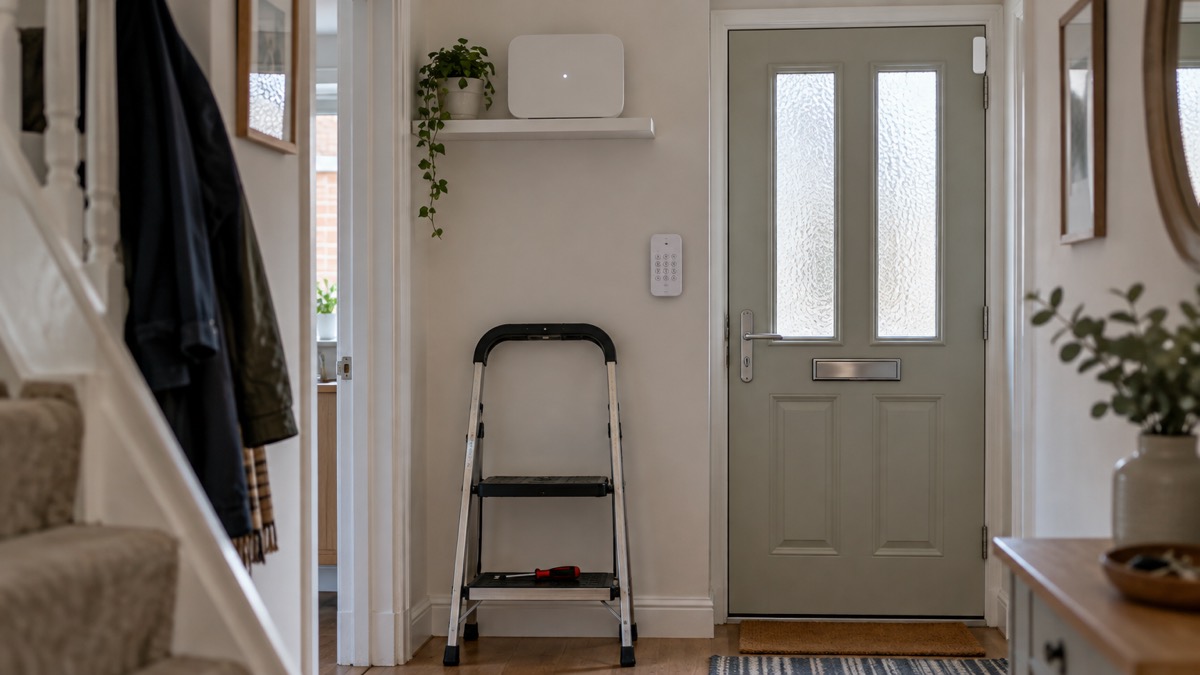
That last point is the one households miss. The siren may still work on battery, but the app alert needs your internet connection. If the router is off, the hub cannot send a notification. Our guide to keeping your home protected in a power cut covers the wider picture, and Will a Burglar Alarm Work After the Digital Switchover? explains what is changing for alarm signalling.
Two habits help. First, test the system after any power cut, because a battery that has been drained needs time to recharge. Second, note the date you fitted the kit and diarise a battery check every few years, in line with the 3 to 4 year guidance2.
Who should fit the mains-powered siren
The Sync kit is a DIY system, and Yale describes its smart alarm range as a DIY system fully integrated with other security devices and smart home tech1. Battery-powered sensors and a plug-in hub are within the reach of a careful householder. Mains wiring is not: Yale states that the mains-powered siren should be professionally installed2.
Fire and rescue services are consistent on this point. If you choose to have a mains-powered alarm, make sure it is installed by a qualified electrician3. Mains alarms need to be installed by a qualified electrician10, and mains-wired alarms must be fitted by a qualified electrician11. Where linked alarms are being fitted, the advice is to ask a qualified electrician12. Mains-powered alarms are powered by your home power supply and have a back-up battery in case of a power cut, and they need to be installed by a qualified electrician13.
For a bells-only intruder alarm, independent guidance says the system should always be fitted by a certificated installer to the relevant British Standards14. That is a higher bar than a plug-in kit, and it is the right one if you are having anything wired into the fabric of the house.
If you are unsure whether an installer is properly accredited, our guide to checking an alarm installer is approved sets out what to look for. For siren placement, Where to Fit an Outdoor Alarm Siren covers height and visibility.
Arming, part arming and alerts from the Yale Alarm app
The Sync range is controlled two ways: a keypad and the app. Yale describes the range as app-enabled and controllable remotely, fully customised to fit your lifestyle1. Alerts arrive as notifications on your phone when a device is triggered1.
A sensible routine looks like this:
- Arm before you leave or go to bed. Use the keypad or the app. Independent guidance on wireless systems says to use the app or control panel to arm the system4.
- Use part arming at night. Arm the perimeter contacts and leave the internal motion detector off so you can move around the house.
- Check the app after arming. Confirm the system reports as armed, not just that the command was sent.
- Respond to alerts calmly. An alert means a sensor was triggered, not that someone is inside. Check a camera or ask a neighbour before you act.
- Disarm on return. Use the keypad or app, and check the event log for anything unexpected.
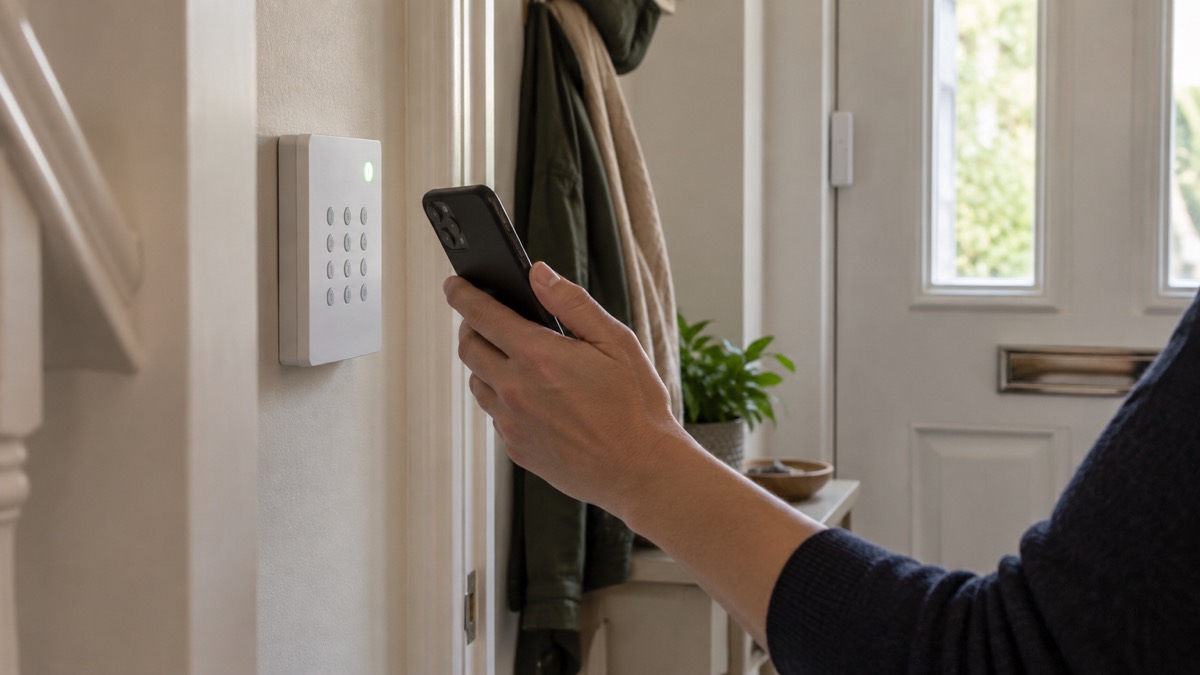
Part arming is the feature most households use most. It lets the door contacts guard the perimeter overnight while the landing sensor stays quiet, which avoids false alarms from trips to the bathroom.
Two limits are worth knowing. First, the app depends on your internet connection, so a broadband outage silences the alerts even though the siren still works. Our guide to alarms and cameras on a weak mobile signal or slow broadband covers what to do about that. Second, an alert is only useful if someone acts on it. If you are away and cannot respond, a neighbour or keyholder needs to know.
Working with SensCheck sensors, voice assistants and Philips Hue
Yale says the Sync range works with Yale SensCheck Door and Window Sensors and connects smoothly with Alexa, Google Home and Philips Hue1. That makes the alarm part of a wider smart home rather than a standalone box.
What each integration does for you:
- SensCheck door and window sensors extend the alarm's coverage to more openings, and Yale has continued to expand the SensCheck range15.
- Alexa and Google Home let you arm or check status by voice, which helps when your hands are full or the keypad is across the room.
- Philips Hue lets lighting respond alongside the alarm, so lights can come on when something is triggered.
If you are building a smart home, think about how the pieces fit. Our guide to smart locks explains how locks and alarms can work together, and Do Smart Locks Work in a Power Cut? covers what happens when the power fails. For cameras, Burglar Alarm or CCTV Camera: Which Suits Your Home? helps you decide where to spend first.
Support, guarantees and what to check before you buy
Yale is an old firm: the company says it has been protecting UK homes for over 185 years, since 1840, and that its UK based team are on hand to help16. That matters for a product you will live with for years.
Before you buy, check these points:
- Safety marks. Fire and rescue services advise making sure any alarms you buy are marked with a current British Standards or European (CE) safety mark, which shows they are approved, tested and safe17. The same advice applies to electrical goods bought as gifts: check they come from reputable sellers with CE or UKCA marks visible20.
- What the guarantee covers. Ask the retailer for the written terms. The material available here does not describe a Yale Total Trust Guarantee, so read the terms yourself rather than relying on the name.
- The EAN code. The barcode is not given here; check the box against the retailer's listing before you buy5.
- Support route. Contact Yale through its website, and keep your receipt and the quick start guide16.
For the wider context on alarms and how they fit with insurance conditions, see Home Insurance Conditions: Locks, Alarms and Unoccupancy. If you are weighing up whether an alarm is the right first purchase, Burglar Alarms: Types and How to Choose One sets out the options, and Home Security: A Household Guide is the place to start.
Sources (20)
- Alarms: which is right for me, Yale, 2026-11-02
- My alarm system has a back-up power battery: what is the life of the battery, NSI, 2019-02-05
- Smoke alarms and heat alarms, London Fire Brigade, 2026-10-25
- How to install a wireless burglar alarm system, Verisure, 2026-10-27
- Smart Alarm Starter Kit, Yale, 2026-11-03
- Best burglar alarms and smart security systems, Which?, 2021-09
- Alarms, London Fire Brigade, 2026-10-25
- Your landline is going digital: here's how to stay connected, RNID, 2025-11-03
- Planned interruptions leaflet, SP Energy Networks, 2023
- Smoke alarms, Staffordshire Fire and Rescue Service, 2026-10-29
- Fire and smoke alarms in Scottish homes: where and what to buy, Scottish Government, 2024-08-14
- Fire safety for people with hearing difficulties, Devon and Somerset Fire and Rescue Service, 2026
- Fire safety in the home, Suffolk County Council, 2021-11
- Protecting your home: alarm systems, SSAIB, 2026-11-02
- Yale Expands Smart Security with SensCheck™- Compatible Door and Window Locks, introducing a New Keep Mounted Sensor | Yale, Yale (www.yaledws.co.uk)
- Yale UK, Yale, 2026-11-02
- Alarms and sprinklers, Warwickshire County Council, 2026-10-29
- Detectors, Surrey County Council, 2026-10-28
- Smoke alarms, Devon and Somerset Fire and Rescue Service, 2026
- Councils and fire chiefs issue reminder on home fire safety ahead of festive season, NFCC, 2024-12-21

 Ring Alarm 2nd Gen