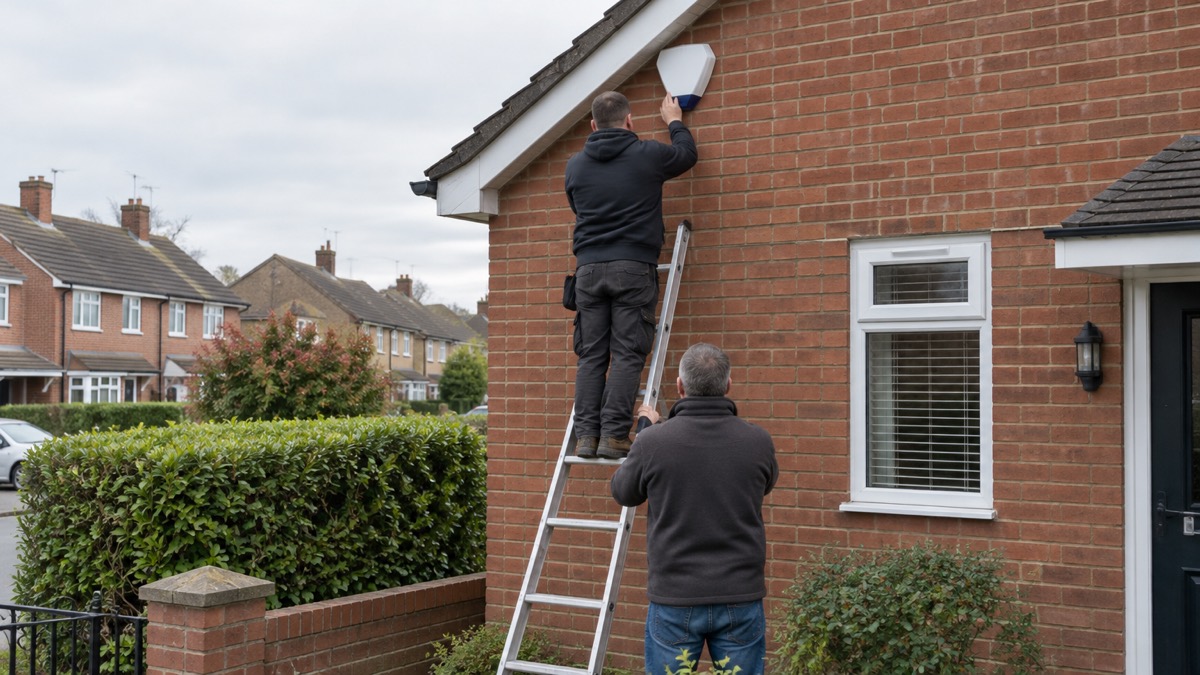
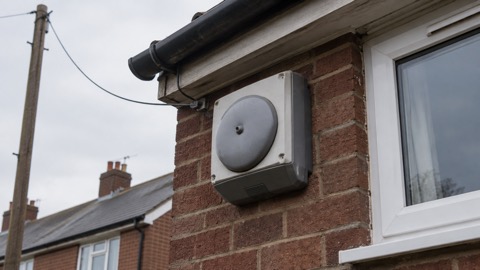
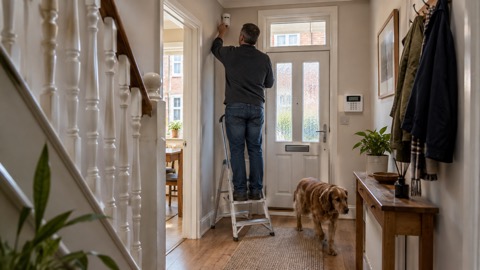
If you are fitting an outdoor alarm siren yourself, the height is the first decision and the one most makers agree on. Ajax recommends 2.5 metres or more for its outdoor and indoor sirens alike1. Bosch puts the reason plainly: the siren should be at a sufficient height to protect it from tampering attempts4. High enough to be heard over a fence, high enough that nobody can reach it from a wheelie bin.
The second decision is whether the unit is built for an outside wall at all. Some sirens are outdoor devices with their own weatherproofing and their own volume; others are indoor-only and must never go outside, however sheltered the spot looks5. Getting that wrong is the mistake that matters most, because an indoor siren on a garden wall will not last and may not be covered.
This page takes the fitting in order: the height, the choice of unit, the places an indoor siren must never go, the awkward spots under eaves and in outbuildings, running two sirens, and how to check the job once it is up. It is about the siren itself. For the wider system it belongs to, see Burglar Alarms: Types and How to Choose One.
Why 2.5 metres is the figure to aim for
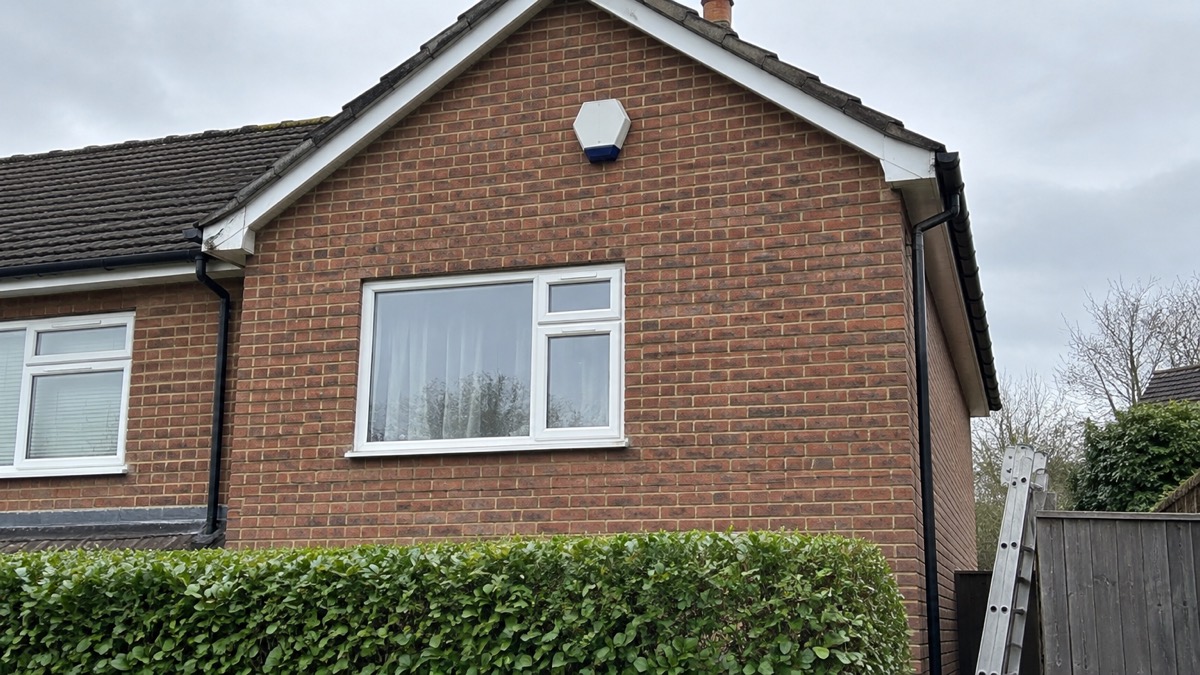
The 2.5 metre figure comes up again and again across makers, which is a good sign it is a practical rule rather than a marketing one. Ajax gives it for the Superior HomeSiren Fibra, for the StreetSiren Jeweller and for the HomeSiren Jeweller, in each case as a recommended installation height of 2.5 metres or more1. The same maker's datasheets put it in imperial units as 8.2 feet and higher5.
Two things drive it. The first is reach. A siren at head height can be knocked off a wall, covered or pulled down by anyone who can stand next to it. Bosch's support guidance says the siren should be at a sufficient height to protect it from tampering attempts, which is the same idea in fewer words4. The second is sound. A siren mounted high clears hedges, fences, bins and parked cars, so the noise travels rather than being absorbed at ground level.
Height is not the only placement rule, though, and the manuals are specific about what else to avoid. Do not install near metal objects and mirrors, because they can interfere with the radio signal and cause it to fade; do not install where the sound can be muffled; and do not install closer than 1 metre from the hub2. The Superior HomeSiren Fibra adds one more: keep it away from glass break detectors, because a nearby siren can cause the glass break detector to raise false alarms1.
If you are weighing up where the siren fits into the rest of your defences, How Burglars Choose a Home and What Puts Them Off sets out what actually deters an intruder, and Should a Burglar Alarm Bell Box Be Visible? covers the related question of whether the box on the wall should be seen at all.
Outdoor or indoor siren: which models are built for outside walls
The single most useful distinction when you are buying is between a siren designed for an outside wall and one designed for a hallway. They look similar in a photograph and behave very differently in the rain.
Outdoor units are built and rated for the job. The Ajax StreetSiren Jeweller is described by its maker as a wireless outdoor alerting device with a sound volume of up to 113 dB2. The Ring Alarm Outdoor Siren is made to mount to flat walls and gives over 100 dB at 1 metre, adjustable9. Bosch's outdoor siren raises the alarm with up to a 100 dB siren, measured at 1 metre10. These are the units to put on a gable end or above a back door.
Indoor units are a different product. The Ajax HomeSiren Jeweller offers four volume levels, muted, quiet at 80 dB, loud at 93 dB and very loud at 100 dB, all measured 1 metre from the siren3. The Superior HomeSiren Fibra gives an alarm volume from 81 to 105 dB at a distance of 3.3 feet5. Both are excellent at filling a house with noise. Neither is meant for a garden wall.
| What you are fitting | What to look for | Examples from makers' own descriptions |
|---|---|---|
| Outside wall, gable or porch | Rated for outdoor use, weatherproof housing, high volume | StreetSiren Jeweller, up to 113 dB2; Ring Alarm Outdoor Siren, over 100 dB at 1 metre9; Bosch Smart Home Outdoor Siren, 100 dB at 1 metre10 |
| Hallway, landing or living room | Indoor use only, several volume levels, mains or battery | HomeSiren Jeweller, 80 to 100 dB at 1 metre3; Superior HomeSiren Fibra, 81 to 105 dB at 3.3 feet5 |
| Either, as a second sounder | Compatible with your system, placed to cover a blind spot | SimpliSafe Extra 105dB Siren, placed inside or outside the house11 |
Some systems take a different approach altogether. ADT says it places its siren inside the home rather than outside, to disorientate intruders, and that an external sounding bell box can be added on request12. That is a legitimate design choice, not a shortcut: an indoor siren that is loud and central can be more unsettling to an intruder than a box on the wall. If you are choosing between the two approaches, Monitored or Self-Monitored Alarm? explains who responds and when.
One practical warning before you buy: a mains-powered siren is not a DIY job. Yale states that its mains-powered siren should be professionally installed13. If the unit you are considering needs a mains feed, plan for an electrician rather than a Saturday morning with a drill.
Where an indoor-only siren must never go
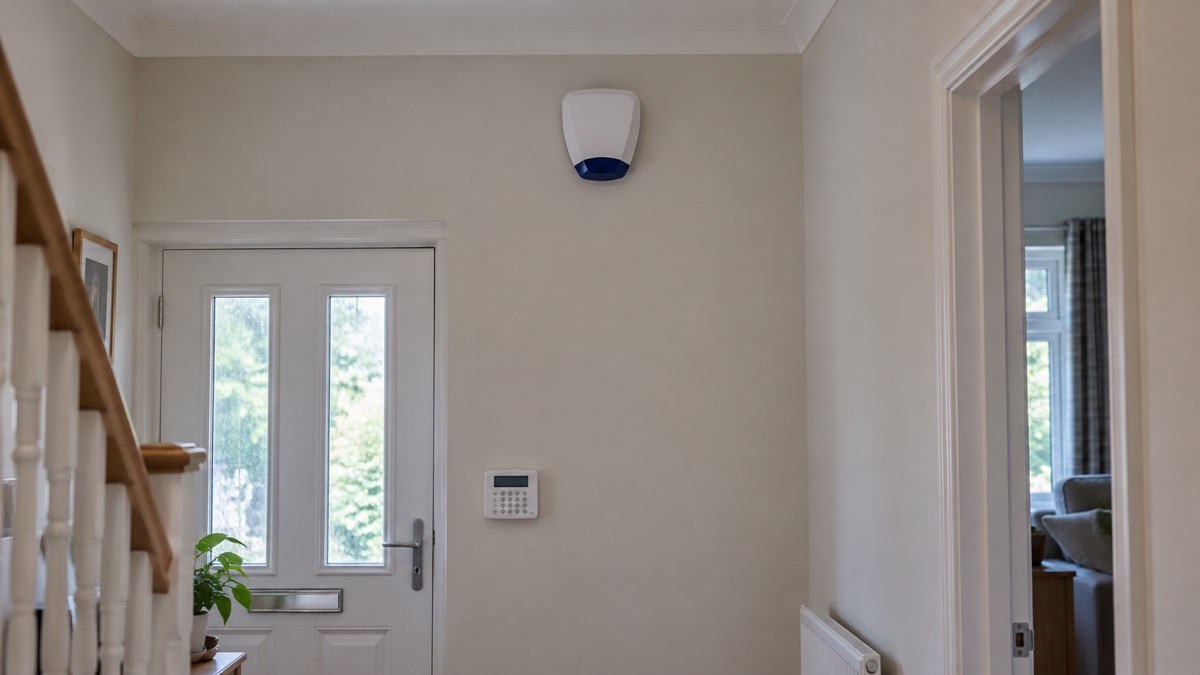
The manuals are unusually blunt on this point, and it is worth quoting the shape of the instruction rather than paraphrasing it away. The Superior HomeSiren Fibra datasheet says the siren is designed for indoor use only5. The Superior HomeSiren G3 Jeweller says the same6. The HomeSiren Plus Jeweller says the device is designed for indoor use only7. Three products, one rule.
The HomeSiren Jeweller manual goes further and lists where not to install it: outdoors; where the acoustic signal will be attenuated; nearby metal objects or mirrors; premises with temperature and humidity beyond permissible limits; and closer than 1 metre from the hub3. The StreetSiren Jeweller manual repeats the metal, mirror, muffling and 1 metre rules for the outdoor unit2. The Superior HomeSiren Fibra manual adds unstable or low signal strength and proximity to glass break detectors to the list1.
The 1 metre rule deserves a note of its own. The HomeSiren U Jeweller manual says do not install closer than 1 metre from the hub or radio signal range extender, because this can lead to a loss of communication with the siren8. It sounds trivial, a metre is less than a stride, but a siren mounted right beside the control panel is exactly the mistake people make when the panel is in the hall and the siren is going on the hall wall.
There is a mirror-image rule for the sensors themselves. The GlassProtect manual tells you not to install the detector nearby sirens and speakers, among a longer list of places to avoid14. If you are placing both, keep them apart.
Indoor sirens: mount at 8.2 ft (2.5 m) or higher
The 2.5 metre rule is not only for outdoor units. The same makers give the same figure for indoor sirens, expressed in feet on the datasheets: the Superior HomeSiren Fibra recommends 8.2 ft and higher5, the Superior HomeSiren G3 Jeweller recommends 8.2 ft or higher6, the HomeSiren Plus Jeweller recommends 8.2 ft or higher7, and the HomeSiren U Jeweller manual gives 2.5 metres and more8.
Why so high indoors? A siren at 2.5 metres on a landing is above the door frames and above the reach of anyone standing on the floor. It also puts the sound source near the ceiling, where it can travel along the landing and into the bedrooms rather than being blocked by furniture. The HomeSiren Jeweller manual adds a signal instruction that matters as much as the height: install the siren in places with a signal strength of 2 to 3 bars3.
For comparison, other devices in a typical system sit much lower, and it helps to know the difference so you do not apply the siren rule to everything:
- Motion detectors outdoors are placed 0.8 to 1.3 metres above ground level, or 1 metre for effective pet immunity15.
- The Superior MotionProtect Fibra is installed at a height of 2.4 metres without obstruction to its view16.
- The Curtain Outdoor Jeweller is recommended at 7.9 ft, or 3.3 ft when pet immune mode is enabled17.
- The Curtain Outdoor Mini Jeweller goes at 3.3 ft on a side surface or up to 16.4 ft on the ceiling18.
- A battery video doorbell is best at around four feet, 1.2 metres, to the bottom of the unit19.
- The SpeakerPhone Jeweller is recommended at 5.2 ft20.
The pattern is that sensors look outward and sit at the height of what they are watching, while sirens are heard and sit high. If you are fitting a mix of devices, Which Alarm Sensors Are Safe to Use with Pets? explains why the pet-immune heights differ.
Fitting under eaves or porches
A porch roof or a deep eaves overhang is the obvious place for an outdoor siren: sheltered from the worst of the weather, out of the direct line of a ladder, and usually high. It is a good choice, with conditions.
The first condition is that the fixing point is still at least 2.5 metres above the ground. An eaves line over a single-storey extension may be lower than you think once you measure from the ground rather than from the gutter. Measure to the intended fixing point, not to the roof.
The second is that the siren is not boxed in. A siren tucked into a narrow porch with walls on three sides will be muffled, and the manuals tell you not to install where the sound can be muffled2. A porch open on two sides is fine; a closed porch is not much better than a cupboard.
The third is the surface. The Ring Alarm Outdoor Siren is made to mount to flat walls9, so a flat fascia or render is straightforward while a curved or uneven surface needs a mounting plate. The fourth is the signal. Metal gutters, downpipes and foil-backed insulation can all interfere, and the manuals warn against metal objects and mirrors for exactly this reason2. If the signal at the eaves is weak, the maker's advice is to move the siren: even a 20 cm shift can significantly improve the quality of signal reception2.
For the wider question of what goes on the outside of a house and where, Outdoor Lights That Deter Burglars: Types and Placement covers the same ground for lighting, and Video Doorbells: What They Do and How to Choose One covers the door.
Sirens in garages, sheds and outbuildings
An outbuilding is the awkward case. It is not the house, so an indoor-only siren cannot go there, because the makers state those units are for indoor use only and list outdoors among the places not to install them3. A detached garage or a garden shed is outdoors for this purpose, however dry it stays.
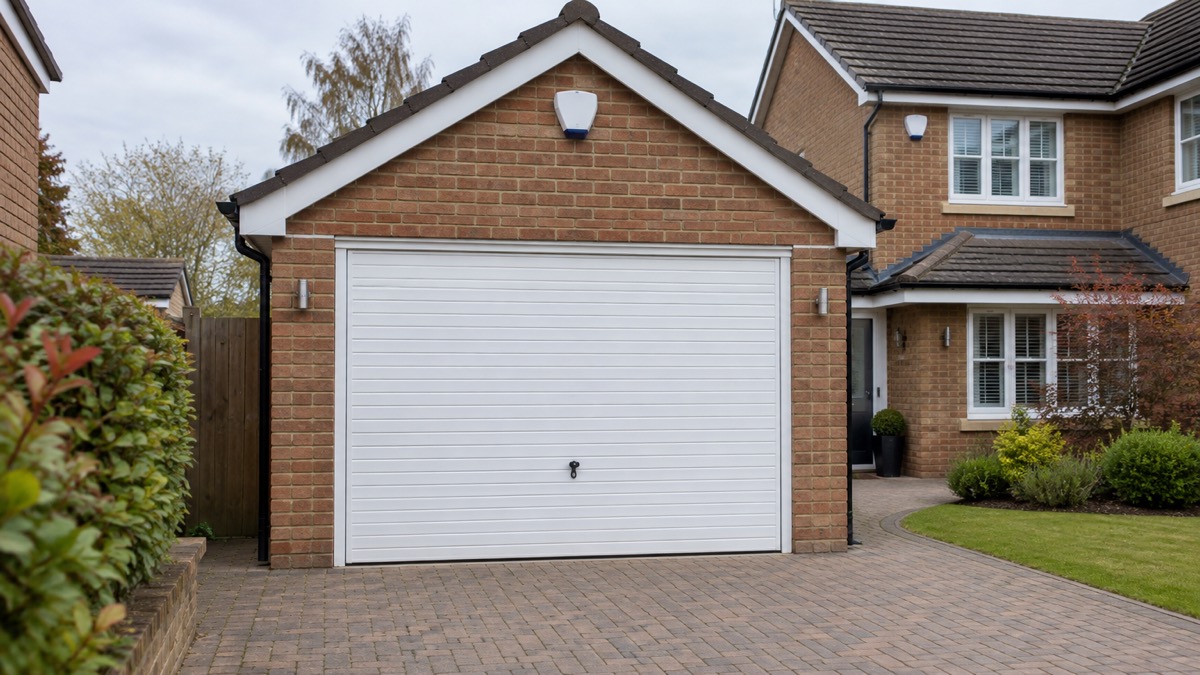
The practical answer is a unit rated for the job, or a separate simple alarm for the outbuilding. Yale describes a simple solution to protect your shed, garage or caravan, with a siren triggered when movement is detected22. That is a different product from the house alarm, and for many households it is the sensible way to cover an outbuilding without running cable or stretching the range of the main system.
If you do fit a siren in a garage or shed, the same placement rules apply as outside the house. Mount it high, keep it away from metal objects and mirrors, and check the signal before you commit. A metal shed is close to a Faraday cage, and the manuals warn that metal interferes with the radio signal2. If the outbuilding is at the far end of a long garden, the range may simply not reach, and a separate alarm is the better answer.
There is a related point about what is visible from the street. Northern Ireland's official guidance on securing your home says hedges, shrubs and walls in the front garden should be no higher than one metre or three feet, to avoid giving a burglar a screen to hide behind23. The same logic applies to a siren: a unit hidden behind a tall hedge is harder to see and its sound is softened. For more on outbuildings and boundaries, see Terraced Houses and Rear Alleys: Gates, Gardens and Back Doors and Rural and Remote Homes: Crime Risks and Slower Response.
Using two sirens together
Two sirens are better than one when the house is large, when there is a long garden, or when one siren would be inaudible from the bedrooms. Most systems allow more than one sounder, and the makers' guidance is mostly about range and spacing.
The spacing rule is the 1 metre minimum from the hub, repeated across the Ajax manuals: do not install closer than 1 metre from the hub or radio signal range extender, because this can lead to a loss of communication with the siren8. Two sirens both crammed beside the control panel is the arrangement to avoid.
The range rule is the one that catches people out. Bosch says the range between the Smart Home Controller and the Outdoor Siren can be extended by placing a Compact Smart Plug halfway between the Controller and the Outdoor Siren4. That is a neat trick: a mains device in the middle of the house acts as a stepping stone for the signal. Ajax's HomeSiren Plus Jeweller quotes a radio communication range up to 6,550 ft7, which is generous on paper and shorter in a house full of brick walls.
A sensible arrangement for a typical semi is one siren high on the front elevation and one high at the back, each at least 2.5 metres up, each at least 1 metre from the hub, and each checked for signal at its own position. If the back siren is weak, move it before you drill: the maker's advice is that even a 20 cm shift can significantly improve reception2. For systems that struggle with signal generally, Alarms and Cameras on a Weak Mobile Signal or Slow Broadband is the place to start.
Checking a siren after fitting
The job is not finished when the last screw goes in. A siren that is high, dry and well placed but silent is worse than no siren, because you will assume it works.
Work through these checks in order:
- Signal strength. Confirm 2 to 3 bars at the siren's position, as the HomeSiren Jeweller manual recommends3. If it is lower, move the unit slightly and recheck before making new holes.
- Audibility from outside. Trigger a test and listen from the far end of the garden and from the pavement. A siren that cannot be heard over the fence is not doing its job.
- Audibility from inside. Trigger a test with the doors closed and listen from the furthest bedroom. This is the check that tells you whether a second siren is needed.
- Volume setting. If the unit has adjustable volume, confirm it is set where you want it. The Ring Alarm Outdoor Siren is adjustable and gives over 100 dB at 1 metre9; the HomeSiren Jeweller has four levels from muted to very loud at 100 dB3.
- Fixings and weather. Check the unit is secure and that water cannot run into it. A siren that works in October may not work in February.
- The rest of the system. Test the sensors and the panel at the same time, so you know the whole chain works, not just the sounder.
For context on how loud a siren needs to be, European fire safety standards call for a notification of at least 85 dB at a distance of three metres from the sound source24. Domestic smoke alarms sit around 75 to 85 dB depending on the model25. A burglar alarm siren is deliberately louder than either, which is why the makers quote figures over 100 dB at 1 metre9.
If the siren is part of a monitored system, tell your monitoring company when you are testing so a genuine alarm is not mistaken for a fault. How Police Respond to Burglaries and Intruder Alarms explains how a response is triggered and what the monitoring centre does with it, and How Many False Alarms Before Police Stop Responding? covers why a badly placed siren that triggers in the wind is a problem worth fixing early.
Sources (25)
- Superior HomeSiren Fibra manual, Ajax Systems, 2026-06-04
- StreetSiren Jeweller manual, Ajax Systems, 2026-10-12
- HomeSiren Jeweller manual, Ajax Systems, 2026-07-28
- Outdoor Siren help, Bosch Smart Home, 2026-11-02
- Superior HomeSiren Fibra specifications, Ajax Systems, 2026-11-02
- Superior HomeSiren G3 Jeweller specifications, Ajax Systems, 2026-11-02
- HomeSiren Plus Jeweller specifications, Ajax Systems, 2026-11-02
- HomeSiren U Jeweller manual, Ajax Systems, 2026-06-04
- Ring Alarm Outdoor Siren, Ring, 2026-11-03
- Bosch Smart Home products overview, Bosch Smart Home, 2026-11-03
- SimpliSafe Home Security System Tower, SimpliSafe, 2026
- Smart burglar alarm systems, ADT, 2026-11-03
- Yale Sync Smart Home Alarm, Yale, 2026-11-03
- GlassProtect manual, Ajax Systems, 2025-12-30
- MotionProtect Outdoor Jeweller manual, Ajax Systems, 2026-06-08
- Superior MotionProtect Fibra manual, Ajax Systems, 2026-06-11
- Curtain Outdoor Jeweller specifications, Ajax Systems, 2026-11-02
- Curtain Outdoor Mini Jeweller manual, Ajax Systems, 2026-07-30
- How to buy the best smart video doorbell, Which?, 2026-10-16
- SpeakerPhone Jeweller specifications, Ajax Systems, 2026-11-02
- Safety at home, SSEN, 2026-10-25
- Alarms: which is right for me?, Yale, 2026-11-03
- Securing your home, nidirect, 2024-01-23
- What is interconnected fire alarms?, Ajax Systems, 2026-05-05
- How often should fire alarms be tested?, Verisure, 2026
 Moving Home Locks Checklist
 After a Break-In Checklist
 Holiday Security Checklist
 Alarm Before Going Away
 False Alarms and Police Response
 Checking an Alarm Installer
 Should a Burglar Alarm Bell Box Be Visible?
 Alarms After Digital Switchover
 Alarm Sensors and Pets