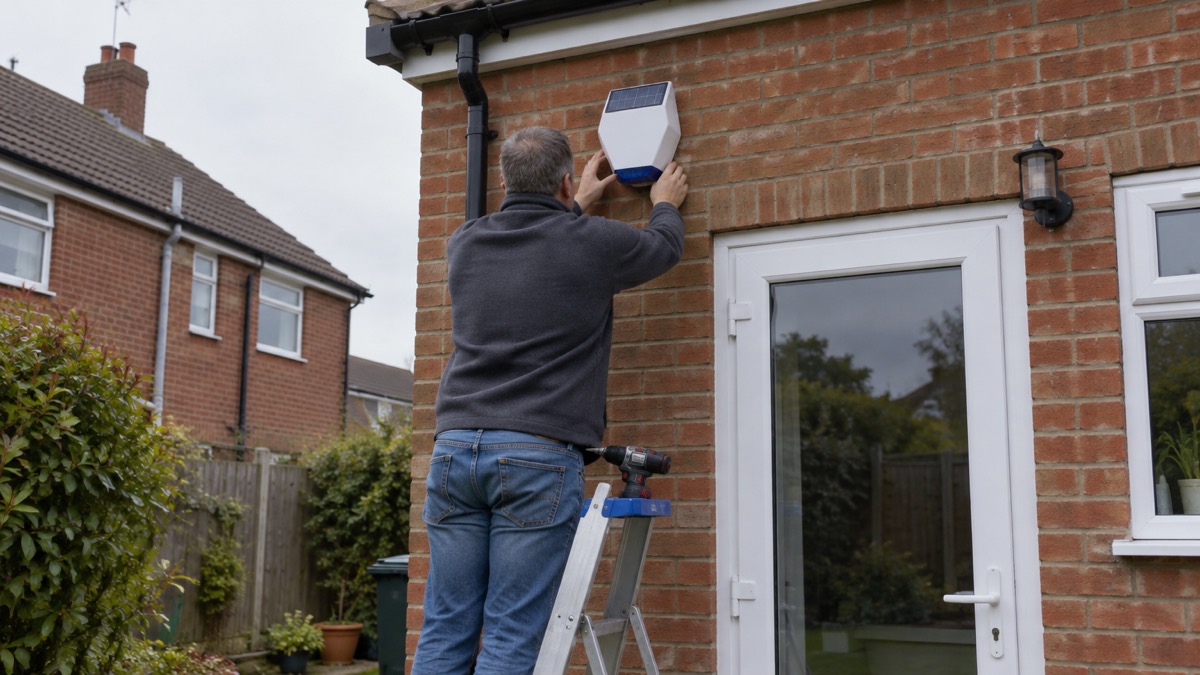
The Bosch Smart Home Outdoor Siren is an outdoor alarm sounder and flashing light that can be run from its own solar panel and backup battery, from a low voltage supply of 5 to 28V, or from a 230V mains supply1. It sounds at 100dB measured at one metre and flashes red across a 180° field so that people nearby can see as well as hear that something is wrong1. Bosch gives its dimensions as 249 x 79 x 160mm and its protection class as IP55, meaning it is protected against water from all angles1.
What you do with it depends on what you already have. If you have a Bosch Smart Home Controller II, the siren pairs to it over ZigBee 3.0 and can send push notifications to your smartphone in the event of a break-in1. If you have an existing wired alarm system, the siren can replace an existing outdoor sounder without a Controller, but only qualified personnel may work on an existing burglar alarm system, and Bosch states that its own installation service cannot be carried out on existing alarm systems1. Work involving voltages of 50V and above is also reserved for qualified personnel1.
Before you buy, check two things: whether your wall gets enough daylight for the solar panel, and whether the siren will be silent by default in the mode it ships in. Bosch states that in the delivery state the siren is set to Smart mode, in which no alarm tone is triggered without the Controller if the siren is tampered with1. Pairing it, or setting it to Legacy for a classic alarm, is what makes it sound.
What the siren does, and what it adds to a house
The siren is a sounder and a light, not a sensor. It draws attention with a volume of 100dB measured at one metre, and the optical flash light provides a 180° visible alarm in case of burglary1. Bosch describes the purpose plainly: it flashes red to alert bystanders to a suspected break-in1. That combination matters because an alarm heard indoors is easy to ignore from the street, while a light on the wall tells a passer-by, a neighbour or a patrol car which house is signalling.
It also has a tamper response. In case of sabotage and theft, Bosch states you will be notified immediately via the Bosch Smart Home App, and the Outdoor siren will automatically trigger and draw attention to itself acoustically1. The unit carries a tear-off contact, and the maker's indicator guide says flashing red three times every 15 seconds means the tear-off contact has been triggered, either by tampering or by incorrect adjustment of the contact1. If you see that pattern, read the app before assuming someone has interfered with the unit.
Where the siren fits in a wider plan is worth thinking through before you buy. A sounder on the outside wall is one layer among several, and the pages on burglar alarms and on where to fit an outdoor alarm siren set out the alternatives and the siting questions. If you are weighing an alarm against cameras, burglar alarm or CCTV camera compares what each does for a household. The siren is made by Bosch, and its own instructions are the authority for everything below.
Power supply options: solar, low voltage or 230V
There are three ways to feed the siren, and the choice decides where it can go and what installation involves1.
| Supply | What it means in practice | What to weigh |
|---|---|---|
| Integrated solar panel and backup battery | No cable to the unit; the panel keeps the battery topped up | Needs daylight; winter sun at high latitude may not be enough1 |
| Low voltage, 5 to 28V | Fed from a low voltage source | Still a wired installation, so plan the cable route1 |
| 230V mains | Fed from the mains supply | Work at 50V and above is for qualified personnel only1 |
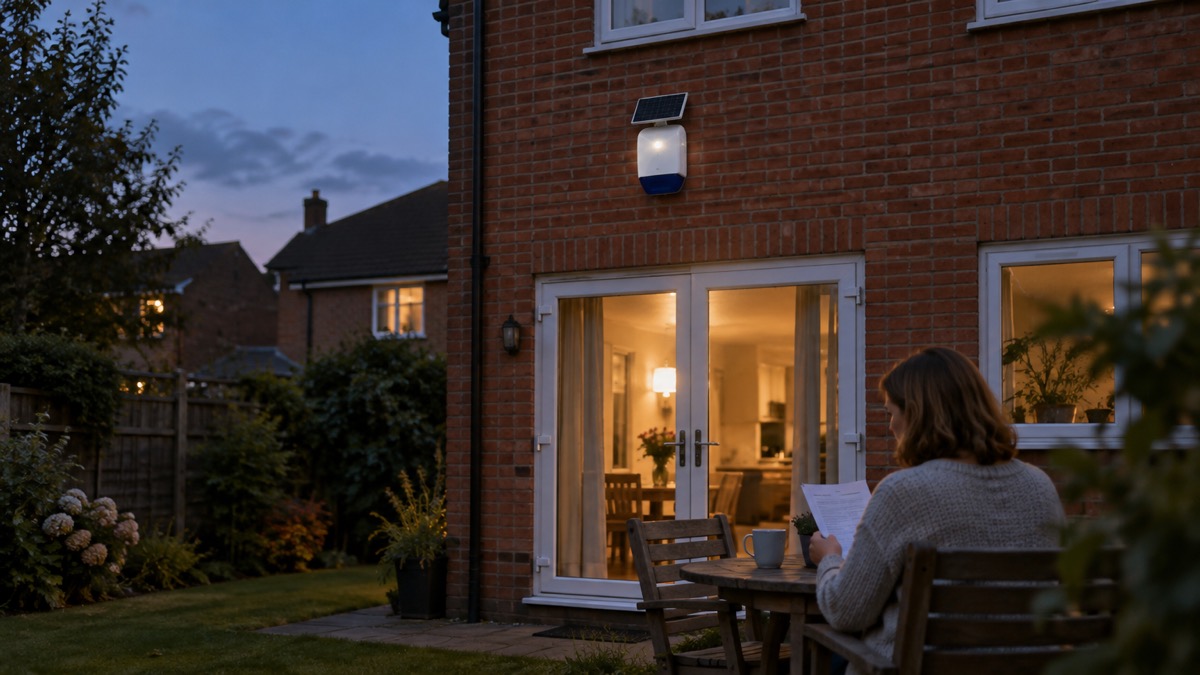
The solar option is the one most households will want, because it avoids running a cable to a wall that may be far from any supply. Bosch states that the integrated battery ensures reliable operation even during overcast periods or low sunlight, and describes the panel as a very high-quality and durable unit with a glass cover that does not require maintenance1. That covers dull weeks. It does not cover a whole winter at high latitude, which is the limitation below.
If you are used to thinking about solar in other settings, the principle is the same one the Caravan Club sets out for panels on caravans and motorhomes: the power generated by a solar panel is direct current, so an inverter is needed to convert it to alternating current for anything that uses a three-pin 230V socket2. The siren avoids that step entirely by running on low voltage and its own battery, which is why it can be a self-contained unit on a wall.
Using it with or without the Bosch Smart Home Controller II
The siren can be used without the Bosch Smart Home Controller II by replacing an existing outdoor siren; with the Controller II you get push notifications to your smartphone in the event of a break-in and additional smart features1. Those are two quite different products wearing the same box, and it is worth being clear which one you are buying.
With the Controller, the siren communicates over ZigBee 3.01. That is a low-power radio link, and like any radio link it has a working distance and it dislikes thick walls. Bosch's answer is simple: the range between the Smart Home Controller and the Outdoor Siren can be extended by placing a Compact Smart Plug halfway between the Controller and the Outdoor Siren1. Put the plug in a socket roughly midway along the path, and the signal has a stepping stone rather than one long jump. If your broadband or mobile signal is already poor, the page on alarms and cameras on a weak mobile signal or slow broadband covers what that means for app alerts.
Without the Controller, the siren works as a replacement sounder on a conventional alarm. Bosch is explicit that the installation cannot be carried out on existing alarm systems by its own service, and that only qualified personnel with appropriate training may work on non-smart alarm systems1. In practice that means an alarm company or an electrician, not a DIY afternoon.
Where to mount it so the solar panel stays charged
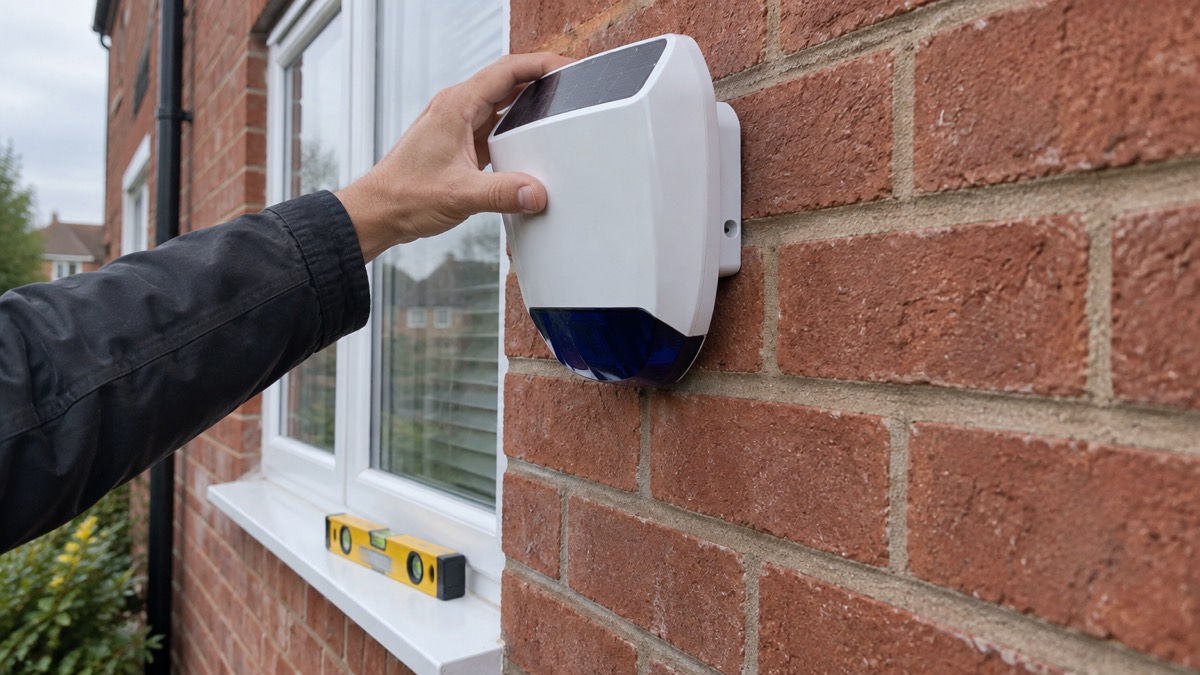
Bosch's instruction is to choose a mounting location with sufficient daylight if you want to operate the siren with the solar panel, and it names south, west or east orientation as particularly suitable1. A north-facing wall is the wrong wall. So is the shaded side of a building, or a spot under a deep eaves overhang where the panel never sees direct sun.
The maker then gives a latitude limit that matters in Britain. Bosch states that in Northern Europe above 55° latitude it may be necessary to operate the siren with a permanent power supply, as the duration of winter sunlight may not be sufficient to charge the battery via the solar panel1. Much of Scotland, the whole of Northern Ireland and the far north of England lie above that line. If you are in those areas, plan for a wired supply from the outset rather than discovering in January that the battery is flat.
Weather is the other half of siting. The Met Office's winter picture is one of sharp overnight frosts and wintry showers in northern areas, with the coldest conditions concentrated where the northerly wind bites4. Its warning guidance for wind asks households to check for loose items outside the home and plan how to secure them, naming bins, garden furniture, trampolines, tents, sheds and fences6. A siren on a wall is exposed to exactly that weather, which is why the IP55 rating matters: it is protected against water from all angles1. For comparison, Electrical Safety First asks for an outdoor socket to be rated IP44 or preferably higher, and IP55 or IP66 if it is likely to be subjected to water jets7. The siren's rating sits comfortably in that band for a normal wall.
Who must install it: 230V work and existing alarm systems
Two jobs on this product are not household jobs, and Bosch says so directly. Work involving voltages of 50V and above and work on existing burglar alarm systems may only be carried out by qualified personnel1. The maker also states that an installation service can be commissioned, but that installation cannot be carried out on existing alarm systems1.
That leaves a clear split:
- Solar or low voltage, new installation, no existing alarm: the householder can mount and set up the unit following the maker's instructions.
- 230V supply: qualified personnel only, because it is above the 50V threshold1.
- Replacing a sounder on an existing alarm system: qualified personnel only1.
This is the same principle that runs through fire safety advice for the home. The Scottish Government states that mains-wired alarms must be fitted by a qualified electrician8, Staffordshire Fire and Rescue Service says mains alarms need to be installed by a qualified electrician9, and Dorset and Wiltshire Fire and Rescue Service advises asking a qualified electrician to fit linked alarms10. If you are having alarm work done anyway, the Police Service of Northern Ireland recommends using a contractor affiliated to one of the recognised alarm inspectorate bodies, such as the NSI or SSAIB11. The page on how to check an alarm installer is approved walks through that check.
Setting volume, alarm duration and the visual alarm in the app
Once the siren is paired, three settings decide how it behaves, and all three live in the Bosch Smart Home App under Management, then Devices, then Outdoor Siren1.
- Volume: adjustable in the app; without a Controller, adjust it using the DIP switches1.
- Alarm duration: adjustable in the app; without a Controller, adjust it using the DIP switches1.
- Visual alarm: to trigger a flash on intrusion, go to Services, then Alarm System, select the profile such as Full Protection, and in the Intrusion Alarm section select Visual Alarm and tick the box for the outdoor siren1.
The visual alarm setting is the one people miss. The siren will sound without it, but the 180° red flash that alerts bystanders is switched on through the alarm system profile, not by the siren alone1. If your reason for buying an outdoor sounder was that neighbours and passers-by would see it, check that box.
The primary power supply can also be adjusted in the app, under Management, then Devices, then Outdoor Siren1. When operating the Outdoor Siren with the Bosch Smart Home Controller and 230V as the primary power supply, DIP switch 7 must be set to OFF1. Getting this setting wrong is one route to the red flash every 4 seconds that signals a failed primary supply1.
Battery checks, charging and replacement
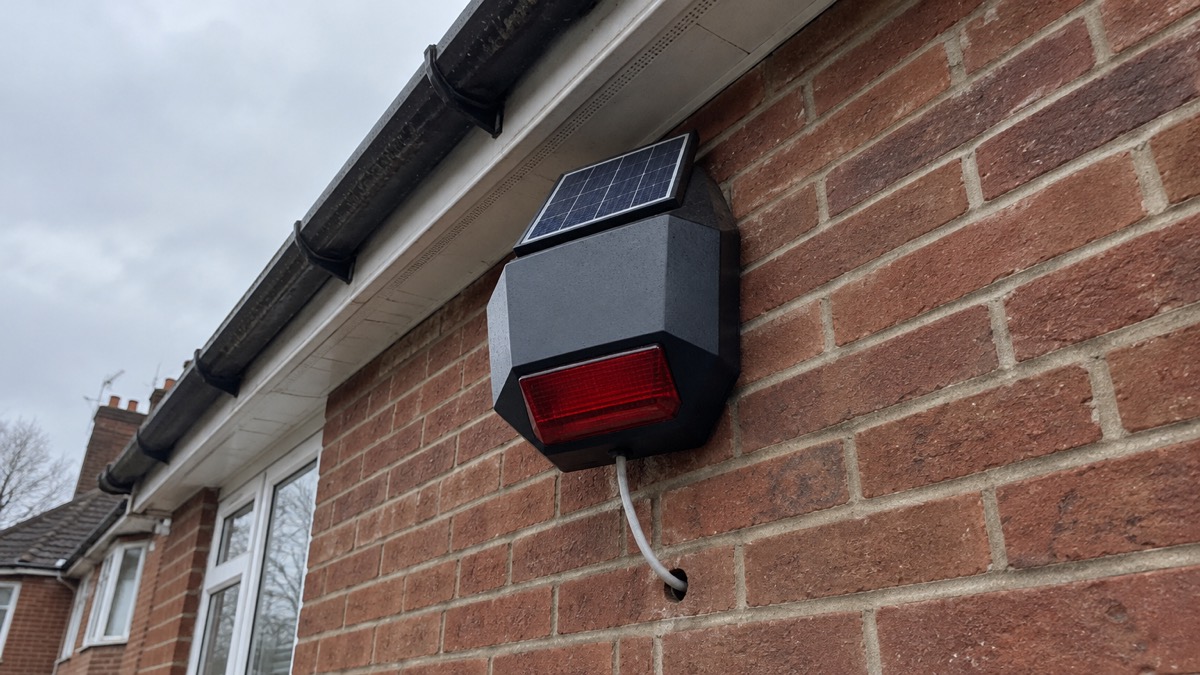
During operation the battery usually does not need to be recharged; only during installation, or after long storage, may recharging be necessary1. That is the maker's expectation for a solar-fed unit in a good position. It is not a promise for a north-facing wall in Aberdeen.
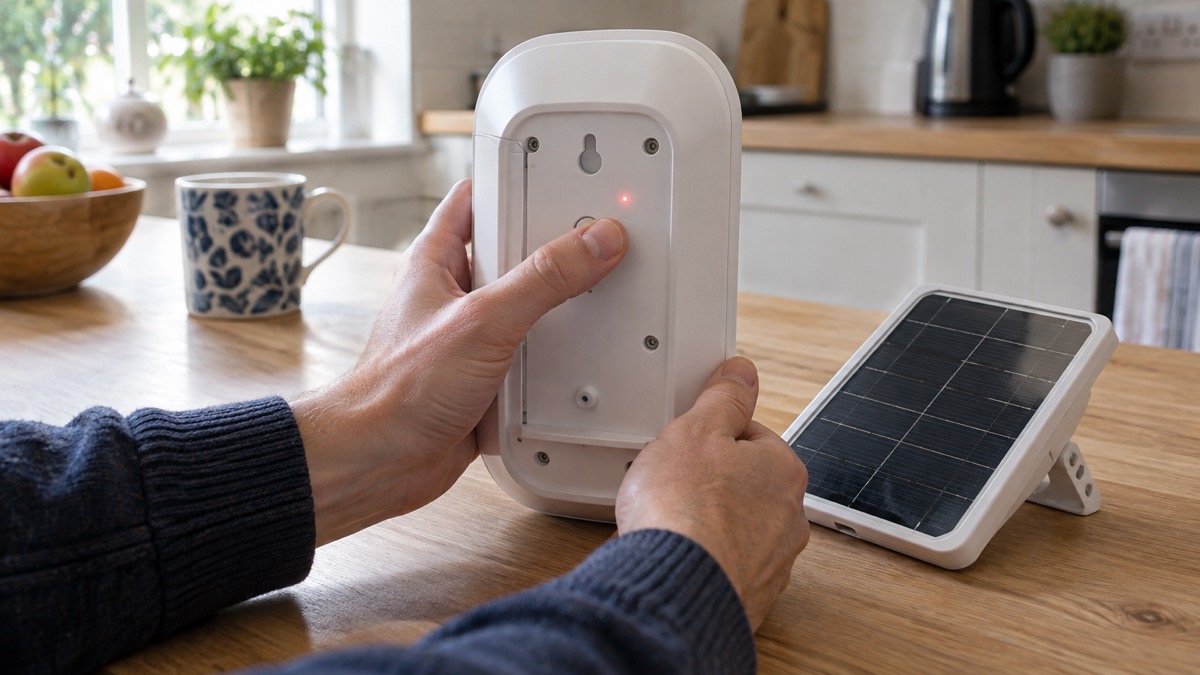
To check the charge, open the battery compartment cover, turn the device on and press and hold the Reset button1. Bosch gives the readings: a green status LED indicates the battery is sufficiently charged, orange means it is recommended to charge further, and red or no light means very low charge1. The battery can be charged via USB-C before installation1.
To charge it, loosen the screw, remove the unit from the mounting plate, open the connection compartment cover, set DIP switch 6 to OFF and DIP switch 7 to ON, connect a standard power supply unit to the USB-C socket and switch on1. The LED flashes orange during charging and lights up green continuously when charging is complete1.
If the battery can no longer be fully charged, it must be replaced1. Bosch's sequence is to deactivate the Alarm system service in the app and the existing intrusion detection system, remove the siren from the mounting plate, open the battery compartment, switch off, disconnect the battery cable, connect the new battery, check the charge level and charge if necessary, switch on, remount, and reactivate the alarm system intrusion detection system and the Bosch Smart Home System1.
The same discipline applies to the other battery-powered safety kit in a home. Warwickshire Fire and Rescue Service advises regularly checking and replacing the batteries in carbon monoxide detectors so they function correctly15, and advises replacing damaged or worn-out batteries in vaping devices promptly to reduce the risk of malfunctions and fires16. Northern Ireland's winter advice is to make sure your battery is fully charged and to replace it if it is no longer reliable17, and the Met Office winter checklist names a torch and spare batteries among the things to have ready18. If a fire does start in a device, London Fire Brigade's instruction for an e-bike or e-scooter fire is blunt: get out immediately19. The Northern Ireland Fire and Rescue Service gives the same emphasis on checking batteries and chargers for damage and not storing or charging them on escape routes20.
Cleaning, checks and the size of the unit
Cleaning is a dry job. Bosch's instruction is to clean the device with a soft, clean, dry and lint-free cloth, and not to use solvent-based cleaning agents1. Do not hose it down, and do not reach for a spray. The glass cover on the solar panel is described by the maker as not requiring maintenance1, so a wipe to remove dust and bird mess is enough. The same logic applies to other outdoor kit that collects debris: chimney sweeping advice notes that sweeping also clears obstructions such as bird and animal nests, leaves and debris21, and Somerset Council suggests washing up liquid, or white wine vinegar as an environmentally friendly disinfectant, for cleaning a bin or caddy22. Neither is appropriate for the siren; the maker's dry cloth is the instruction.
On size, the unit measures 249 x 79 x 160mm1. That is long and shallow, so measure the gap between a window sill and a downpipe, or between a door frame and a corner, before drilling. The page on where to fit an outdoor alarm siren covers height and position more generally.
If you are cleaning up after a flood or a storm and the siren has been submerged or damaged, do not assume it will work. For the wider job of securing a property that has been damaged, see making a damaged home safe from intruders.
If you cannot hear the siren: alarms for people who are deaf or hard of hearing
A 100dB sounder on an outside wall is no use to the person asleep in the back bedroom if they cannot hear it. Bosch's siren is an outdoor sounder, and the maker's instructions do not describe it as a substitute for an indoor alarm.
Official fire safety guidance is clear that specialist alarms exist for people who need them. Dorset and Wiltshire Fire and Rescue Service notes that specialist alarms can also be fitted, for example strobe light and vibrating pad alarms for those who are deaf or hard of hearing23. The Silent Solution guide, published by the Independent Office for Police Conduct, explains how a person who cannot speak safely can still alert the police by calling 999 and pressing 55 when prompted.
If someone in the household would not hear an outdoor siren, plan around that rather than relying on it. The page on extra help in an emergency covers the Priority Services Register and other routes to support, and Scotland and Northern Ireland: reporting crime and getting support sets out the differences in those two nations.
Sources (23)
- Outdoor Siren help and support articles, Bosch Smart Home, 2026-11-02
- Solar power for caravans and motorhomes, The Caravan Club, 2026-10-25
- Safety tips for using a portable generator in an emergency, Health and Safety Executive Northern Ireland, 2025-01-26
- Amber warning issued as cold weather continues, Met Office, 2025-11-18
- Amber snow warning issued, Met Office, 2023-12-02
- UK weather warnings, Met Office, 2026-10-24
- Patio heaters, Electrical Safety First, 2026-10-25
- Fire and smoke alarms in Scottish homes: where and what to buy, Scottish Government, 2024-08-14
- Smoke alarms, Staffordshire Fire and Rescue Service, 2026-10-29
- Fire safety for people with hearing difficulties, Dorset and Wiltshire Fire and Rescue Service, 2026
- Protect Yourself booklet, Police Service of Northern Ireland, 2024-10
- Battery safety, Manchester Fire and Rescue Service, 2026-10-29
- Electrical fire safety leaflet, Manchester Fire and Rescue Service, 2026
- Battery safety for e-scooter users, GOV.UK, 2024-02-01
- Safe home heating, Warwickshire County Council, 2026-10-29
- Fire safety tips: smoking, vaping and e-cigarettes, Warwickshire County Council, 2026-10-29
- Ice weather warning: information and advice, nidirect, 2026-02-16
- WeatherReady winter checklist, Met Office, 2026
- What to do if there is a fire caused by an e-bike or e-scooter, London Fire Brigade, 2026-10-25
- Home fire safety, Northern Ireland Fire and Rescue Service, 2026-10-14
- Chimney fire safety advice, Warwickshire County Council, 2026-10-29
- Bins, recycling and waste: services and weather, Somerset Council, 2025-08-13
- Ability to respond and escape, London Fire Brigade, 2026-10-25

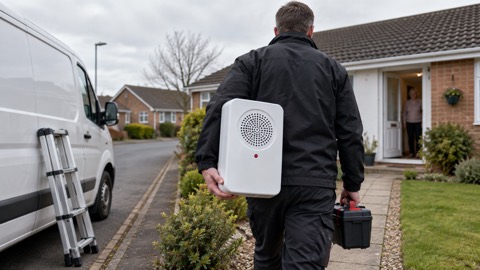 Ajax HomeSiren
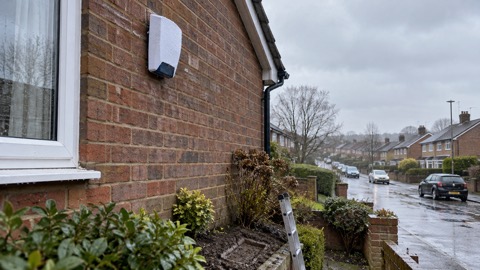 Ajax StreetSiren