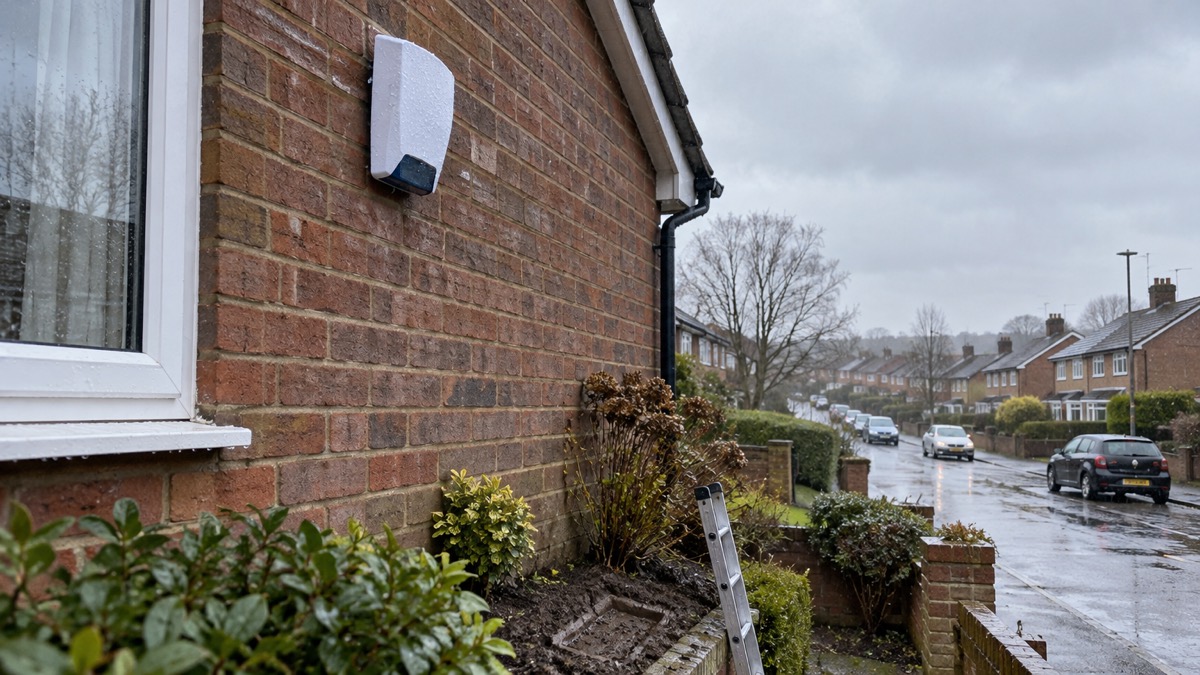
The Ajax StreetSiren is a wireless outdoor siren for an Ajax alarm system, with a sound volume of up to 113 dB1. It is the part of the system that makes the noise outside the house, and it is built to sit on an external wall in British weather: the maker rates it IP54, meaning it is protected from dust and moisture and can be placed outdoors1. It runs from pre-installed batteries for up to 5 years, with a 12 V external power supply as an option1.
If you are considering one, the practical questions are how loud it is, how far it reaches the hub, where it goes on the wall and how you keep it working. The maker's manual answers all four. Volume is set in the app at Quiet (85 dB), Loud (100 dB) or Very loud (113 dB), measured 1 m from the siren, and the alarm itself can also be set to Muted1. The radio range is up to 1,500 metres with no obstacles, and the recommended installation height is 2.5 metres and higher1. It works only with Ajax hubs, not through uartBridge or ocBridge Plus integration modules1.
This page sets out what the siren does, the specifications that decide whether it suits your home, how to pair and mount it, how to set the alarm length and tones, and how to clean and handle it safely. It is a description of one product, not a comparison, and it gives no prices.
What the StreetSiren does, and what it does not
The StreetSiren Jeweller is a wireless outdoor alerting device with a sound volume of up to 113 dB1. Its job is to be heard outside the building when the alarm is raised, so that neighbours and anyone nearby register that something is wrong. It is not a detector: it does not sense movement or opening, it sounds when the hub tells it to. The detection comes from the sensors on doors, windows and rooms, and the siren is the output.
Because it is rated IP54, the maker says it can be placed outdoors1. That rating covers dust and splashing water, which is what an exposed wall in a British winter throws at it. It also reports temperature, with an acceptable error of 2°C between the value in the app and the temperature at the installation site, and it updates when it detects a change of at least 2°C1. That makes it a useful outdoor temperature reading as well as an alarm.
It is part of a wider system, and it is worth being clear about the boundary. The siren operates with Ajax hubs only and does not support connecting via uartBridge or ocBridge Plus integration modules1. If you already run an Ajax hub, it fits. If you are choosing an alarm from scratch, the burglar alarms guide sets out the types, and the Ajax Hub (2 Plus, 2, Plus) and Ajax Hub (4G) Jeweller pages cover the hubs this siren pairs with.
One thing the siren is not is a substitute for the national Emergency Alerts system. That system sends a siren-like sound to mobile phones for up to 10 seconds, even if the phone is set to silent, along with a message about the emergency and what to do2. The StreetSiren is a private alarm on your own property; the Emergency Alerts service is the government's way of warning the public. Both have their place, and the staying informed guide explains the public side.
Volume levels: Quiet 85 dB, Loud 100 dB, Very loud 113 dB
The siren's volume is set in the app, and the maker gives four options for the alarm: Muted, Quiet at 85 dB, Loud at 100 dB and Very loud at 113 dB1. The volume level is measured 1 m away from the siren1. Chimes have three levels, Quiet (85 dB at 1 m), Loud (100 dB at 1 m) and Very loud (113 dB at 1 m), with no muted option1.
To put 113 dB in context, the RSPCA's decibel guide lists 80 dB as a police siren4. The StreetSiren at its highest setting is louder than that, which is the point of an outdoor siren: it has to carry across a garden, over traffic and through a closed window. It is also why the setting matters. A siren at 113 dB a metre away is uncomfortable to stand next to, and the maker provides the quieter settings and the Muted option so you can match the response to the situation.
| Setting | Level | Where it suits |
|---|---|---|
| Muted | No sound when the alarm is raised | When you want the notification without the noise, for example testing or a household where a loud external siren would cause a problem |
| Quiet | 85 dB at 1 m | A small garden or a close neighbour, where you want an audible warning without the full output |
| Loud | 100 dB at 1 m | The everyday setting for most semi-detached and terraced homes |
| Very loud | 113 dB at 1 m | A large plot, a busy road or a detached house where the siren has further to carry |
The choice is a judgement about your property, not a fixed rule. The maker does not prescribe a setting for a given house type; it gives the levels and leaves the decision to the household. What the maker does say is that an alarm duration of more than 3 minutes is available only with firmware version NA 5.60.4.14 or higher and with the Quiet or Loud alarm volume1. So if you want a long alarm, you cannot also have the Very loud setting.
Battery life: up to 5 years, with 12 V external power as an option
The maker states that StreetSiren Jeweller can operate up to 5 years from the pre-installed batteries, with the detector ping interval of 1 minute, or approximately 5 hours of constant signaling with the buzzer1. The default device ping interval set in the hub settings is 36 seconds1. Those two figures sit together: the 5-year estimate assumes a 1-minute ping, and the hub's default is shorter, so the real figure in a default installation will be shorter than the headline. The maker gives the estimate on its stated condition, and the condition is worth reading before you rely on the number.
The 5-year figure is also the reason the warranty wording matters. The warranty for Ajax Systems Manufacturing products is valid for 2 years after the purchase and does not apply to the pre-installed battery1. So the battery that is expected to last up to 5 years is outside the 2-year warranty. That is not unusual for a sealed battery, but it means a battery fault in year three is not a warranty claim.
External power is an option. The manual describes using a 12 V external power supply, with a hole drilled in the SmartBracket for the wire1. The DoubleDeck variant of the siren supports connecting a 12 V DC (1.5 A) external power supply5. Running a permanent supply means the siren is not relying on the battery for its everyday operation, which suits a position that is awkward to reach or a household that wants the siren to keep sounding for as long as the alarm lasts.
Pairing it with an Ajax hub
Pairing is done from the app, and only users with administrator rights can pair the device with the hub1. Before you start, the siren needs to be switched on: hold the power button for 3 seconds1. To switch it off again, press the power button for 3 seconds6.
The limit on how many you can fit is the first thing to check. The maker states that only 10 sirens or keypads with a built-in siren can be connected to one hub1. That is a shared allowance, so a keypad with its own siren counts towards the same ten. On a large property with several keypads and sirens, plan the total before buying.
Once paired, the siren is part of the hub's notification chain. The hub consecutively calls all users who have enabled that type of notification in the order specified in Users settings, and it calls every 2 minutes at most7. Ajax apps can notify users when the hub loses connection to the server using a standard push notification sound or a siren sound, the latter enabled by default7. Alarm notifications can go by call, push notification with a siren sound, or SMS, though calls are not available for messages about the loss of connection between the hub and the Ajax Cloud server7.
A useful reassurance: if the internet goes down, the security system continues autonomous operation, responding to all events, executing the enabled scripts and activating the siren when applicable8. The siren does not stop working because the broadband has dropped. The hub's event buffer, which holds a record of events, is available on hubs with OS Malevich firmware version 2.25 and later, except for the Hub (2G) Jeweller model, and you can select from 100 (by default) to 1000 events in increments of 508. The Ajax Hub (4G) Jeweller page covers the hub side in more detail, and the monitored alarms guide explains what happens when an alarm is passed to a receiving centre.
Where to mount it: 2.5 metres up, at least 1 metre from the hub
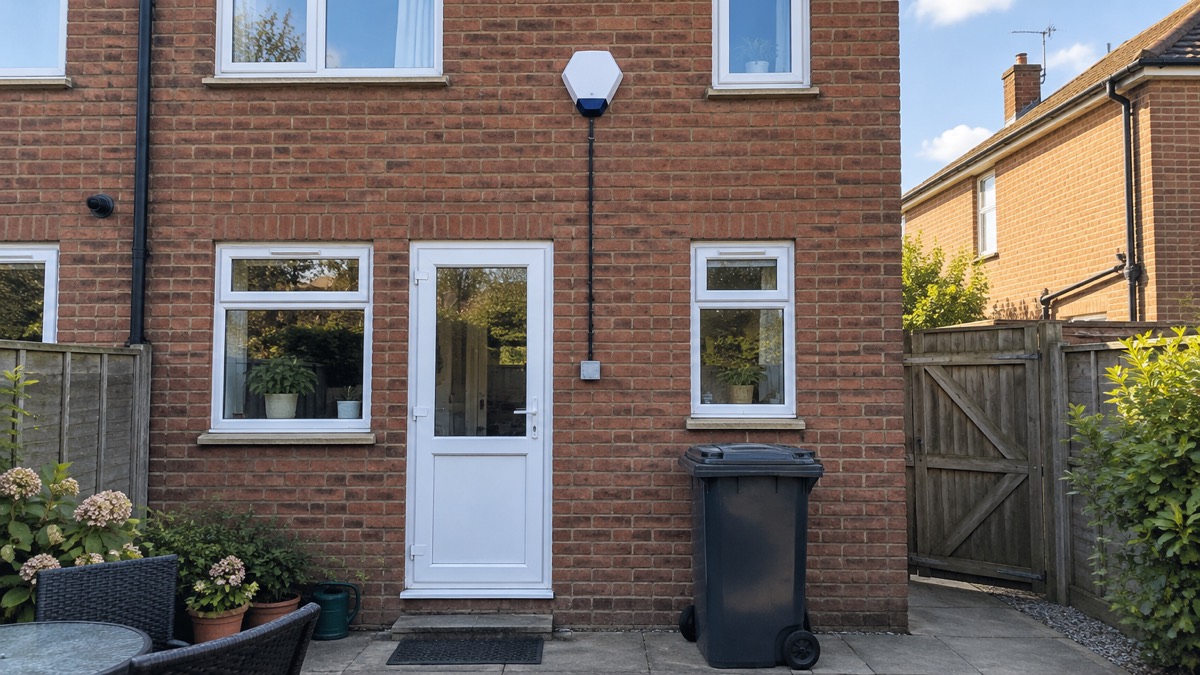
The maker's installation rules are short and specific. The recommended installation height is 2.5 metres and higher1. The siren should not be installed closer than 1 m from the hub1. And it should not go near metal objects and mirrors, which can interfere with the RF signal and cause it to fade, in places where its sound can be muffled, or closer than 1 m from the hub1.
Those rules are about both audibility and radio. Height gets the sound out over fences and hedges and puts the device out of easy reach. Distance from metal and mirrors protects the radio link back to the hub. The 1 m gap from the hub is there because a siren that close to the receiver can overwhelm it.
The fixing itself is on the SmartBracket panel. The maker's instruction for the DoubleDeck variant is to put the siren on the SmartBracket, turn it clockwise and secure it with the screw, which minimises the risk of tearing off and theft5. To remove it later, you turn off the siren's external power supply if applicable, unscrew the locking screw at the bottom with a PH2 cross screwdriver, and remove the siren from the SmartBracket panel by turning it counter-clockwise6. When prising off the protective panel, the maker recommends a plastic card or a plectrum, because a metallic object can scratch the siren body6.
If you are working out the best spot on the wall, the outdoor siren height guide covers the general principles, and the outdoor lights guide is useful if you are planning the whole outside of the house at once.
Alarm length, beeps and chimes you can set
The siren's behaviour is configurable, and the settings are where most of the practical decisions sit. The duration of the audible alarm runs from 3 seconds to 3 or 15 minutes, set in 3-second intervals1. There are four options for when the fast beep should start: Never, Last 5 seconds, Last 10 seconds or Last 15 seconds1. When the system is disarmed and opening detectors are triggered, the siren beeps 1 to 4 times1.
The alarm duration has a condition attached. An alarm duration of more than 3 minutes is available only for StreetSiren Jeweller with firmware version NA 5.60.4.14 or higher and with the Quiet or Loud alarm volume1. So the longest alarm and the loudest volume are mutually exclusive.
Several of these features depend on firmware, and the versions differ:
| Feature | Minimum firmware |
|---|---|
| Signal fade test mode | 3.50 and later1 |
| Beeps on delays | 3.51.0.0 or later1 |
| Chime | 3.73.1.0 and later1 |
| Beeps when disarmed | 3.73.1.0 and later1 |
| After-alarm indication | 3.73.1.0 and later1 |
| Permanent deactivation | 3.71 and later1 |
| Alarm duration over 3 minutes | NA 5.60.4.14 or higher, with Quiet or Loud volume1 |
| Alarm cancellation and abort annunciation | from 5.60.5.0 to 6.0.0.0 and from 6.56.1.57 or higher1 |
| Mute on keypad code | from 5.60.5.0 to 6.0.0.0 and from 6.56.1.57 or higher, with hubs on OS Malevich 2.19 or higher1 |
The audible alarm setting itself is available for hubs with the firmware version OS Malevich 2.16 or later1. A firmware update is available for StreetSiren Jeweller with firmware version 10.63.1.17 or later1. If a feature you expect is missing from the app, check the firmware version before assuming a fault.
The alarm cancellation and abort annunciation features are required for systems that should comply with ANSI/SIA CP-01-20191, a standard for reducing false alarms. That is a detail for anyone whose insurer or installer asks about false alarm performance; the false alarms guide explains why it matters for police response.
Weatherproofing, cleaning and safe handling
The IP54 rating is what allows the siren outdoors, and keeping that protection intact is mostly about how you clean and handle it. The maker's cleaning advice is to use a soft dry napkin suitable for tech equipment, and not to use any substances containing alcohol, acetone, petrol and other active solvents to clean the device1. Solvents can attack the plastic and the seal, which is exactly what you do not want on an outdoor unit.
The safety warnings are firm. The maker states that it is strictly prohibited to disassemble the device under voltage, and that you should not use the device with a damaged power cord1. The DoubleDeck support article repeats the point: do not disassemble the electrified device, and do not use a damaged power cable5. If the cable is damaged, stop using the external supply and have it dealt with before the siren is relied on again.
There is one handling quirk worth knowing if you ever open the unit. There can be a non-hardening sealant on the piezoelectric detector, and the maker says do not wipe it; if the sealant contaminates your hands, wipe it off with a napkin9. When refitting the protective plastic panel with the Ajax logo, the maker says to put it back on the side of the LED strip connection to the board, exerting slight effort9.
The LED indicator has three modes: Disabled, where the indication is off; Armed, where the LED blinks once every 3 seconds only when the system is armed; and Always, where it blinks once every 3 seconds regardless of mode1. If the siren is on external power and the firmware is 3.41.0 or higher, the LED in the lower right corner is on continuously; below 3.41.0 it lights up with a pause of 3 seconds1. The tamper alarm option is disabled by default, and the tamper reacts to the opening and closing of the body even if the system is not armed1. If you want the siren to respond when someone interferes with it, enable that option.
The built-in accelerometer takes 60 seconds to remember the normal position1, so give it that time after fitting before you test the tamper. Tests do not start straight away but within a period of 36 seconds when using the standard settings1.
Warranty and support
The warranty for Ajax Systems Manufacturing products is valid for 2 years after the purchase and does not apply to the pre-installed battery1. Keep the purchase date somewhere you can find it, because the two years run from purchase, not from installation.
Support is available around the clock. The maker says its AI-powered chatbot and professional technical support team are available 24/71, and the manual gives the address support@ajax.systems1. For a device on the outside of a house, that matters: a fault discovered in the evening or at a weekend can be raised straight away rather than waiting for office hours.
The device name you give it in the app can contain up to 12 Cyrillic characters or up to 24 Latin symbols1, which is enough for "Front siren" or "Drive siren" and helps when several devices are listed. The siren also has a panic button note worth knowing: the panic button can be pressed even if the system is disarmed1. The panic buttons guide explains how that fits with the rest of a household's arrangements.
If you are weighing up whether an outdoor siren belongs in your setup at all, the burglar alarms guide and the monitored or self-monitored comparison set out the choices. The home security section is the place to start for the wider picture, and the power cut guide is worth reading if your siren runs on external power and you want to know what happens when the mains drops.
Sources (10)
- StreetSiren Jeweller user manual, Ajax Systems, 2026-10-12
- Emergency Alerts, GOV.UK, 2026
- Emergency Alerts service, Croydon Council, 2026
- Fireworks safety, RSPCA, 2026-10-29
- StreetSiren DoubleDeck external power supply, Ajax Systems, 2020-08-04
- How to replace batteries in StreetSiren, Ajax Systems, 2026-04-02
- How Ajax sends alarms, Ajax Systems, 2026-07-09
- Hub without internet, Ajax Systems, 2024-10-11
- StreetSiren DoubleDeck: replace batteries, Ajax Systems, 2024-03-04
- Hub Plus user manual, Ajax Systems, 2026-09-25

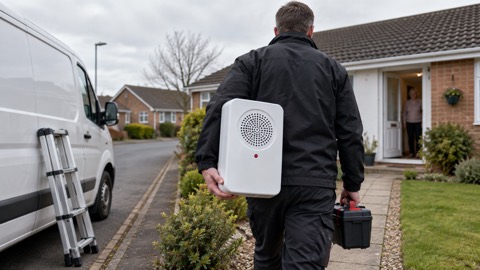 Ajax HomeSiren
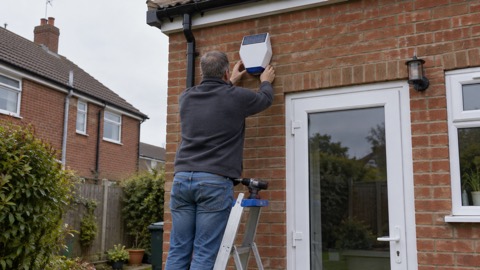 Bosch Smart Home Outdoor Siren