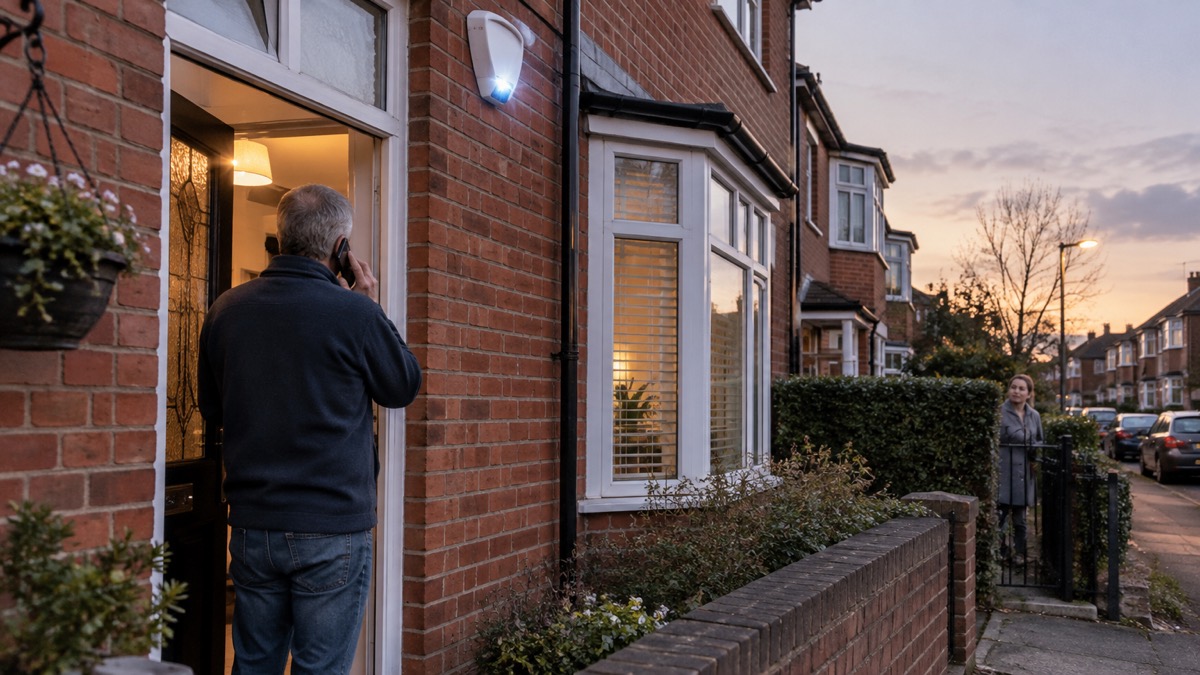
Whether a monitored alarm is worth it comes down to one question: what do you want to happen in the seconds after the alarm goes off? A monitored system is watched around the clock by an approved alarm receiving centre, which checks the signal, alerts a keyholder and, if the system complies with the NPCC Security Systems Policy, contacts the police1. An unmonitored alarm triggers but tells no one automatically: you or a neighbour have to see what happened and call the police2.
That difference is the whole trade. Monitoring buys you a response when nobody is home and a route to the police that does not depend on a neighbour hearing the bell. It also brings a monthly cost, a contract and a set of rules about false alarms that you need to understand before you sign. A self-monitored alarm costs less to run and keeps you in control, but it can only tell you, and only if its connection is working.
This page sets out what each type does, how police response actually works, who is allowed to install and monitor a system, and what happens when an alarm keeps going off by mistake. It covers burglar alarms and the fire detection that often sits alongside them, because the same monitoring centre and the same police rules apply to both.
| Monitored | Self-monitored | |
|---|---|---|
| Who is told | An approved alarm receiving centre, 24/71 | You, by app or notification5 |
| What the centre does | Checks the signal, alerts a keyholder, contacts police if compliant1 | Nothing; there is no centre |
| Police attendance | Possible, if the system complies with the NPCC Security Systems Policy1 | Only if someone at the scene calls and reports a crime in progress1 |
| Works when you are away | Yes, subject to keyholder response1 | Only if your connection and phone are working5 |
| Running cost | Some companies may charge each month for setting up and monitoring11 | No monitoring charge |
| Best suited to | Households empty for long periods, people living alone, anyone who wants a response without relying on neighbours | Households usually occupied, tight budgets, people who want alerts rather than a response |
What a monitored alarm actually does when it goes off
A monitored alarm system is monitored 24/7 by an approved commercial alarm receiving centre, usually shortened to ARC1. When a sensor triggers, the signal goes to that centre rather than to a siren in the street. The ARC immediately checks the signal to verify it is a genuine alarm, alerts a keyholder and, if the system is compliant, contacts the police1. That sequence matters: the centre is not a call centre that simply dials 999 on your behalf. It filters, verifies and then escalates.
The practical benefit is coverage of the hours when nobody is awake or at home. A bell box on the wall tells the street that something is wrong. A monitored system tells someone who can act. For a household where everyone works away from home, or where someone lives alone and wants a response at night, that is the core of the case.
There is a second layer that many households add: monitored fire detection. Remotely monitored fire alarms work on the same principle, but the guidance is careful about how they are used. When the building is occupied, the cause of any alarm should be investigated locally and calls to the Fire and Rescue Service only made if a fire is discovered3. In other words, monitoring is not a substitute for looking. It is a backstop for when nobody is there to look.
The limits are worth stating plainly. Monitoring does not make an alarm more likely to detect an intruder; that is the job of the sensors and their placement. It does not shorten the police response once a call is made. And it does not remove the need for the household to test the system and keep it maintained. What it changes is who is told, and how quickly a verified signal reaches someone who can send help.
How a monitored alarm gets a police response
Police response to a monitored alarm is not automatic. The police will only attend an alarm signal from a monitored alarm as long as the system complies with the NPCC Security Systems Policy1. That policy is the framework that sets out how alarms are registered, how signals are verified and when officers will be sent. Compliance is handled between your installer, your monitoring centre and the police; it is not something you arrange yourself on the night.
For an audible-only alarm, the position is different. For the police to respond, someone at the scene would need to call the police and report that a crime is in progress1. That is why a neighbour who hears the bell and looks out of the window is doing something genuinely useful, and why an empty house with an unmonitored bell box may produce no response at all.
The route from sensor to officer looks like this:
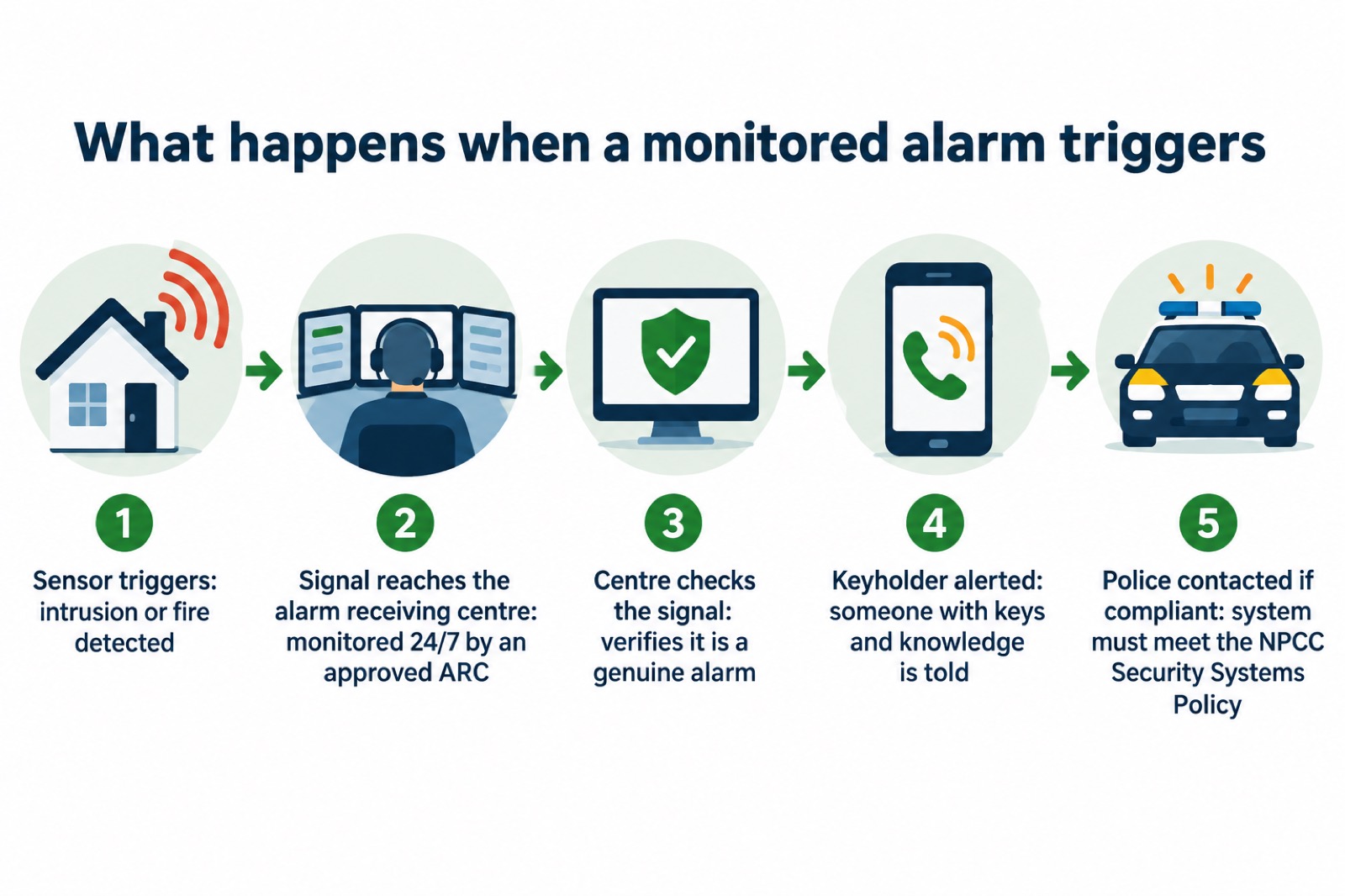
Two practical points follow. First, your keyholders need to be people who will actually answer the phone at three in the morning and who live close enough to attend. Second, the compliance status of your system is worth confirming in writing when it is installed, because it is the thing that decides whether the police are called at all.
If you want the detail on how calls are prioritised and what officers will attend, the guide to how police respond to burglaries and intruder alarms sets it out. For the receiving centre side, see monitored alarms: receiving centres and who responds.
Who can install and monitor a monitored alarm
The person or company setting up a monitored alarm should hold National Security Inspectorate (NSI) or Security System and Alarms Inspection Board (SSAIB) certification2. These are the two inspectorate bodies for alarm installers1. Using a contractor affiliated to a recognised alarm inspectorate body such as NSI or SSAIB is the recommendation for anyone having an alarm fitted5.
Certification is not a formality. Inspectorate approval of an alarm installation company gives you a reliable and well maintained system that meets relevant British and European standards, and it could result in lower insurance premiums1. The Secured by Design scheme goes further, giving reassurance that an alarm installation company meets the exacting standards of the Police Service1.
| What to check | Why it matters | Where it comes from |
|---|---|---|
| NSI or SSAIB certification | The two recognised inspectorate bodies for alarm installers | 1 |
| Compliance with the NPCC Security Systems Policy | The condition for police attendance at a monitored signal | 1 |
| British Standards or CE mark on the alarm equipment | Shows the alarm is approved, tested and safe | 6 |
| Competent person scheme registration, where building regulations apply | The installer can self-certify their work complies | 7 |
For work that touches the fabric of the building, such as mains wiring, the advice is to choose someone registered with a competent person scheme who can self-certify their work complies with building regulations7. Mains-wired alarms must be fitted by a qualified electrician8. If you are weighing up what kind of system to have in the first place, the guide to burglar alarms: types and how to choose one covers the options, and how to check an alarm installer is approved walks through the verification.
False alarms: why three in a year matters
The phrase most households have heard is that three false alarms in a year, or four in Scotland, will lead to police response being withdrawn. The principle behind it is set out clearly in fire safety guidance: if there are excessive false alarms at your premises, people may become complacent and not respond correctly to a warning of a real fire, and in such circumstances you may be failing to comply with fire safety law3. The same logic applies to intruder alarms: an alarm that cries wolf stops being believed, by neighbours, by keyholders and eventually by the police.
The remedy is not to ignore the problem but to investigate it. All false alarms should be investigated to identify the cause and any necessary remedial action taken3. In practice that means looking at what triggered the sensor: a pet, a draught, steam from a bathroom, a spider on the detector, a door left ajar, or a user error at the keypad. Each has a fix, and most are cheap.
Regular testing is part of prevention. Test smoke, heat and carbon monoxide alarms every week, and if an alarm does not sound, buy a new alarm4. Test your alarms at least monthly if weekly is unrealistic, but do not let testing slide altogether9. A system that is tested and maintained produces fewer surprises.
If you want the detail on how many false alarms trigger withdrawal and how the policy is applied, see how many false alarms before police stop responding.
Getting police response back after it has been withdrawn
Response can be restored, and the route back runs through the same bodies that set the system up. Because attendance depends on compliance with the NPCC Security Systems Policy1, the work is to bring the system back into compliance: identify and fix the cause of the false alarms, have the system checked and maintained by a certified installer, and confirm with the monitoring centre that the registration is active again.
The practical steps are these:
- Investigate every false alarm and record what caused it3.
- Have the sensors, wiring and keypad checked by an NSI or SSAIB certified installer2.
- Confirm with the alarm receiving centre that the system is registered and compliant1.
- Agree with your keyholders how they will respond, so a genuine alarm is not wasted1.
- Keep testing weekly, and replace any alarm that fails to sound4.
The three month figure that circulates is best treated as a working expectation rather than a promise. What the guidance is clear about is the direction of travel: fix the cause, get the system verified, and let the monitoring centre confirm the status. Households that treat a withdrawn response as permanent often live with an alarm that no longer does the job it was bought for.
Self-monitored alarms: what they can and cannot do
A self-monitored alarm sends its alert to you. The clearest example is smart home security, which relies on an internet based app alert sent to a smartphone or other internet device5. Nothing is verified by a third party and no keyholder is called automatically. You get a notification, and what happens next is down to you.
That model suits some households well. If someone is usually at home, if neighbours are close and willing, or if the alarm is mainly there to tell you that a door has opened while you are in the garden, a self-monitored system does the job at a fraction of the running cost. It also keeps you in control of who is told and when.
The weaknesses are worth naming:
- It depends on a connection. An app alert needs the internet or mobile network to reach you5.
- It depends on you. If your phone is on silent, in another room or out of battery, the alert waits.
- It tells no one else. An unmonitored alarm triggers but no one is automatically told, so you or a neighbour have to see what happened and call the police2.
There is a useful comparison to draw with the Emergency Alerts system, which is designed to get through when other things fail. Your mobile phone or tablet may make a loud siren-like sound even if it is set on silent, vibrate and read out the alert10. That is a public warning system, not a burglar alarm, but it shows what a resilient alert looks like: it does not depend on an app being open or a notification being allowed.
For the specific problem of poor coverage, see alarms and cameras on a weak mobile signal or slow broadband. For the digital phone switchover and what it means for alarm signalling, see will a burglar alarm work after the digital switchover.
Monitored or self-monitored: side by side
The two models are easiest to compare by what happens after the trigger.
Neither column is better in the abstract. The question is which failure you can live with: the monitored system's monthly bill and its dependence on a centre and a keyholder, or the self-monitored system's dependence on your phone and your attention.
If you are still deciding whether you need an alarm at all, burglar alarm or CCTV camera: which suits your home sets the two against each other. If you have already chosen monitoring, monitored alarms: receiving centres and who responds explains what the centre does in more detail.
Alarms without Wi-Fi, and what happens in a power cut
A common worry is that a modern alarm will stop working when the broadband goes down. For fire detection, the answer is reassuring: interlinked smoke and heat alarms are linked by radio frequency and do not need Wi-Fi8. Wire-free alarms are available if you are worried about wiring in your house1. The link between the alarms is a radio signal between the devices, not an internet connection.
Mains-powered alarms are powered by your home power supply and have a back-up battery in case of a power cut12. They need to be installed by a qualified electrician and require testing like battery alarms12. That back-up battery is why a hard-wired alarm can still beep during a power cut: if it beeps every minute or so, this could be a low battery warning, and this can also occur with hard-wired alarms as there is often a battery backup in case of a power cut13.
For burglar alarms, the picture depends on the signalling path. A monitored system that signals over a phone line or mobile network behaves differently from one that relies on your broadband. Ask the installer which paths the system uses and what happens when each fails. For the household side of a power cut, see keeping your home protected in a power cut and the wider guide to power cuts.
Fire and carbon monoxide alarms alongside your burglar alarm
Most households end up with both intruder detection and fire detection, and the fire side has its own rules that are stricter than many people realise. Fit smoke and carbon monoxide alarms on each level in your home and test them regularly; they are reliable, easy to use and inexpensive6. Make sure any alarms you buy are marked with a current British Standards or European (CE) safety mark16. Look out for the British Standard Kitemark and Loss Prevention Certification Board (LPCB) symbols, which show the alarm is approved and safe13.
Scotland has its own standard, and it is more demanding. All alarms should be ceiling mounted and interlinked4. If your home is on one level, a flat or bungalow, you need to fit at least two smoke alarms4. One heat alarm in the kitchen is required17. If you have an open plan area, for example a combined hall and living room, you only need one alarm, but it should be no more than 7.5 metres from any point in the room; if the area includes a kitchen, it should be a heat alarm17. Interlinked alarms means if one goes off, they all go off, so you will always hear an alarm wherever you are in your home17.
| Nation | Fire alarm position in brief |
|---|---|
| England | Fit smoke and carbon monoxide alarms on each level and test regularly6 |
| Scotland | Ceiling mounted, interlinked; at least two smoke alarms in a flat or bungalow; one heat alarm in the kitchen4 |
| Wales and Northern Ireland | Follow the same principle of alarms on each level, tested regularly, with British Standards or CE marking6 |
In Scotland, private landlords must provide a smoke alarm on each floor of a property, and a carbon monoxide alarm must be in place within any room with a solid fuel burning appliance18. Specialist alarms, for example if you are deaf or have a Telecare system, must be fitted in addition to any smoke, heat and carbon monoxide alarms17. For the background to the Scottish standard, see the Scottish Government guidance on fire and smoke alarms in Scottish homes.
Where to get help and advice
If you are unsure whether your alarm is working, your local fire and rescue service may be able to help. If you have a smoke alarm fitted by the fire service and it is not working correctly, they will come and take a look and replace the alarm if necessary13. Fire services also offer home safety visits, and testing the alarm every week is part of the advice they give19.
For households where escape might be delayed, the case for interlinked and monitored protection is stronger. Interlinked alarms are particularly important where a person has any issues that may prevent or delay their escape16. Specialist alarms such as strobe light and vibrating pad alarms can be fitted for those who are deaf or hard of hearing16. If you are setting up support for someone who needs it, the NHS Inform guide to creating a falls plan is a useful starting point for thinking through who is called and when11.
For personal alarms, the advice is to understand the costs involved, as some companies may charge each month for setting up and monitoring the alarm11. A personal attack alarm is a good deterrent, and the police advice is to scream and set it off if you are threatened20. For the wider picture on panic buttons and who is told, see panic buttons on home alarms.
If you are in rented accommodation, it is up to your landlord to ensure you have the correct alarms installed, but you should still ensure they are tested regularly21. For more on rented homes in Scotland, see Fire Scotland's guidance on rented accommodation22.
Sources (22)
- Alarms advice for domestic properties, Secured by Design, 2023
- Break-in and housebreaking, Police Scotland, 2026
- Phone and broadband outages, Prepare campaign, 2026
- Fire alarms standard campaign 2021 evaluation report, Scottish Government, 2022
- Protect Yourself booklet, Police Service of Northern Ireland, 2024
- Home fire safety visits, Staffordshire Fire and Rescue Service, 2026
- Oil storage regulations and safety, GOV.UK, 2026
- Fire safety in the home, GOV.UK, 2022
- Protect yourself outdoors, Police Service of Northern Ireland, 2026
- Emergency Alerts, GOV.UK, 2026
- Creating a falls plan, NHS Inform, 2024
- Smoke alarms and heat alarms, London Fire Brigade, 2026
- Problems with smoke alarms, Devon and Somerset Fire and Rescue Service, 2026
- Carbon monoxide alarms, Health and Safety Executive Northern Ireland, 2026
- Thatched property safety guide, Suffolk County Council, 2023
- Fire alarms and carbon monoxide detectors, Lincolnshire County Council, 2026
- Fire and smoke alarms in Scottish homes: where and what to buy, Scottish Government, 2024
- Rented accommodation, Scottish Fire and Rescue Service, 2026
- Your guide to fire safety, Scottish Fire and Rescue Service, 2023
- Smoke alarms, Devon and Somerset Fire and Rescue Service, 2026
- Home safety detectors, Surrey County Council, 2026
- Smoke and heat alarms, Greater Manchester Fire and Rescue Service, 2026