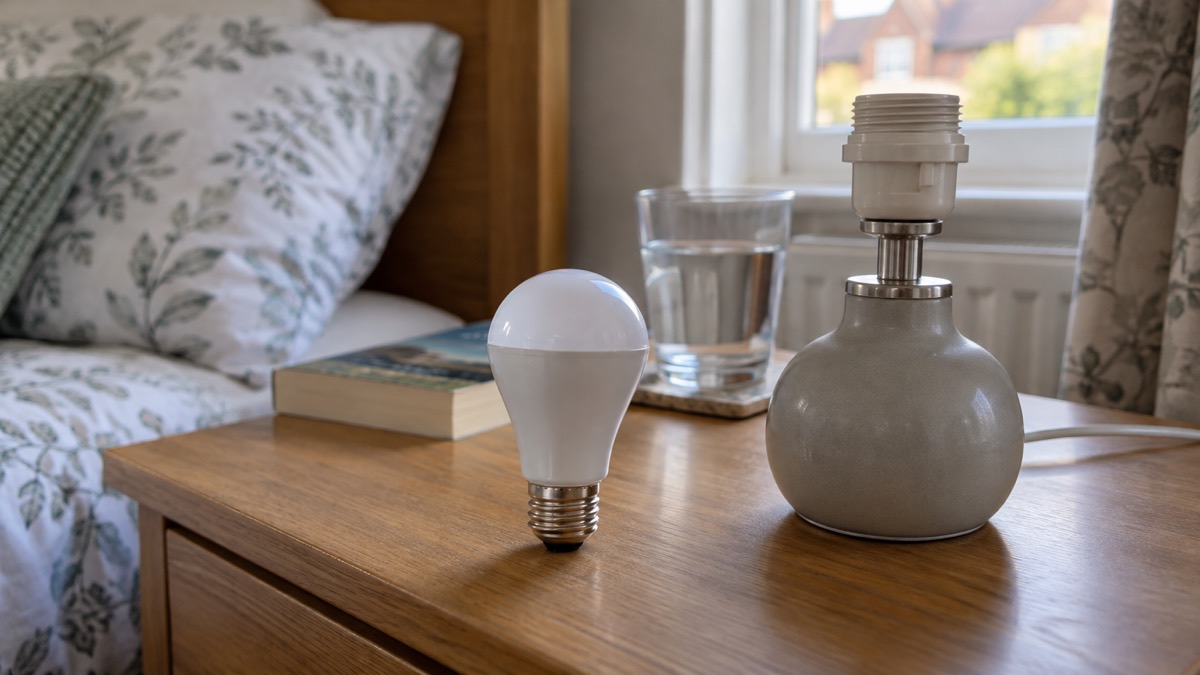
The NEBO Blackout Backup Emergency LED Bulb is a rechargeable light bulb that behaves like an ordinary bulb while the power is on and switches to its own built-in battery when the power fails. You screw it into a standard E27 fitting, use it from your normal light switch, and leave it switched on so the battery stays charged. In a cut it gives you light from the fitting you already have, rather than a torch you have to find in the dark.
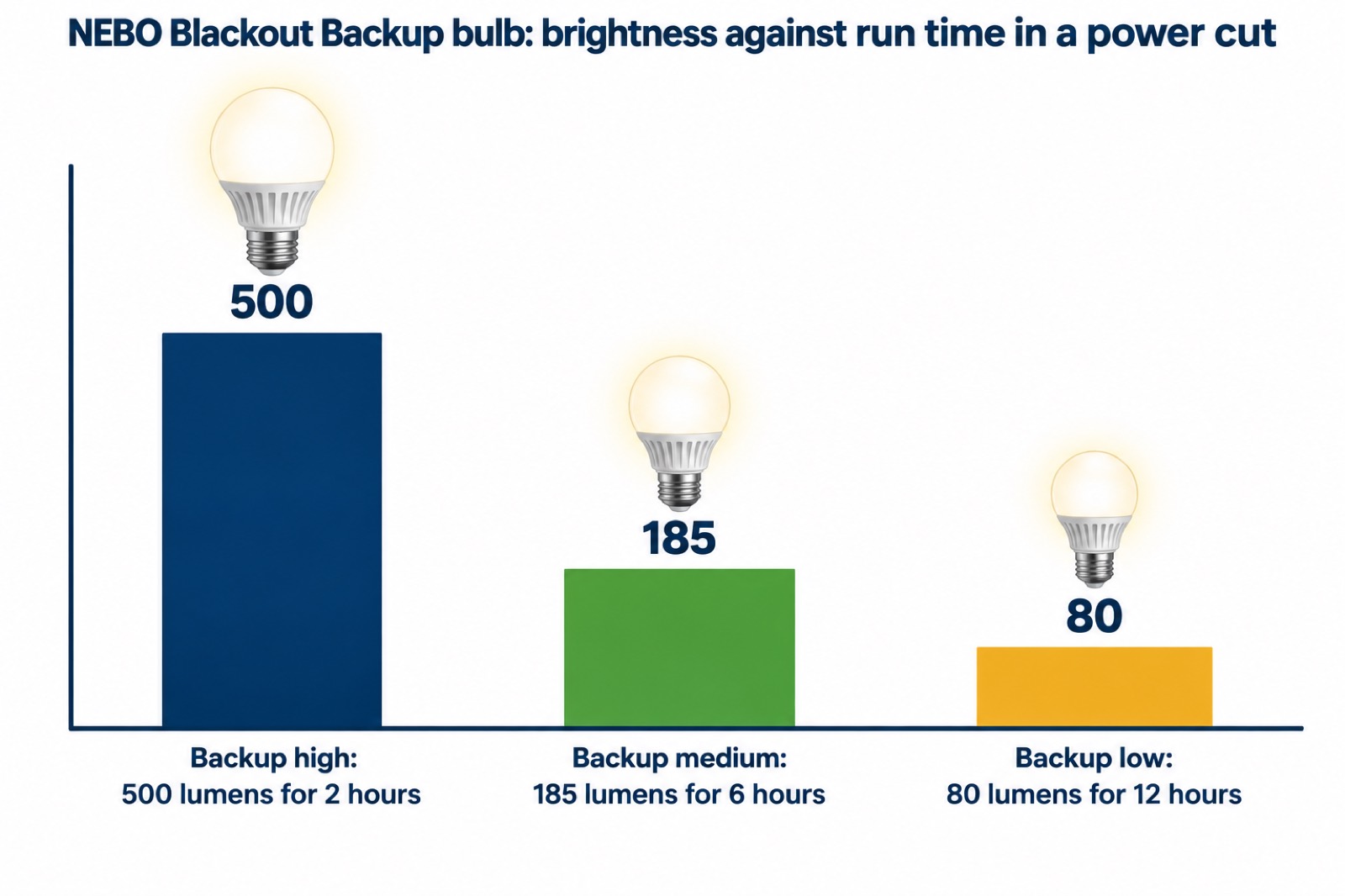
The figures that decide whether it suits your home come from the maker. In everyday use it gives 850 lumens with 360-degree light. In a power cut it steps down through three backup modes: 500 lumens for 2 hours, 185 lumens for 6 hours, or 80 lumens for 12 hours, which the maker describes as up to 12 hours of emergency lighting during outages1. It is non-dimmable, it is not suitable for enclosed luminaires, and its battery is not user serviceable1.
This page sets out what the bulb does, how to fit and charge it, where it must not go, and how to use it safely alongside the other lighting a household should keep. It is one part of a wider approach: a bulb in a ceiling rose is useful, but it is not a substitute for a torch you can carry, and fire and rescue services across the UK are consistent that battery lights and torches are the right alternative light source in a power cut2.
What the Blackout Backup bulb does in a power cut
The bulb is a rechargeable emergency LED that works like a standard bulb in a wall or ceiling lighting fixture, with an internal battery for power outages1. While mains power is present it lights the room as a normal bulb and charges its cell. When the supply drops, the internal battery takes over and the bulb stays lit, so the room you were in does not go dark at the moment the power fails.
That matters more than it might sound. Official advice for households during a power cut is to leave one light switched on so you know when power is restored4. A bulb like this does that job and lights the room at the same time. It also means the light is where a ceiling light already is, at head height and out of reach of children and pets, rather than on a shelf where it has to be found.
What it cannot do is replace a torch. It is fixed in its fitting, so it lights one room and cannot be carried to the fuse box, the gas meter or a child's bedroom. Fire and rescue services in Scotland, Northern Ireland and England are consistent that battery-operated lights or torches are the alternative light source to use during a power cut2. Treat the bulb as the light that stays on in the room you use most, and keep a torch for everything that involves moving.
It is also worth knowing why the power goes off. Planned cuts happen because network operators inspect, test and maintain equipment such as backup batteries, switchgear and transformers, clean and service components, and replace parts that are worn or near the end of their life, at the local substation and the surrounding network5. Unplanned cuts come with weather. During Storm Isha, Northern Powergrid advised customers to keep one light switched on so they would know when power was restored4. A bulb that stays lit through the cut is a practical answer to that advice.
Fitting it: an E27 bulb that works from your normal light switch
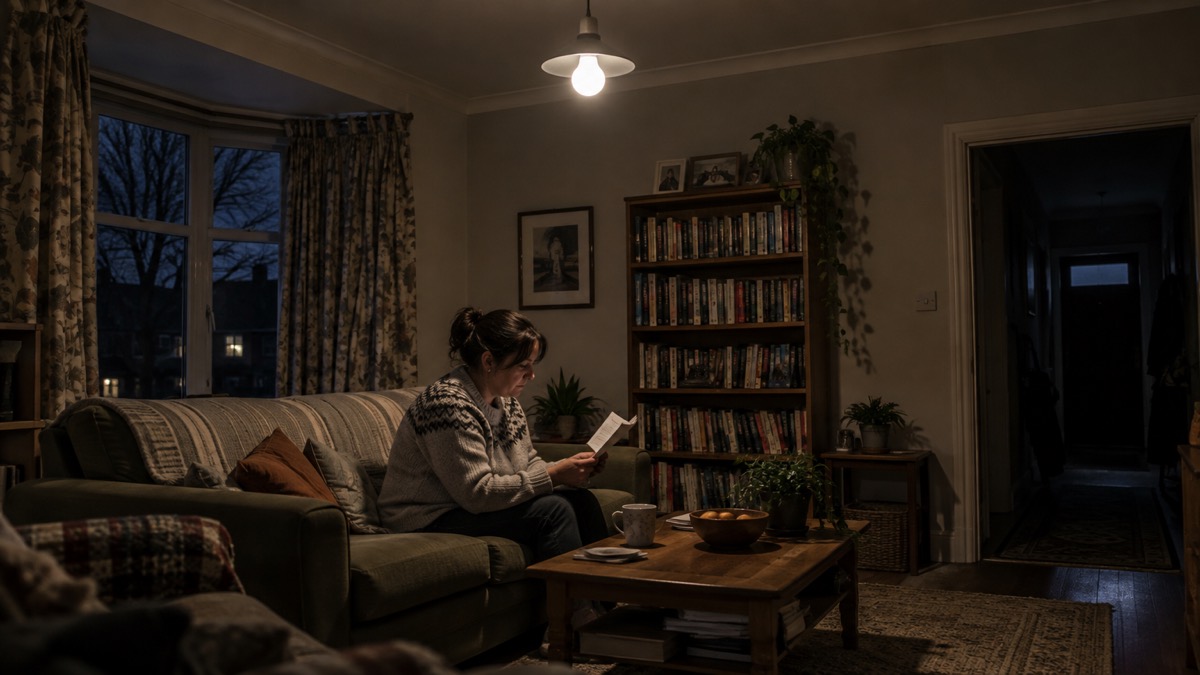
Fitting is the same as changing any bulb. The maker's instruction is to screw the bulb into any standard light fixture as you would any other bulb, and the bulb lights whenever the fixture or wall switch is turned on1. The base is E27, the standard large screw fitting used across UK homes1.
Before you buy or fit any replacement bulb, the independent safety body Electrical Safety First advises making a note or taking a photo of the rating in watts and voltage of the bulb you are removing, and of what type and size of connection it has, push fit or screw type6. It warns that an incorrect wattage or voltage, as well as the wrong type of lamp, can lead to overheating and potential fire, so the details should match the ones you are replacing6. Electrical Safety First also says to use the correct bulb type for your lamp, with a fit that is perfect rather than forced or loose7. Cleveland Fire Brigade's lighting safety advice is the same: ensure bulbs are the correct size and wattage for the lamp or light8.
In practice, check three things before fitting:
- The base. The NEBO bulb is E27. If your fitting is a small screw (E14) or a bayonet, it will not fit, and forcing it is exactly what the safety guidance warns against1.
- The wattage. The bulb is rated 8W at 220-240V, 50/60Hz1. Check the maximum wattage marked on the fitting.
- The enclosure. The maker states the bulb is not suitable for enclosed luminaires1. A fitting with a sealed glass or plastic cover traps heat, and this bulb is not designed for that.
Once it is in, switch it on and leave it on. The bulb charges whenever the fixture or wall switch is on, so the fitting you use most evenings is the natural home for it. If you have a light that is on for hours at a time, in a hallway, living room or kitchen, that is the one that will keep the battery topped up without you thinking about it.
Backup modes: from 500 lumens for 2 hours to 80 lumens for 12 hours
The bulb does not hold one brightness in a cut. The maker gives three backup modes, and the trade-off is straightforward: the brighter the light, the shorter it lasts.
| Mode | Brightness | Run time | Beam distance |
|---|---|---|---|
| Backup high | 500 lumens | 2 hours | 18 metres |
| Backup medium | 185 lumens | 6 hours | 9 metres |
| Backup low | 80 lumens | 12 hours | 16 metres |
All figures are the maker's1. The maker summarises the bulb as providing up to 12 hours of emergency lighting during outages1.
How you use those modes depends on the cut. For a short interruption, the brightest setting is fine and gives you a properly lit room. For a cut that stretches into the evening, drop to medium or low early rather than running high until the battery is flat. Eighty lumens is not bright, but it is enough to move around a room safely, and twelve hours will carry you through a night.
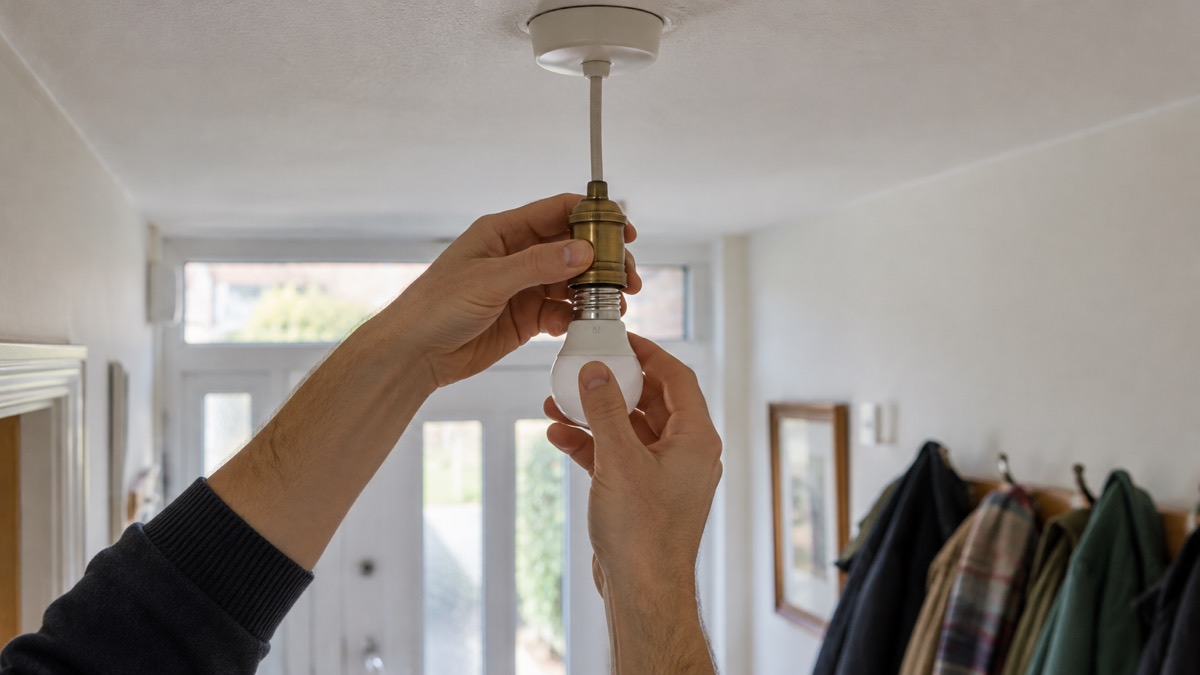
It helps to know what else is happening in the house. If you rely on a landline rather than a mobile, or live somewhere with no signal, your landline provider should offer you a solution such as a battery back-up unit so you can still make emergency calls during a power cut, and that back-up must last at least one hour, though some providers have units that last up to seven hours9. Medical equipment users are advised to have backup power sources that keep vital equipment running for several hours, checked and maintained regularly10, and one network operator's leaflet asks that backup systems work properly and have a battery lasting at least 3 hours during a power cut11. A bulb is a comfort and a safety aid; it is not backup power for equipment.
Everyday brightness: 850 lumens with 360-degree light
When the mains is on, the bulb is an ordinary household light. The maker gives 850 lumens in fixture high mode, with a beam distance of 24 metres1. For a domestic ceiling light that is a normal, comfortable level of light rather than a dim emergency glow.
The maker describes the light distribution as 360-degree lighting, dispersing light in all directions simultaneously and eliminating shadows and dark spots1. In a ceiling fitting that is what you want: light that fills the room rather than a bright patch on one wall. It is the same principle that makes a lantern better than a torch for lighting a room, which is covered in Lantern or Torch: Which Lights a Room Better?.
Two practical points follow from the everyday figures. First, 850 lumens is bright enough that you will notice if the bulb is in a fitting you use at night, so put it where that light is useful rather than in a spare room. Second, the bulb is non-dimmable1. If your fitting is on a dimmer circuit, this is not the bulb for it; keep a dimmable bulb there and put the NEBO bulb in a fitting with a standard switch.
If you want to compare the brightness and run time figures with other lights, Lumens, Beam Distance and Run Time Explained sets out what the numbers mean in a room. The short version is that lumens measure how much light comes out and beam distance measures how far it carries; a bulb in a ceiling rose is judged on the first, a torch on the second.
Charging: leave it on for 12 hours after first fitting and after every outage
The maker's charging instruction is simple and worth following exactly: leave the bulb on for 12 hours to fully charge on first use, or after a power outage1. That is the whole charging routine. There is no separate charger and no cable.
The reason to be deliberate about it is that the bulb only charges while the fitting is switched on. After a cut, the battery will have been drained by however long the bulb ran in backup mode, so switch it on and leave it on for the full 12 hours before you rely on it again. If the fitting is one you normally switch off at the wall, make an exception for that day.
The wider safety advice on rechargeable lithium ion devices applies here too, and it is consistent across the fire and rescue services and the independent safety bodies:
- The National Fire Chiefs Council advises always using and charging a product in accordance with the manufacturer's guidance, including advice on charging times, and unplugging devices once they are fully charged12.
- Electrical Safety First advises unplugging a device after charging, not leaving it on prolonged charge when not in use, and ensuring it is uncovered and in a well-ventilated environment when charging13.
- The London Fire Brigade advises only charging items and batteries during the daytime and unplugging once charged15.
- Wiltshire and Swindon Prepared, in an electrical safety reminder, advises never leaving a device on charge when you are out of the house or asleep, following the manufacturer's instructions for charging times, and always unplugging the charger once it is finished16.
For this bulb the maker's own instruction takes precedence on duration: 12 hours on first use and after an outage1. The general advice still shapes how you do it. Charge it while you are at home and awake, in a fitting that is not covered, and do not leave it on charge indefinitely once that 12 hours is done if you do not need the light on.
Where the bulb must not go
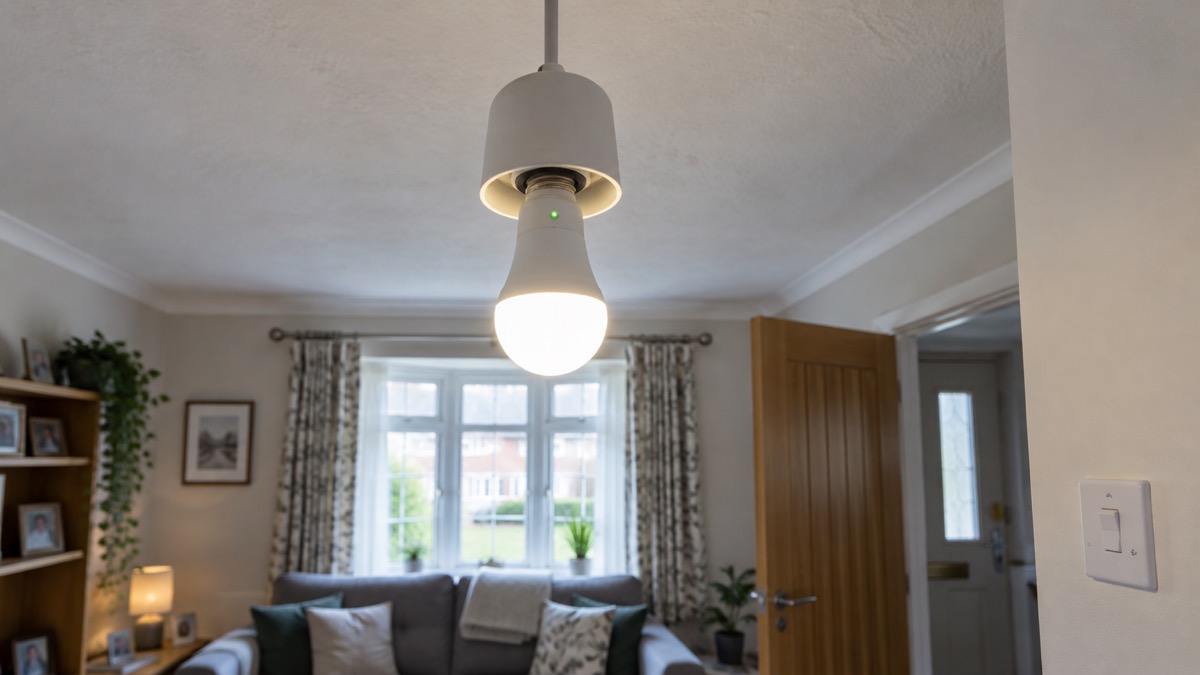
The maker gives one clear restriction: the bulb is not suitable for enclosed luminaires1. An enclosed fitting is one with a sealed cover over the bulb, common in some bathroom and hallway lights. Heat builds up inside and the bulb is not designed for it. If you cannot see the bulb once it is fitted, check the fitting's instructions before using this one in it.
The second restriction is the dimmer. The bulb is non-dimmable1, so a dimmer circuit is not the place for it. A dimmer that is turned down may not deliver the power the bulb expects, and the maker does not list dimmer operation as supported.
The third is about where the fitting sits in your home. The bulb is suitable for damp locations1, so a bathroom is within what it is built for. Damp rooms still need care with the switch: Electrical Safety First says a ceiling-mounted pull-cord switch is a better option than a typical wall light switch because of dampness and wet hands18. Keep the bulb in a fitting appropriate to the room and use the pull cord.
Beyond the maker's own limits, the fire services' advice on lithium ion devices applies to where the bulb is charged. The National Fire Chiefs Council advises not charging devices in hallways, landings or near doors where they could block your escape12. The London Fire Brigade gives the same warning for batteries and chargers19. The Scottish Fire and Rescue Service advises against charging lithium ion batteries in hallways or communal areas that serve as escape routes17. A ceiling light in a hallway is a common place for a bulb like this, so think about it: if the hallway is your only way out, a fitting in a living room or kitchen is the safer home for the bulb.
Battery and specifications
The bulb's specifications are set out by the maker1. They are worth keeping to hand, because they decide what the bulb can do and what you should not attempt.
| Specification | Maker's figure |
|---|---|
| Product type | Rechargeable emergency LED bulb with internal battery |
| Base | E27 |
| Everyday brightness | 850 lumens (fixture high) |
| Everyday beam distance | 24 metres |
| Backup high | 500 lumens, 2 hours, 18 metres |
| Backup medium | 185 lumens, 6 hours, 9 metres |
| Backup low | 80 lumens, 12 hours, 16 metres |
| External power input | 100-240VAC, 50/60Hz, 8W |
| Rated output | 8W at 220-240V, 50/60Hz |
| Battery | Lithium ion, 18650, 3.7V, 2000mAh, 7.4Wh |
| Battery serviceable | No, the battery is not user serviceable |
| Construction | ABS (Acrylonitrile Butadiene Styrene) |
| Dimmable | No |
| Enclosed luminaires | Not suitable |
| Damp locations | Suitable |
The battery is the part that matters most. It is a single 18650 lithium ion cell rated 3.7V, 2000mAh and 7.4Wh, and the maker states plainly that it is not user serviceable1. Do not open the bulb, do not try to swap the cell, and do not use a second-hand battery in it. The London Fire Brigade advises avoiding second-hand batteries20.
On voltage, the bulb is comfortable on a UK supply. The declared voltage and tolerance for a UK electricity supply is 230 volts, -6%, +10%, which gives an allowed range of 216.2 volts to 253.0 volts21. UK Power Networks gives the same standard voltage of 230 volts for a single-phase supply and the same tolerance range of 216.2 volts to 253 volts22. The bulb's input of 100-240VAC sits inside that range1.
The ABS body is a robust thermoplastic known for strength and impact resistance1. That is a materials fact rather than a promise about drops; treat the bulb as you would any other.
Using it well in a long outage, and where to get help
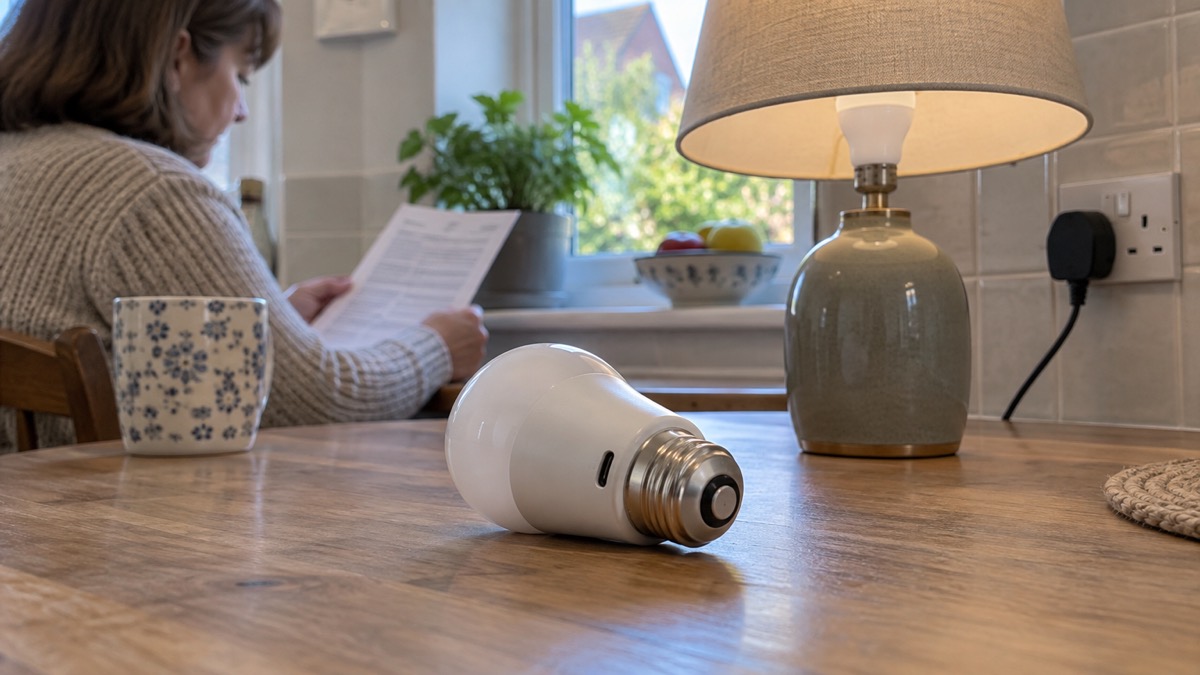
A bulb in a ceiling rose is one light in one room. In a long cut, plan around that. Use the lowest backup setting you can see by, keep a torch for moving between rooms, and remember that the bulb will need 12 hours on the mains to recharge once power returns1. If the cut is planned, you can charge it beforehand by leaving the fitting on.
For households with someone older or disabled, lighting is part of a wider plan. Network operators run a Priority Services Register for customers who need extra support, and the Energy Networks Association sets out how care and assisted living providers should consider backup power for equipment such as air beds and ceiling hoists23. If that applies to you, register with your network operator before you need it. Lights for Older and Disabled People in a Power Cut covers the practical side.
The Ready Scotland emergency kit advice is to include a battery-operated torch and spare batteries, or a wind-up torch24. That is the baseline every household should have, whatever else is in the cupboard. A rechargeable bulb adds a light that stays on without anyone having to find it, but it does not remove the need for a torch.
For more on the wider subject, Power Failure Lights and Rechargeable Emergency Bulbs covers the range of bulbs and plug-in lights, and Lighting Your Home Safely When the Power Goes Off sets out what to do room by room. If you are choosing between a bulb, a lantern and a torch, Emergency Lighting at Home: Torches, Lanterns and Candles is the place to start. The maker's own product information is at Nebo.
Sources (25)
- Blackout Backup Emergency LED Bulb, NEBO, 2026-10-25
- Power cuts, Scottish Fire and Rescue Service, 2026-10-25
- Lighting factsheet, Suffolk Fire and Rescue Service, 2014-01-09
- Strong winds and heavy rain warning information and advice, nidirect, 2026-01-27
- Your planned power cut explained, SSEN, 2026
- How to avoid a costly lockdown DIY disaster, Electrical Safety First, 2026-10-25
- Lamps, Electrical Safety First, 2026-10-25
- Lighting safety, Cleveland Fire Brigade, 2022-11-12
- UK transition from analogue to digital landlines, GOV.UK, 2023-01-06
- FAQs, Electricity North West, 2026-10-25
- Customer leaflet, SP Energy Networks, 2025-06
- Lithium-ion batteries, National Fire Chiefs Council, 2026-10-09
- Chargers, Electrical Safety First, 2026-10-26
- Power banks, Electrical Safety First, 2026-10-26
- Digital easy read fire safety booklet, London Fire Brigade, 2026
- Reminder not to cut corners with electrical safety this Christmas, Wiltshire and Swindon Prepared, 2026-10-25
- Lithium-ion batteries, Scottish Fire and Rescue Service, 2025-11-27
- Bathroom safety, Electrical Safety First, 2026-10-25
- Batteries and chargers, London Fire Brigade, 2026-10-25
- E-bike conversion kits fire risks and safety advice, London Fire Brigade, 2026-10-25
- Voltage changes, SP Energy Networks, 2026-10-26
- Voltage changes in your home or business, UK Power Networks, 2026-10-25
- Care and assisted living providers, Energy Networks Association, 2026-10-25
- Emergency kit, Ready Scotland, 2026-10-22
- Carbon monoxide, Health and Safety Executive, 2026