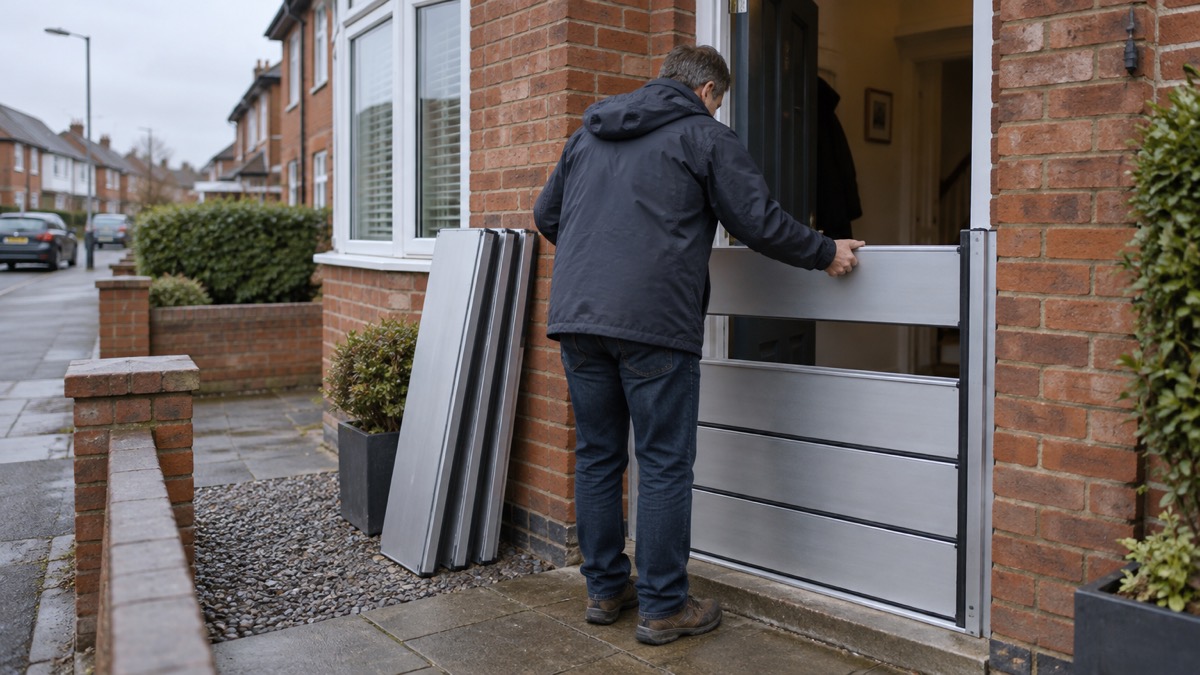
A Nautilus 200 is a demountable aluminium flood barrier for a doorway. It is not a flood door and it is not a sandbag wall: it is a set of rails fixed to your door opening and a stack of 200mm boards that slot in when a flood is forecast, then come out and go into store once the water has gone. The distributor describes it as a watertight aluminium barrier that can be quickly and safely deployed before a flood, and says the system has been installed on over 1000 properties across the U.K and internationally1.
If you are weighing one up, the things that decide it are the doorway, not the brand. Each board is 200mm high and 16mm thick, weighs 2.68 kg per metre, and carries EPDM rubber seals to keep water out1. The rails fix either between the reveals of the opening or onto the outer face of the brickwork, and you build the height you need one 200mm board at a time1. The distributor states the barriers comply with BSI Standard PAS1188 and BS851188 for demountable and building aperture flood defence barriers1.
The single most useful thing to know before you order is that this is a made-to-order product with a lead time, and that the standard online kit is for flat, smooth ground and does not include a ground strip1. Order in good time, check your threshold, and read the fitting options before you commit.
What the Nautilus 200 is, and where a doorway barrier fits
A doorway barrier is one of a family of property flood products. Official guidance groups sealable air bricks, flood doors, demountable flood barriers and flood boards together as the measures a household can fit to keep water out2. Some of these are permanent, such as a watertight PVC flood door, and some are demountable, such as barriers for doors and windows3. The Nautilus 200 is in the second group: it goes up when you need it and comes down afterwards.
That distinction matters when you are choosing. A demountable barrier lets you use the doorway normally for most of the year and put the protection in place only when a warning comes. The trade-off is that it only protects you if it is fitted before the water arrives, and only if someone is at home to fit it. Official guidance is blunt about the timing: put temporary flood protection measures in place as soon as you get a flood warning, or before if you are not likely to be home at the time, and always remove them once the flood water has gone to help the property dry out4.
The Nautilus 200 itself is described by its distributor as suitable for residential and commercial properties, for doorways, or for large lengths with demountable posts1. The listing shown is a single door barrier measuring 0.6m high by 1m wide, and the distributor notes that different heights and lengths are available1. It is one option among several for a doorway; if you are still deciding between approaches, the guide to door flood barriers: types and how to choose sets the choices out side by side, and door barriers or flood doors for a home covers the permanent alternative.
Specifications: 200mm boards, 16mm thick, 2.68 kg per metre
The barrier is built from identical boards, and the board is the unit that decides everything else: the height you can reach, the weight you lift, and how much storage space the kit takes when it is down. The distributor's figures for its own product are set out below1.
| Specification | Figure | What it means for you |
|---|---|---|
| Board height | 200mm per panel | Each board adds 200mm of protection; you choose the stack height1 |
| Board thickness | 16mm | Slim enough to store flat against a wall or in a shed1 |
| Board weight | 2.68 kg per metre | A one metre board is light enough to lift and slot in by hand1 |
| Seals | EPDM rubber on all seals | Flexible rubber that seals the joints between boards1 |
| Compression bolts | LM 26, A3 stainless steel | Corrosion-resistant bolts that clamp the barrier1 |
| Ancillary parts | Die cast aluminium | The compression and ancillary parts are cast aluminium1 |
| Listed size | 0.6m high x 1m wide | The single door barrier in this listing1 |
| Height options | Different combinations available | Because each board is 200mm high, you build the height you need1 |
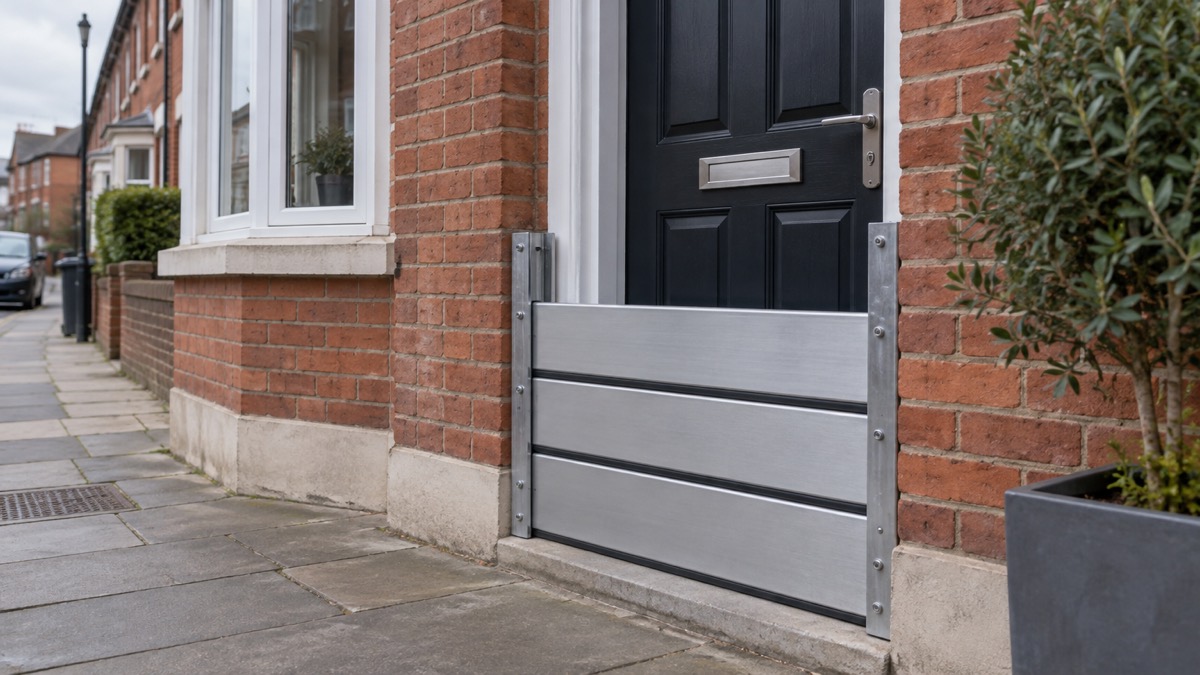
Two details are worth pausing on. The first is the weight: at 2.68 kg per metre, a board is a one-person lift, which matters if you are fitting the barrier alone in bad weather1. The second is the seal. The distributor says a thick rubber seal reduces any groundworks required, which is the maker's claim about how the bottom of the barrier meets the ground1. It does not remove the need for a flat, smooth surface, which is what the standard kit is described for1.
If you want the wider picture on what these standards mean and how products are tested, the guide to kitemarked flood products and PAS 1188 explained covers it.
Certified to PAS 1188 for building aperture flood barriers
The distributor states that the barriers have been rigorously tested and comply with BSI Standard PAS1188 and BS851188 for demountable and building aperture flood defence barriers1. In plain terms, PAS 1188 is the standard that covers temporary products used to close a building opening against floodwater, which is exactly what a doorway barrier does.
Why does the standard matter to a household? Because official guidance in Wales tells people to choose BSI kitemark certified flood protection products that meet the British standard for quality and safety5. That is the independent voice in this decision: a certification is something you can check, rather than a claim you have to take on trust. The distributor's statement of compliance is the maker's own description of its product; if you need the certificate itself, for an insurer or a grant application, ask the supplier for it with your order.
Certification is not the whole story, though. Official guidance notes that alternative products, such as barriers, often provide more effective long term protection, are more easily deployed and have greater reliability when fitted correctly6. The phrase that carries the weight is "when fitted correctly". A certified barrier fitted to a damaged reveal, or left with a perished seal, will not perform as tested. That is why the fixing method and the annual check matter as much as the certificate.
Reveal fix or face fix: how the rails go on your doorway
The barrier needs rails fixed to your doorway, and there are two ways to do it. The distributor explains both: Reveal Fix means the rails are fixed in between the reveals (brickwork) of the doorway, and Face Fix means the rails are fixed onto the outer face of the brickwork1. The barriers are available in either option, depending on the aperture and location1.
Which one suits you depends on the shape of your opening rather than on preference.
- Reveal Fix sits inside the door opening, between the brickwork reveals. It suits an opening with a clean, square recess where the rails can be fixed to the sides.
- Face Fix sits on the outer face of the wall. It suits an opening where the reveal is not suitable, or where the wall face gives a better fixing.
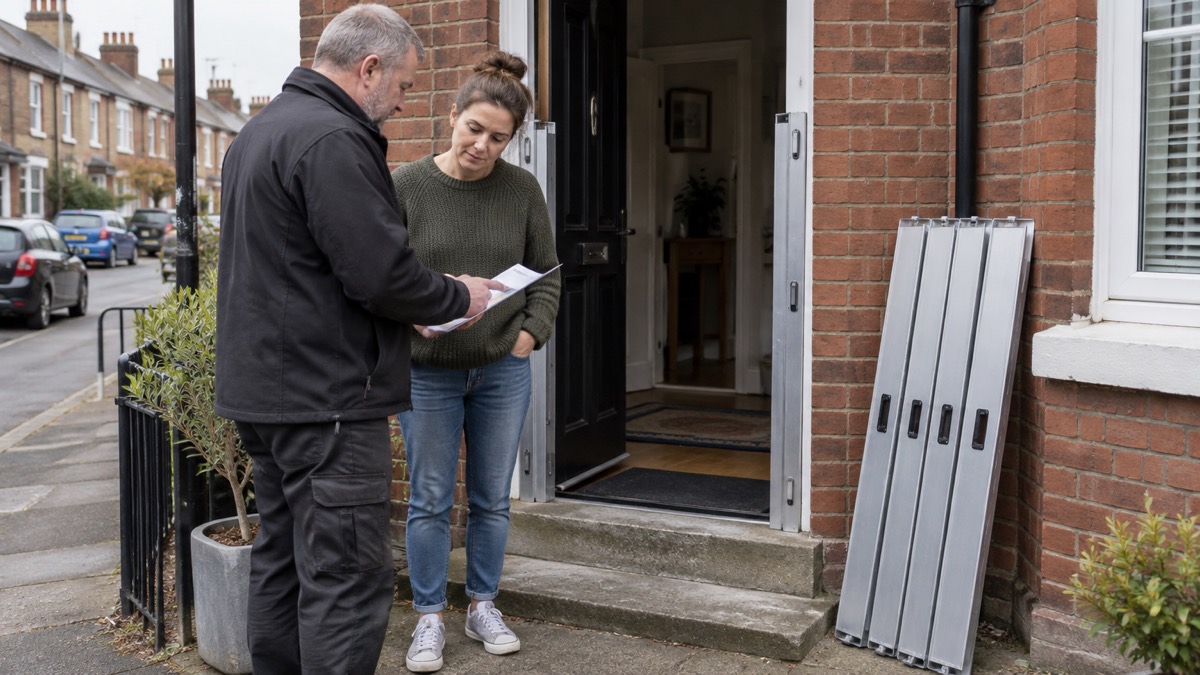
The choice is made when you order, so measure carefully and, if you are unsure, ask the supplier which fixing suits your aperture and location1. Getting this wrong is not a small matter: the rails are what hold the boards against the pressure of the water, and they are fixed once.
While you are looking at the doorway, it is worth checking the rest of the opening. Official guidance suggests checking access points for pipes, such as those for a washing machine, for gaps and filling them7. A barrier across the door is only as good as the rest of the wall around it.
Building up the height you need, 200mm at a time
The barrier grows one board at a time. Each board is 200mm high, and the distributor says that because of this, different height combinations are available1. You decide the height you want to protect to, and the stack of boards gives you that height in 200mm steps.
This is where a doorway barrier differs from a sandbag wall. Official guidance describes the most basic method as a strong wooden or metal barrier secured flat against the wall or frame surrounding a door or window, with the pressure of floodwater itself helping to seal the barrier8. A board system works on the same principle but with engineered seals and compression bolts instead of weight and sheeting. The boards stack, the seals close the joints, and the bolts clamp the stack.
How high should you go? That depends on your flood risk, which is why the first step is to understand what you are protecting against. The guide to checking your home's flood risk by postcode explains how to find the predicted depths for your address, and types of flooding: river, sea, surface water and groundwater explains why the source of the water changes how deep and how fast it arrives. Order the height that matches your risk, not the height that happens to be in stock.
Putting the barrier up before a flood and taking it down after
Fitting the barrier is one task in a sequence, and the sequence is what keeps you safe. Official guidance for the moments before a flood sets out the actions to take: turn off electricity, water and gas supplies; lift curtains over rails above flood water levels; use door guards or air brick covers; move important items to safety; lift rugs and smaller furniture upstairs or on to tables or worktops; get your flood kit together; move pets and vehicles away from flood areas; and make sure mobile phones or devices are charged10.
The barrier goes in as part of that list, not instead of it. The distributor says the system is extremely user-friendly and fast to deploy, and that once the flood has passed it is easily dismantled and stored away, ready for the next event1. Official guidance says to use flood protection products if you have them, for example flood barriers or air brick covers11, and to use flood barriers to divert water away from your home and prevent it entering12.
A sensible order for the day a warning comes:
- Get the boards and rails out of store and check the seals are clean and undamaged.
- Fit the boards into the rails to the height you need, and tighten the compression bolts.
- Turn off electricity, water and gas supplies before flood water enters your home13.
- Move important items, rugs and smaller furniture upstairs or onto tables and worktops10.
- Get your flood kit together and charge your phone10.
- Move pets and vehicles away from flood areas10.
Taking it down matters as much as putting it up. Official guidance says to always remove temporary flood protection once the flood water has gone, to help the property dry out4. Wait until water levels outside are lower than inside before using a bucket or pump to remove water14, and remove any coverings on airbricks once the flood has passed, as ventilation is essential to dry wall cavities8. The full sequence for the days after is in after a flood: returning home safely and cleaning up safely after floodwater.
What the standard kit leaves out
The standard online kit is not the whole installation. The distributor states that the online purchase includes the barrier rails and boards for a standard installation on flat and smooth ground, and that a ground strip is not included1. That single sentence decides whether the barrier will work at your door.
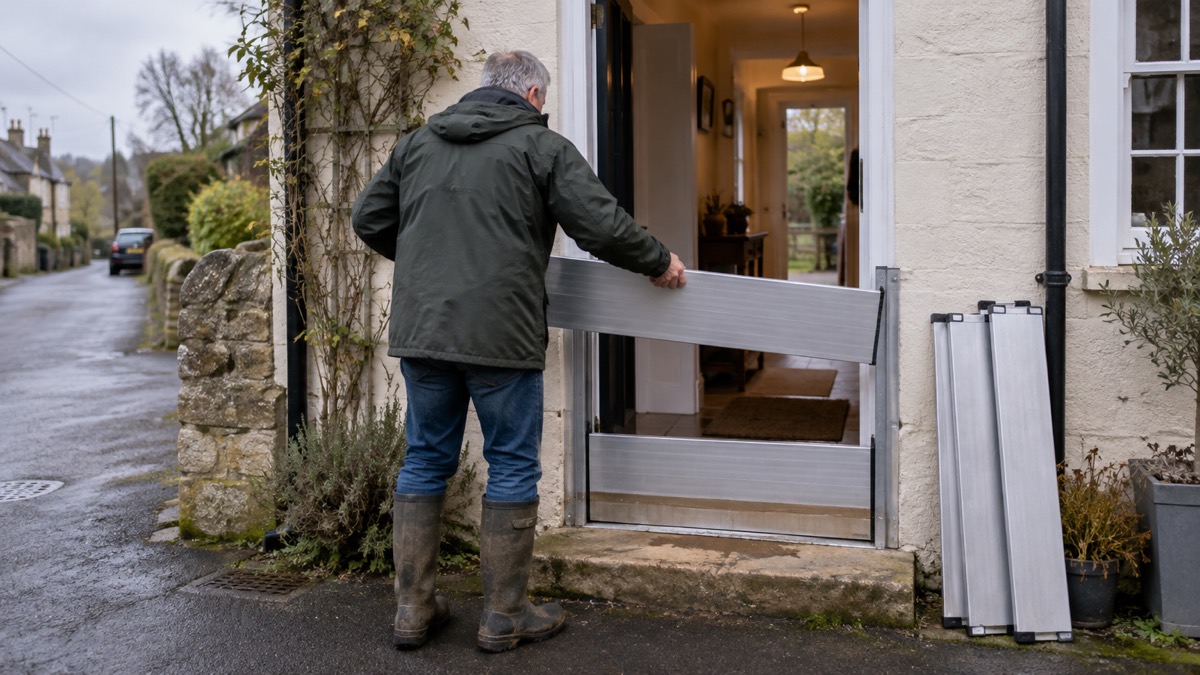
If your threshold is flat and smooth, the standard kit is described for your situation. If it is uneven, sloped, or has a raised lip or step, the boards need something to seal against at the bottom, and the ground strip is the part that does it. Ask the supplier before you order, because the kit as sold is described for flat, smooth ground only1.
The other thing the kit does not include is the rest of your flood preparations. A barrier across the door is one measure; official guidance lists others that work alongside it, including fitting flood resistant valves to drains and water pipes, which close under pressure and stop sewage and dirty water flooding into your home or business15. Floodboards themselves can be washed, stored and used again16, and the same is true of a demountable barrier, provided it is stored dry and checked before the next season.
- Ground strip: not included in the standard kit; ask about it if your threshold is not flat and smooth1
- Drain valves: fit flood resistant valves to drains and water pipes to stop backflow15
- Airbrick covers: use door guards or air brick covers as part of the same routine10
- A flood kit: torch, blankets, waterproof clothing, wellingtons, a battery-powered radio, first-aid kit, rubber gloves and key documents, kept upstairs if possible17
Ordering, installation and annual maintenance checks
The barrier is manufactured to order, and the distributor states that turnaround time is usually 2 to 4 weeks from receipt of order1. That is the maker's own figure, so treat it as a guide. The practical consequence is simple: order well before the wetter months, not when a warning is already in force.
On installation, the distributor says the price is for supply only, but that it offers a full installation service1. If you are having the rails fitted professionally, the guide to property resilience surveys and professional installation explains what a survey involves and what to ask. If you are buying products and looking for suppliers, Westminster City Council advises buying flood protection products and finding service providers on the National Flood Forum's Blue Pages Directory18.
Maintenance is the part people forget. The distributor offers an ongoing optional annual maintenance check1. That matches what households who have been through a flood report: one case study advises having pumps tested each year and taking out a maintenance contract for flood doors and flood barriers, so that the gaskets get checked annually19. A perished seal is exactly the failure a barrier cannot survive, so put the check in the diary for the same month each year.
For the routine itself, storing and checking flood barriers: a checklist sets out what to inspect and when. And if you want to know when a warning is likely, flood alerts, flood warnings and severe flood warnings explains the three levels, while how to sign up for free flood warnings shows how to register. In England the Floodline service runs 24 hours20; for the numbers in each nation, see Floodline numbers for England, Scotland and Wales.
Sources (20)
- Single Door Barrier Nautilus 200, Flood Protection Solutions, 2018-08-29
- How to prepare for flash flooding, London Assembly, 2026-10-25
- Property flood resilience questions and answers, Argyll and Bute Council, 2026
- Before, during and after a flood, Suffolk County Council, 2021-05
- Preparing for a flood, Natural Resources Wales, 2026-10-29
- Flooding FAQs, SEPA, 2026-10-29
- Getting back into your home following flooding, Surrey County Council, 2026-10-28
- Damage limitation guide, Dover District Council, 2001-09
- Preparing for flooding, Surrey County Council, 2026-10-29
- Personal flood plan, GOV.UK, 2023-11-15
- Help during a flood, GOV.UK, 2026-10-25
- Preparing for a flood, London Fire Brigade, 2026-10-29
- Flood evacuation checklist, Croydon Council, 2025
- After a flood: flood recovery leaflet, Tewkesbury Borough Council, 2023
- Adapting your home or business to the risk of flooding, GOV.UK, 2009-10-01
- Preparing your home for flooding, Cotswold District Council, 2020
- Flooding advice, Merseyside Fire and Rescue Service, 2026-10-29
- Plan and prepare for floods, Westminster City Council, 2026-09-03
- Property flood resilience case studies, Derbyshire County Council, 2024
- After a flood, GOV.UK, 2026-10-25