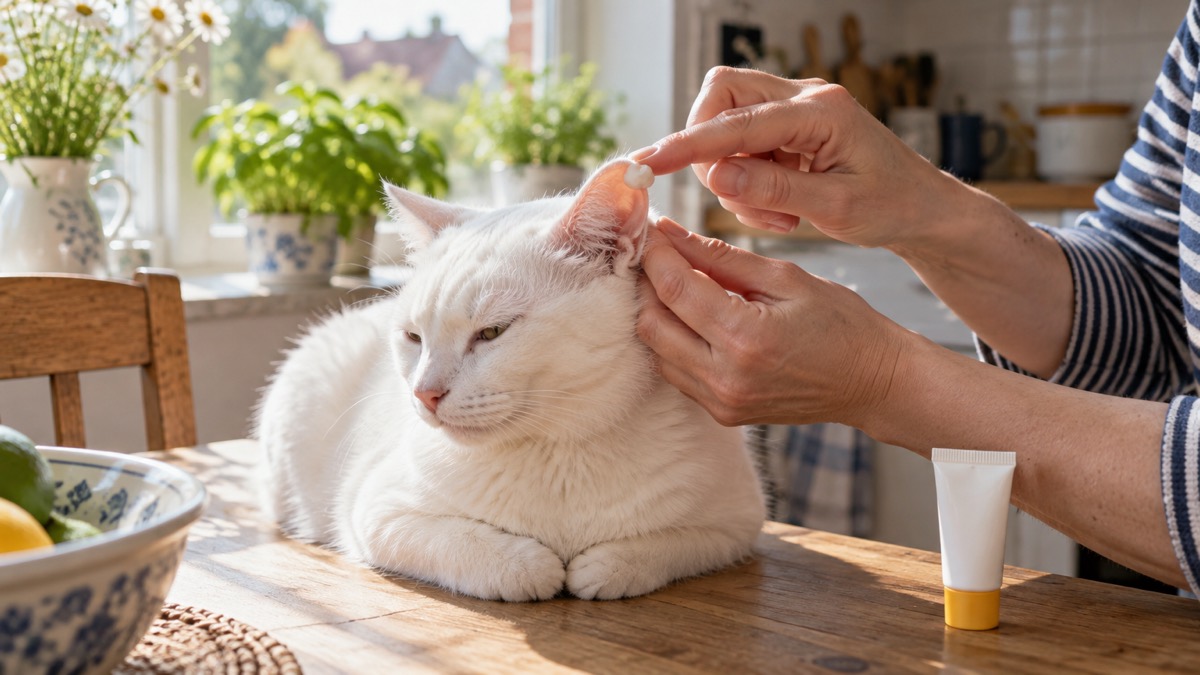
Yes, dogs and cats can get sunburnt. Their skin burns in the same way ours does, and the pets most at risk are those with little to shield them: pale or white fur, a thin or patchy coat, or areas of pink skin showing on the nose, ears, belly or groin. Short-haired dogs, dogs with light hair, white or pale cats and cats with unpigmented white noses or ears are all more vulnerable1.
The places that burn are the places with little or no fur. For dogs that means the bridge of the nose, the belly and the groin, and the ear tips3. For cats it is the ears and nose, and the ear tips in particular1. The protection is straightforward: keep pets out of the sun when the rays are strongest, between 11am and 3pm, and use a pet-safe sun cream on exposed skin4.
Sunburn is not only sore for a few days. Continued overexposure dramatically increases the risk of developing skin cancer6. Repeated burning of thin-skinned areas is the pattern to avoid, which is why shade, timing and a safe cream matter more than a one-off application on the hottest day of the year.
Which pets burn, and where
Any dog or cat can burn, but the risk is not spread evenly. The RSPCA sets out the dogs most likely to suffer: short-haired breeds, dogs with light hair, dogs with a thin or patchy coat, and dogs with areas of pink skin visible on their face or nose2. The Met Office makes the same point for both cats and dogs, noting that breeds with lighter-coloured or finer fur may benefit from pet-safe sun cream, especially on the ear tips, which are prone to sunburn5.
For cats, the RSPCA is specific. White or pale-coloured cats, cats with unpigmented white noses or ears, and cats with sparse hair on their ears are most vulnerable, because they have little pigment or hair to protect them from the sun's harmful rays1. Ears and noses are where a cat is most likely to get burnt1.
The skin that burns is the skin with no fur over it. Blue Cross describes the areas with little to no fur, such as the bridge of the nose, belly and groin, as the most likely to get burnt, and lists the signs as red or pink skin, dry or cracked skin, and ears that curl at the edges3. The RSPCA advises applying sun cream to a cat's nose, the tips of the ears, the belly and groin, and anywhere that has thin to no fur10.
| Pet | Most likely to burn | Why |
|---|---|---|
| Short-haired dog | Nose bridge, belly, groin, ear tips | Little fur to screen the skin2 |
| Dog with light or patchy coat | Face, nose, any pink skin | Light hair and visible pink skin2 |
| White or pale cat | Ear tips and nose | Little pigment or hair for protection1 |
| Cat with sparse ear fur | Ear tips | Thin coverage on the ear1 |
Pet-safe sun cream: what to use and what to avoid
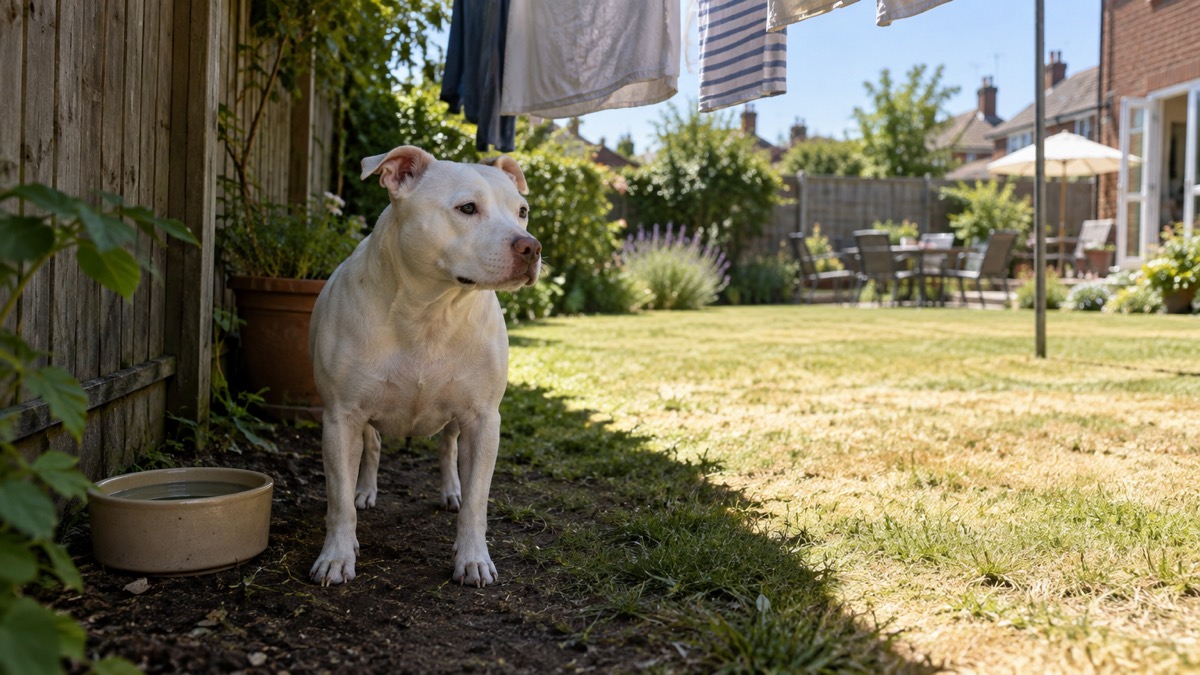
If you use a cream at all, it has to be one made for pets. The RSPCA is direct: do not be tempted to share your sun cream with your pets, because ours includes chemicals which can be toxic to cats and dogs7. Blue Cross gives the two ingredients to check for on the label: use a pet-safe sunblock that is zinc oxide or para-aminobenzoic acid (PABA) free3. Its separate guidance repeats the point, advising a sunblock product specifically for pets that does not contain zinc oxide or PABA, or covering vulnerable areas instead8.
Cats need particular care. If you are unsure which product to use on a cat, ask your vet: the RSPCA's advice for cats is to use pet-safe sun cream on exposed skin such as the ear tips and nose, especially for white or light-coloured cats, and to ask a vet which product to use1.
Applying it is simple. The Scottish SPCA advises a specially formulated sun cream on areas where your pet's fur is thin, meaning the nose, the ear tips and the tummy, ensuring the cream is pet safe2. Dogs Trust says the same for dogs: use pet-safe sun cream on exposed parts of your dog's skin, like the tips of their ears and nose11. Reapply as the maker directs, and cover vulnerable areas with a t-shirt where cream is not practical3.
Keep pale pets out of the sun between 11am and 3pm
The single most effective thing you can do is change when your pet is outdoors. Official heat advice converges on the same window. The National Heatwave Plan for England says to keep out of the sun between 11am and 3pm12. NHS Inform in Scotland says to stay out of the sun when the sun's rays are strongest, 11am to 3pm13. Cornwall Council advises keeping out of the sun between 11am and 3pm, when the UV rays are strongest, and walking in the shade where you can14. The Met Office says to keep out of the sun and avoid any exercise between 11am and 3pm when the sun is strongest15.
For dogs, that window is also when walks should stop. Derbyshire County Council's severe weather planning says: do not walk pets during the hottest time of the day, usually 11am to 3pm16. A Welsh council's hot weather guidance says not to exercise dogs in the hottest parts of the day, especially older pets, flat-faced breeds or dogs with known heart or lung problems, and to stick to early morning or late evening walks17. The RSPCA adds that you should not run or cycle with your dog when it is hot18.
Most dogs will be comfortable walking between 15°C and 25°C, depending on age, breed, size, coat length, amount of exercise and general health and fitness2. Above that, shift the walk to the ends of the day and keep it short. For cats, the job is to make the garden work: provide lots of shady spots for them if they like going outside1. Cats will often seek shade and drink more water to keep themselves safe in hot weather, so give them somewhere cool to go and water close by1.
Hot pavements, paws and the rest of the hot day
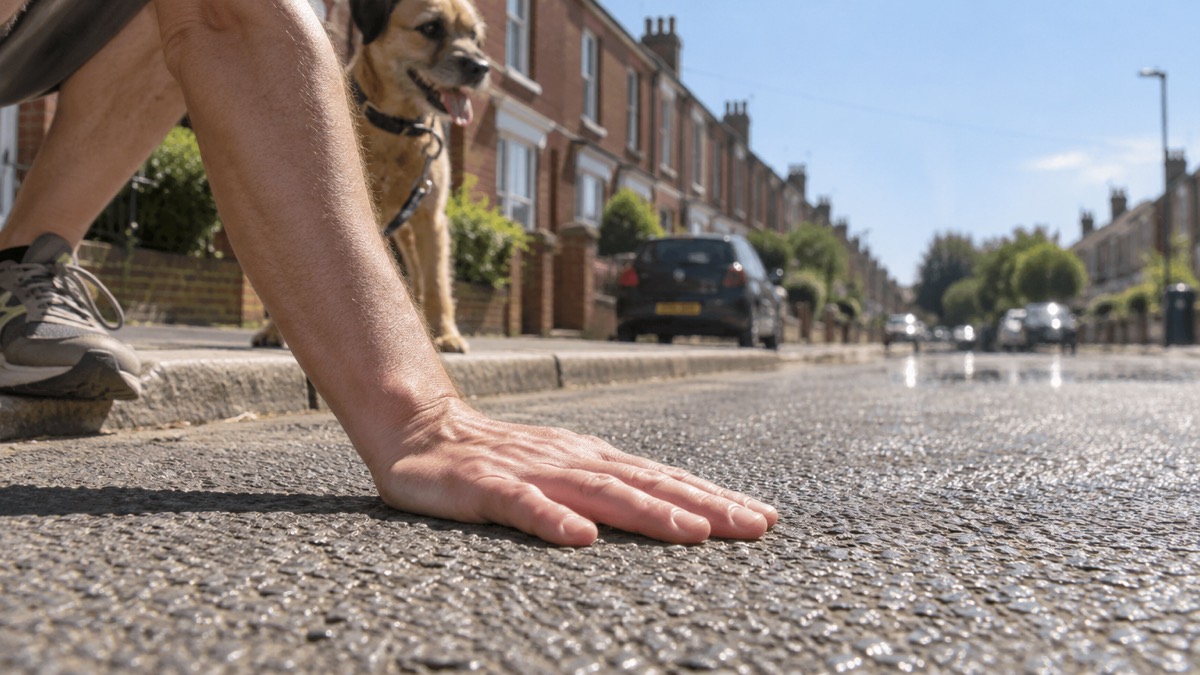
Sunburn is one of several ways a warm day harms a pet, and the others often need action sooner. Pavements are the common one. Devon County Council warns that surfaces such as tarmac, artificial grass, pavements and sand can become extremely hot and may cause burns to bare feet and pets' paws19. The Scottish SPCA gives the test to use before you leave the house: if you cannot hold your hand down on the tarmac for five seconds, then it is too hot for your dog's paws2. Blue Cross puts it as a general rule: if it is too hot for your hand, it is too hot for their paws3.
Signs of burnt paws include limping or refusing to walk, licking or chewing at the feet, pads that are darker in colour, missing part of a pad, and blisters or redness18. If you see these, keep your dog off hot ground and contact your vet.
Heatstroke is the more urgent danger, and it can develop alongside sunburn. Dogs Trust lists the signs: heavy or continuous panting even when they have stopped exercise, tongue hanging out more, squinty eyes, difficulty breathing, bright pink or red gums and lips, lethargy, drowsiness, stiffness, shade seeking, wobbliness, excessive drooling, vomiting and diarrhoea, collapse and seizures11. The RSPCA says to contact a vet immediately if you spot them18. Some dogs are at higher risk: flat-faced breeds such as English Bulldogs, Pugs and French Bulldogs, older dogs, puppies, overweight dogs, dogs with underlying health conditions or respiratory or heart diseases, larger breeds, and dogs not used to warm weather11. The Scottish SPCA adds overweight dogs, flat-faced breeds, dogs over 8 years old and dogs under 6 months old to the higher-risk groups2.
Dogs are 10 times more likely to experience heat-related illnesses when out in hot weather than overheating in cars, so the walk itself is the risk most owners face20. Dogs can overheat at any temperature, and at any time of year including winter11.
Why repeated sunburn matters: the skin cancer risk
Sunburn is damage, not just discomfort, and it adds up. The Met Office explains the mechanism: excessive UV radiation directly damages the DNA in your skin cells, and if this DNA does not correctly repair itself this can lead to skin cancer6. Its conclusion is blunt: continued overexposure dramatically increases the risk of developing skin cancer6. The same page notes that overexposure to the sun is equally dangerous, with effects ranging from mild sunburn to skin cancer, and that it does not have to be hot for the UV index to be high6.
The NHS makes the human parallel explicit, and it is the reason to take a pet's burn seriously rather than treat it as a minor annoyance. Sunburn increases your risk of skin cancer, it does not just happen on holiday, you can burn in the UK even when it is cloudy, and there is no safe or healthy way to get a tan21. Even brief exposure to the sun can cause sunburn and increase your risk of skin cancer22. For babies and children the NHS warns that their skin is much more sensitive than adult skin, and damage caused by repeated exposure to sunlight could lead to skin cancer in later life23. A pet's thin-skinned nose and ear tips are exposed season after season, which is why the advice is to prevent the burn rather than treat it.
For cats there is a named condition to watch for. Cats with white noses and ears can be affected by solar dermatitis, which causes the tips of the ears to go red and can be quite sore7. Sunburn in cats shows as red, sore skin in the affected area, with blistering and peeling10. The RSPCA says that if you notice this, make an appointment with your vet straight away10.
If your pet is already burnt
Get the animal out of the sun first, then cool the skin gently. The NHS advice for sunburnt skin is to get out of the sun as soon as possible, cool the skin with a cool shower, bath or damp towel, apply aftersun cream or spray, drink plenty of water, take painkillers such as paracetamol or ibuprofen, and cover sunburnt skin from direct sunlight until healed24. That is written for people, so use the cooling and covering principles for a pet and take veterinary advice on anything you apply to its skin.
The NHS also lists what not to do, and these translate directly to animals: do not use petroleum jelly on sunburnt skin, do not put ice or ice packs on it, do not pop blisters, do not scratch or try to remove peeling skin, and do not wear tight-fitting clothes over sunburnt skin24. For a pet, that means no ice packs on a sore nose or ear, no picking at peeling skin, and no fiddling with blisters.
If a cat shows the red, sore ear tips of solar dermatitis, or a pet's skin is blistered or peeling, make an appointment with your vet1. For burnt paws, or a dog that is limping or chewing at its feet, contact your vet18. And if there are any signs of heatstroke, contact a vet immediately18.
Cars, conservatories and other traps
The most dangerous hot-weather mistake is leaving an animal in an enclosed space. The RSPCA says never leave animals in cars, conservatories, outbuildings or caravans on a warm day, even for a short while8. Temperatures can quickly rise to 47°C (117°F) in these environments, which can be fatal1. The Northern Ireland executive's hot weather advice is equally plain: never leave animals inside a car on a hot day25. The Scottish SPCA adds that leaving an animal in a hot car can have fatal consequences and lead to prosecution2.
Conservatories and outbuildings catch people out because they feel like part of the house. They heat like a car. Treat a conservatory on a sunny day as you would a parked car, and keep pets out of it. The same applies to sheds, greenhouses and summerhouses for cats: check them before closing them up, because cats can find their way into warm areas and become trapped, too hot or dehydrated1.
If you are walking your dog and the day turns hotter than forecast, cut the walk short and head for shade and water. The Scottish SPCA suggests placing multiple bowls in different spots around your house and garden so your pet does not have far to go for a drink, and offering ice cubes with treats frozen into them, or frozen Kongs2. If you want your dog cooler in hot weather and to reduce the risk of heatstroke, it needs a shorter, thinner coat2. If your dog swims, do not push it too hard, as this can lead to it swallowing too much water and water intoxication2.
For the wider picture on keeping animals comfortable through a hot spell, see Keeping Dogs, Cats and Small Animals Cool in Hot Weather. If you are worried about a dog shut in a car, Dogs in Hot Cars: How Fast a Car Heats Up explains how quickly the temperature climbs, and What to Do If You See a Dog in a Hot Car sets out the steps to take. For cats specifically, How to Keep Your Cat Cool in a Heatwave goes further, and When Is It Too Hot to Walk Your Dog? covers the walk itself. If your pet is injured or unwell and you need out-of-hours help, Emergency Vets: Out-of-Hours Care and the 24-Hour Rule explains how to find it.
Sources (25)
- Cats and warm weather, RSPCA, 2026
- Dog care in summer, Scottish SPCA, 2026
- How to keep dogs cool in the summer heat, Blue Cross, 2023
- Tips for keeping older people cool, Met Office, 2026
- Hot weather and its impacts, Met Office, 2026
- Sunburn, Met Office, 2026
- How to care for your cat in the hot weather, Woodgreen, 2023
- How to keep pets cool in summer, Blue Cross, 2023
- Dogs in hot cars, Blue Cross, 2026
- Cats and Warm Weather | Cats Protection, Cats Protection
- Hot weather, Dogs Trust, 2026
- Heatwaves, Birmingham Women's and Children's NHS Foundation Trust, 2026
- How to stay safe in hot weather, NHS Inform, 2026
- Stay safe this summer, Cornwall Council, 2026
- Stay safe in extreme heat, Met Office, 2026
- Severe weather planning, Derbyshire County Council, 2026
- Adverse weather events, Llangattock Community Council, 2026
- Dogs in hot weather, RSPCA, 2026
- Staying well in hot weather, Devon County Council, 2026
- Heatstroke, RSPCA, 2026
- How to cope with hot weather, Keeping Well North West London, 2026
- Self care, NHS Cheshire and Merseyside, 2024
- Summer Safety :: Cheshire and Wirral Partnership NHS Foundation Trust, Cheshire and Wirral Partnership NHS Foundation Trust
- Staying safe over the summer, Healthier Together, 2026
- Hot weather advice, nidirect, 2026
 Pet Emergency Documents
 Storing Pet Food and Water
 Carer's Emergency Plan
 Pet Birds in Cold Weather
 Birds and Chickens in Heat
 Breaking a Car Window for a Dog
 Keeping a Cat Cool in a Heatwave
 Chocolate Poisoning in Dogs
 Christmas Hazards for Pets
 Dog Left Alone on a Hot Day
 Dog in a Hot Car
 Hypothermia in Dogs and Cats
 Dogs in Water or Coast Trouble
 Fireworks and Small Pets
 Fish in a Power Cut