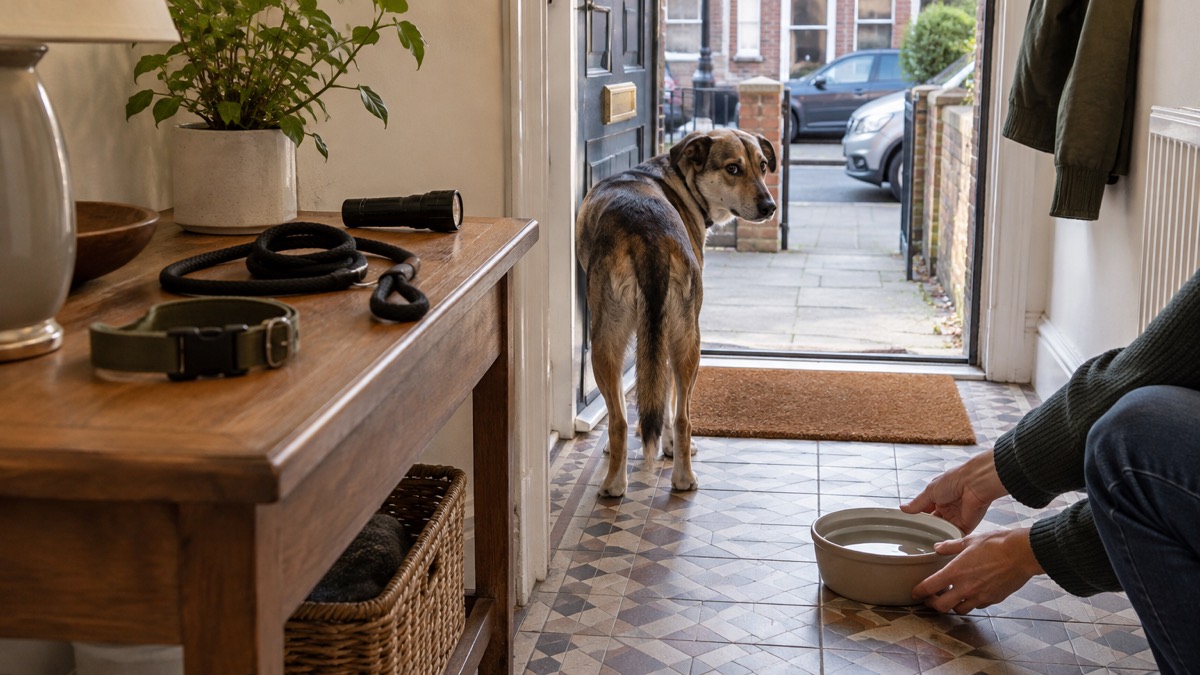
A dog on its own in the street is usually not far from home. The quickest way to get it back there is to look at the collar first: if there is a tag with a phone number, call it. If there is no identification, contact your local council's dog warden, who will scan the dog for a microchip and do their best to reunite it with its owner1. A local vet can also scan for a microchip2.
Most of what you need to do can be done from your phone, standing a safe distance from the dog. Do not chase it, do not corner it, and do not put your hands near its face. If the dog is calm and friendly, keep it safe and contained while you make the calls. If it is injured, approach only if it appears calm, and call the vet before you set off1.
The sections below take you through the collar, the council, the vet and the awkward cases: a dog that will not be caught, a dog that is hurt, and a dog whose owner cannot be found. If you have lost a dog yourself, the same services work in reverse, and the Pets and Animals in an Emergency: A Household Guide sets out how to plan ahead so a lost pet is easier to trace.
Check the collar first: call the number on the tag
The first thing to do is look, from a distance, at whether the dog is wearing a collar. If it is, and there is a phone number on the tag, call it. That single call is usually the end of the matter, and it is why the law and the advice are so clear that dogs should carry identification at all times. The Blue Cross advises that dogs wear some form of easily readable identification, at least a collar and tag, even in the house4. Official emergency guidance goes further and suggests fastening a current identification tag to your pet's collar, and, if you face evacuation, attaching the phone number of a friend or family member who knows how to contact you5.
If the dog has a collar but no tag, or the tag is worn blank, you cannot identify the owner from it. Do not take the collar off to read it more closely unless the dog is calm and clearly comfortable with you doing so. A collar can be a useful handle if you need to lead a willing dog to safety, but it is not a licence to grab a frightened animal.
If you cannot read a tag or there is no collar at all, move to the next step: the council. The same applies if the number on the tag does not answer. Leave a voicemail if you can, then report the dog so that the official route is running in parallel.
No identification: report the dog to the council
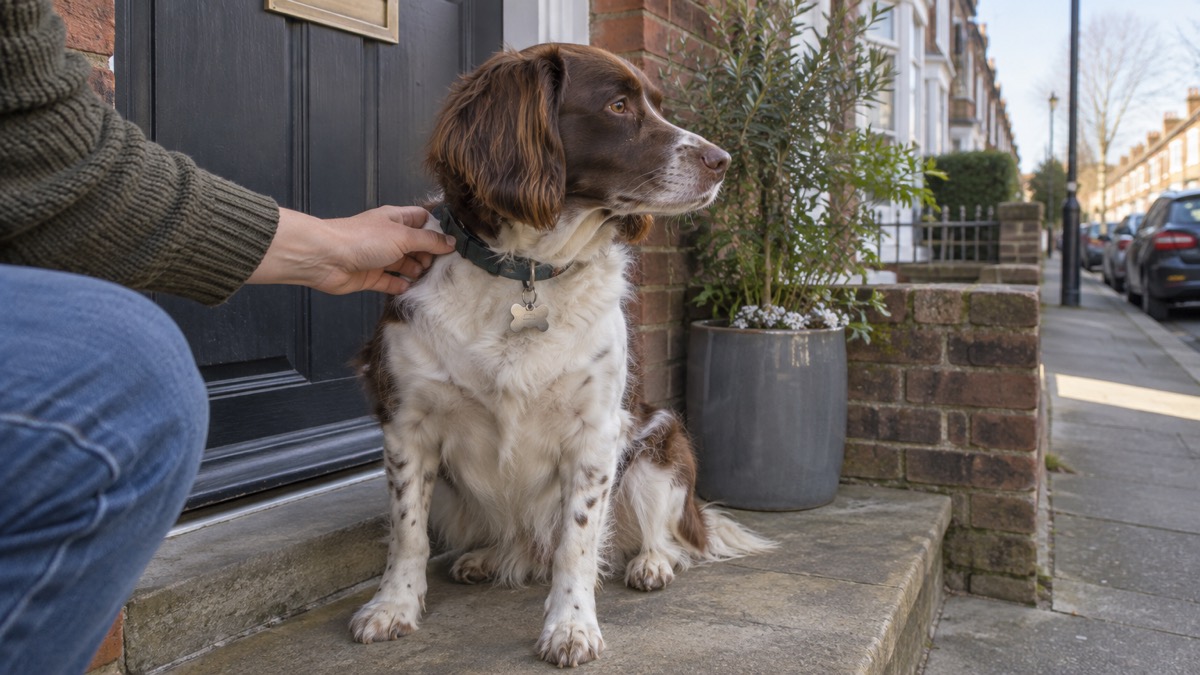
If there is no identification, contact your local council's dog warden. The PDSA's advice is to contact your local dog warden, who will scan the dog for a microchip and do their best to reunite it with its owner1. The RSPCA gives the same instruction in slightly different words: report the dog to the council or to a local vet, to check for a microchip and locate the owner if there is one2. The dog warden service is the part of the council that deals with lost, found and stray dogs, along with dog fouling and dogs barking too loudly6.
You do not need to know which department to ask for. Search your council's website for "stray dog" or "dog warden", or phone the main council number and ask for the dog warden service. Have ready a description of the dog, the breed or type if you can tell, the colour, any distinguishing marks, and exactly where you found it. That last detail matters: an owner searching for a dog will usually start from where it went missing, and the warden can match the two.
What happens next depends on the council. Some will send an officer or arrange collection; others will ask you to keep the dog safe until it can be collected, or to take it to a named kennel or vet. Follow the instruction you are given. If you are asked to hold on to the dog, keep it contained and away from your own pets, and see the section below on keeping a stray dog safely.
A local vet can scan for a microchip and find the owner
A microchip is the best way to make sure you and your pet are reunited7, and it is now a legal requirement to make sure your dog is microchipped8. That is why a scan is the second line of enquiry after the collar. Vet practices, rescue centres and grooming parlours may be able to scan a dog for a microchip, but they are unlikely to be able to take the dog into their care1. In other words, a vet can tell you whether there is a chip and, if the details are up to date, who the owner is, but the vet is not a stray dog kennel.
Phone the vet before you go. Explain that you have found a dog, that it has no identification you can read, and ask whether they can scan it and when. If the dog is calm and you can transport it safely, that is usually straightforward. If the dog is not calm, do not force it into a car; call the dog warden instead.
For cats, the PDSA says taking the animal to a local vet to be scanned for a microchip is free of charge, but there may be a wait and you may be asked to return the cat to where you found it1. The same practical points apply to a dog: expect to wait, and expect the vet to hand the animal back to you or to the warden rather than keeping it.
Microchips only work if the details are current. Official emergency guidance for households advises ensuring your pet is identifiable, with a microchip recommended9, and keeping current photos of your pet in case they get lost10. If you have a dog of your own, check the chip details are up to date today, not after the next escape. The Including Your Pets in a Household Emergency Plan page explains how to record those details alongside the rest of your household plan.
Keeping a stray dog safe until its owner is found
If you are asked to hold on to the dog, or if you are waiting for the warden to arrive, the aim is simple: keep the dog contained, calm and away from other animals. A frightened dog can slip a collar, bolt through an open door or bite a hand that reaches for it. Use a secure room or a secure garden rather than a busy kitchen, and keep children and your own pets out of the way.
- Contain, do not comfort. A dog that is wary of strangers may accept water and a quiet space but not handling. Let it settle.
- Keep your own pets separate. Do not introduce a found dog to your own dog or cat, even briefly.
- Offer water, not food, unless the warden says otherwise. A dog that has been out for a while may be thirsty, but food can complicate a vet's assessment.
- Do not leave it alone with children. However friendly the dog seems, supervise every interaction.
- Note the time and place you found it. The owner and the warden will both want to know.
If you use lost and found social media groups to try to trace the owner, use them with care, and ask for proof of ownership from anyone claiming to be the dog's owner1. A photograph of the dog with the claimant, a vet record, or a microchip number that matches are all reasonable proof. Do not hand a dog over on the strength of a message alone.
If the dog is in a hot car rather than loose on the street, that is a different emergency. The RSPCA's advice is to dial 999 immediately and ask for the police if a dog is showing signs of heatstroke in a car11, and the Dogs in Hot Cars: How Fast a Car Heats Up page sets out the signs and the steps.
If the dog seems unfriendly or will not be caught
Not every stray dog wants to be helped. If the dog is displaying any concerning behaviour, stay away and contact your local dog warden1. Do not try to coax, corner or catch a dog that is growling, backing away, showing its teeth or holding its tail low and stiff. A dog that is frightened of people is more dangerous than one that is simply lost, and a bite is a serious matter.
A dangerously out-of-control dog is a police matter. You must report a dangerously out-of-control dog to the police on 9993. When you report it, the police will want to know what happened, so note whether the owner tried to control the dog by calling it back, putting it on a lead or holding its collar3. That detail helps them judge whether the dog was out of control or simply loose.
If you are bitten, clean the wound and seek medical advice. Contact NHS 111 if you are concerned about the injury, and seek urgent medical attention for severe wounds, heavy bleeding, signs of infection, or bites to the face, hands, feet or head12. The St John Ambulance Service adds that you should seek medical assistance or contact 111 if there may still be objects such as teeth, hair or dirt in the wound13.
An injured stray dog: first aid and the vet
An injured dog needs a vet, but it also needs to be moved safely. Only approach the dog if it appears calm1. If it is calm, give any necessary first aid, keep it as still and warm as possible, then transport it to the nearest vet, always calling ahead1. Calling ahead matters because the vet needs to know what is coming and whether they can take it; not every practice is set up for an injured stray at short notice.
If the dog is not calm, do not move it yourself. Call the dog warden and, if the dog is in immediate danger, the police. A dog in pain may bite even a familiar hand, and a badly injured dog should be moved by someone with the equipment and training to do it. The How to Move an Injured Dog or Cat to the Vet page covers the practicalities of lifting and carrying.
If the dog is in water or at the coast, do not go in after it. The RNLI's advice for dog walkers is that if you are worried about the dog, call 999 or 112 and ask for the Coastguard14. The What to Do If Your Dog Gets Into Trouble in Water or at the Coast page explains why going in after a dog is so dangerous.
Who to contact if the council or vet cannot help
Sometimes the council cannot collect and the vet cannot keep the dog. The next calls depend on the situation.
| Situation | Who to contact |
|---|---|
| Lost, found or stray dog, dog fouling, barking | Your local council's dog warden6 |
| Dog dangerously out of control | Police on 9993 |
| Dog in distress or being neglected | RSPCA in the first instance; the RSPCA or another emergency service will contact the fire service if needed15 |
| Dog left outside showing signs of hypothermia | RSPCA immediately, to report it as neglect2 |
| Dog in trouble in water or at the coast | 999 or 112 and ask for the Coastguard14 |
| Stray pets in Scotland | Scottish SPCA at scottishspca.org/stray-animals1 |
| Injured wildlife (not a dog) | Local wildlife rescue centre or vet16 |
In Northern Ireland, Belfast City Council directs people to nidirect for contact details of other council areas, to DAERA for dead wild birds, and to the USPCA for injured wildlife17. If you are in England, Scotland or Wales and are not sure which council area you are in, the council website for the area where you found the dog is the place to start.
If the dog is in distress and you cannot get through to the warden, the RSPCA is the first call for an animal in distress; the RSPCA or another emergency service will contact the fire service if needed15. The fire service does not want to be called directly for an animal rescue unless there is a risk to people.
If the dog's owner has died or is seriously ill, the situation is different. Guidance for professionals is that Fire and Rescue or the Ambulance Service should contact the local council to ask them to take responsibility for the animal and locate the next of kin, and if next of kin cannot be contacted or cannot assist that day, it is the responsibility of the police or council to take care of the animal, caring in situ or removing it to a boarding facility18. If you are a neighbour in that position, call the council and explain.
Making it easier to be reunited if your own dog goes missing
The same services work in reverse if your dog goes missing. Notify your local dog warden if you have lost your dog1, and keep your pet's identification and contact details up to date in case they are lost19. A microchip is the best way to make sure you and your pet are reunited7, and the law requires your dog to be microchipped8.
If you have to evacuate, official guidance suggests attaching the phone number of a friend or family member who knows how to contact you to the dog's collar5. The Documents to Keep for Your Pet in an Emergency checklist sets out what to keep together.
Sources (19)
- Missing pets, PDSA, 2026-10-29
- Dogs in winter, RSPCA, 2026-10-29
- Dangerous dogs, Highland Council, 2026-02-02
- Fireworks and pets, Blue Cross, 2025-11-26
- You prepare for an emergency, Slough Borough Council, 2026-10-29
- Others who can help, Devon and Cornwall Police, 2026-10-29
- Winter service, Highland Council, 2025-09-18
- Your pets, Wiltshire and Swindon Prepared, 2026-10-25
- Pets, West Yorkshire Prepared, 2026-10-29
- Get help and advice in an emergency, Lincolnshire County Council, 2026-10-29
- Dogs in hot cars, RSPCA, 2026-10-29
- Child safety, Berkshire Healthcare NHS Foundation Trust, 2026-10-29
- Human and animal bites, St John Ambulance, 2026-10-28
- Dog walking by the coast, RNLI, 2026-10-29
- Top causes of rescues and how to avoid them, Devon and Somerset Fire and Rescue Service, 2026
- Summer, RSPCA, 2026-10-29
- Emergency contact numbers, Belfast City Council, 2026-10-29
- managing-animals-due-to-sudden-death-of-owner, RSPCA
- Looking after your pets in an emergency, Medway Council, 2026-10-29
 Pet Emergency Documents
 Storing Pet Food and Water
 Carer's Emergency Plan
 Pet Birds in Cold Weather
 Birds and Chickens in Heat
 Breaking a Car Window for a Dog
 Keeping a Cat Cool in a Heatwave
 Chocolate Poisoning in Dogs
 Christmas Hazards for Pets
 Dog Left Alone on a Hot Day
 Dog in a Hot Car
 Hypothermia in Dogs and Cats
 Dogs in Water or Coast Trouble
 Fireworks and Small Pets
 Fish in a Power Cut