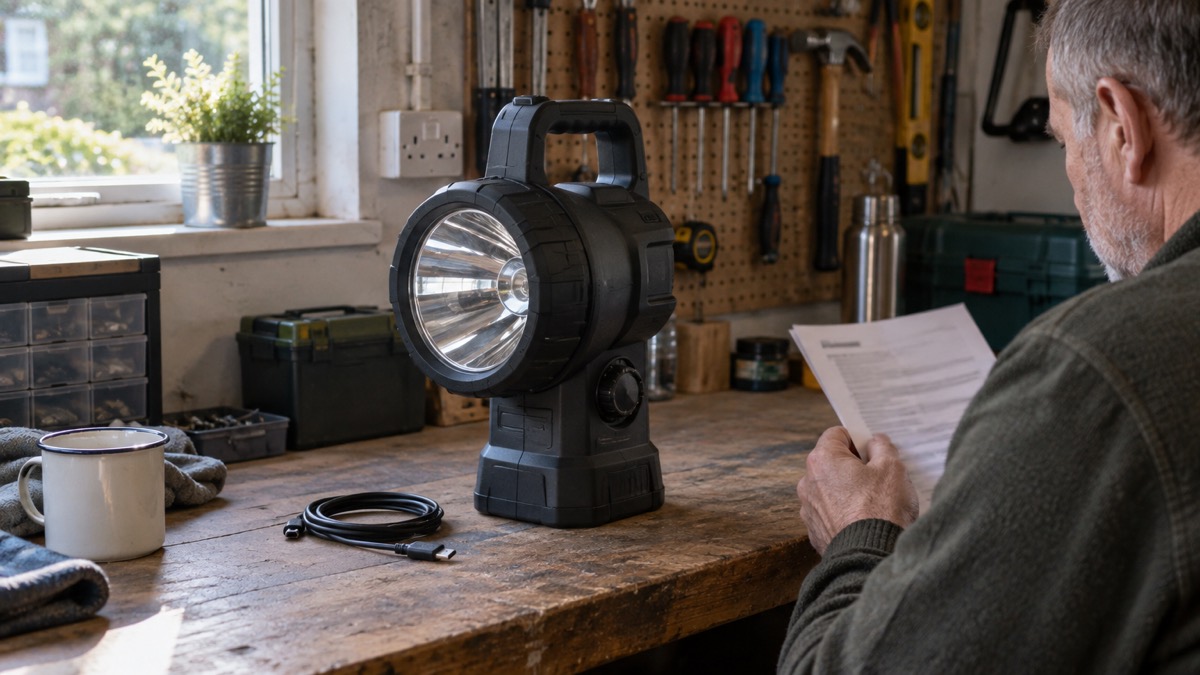
The Fenix LR60R is a large rechargeable searchlight with a separate floodlight built in. Its headline figure is 21,000 lumens, reached in Turbo mode with the spot and flood beams combined, and its beam throws up to 1,085 m1. It is not a torch you keep in a kitchen drawer: it weighs 1,500 grams including the battery and measures 207 mm by 85 mm by 90 mm1. What makes it interesting for a household preparing for power cuts is the combination: a very bright search beam, a wide floodlight for lighting an area, a battery that recharges in about 1.5 hours from a 45 W USB-C adapter, and a USB output that lets it charge a phone1.
For most homes the LR60R is a specialist tool rather than the first light you buy. A searchlight of this size suits someone who needs to see a long way across open ground, check a large garden or outbuilding after a storm, or light a wide area from one point. For finding your way around a dark house, a smaller torch or a head torch is easier to carry and to keep by the bed. If you are still choosing, our guide to torches and how to choose one for home sets out the sizes and what each is for.
This page covers what the LR60R can do, how long it runs on each setting, how to charge it, how to use it as a power bank, and how to use and store it safely. Every specification here is the maker's own figure for this model, as listed by the UK Fenix distributor1.
What the Fenix LR60R is and who it suits
The LR60R is built around two light sources in one body. A central spotlight gives the long throw, and a ring of flood LEDs gives a wide pool of light for working or lighting a space. The maker describes the spot and flood beams as usable separately or combined in Turbo Mode for the maximum 21,000 lumens1. Inside are one Luminus SFT70 LED and twelve Lumileds SST40 LEDs, behind a smooth aluminium reflector and a toughened, anti-reflective glass lens1. The body is A6061-T6 aircraft grade aluminium, and the mode control is a rotary mechanical switch rather than a push button1.
That combination of a narrow beam and a wide one is what separates it from an ordinary torch. A searchlight alone is poor at lighting a room, because it puts a small bright circle on one wall. A floodlight alone cannot reach the end of a field. The LR60R does both, and you choose which by turning the switch.
It suits a household with a specific job in mind: a large garden, an allotment, a rural property, a boat, or a garage and outbuildings that need checking in the dark. It is a poor fit as the only light in a flat, where its weight and size count against it and its beam is far more than you need. There is no pocket clip, so it is carried in the hand or in a bag rather than clipped to clothing1. If you want a light you wear and forget, a head torch is the better shape.
Specifications
The figures below are the maker's published specifications for the LR60R, as listed by the UK distributor1. Where a specification decides whether the light suits you, the note explains why.
| Specification | Figure |
|---|---|
| Maximum output | 21,000 lumens (Turbo, spot and flood combined)1 |
| Maximum beam distance | 1,085 m1 |
| LEDs | 1 x Luminus SFT70 and 12 x Lumileds SST401 |
| Colour temperature (spotlight) | 6000K1 |
| Body | A6061-T6 aircraft grade aluminium1 |
| Switch | Rotary mechanical on-off-mode switch1 |
| Lens | Toughened ultra-clear glass with anti-reflective coating1 |
| Waterproof rating | IP68, 2 m depth for 4 hours1 |
| Operating temperature | -35 to +45C1 |
| Impact resistance | 1 m1 |
| Dimensions | 207 mm x 85 mm x 90 mm1 |
| Weight | 1,500 grams including battery1 |
| Battery | Fenix ARB-L56-4000 Li-ion pack2 |
| Charging | USB-C, 45 W or higher adapter, about 1.5 hours1 |
| Power bank output | USB-C 45 W, USB-A 20 W1 |
| Warranty | 5 years on the light, 1 year on the battery1 |
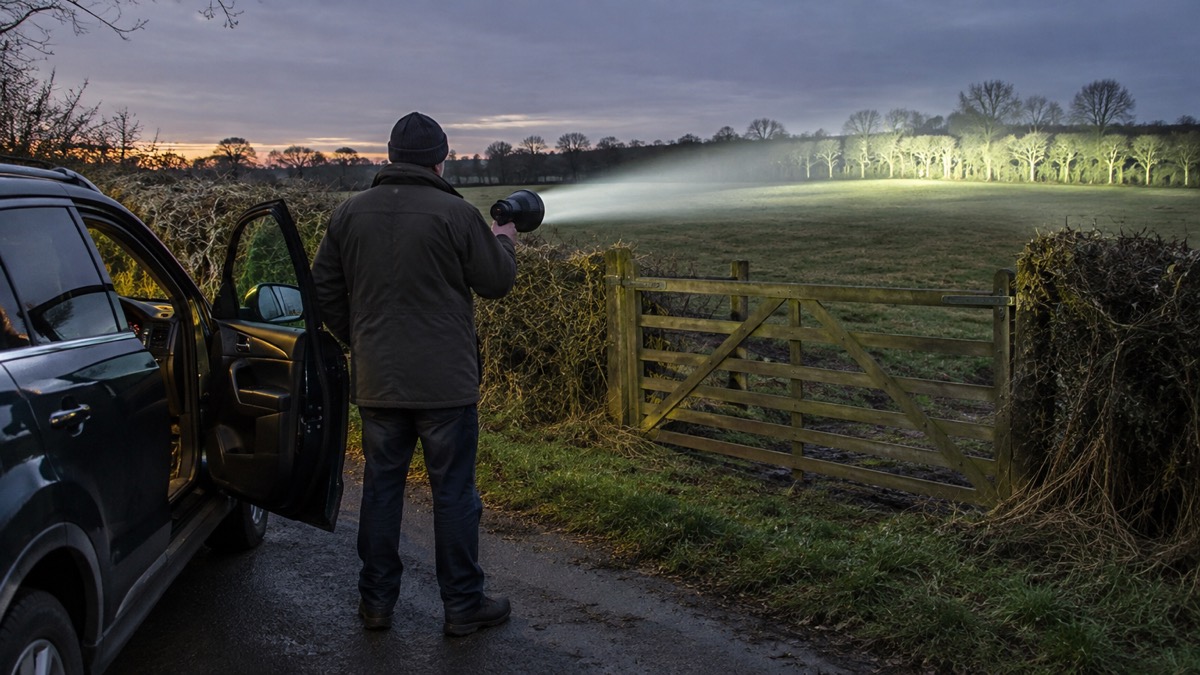
Two of these matter more than the rest for emergency use. The IP68 rating means the light is sealed against dust and survives being submerged to 2 m for 4 hours, so rain and a drop into a puddle are not a problem1. The operating range of -35 to +45C covers a cold winter night and a hot car in summer1. The 1 m impact rating is a modest figure for a light this heavy: it is built to survive a drop, not to be thrown around1. Our page on what IPX ratings mean for torches and lanterns explains the scale if you want to compare it with other lights.
Run times on each setting
Brightness and run time trade against each other, and the LR60R has two sets of settings: Search Mode, which uses the spotlight, and Camp Mode, which uses the floodlight. The maker gives a run time for each level, and the totals are cumulative, meaning the light steps down as the battery and heat allow rather than holding the top output for the whole period1.
| Mode | Setting | Output | Run time | Beam |
|---|---|---|---|---|
| Search | Turbo | 21,000 lumens | 1 hr 50 min total | 1,085 m1 |
| Search | High | 3,000 lumens | 3 hrs 43 min total | 1,000 m1 |
| Search | Medium | 1,000 lumens | 10 hrs 40 min | 607 m1 |
| Search | Low | 300 lumens | 24 hrs 20 min | 330 m1 |
| Search | Eco | 50 lumens | 113 hrs | 132 m1 |
| Camp | Turbo | 15,000 lumens | 2 hrs 10 min total | 352 m1 |
| Camp | High | 6,000 lumens | 3 hrs total | 218 m1 |
| Camp | Medium | 2,000 lumens | 5 hrs 25 min total | 126 m1 |
The pattern is the one you would expect: the top setting is brief, and the low settings run for days. Eco at 50 lumens for 113 hours is the setting to use if you are sitting out a long power cut and only need to see your way around; it will run for the best part of a week on one charge1. Low at 300 lumens for 24 hours 20 minutes is a sensible middle ground for a room or a path1. Turbo is for a few minutes of looking a long way, not for lighting a house. If you want the general principle, our page on lumens, beam distance and run time explains why the numbers behave this way.
The light also protects itself. When it reaches 60°C or above, it automatically steps down a few lumens to reduce heat1. When the head is within about 60 mm of an illuminated object for more than a second, it also steps down, which stops it overheating whatever it is pointed at1. Neither is a fault: both are the maker's design working as intended.
Charging in about 1.5 hours with a 45 W USB-C adapter
The LR60R charges over USB-C, and the maker states that the normal charging time is approximately 1.5 hours from depletion to fully charged with a 45 W or higher-power charging adapter1. A lower-powered adapter will still charge it, but more slowly. Use a reputable adapter and cable, and charge on a hard, non-flammable surface where you can keep an eye on it rather than under a cushion or on a bed.
The same 1.5 hour figure applies when you charge from a separate battery pack or portable power station with USB-C output in the 20,000 to 30,000 mAh range1. That is the practical way to top the light up during an outage when the mains is off. Our page on charging and storing rechargeable torches safely covers the general rules, and can the wrong USB charger damage a torch battery answers the question the adapter rating raises.
Using it as a power bank for phones and radios
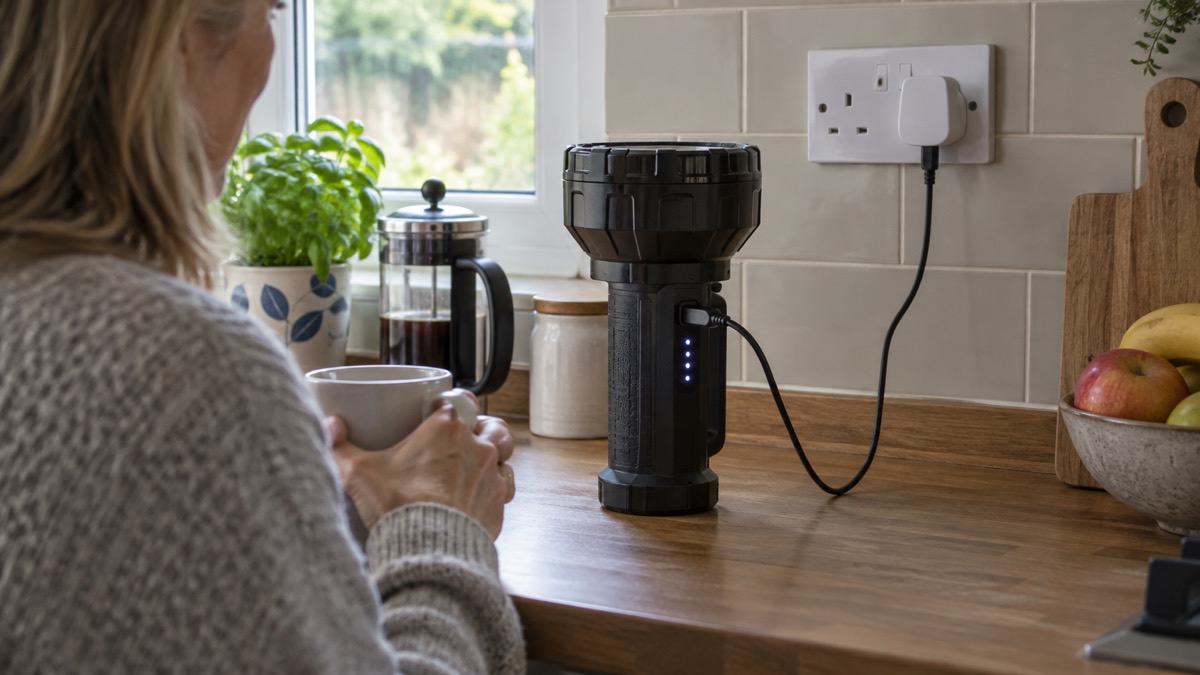
The LR60R has two USB outputs and can charge other devices from its own battery: USB-C fast discharge at 45 W and USB-A discharge at 20 W1. In a power cut that turns the light into a backup battery for a phone, a radio or a set of rechargeable batteries, which is exactly the role official and independent guidance gives to a power bank.
The advice from official sources is consistent. Have a fully charged power bank available in case you need to charge your phone, tablet or other devices3. Keep a portable power bank in your emergency kit to recharge your phone or hearing aids4. Use the power bank only for its intended use, for example to recharge a mobile phone or other USB-powered mobile devices5. Portable power banks can hold enough power to charge a mobile several times and are well worth having to hand to stay connected in a blackout6. Northern Powergrid's storm kit list includes a mobile phone charger and a fully charged portable power bank7, and its grab bag list includes charged power banks for mobile phones8. Charge phones and power banks before hot weather is forecast, so they are full when you need them9.
The LR60R is a large battery, but it is a torch first. Treat its power bank function as a way to keep a phone alive for a call or a radio for the news, not as a household electricity supply. If you want a dedicated backup for the home, our guide to backup power at home sets out the options.
Using it safely: heat, beam and the sealed head
A 21,000 lumen light is bright enough to hurt. Do not look into the beam, and do not shine it at anyone's eyes, at drivers, or at windows where it could dazzle someone. Our page on whether it is safe to look into a bright torch explains the risk in more detail.
The maker's own instructions cover the rest. The light steps down automatically when it gets to 60°C or when the head is close to an object, so give it air rather than covering it1. Do not open the light: the maker states that disassembling the sealed head can cause damage to the light and will void the warranty1. If you need to change the battery, use the Fenix ARB-L56-4000 pack the light is built for2, and have the work done properly rather than forcing the head open.
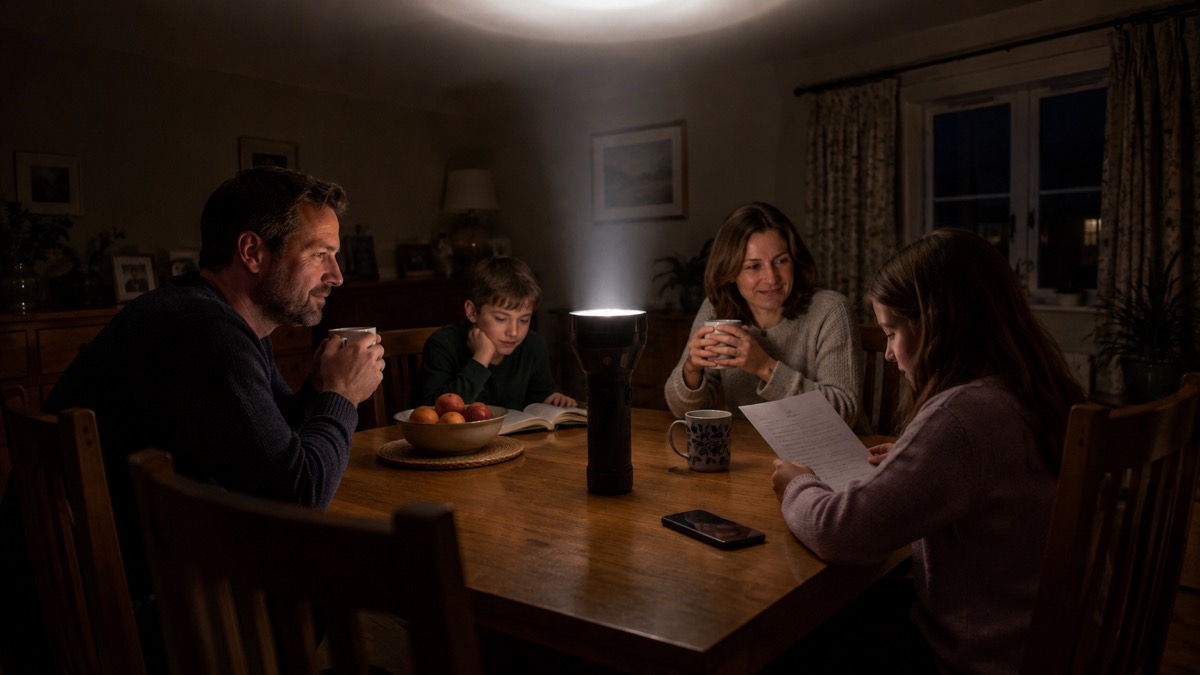
The light stands on its tail, so it can be set upright on a flat surface with the beam on the ceiling to light a room1. Keep it where it will not be knocked over, and away from curtains and anything that could scorch. For a room you are sitting in for hours, a lantern is the kinder light; the LR60R is for seeing a long way and for short bursts of very bright light.
Warranty, battery and support
The LR60R carries a 5 year UK warranty on the light and a 1 year warranty on the battery1. Keep your proof of purchase, and register or keep the receipt with the light. The warranty does not cover damage from opening the sealed head1.
The battery is a consumable. It is the Fenix ARB-L56-4000 Li-ion pack2, and when it no longer holds a useful charge, that is the pack to ask for. Buy from Fenix or an established UK torch retailer, and check the pack is described as the ARB-L56-4000. When the battery level falls below 10%, the battery icon in the lower-left corner of the display flashes to remind you to replace or recharge it1. Treat that flash as your cue to charge before you need the light.
For comparison of how warranties work across makers, Ledlenser, for example, gives most of its lights a standard warranty of 2 years, extendable by a further 5 years with online registration, up to 7 years10. Warranty terms differ between makers, so check the terms for the light you actually own rather than assuming they match.
Sources (10)
- Fenix LR60R Searchlight, Fenix Light UK, 2026-10-25
- Fenix LR50R V2.0 Searchlight, Fenix Light UK, 2026-10-25
- 12 Tips to Prepare for a Power Cut, Horsted Keynes Parish Council, 2026
- Power Cut Plan, Northern Powergrid, 2026-10-26
- What to Do in a Power Cut, Which?, 2026-06-04
- Be Summer Ready, Electricity North West, 2026-10-25
- Are You Ready for Big Coat Weather, Northern Powergrid, 2024-11-08
- Power Banks, Electrical Safety First, 2026-10-26
- Storm Damage: How to Protect Your Home From a Thunderstorm, Which?, 2026-10-21
- Ledlenser P5 Core Battery Operated Torch, Ledlenser, 2026-10-25
 NEBO Newton 500 Torch
 NEBO Davinci 800L
 NEBO Torchy 2K Torch
 NEBO Torchy 600 Flex
 NEBO Tac Slyde Torch
 NEBO Slyde King 4K
 NEBO Mycro 900+ Headlamp
 NEBO Edge 800
 NEBO Transport 400
 Fenix E04R Keyring Torch
 Fenix E05R Keychain Torch
 Fenix E06R Pro Pocket Torch