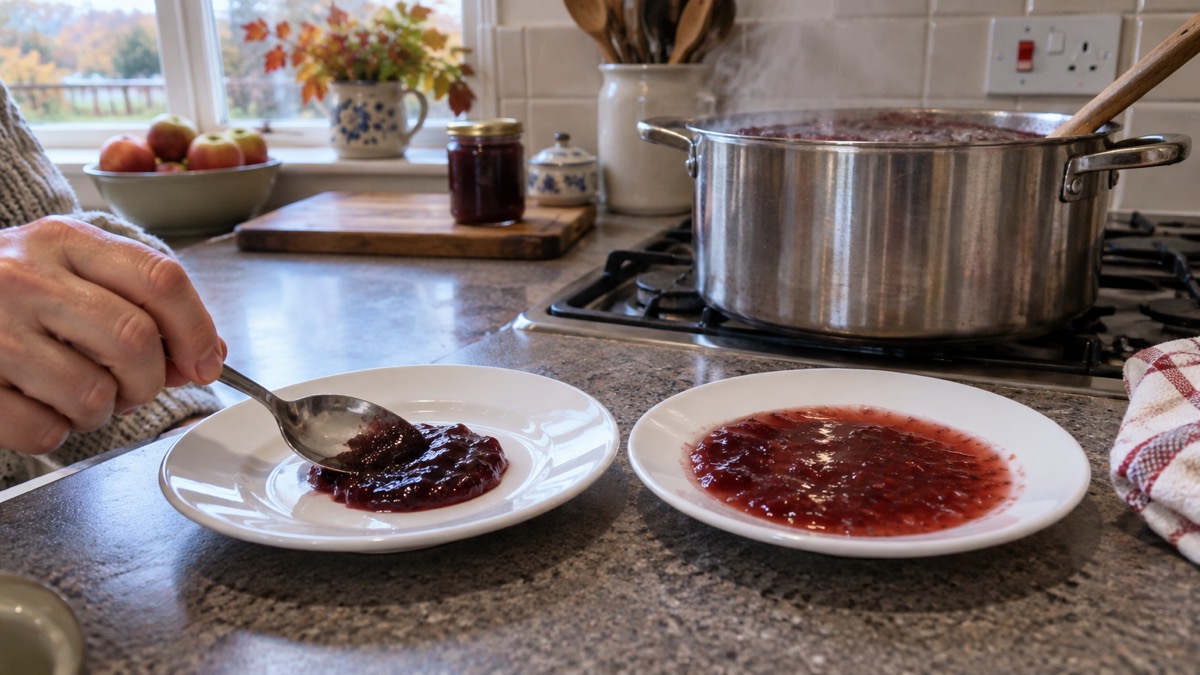
If your no-sugar jam will not set, the pectin is almost always the reason. Ordinary liquid and powdered pectins are made to gel with the full amount of sugar a recipe calls for, and the guidance is clear that you should not swap that sugar for a sweetener1. To make jam with little or no sugar you need a pectin sold as no-sugar-needed, which is a low-methoxyl pectin. With that type, no sugar is required at all, and a sweetener such as Splenda is optional, added for flavour rather than to make the gel2.
That single distinction decides most of what follows. Choose the right pectin and a reduced-sugar jam is straightforward: you follow the leaflet in the packet, which tells you how much pectin to use and when to stir in any sweetener, usually after all the cooking and just before the jars are filled1. Choose a regular pectin and cut the sugar, and you are asking it to do a job it was not designed for.
The other thing to settle before you start is storage. Sugar helps preserve a jam, and a sweetener does not do the same work1. So a preserve made without sugar, or with a sweetener in place of sugar, may need the fridge or the freezer rather than a shelf. This guide sets out which pectins set without sugar, when that applies, how to make the jam and how to keep it safely.
The answer: use a no-sugar-needed pectin, not a regular one
The pectin that makes a no-sugar jam set is a low-methoxyl pectin, sold as a no-sugar-needed pectin. With these, no sugar is required at all, and a sweetener is entirely optional2. The independent home-preserving guidance names examples of this type: Mrs. Wages Lite Home Jell Fruit Pectin, Ball No-Sugar Needed Pectin, and Sure-Jell for Less or No-Sugar-Needed Recipes1. These are the products whose instructions are written for a jam without sugar, and their package inserts tell you when to add any sweetener, usually after all the cooking and right before filling the jars1.
Regular liquid and powdered pectins are a different proposition. They are formulated around the sugar in the recipe, and the guidance is explicit: do not try to substitute Splenda for the required sugar in recipes calling for regular liquid and powdered pectins1. Granular Splenda does not provide preservative properties like sugar1. So a regular pectin with the sugar left out is not a low-sugar version of the same jam; it is a recipe missing the ingredient its setting depends on.
There is a middle route worth knowing about. The USDA Complete Guide to Home Canning includes a Peach-Pineapple Reduced Sugar Fruit Spread that does not require added sugar, and its processing time is longer than for regular jams and jellies, more like that for a fruit puree3. That is a tested recipe rather than a pectin you buy, but it shows the principle: a preserve built from the start to work without added sugar, with its own timings.
| Pectin type | Sugar needed to set | Sweetener | What it suits |
|---|---|---|---|
| No-sugar-needed (low-methoxyl) | None required at all2 | Optional, added near the end1 | Jam and jelly with little or no sugar |
| Regular liquid or powdered | The full amount in the recipe1 | Do not substitute for the sugar1 | Traditional full-sugar jam |
| Reduced-sugar tested recipe | None added3 | As the recipe directs | A batch made to a published method |
When it applies: which preserves and which sweeteners
The no-sugar-needed pectin route applies to jams and jellies, and to fruit spreads made to a tested reduced-sugar recipe. It is the sweetener, not the fruit, that decides which pectin you need. Granular Splenda can be used as the optional sweetener in a jam or jelly made with a no-sugar-needed pectin, and the package insert tells you when to add it1. The same guidance warns that it does not preserve the way sugar does, which is why storage matters as much as setting1.
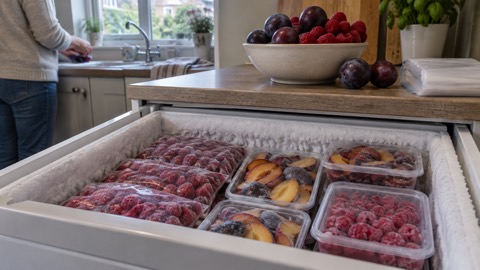
Freezing is a separate case and a simpler one. It is safe to freeze fruits without sugar: sugar is not used as a preservative there, only to maintain flavour, colour and texture, and artificial sweeteners can be used in their place following the equivalents on their labels4. So if your aim is to keep a glut rather than to fill jars for the shelf, you can freeze without sugar and sweeten when you use the fruit. Our guide to freezing fruit without sugar covers that in more detail.
For jam specifically, the practical rule is to match the pectin to the sugar in the recipe, not to your taste. If a recipe is written around regular pectin, make it as written or find a no-sugar-needed recipe instead. If you want to understand more about how sweeteners behave in preserves generally, including pickles and chutneys, see can sweeteners replace sugar in jam and pickles.
What to do: making the jam and getting it to set
Work from a recipe written for the pectin you have. If you are using a no-sugar-needed pectin, use the quantities on its insert and add any sweetener when it says, usually after all the cooking and right before filling the jars1. If you are following a reduced-sugar tested recipe such as the Peach-Pineapple Reduced Sugar Fruit Spread, keep its longer processing time; it is like that for a fruit puree rather than a regular jam3.
Makers' recipes show how varied the ingredient list can be. One published sugar-free blueberry jam is described as a simple three-ingredient recipe made without sugar, and lists 50g of pectin among its ingredients5. Another maker's blackberry and apple jam is made with no added pectin at all, relying on the fruit's own setting quality6. Those are two different approaches, and neither is a substitute for the other: the first depends on added pectin, the second on the fruit. Follow whichever recipe you have chosen rather than mixing the two.
A short order of work helps:
- Decide which pectin you are using, and read its leaflet or the recipe through before you start1.
- Prepare the fruit and measure according to that recipe.
- Cook as directed, adding pectin when the instructions say.
- Add any sweetener at the point the leaflet specifies, usually after cooking and before filling1.
- Fill the jars and process or store exactly as the recipe directs, remembering that a reduced-sugar spread may need a longer process3.
If the jam does not set, check the pectin first. A regular pectin with the sugar reduced or replaced is the most likely cause, because the sugar it needs is missing1. Our home preserving equipment checklist lists the kit that makes the job easier, and how to tell when chutney is ready to bottle covers judging a set in a related preserve.
Keeping it safely: storage, and why sugar matters
Sugar is not just sweetness in a preserve; it helps keep it. Granular Splenda does not provide preservative properties like sugar1. That is why the guidance is cautious about sweetener-based preserves kept at room temperature. Do not substitute Splenda in long-boil or no-pectin-added jams and jellies intended for room-temperature storage as a canned product; freeze or refrigerate for storage instead3. If you want to experiment with these kinds of fruit spreads, the recommendation is freezing or refrigeration for storage3.
So the storage question has a clear answer for the risky cases. A jam made with a no-sugar-needed pectin follows that product's own processing and storage instructions. A long-boiled preserve, or one with no added pectin, where a sweetener stands in for sugar and you had planned to keep it on a shelf, should go in the fridge or freezer instead3. Label the jars with what is in them and the date, so nobody treats a fridge preserve as a shelf one.
Food safety alerts are worth watching if you preserve in quantity or use bought ingredients. Recent recalls have covered products from porridge sachets to cheese and pesto, with the standing advice not to eat the affected product7. Check official alerts before you plan a big batch around a bought ingredient.
Staying safe: the kitchen hazards that matter
Jam making puts a pan of hot sugar and fruit on the hob, and that carries the usual kitchen risks. Keep children and pets away from the stove while you work, and never leave a boiling pan unattended. If you are preserving with others in the house, tell them the hob is in use.
There are a few household dangers that matter more than people expect, and they are worth knowing whether or not you are making jam.
- Skin creams and fabric. Fire services warn that skin creams dried on fabric can lead to fire deaths, and the risk arises even if the creams do not contain paraffin11. This applies to all emollient creams, not just paraffin-based ones13. If anyone in the house uses them, keep bedding and clothing washed and away from flames, and do not smoke14.
- Electric blankets. Do not use an electric blanket if you have a pressure relieving device, experience incontinence or use emollient creams16.
- Smoking and emollients. If someone needs to use emollient and skin creams, tell them not to smoke15.
- Medicines and household products. Keep them out of reach and out of sight, in locked containers with safety caps, in their original packaging, and take unwanted medicines to a pharmacy for disposal17. If a child may have swallowed something harmful, get advice from a pharmacist for minor problems, and seek urgent help for anything more serious18.
- Allergic reactions. If someone has a serious allergic reaction, an adrenaline auto-injector such as Jext can be used; the maker states there are no absolute contraindications to its use during an allergic emergency19. Learn to recognise the signs of sepsis, which needs urgent assessment; the assessment tool requires no medical knowledge20.
"Do not try to substitute Splenda® for the required sugar in recipes calling for “regular” liquid and powdered pectins."
A calm kitchen, a read-through of the recipe before you start, and the right pectin in the pan will see most batches right. If you are preserving as part of a wider household store, our guides to storing the harvest and the emergency food section set jam in context alongside other ways of keeping food.
Sources (20)
- How to Make Jam and Jelly, National Center for Home Food Preservation, 2026
- How to Can, National Center for Home Food Preservation, 2026
- How to Store, National Center for Home Food Preservation, 2026
- How to Dry, National Center for Home Food Preservation, 2026
- Sugar Free Blueberry Jam, Kilner, 2026
- Blackberry and Apple Jam, Kilner, 2026
- MOMA Foods recalls various porridge pots and sachets, Food Standards Scotland, 2026
- Skinny Crunch Light Peanut Butter Bars recall, Food Standards Agency, 2026
- Mrs Kirkham's Lancashire cheese E. coli warning, Food Standards Scotland, 2023
- Trotter's Fresh Wild Garlic Pesto warning, Food Standards Scotland, 2025
- Skin creams dried on fabric can lead to fire deaths, GOV.UK, 2020
- Emollient and skin creams, London Fire Brigade, 2026
- Home safety partnerships, Devon and Somerset Fire and Rescue Service, 2026
- Emollients, Greater Manchester Fire and Rescue Service, 2026
- Caring for smokers, London Fire Brigade, 2026
- Electric blankets, Greater Manchester Fire and Rescue Service, 2026
- Keeping yourself safe, NHS Lanarkshire, 2023
- Poisoning, Frimley Healthier Together, 2024
- UK Jext Prescribing Information, Jext, 2026
- Spotting the signs of sepsis, Sepsis Trust, 2026
 Hydroponic System Parts List
 Year-Round Sowing Calendar
 Preserving Equipment Checklist
 Blanching Vegetables
 Carrot Fly Protection
 Knowing When Chutney Is Ready
 Clubroot in Your Soil
 Drought-Resistant Vegetables
 Edible Flowers Safety
 Extending the Growing Season
 Freezing Fruit Without Sugar
 Garden Fleece Frost Protection
 Avoiding the Hungry Gap
 Keeping Varieties Pure for Seed
 Making Leafmould