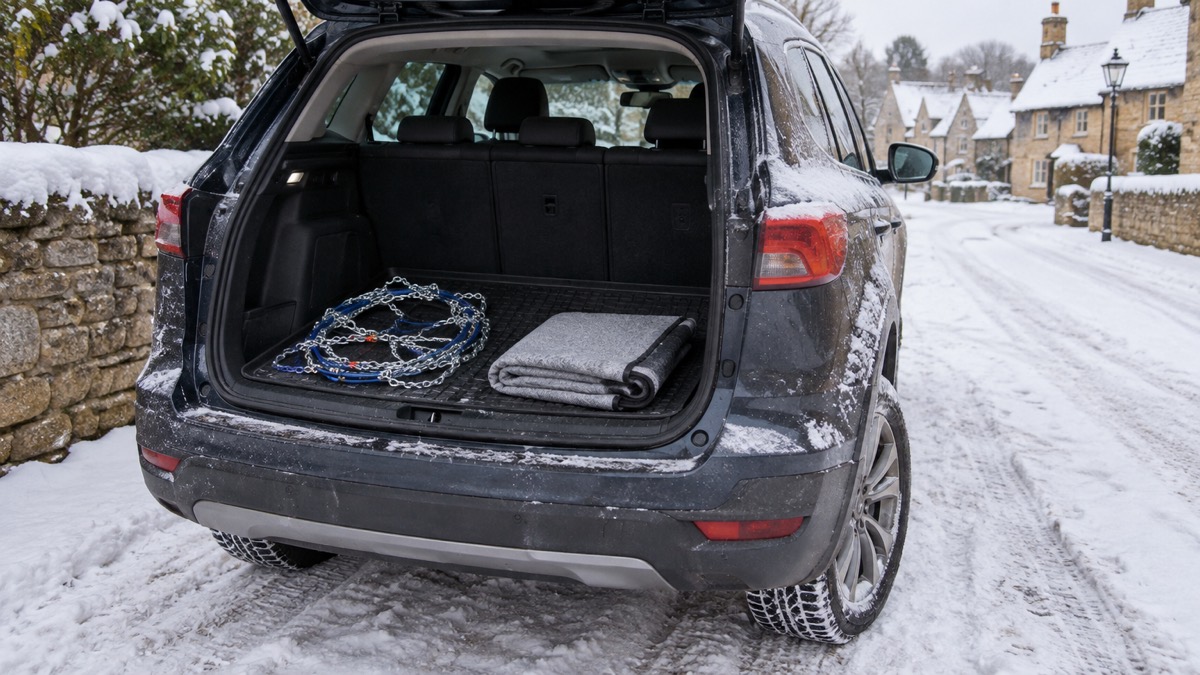
Snow chains and snow socks both do the same basic job: they cover your tyres with a high grip surface so the car can find traction on ice and packed snow. Traffic Scotland describes them as an alternative to winter tyres, improving grip by covering the tyres in either a high grip fabric or a steel equivalent1. The difference is in how they behave. Chains are harder wearing than winter tyres, but they can be trickier to put on1. Socks are the softer, quicker option, and they suit short, low speed work rather than a long motorway run.
The first question is not which one to buy, but whether you need to drive at all. Northern Ireland's Highway Code rules say do not drive in icy or snowy weather unless your journey is essential2. If you do have to go, the official advice is to plan your route, check for delays and road closures, leave more time, and check your wipers, tyres and screenwash before setting off3.
This page sets out what each aid does, where each one fits a journey, how to practise fitting before snow arrives, and what to do when the roads close. It is written for an ordinary UK household, not for a rally team.
Snow chains are harder wearing than winter tyres, but trickier to fit
Chains are the heavy duty option. Traffic Scotland's verdict is blunt: they are harder wearing than winter tyres, but they can be trickier to put on1. That trade off matters most when you are kneeling at the roadside in bad weather. A chain that takes practice in the dry can take far longer in the cold, in the dark, with traffic passing.
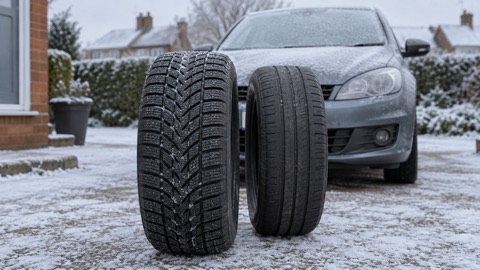
The comparison that decides most household choices is not chain versus sock in the abstract, but what each is being asked to do. Winter tyres are the baseline alternative, and Traffic Scotland notes they can reduce your stopping distance by up to 40%1. Chains and socks are described as an alternative to winter tyres, not a replacement for careful driving1. Bedford Borough Council notes that other countries request motorists change to winter tyres, and that studded tyres give good traction in snow but would be of very rare use in the UK6.
| Aid | What it does | Best suited to | Watch out for |
|---|---|---|---|
| Winter tyres | Reduce stopping distance by up to 40%1 | Regular winter driving, especially in high snowfall areas4 | A seasonal change, not a roadside fix |
| Snow chains | Harder wearing than winter tyres1 | Repeated use on snow covered roads where you can fit them properly | Trickier to put on1 |
| Snow socks | High grip fabric covering for the tyre1 | Short, low speed work to get moving again | Not a long distance solution |
The practical rule is to match the aid to the journey. If you live somewhere that sees regular snow, the official advice is that winter tyres, snow chains or snow socks may all be worth having4. If you are making a one off trip and might need help getting off a snowy side road, socks are the simpler thing to carry. Neither removes the need to slow down: braking distances can be doubled in wet conditions and multiplied by 10 on snow or ice7.
Where snow chains are mandatory: check local rules before you travel
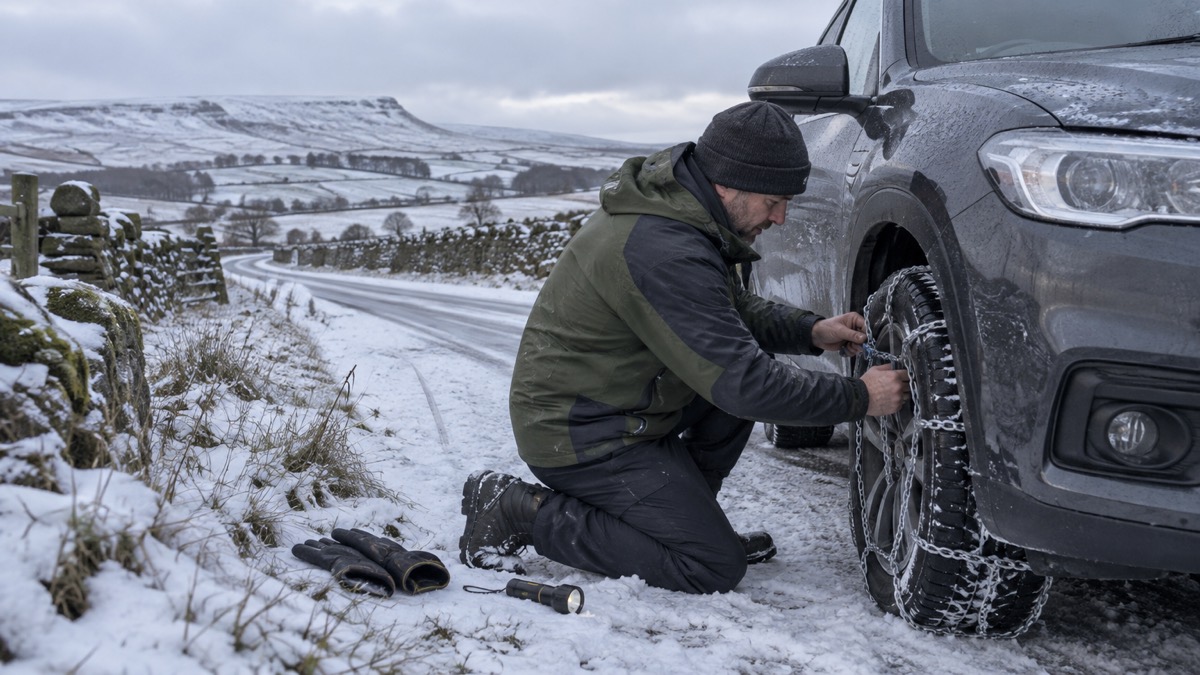
No UK source in this guidance makes chains compulsory on British roads. What the UK guidance does say, consistently, is that the journey itself should be questioned first. Ceredigion County Council puts it as a direct question: ask whether the journey is necessary, and if not, do not travel; if it is, plan using the primary route road network and wait until roads have been gritted5. West Yorkshire Prepared says simply avoid travel if possible8.
Where chains are mandatory is abroad, and that is a matter for the country you are visiting. The UK guidance does not set those rules, so check the local requirements before you travel rather than assuming a UK habit carries over. Bedford Borough Council's point that studded tyres would be of very rare use in the UK is a reminder that British road conditions and continental ones are not the same6.
In the UK, the rules that do apply are about driving to the conditions:
- In Northern Ireland, the Highway Code rules say do not drive in icy or snowy weather unless your journey is essential2.
- National Highways advises sticking to main roads where you can and travelling only if necessary during severe winter weather9.
- If snow or icy conditions are forecast, only travel if absolutely necessary8.
- Check all tyres before you set out3.
If you are heading abroad with chains in the boot, the sensible sequence is to confirm the local requirement, confirm the fitment for your vehicle, and practise before you leave. The UK authorities' wider point still holds: snow, ice, heavy rain and strong winds create difficult driving conditions across the UK in winter3, and the best preparation is often to delay the trip.
Snow chains or snow socks: how each one fits your journey
The choice comes down to the journey you are actually making. Ready Scotland's advice is to get winter tyres, snow chains or snow socks if you need to drive in snow and ice10. That phrasing treats all three as options, and the right one depends on distance, speed and how often you will need it.
Socks suit the short, slow problem: a car that needs to get off a snowy drive, up a short incline, or out of a stuck position. They are the fabric version of the same idea, covering the tyre in a high grip material1. Chains suit repeated use where the road is genuinely snow covered and you can fit them properly, because they are harder wearing1. Neither is a licence to drive at normal speed on ice.
The wider travel picture should shape the decision too. The Met Office warns that snow and ice will severely impact your travel plans, including your commute and getting around11, and that there is likely to be disruption to air, rail and boat, so check ahead before you begin your journey4. If the trains are running and the roads are not, that changes the calculation.
For most households the honest answer is that neither chains nor socks turn a bad journey into a good one. They are recovery aids and short distance aids. The decision that matters most is whether to go at all, and the official guidance on that is consistent across England, Scotland, Wales and Northern Ireland: if it is not necessary, do not travel5.
Practise fitting chains before snow arrives
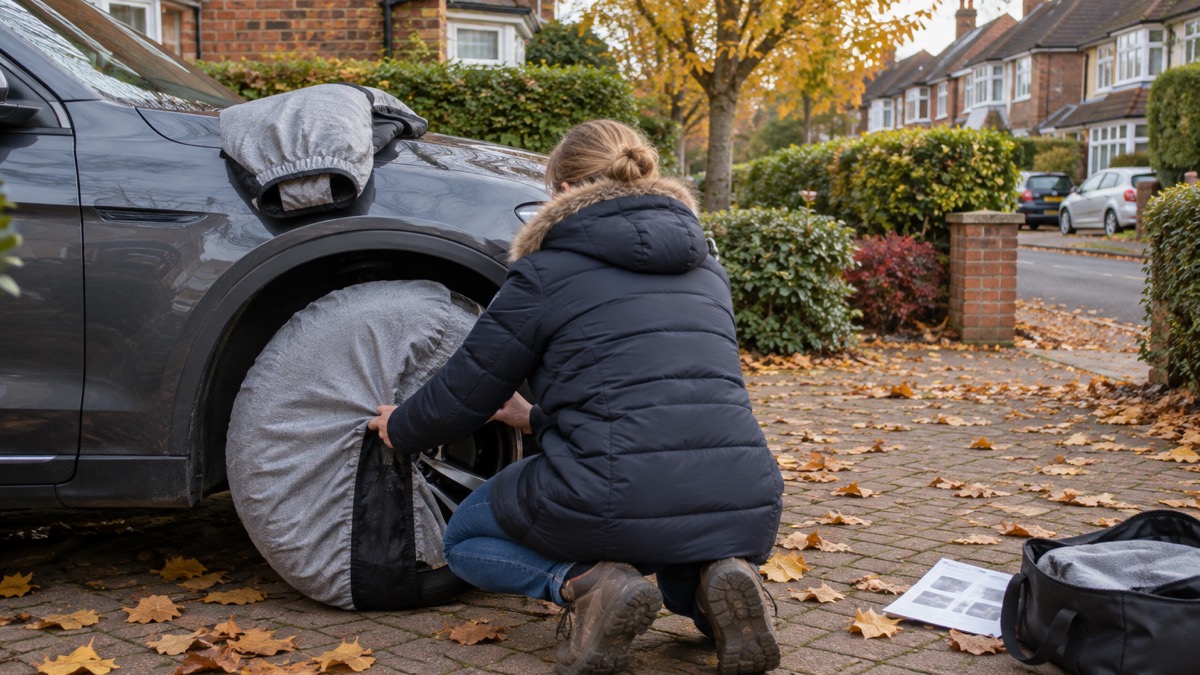
The single most useful thing you can do is fit your chains or socks once, in daylight, in dry weather, before the season starts. Practising turns a fiddly job into a routine, so that when snow comes you are repeating a movement you already know rather than learning it at the roadside.
The same principle runs through all the winter preparation advice. Argyll and Bute Council makes the point about snow clearing: it is much easier to clear fresh snow, so make a start before people squash it down if you can13. Chains are the same: the earlier you prepare, the easier the job.
What to have ready before the first snow:
- A torch and spare bulbs. North Yorkshire Fire and Rescue Service advises carrying a torch and spare bulbs, and changing worn windscreen wiper blades4.
- Visible clothing. Wear or carry something light coloured, bright or fluorescent in poor daylight, and use reflective materials in the dark14.
- Good footwear. Wear comfortable, dry and suitable footwear and be prepared for leaving the vehicle quickly4.
- Gloves. NHS fall prevention guidance says wear gloves to protect your hands in case you do fall15.
- A check of the car. Check wipers, tyres and screenwash before setting off16.
It also helps to check on others while you are at it. The Met Office's winter checklist includes checking on neighbours17, and the South Western Ambulance Service advises ensuring older neighbours wear shoes with good grip to prevent falls18. If you are the household with the chains, you may be the one who can help a neighbour who is not going anywhere.
When roads close in heavy snow: lessons from past UK winters
Heavy snow does not just make driving hard; it closes roads and stops the gritters working as normal. Lancashire County Council is direct: salt becomes less effective in heavy snowfall, and teams may use snow ploughs to clear roads and respond to winter related emergencies19. Derbyshire County Council adds that during heavy or prolonged snowfall the principal route network, consisting of key link roads and routes to hospitals, is where resources are concentrated20. In other words, the road you want may not be treated at all.
The gritting itself has limits. Derbyshire County Council notes that if rain turns to snow during rush hours it is very difficult to salt routes because of the level of traffic21. Devon County Council warns that showers or rain will wash salt off roads, leaving them prone to icing7. And Suffolk County Council is clear that no guarantee can be given that roads will always be completely clear of ice or snow22. Snow ploughing is normally confined to busier A class roads, with considerable delay possible on minor roads22.
The consequences reach beyond the car. Low temperatures and heavy snow can close schools and businesses23. In the severe snow of late 2010, the Forth Road Bridge was closed for over 10 hours on 2 December, the first time it had ever been closed due to snow, and around 7,000 schools closed that day. That winter also brought the worst period from 28 November to 3 December. The Met Office issued two Red Warnings for snow during the severe spell from 26 February to 8 March 2018.
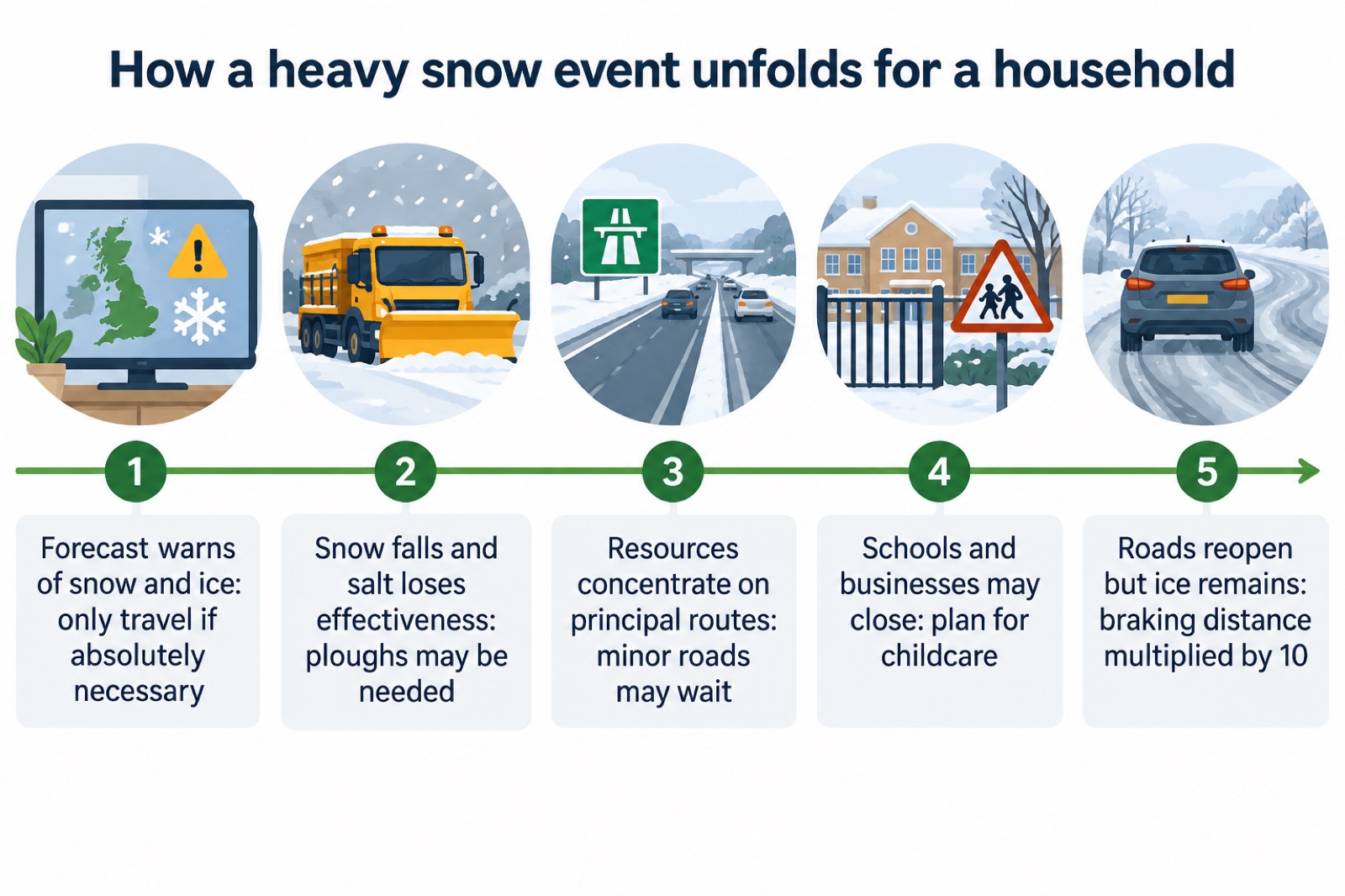
The lesson for a household is to plan for the road being shut, not just slow. Keep the car fuelled and the kit in the boot, but also have a plan for staying put: warm clothes, food, water, boots, a torch and a shovel, and let someone know your route and when you expect to arrive if you do go8. If you are cut off, stay indoors wearing layers of loose fitting lightweight warm clothing rather than bulky clothing16.
Before you set off: snow warnings and local rules
The last check before any winter journey is the forecast and the local picture. The Met Office advises planning your route, checking for delays and road closures, leaving more time to prepare and checking your car before setting off, including wipers, tyres and screenwash24. North Yorkshire County Council adds checking the live weather cameras, allowing extra time, telling someone your plans, and checking whether you need breakdown or recovery insurance12.
Local rules and local knowledge matter as much as the forecast. Check the gritting routes for your area, and do not park where you may block a salting route7. If you are walking anywhere, make sure someone knows your route and when you plan to arrive, and wear clothing visible in the dark10. If you live on a slope, check local grit bins are well stocked and request top-ups if necessary25.
A few habits make the difference between a difficult journey and a dangerous one:
- Use dipped headlights in heavy snow. Do not rely on daytime running lights, as they do not always put your rear lights on4.
- Leave a sensible distance from gritters. Never tailgate, pass carefully only when it is safe, do not use a hard shoulder unless open as indicated by overhead signs, and do not undertake, as gritters need to change lanes at junctions9.
- Reduce speed when conditions are severe9.
- Allow extra time and reduce your speed7.
If you do get stuck, clear the snow from the wheels and put a sack or old rug in front of the driving wheels to give grip14. That is a recovery measure, not a reason to press on. The guidance across all four nations is consistent: the safest winter journey is the one you did not need to make. For the wider picture on staying safe in snow, see Storms, Snow and Ice: A Household Guide, and for the road itself, Driving in Snow and Ice: Staying Safe on the Road.
Sources (25)
- Winter tyres guide, Traffic Scotland, 2026-10-29
- Driving in adverse weather conditions, nidirect, 2026-09-22
- Drive safely in winter weather, Met Office, 2026-10-26
- Staying safe in the snow, North Yorkshire Fire and Rescue Service, 2023-03-09
- Snow and ice, Ceredigion County Council, 2026-10-29
- Keeping winter roads safe, Bedford Borough Council, 2026
- How can you help, Devon County Council, 2023-08-30
- Severe weather, West Yorkshire Prepared, 2026-10-29
- Travelling in snow and ice, National Highways, 2026-10-29
- Cold, snow and ice, Ready Scotland, 2026-03-25
- Winter weather and cycling, Met Office, 2026-10-26
- Winter, summer and wet weather driving tips, North Yorkshire Council, 2026
- Grit bins and heaps, Argyll and Bute Council, 2026-10-29
- Safe driving in winter, Nottinghamshire County Council, 2026-10-29
- Preventing falls, North Cheshire and Mersey NHS, 2024-12-12
- 5 tips for staying safe in snow - Met Office, Met Office
- WeatherReady winter poster, Met Office, 2026-10-28
- Neighbour and vulnerable people support, South Western Ambulance Service, 2026-10-29
- Gritting, Lancashire County Council, 2026-10-29
- Gritting, Derbyshire County Council, 2026-10-29
- Does it work, Derbyshire County Council, 2026-10-29
- Check which roads are gritted, Suffolk County Council, 2026-10-29
- Low Temperatures & Heavy Snow | Dorset Local Resilience Forum, Dorset Local Resilience Forum
- 4 tips for staying safe in ice - Met Office, Met Office
- Cold weather and snow, Lancashire Prepared, 2026-10-29
 Winter Tyres vs All-Season Tyres