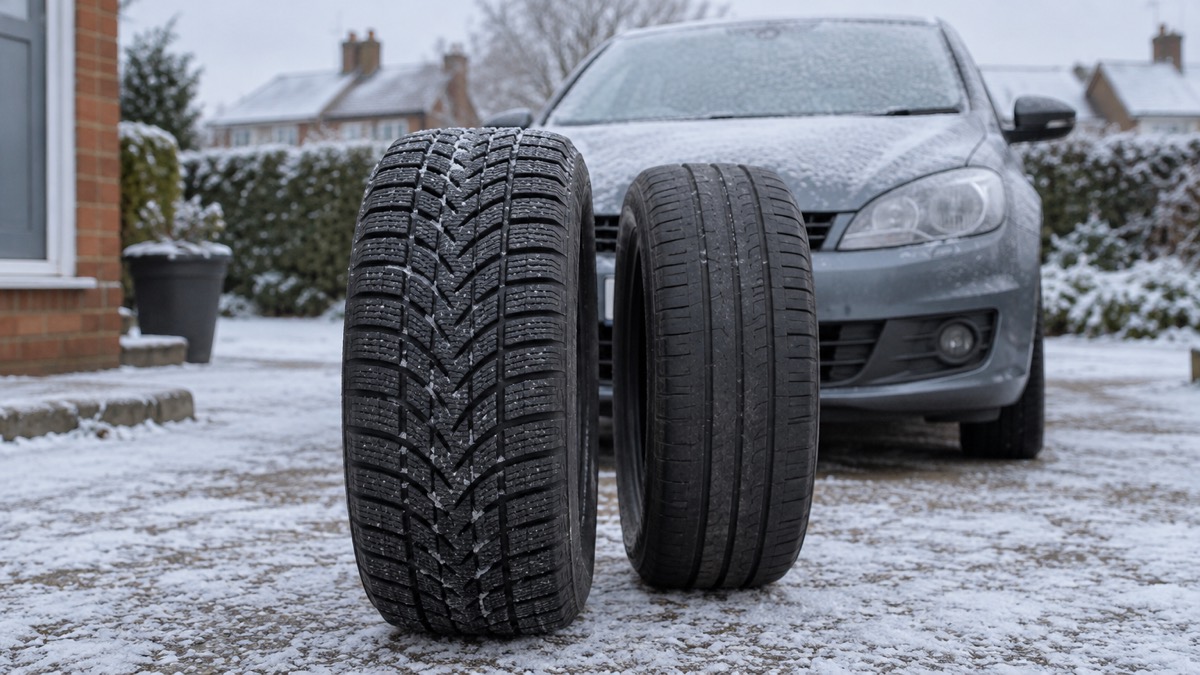
If you are weighing up winter tyres against all-season tyres for the coming cold, the short answer is this: below 7°C, winter tyres grip better than standard all-weather tyres, and they can reduce your stopping distance by up to 40%1. That is the case for fitting them. The case against is cost, hassle and the fact that most UK winters are mild enough that many drivers never need them.
There is no legal requirement to use winter tyres in the UK1. So this is a choice about grip and safety, not a legal duty. What you drive, where you drive and how often you drive in snow and ice should decide it. A driver in the Highlands or on rural lanes has a different calculation from someone doing short commutes on gritted town roads in the south.
This page sets out how each type behaves in cold, snow and ice, where winter tyres are worth the money and where all-season tyres are enough, when to fit them, and what tread depth winter driving actually needs. It also covers the alternatives, snow chains and snow socks, and what to do if you are caught out.
Below 7°C, winter tyres grip better than all-season tyres
The case for winter tyres rests on one fact that official guidance repeats: compared with standard all-weather tyres, winter tyres provide superior grip at temperatures below 7°C2. That is not about snow. It is about the rubber itself. Winter tyres are designed to stay supple in the cold, so they keep their grip on cold, damp tarmac when a summer or all-season compound has stiffened.
Traffic Scotland describes winter tyres as tyres designed to provide maximum traction on roads7. Manchester Fire and Rescue Service puts it more simply: winter tyres offer more grip and can significantly increase performance in icy conditions8. The benefit is not marginal in the conditions that matter.
The stopping distance figure is the one to remember. Winter tyres can reduce your stopping distance by up to 40%3. To put that in context, wet weather alone at least doubles stopping distances compared with dry roads, because tyres have less grip9. Cold temperatures, damp roads, snow and ice all reduce a tyre's ability to grip, leading to longer stopping distances and a higher risk of accident10. Winter tyres claw back part of that loss.
It is worth being clear about what "all-season" means here. The official guidance compares winter tyres with "standard all-weather tyres"2. All-season tyres are a compromise: they are designed to work acceptably across a range of temperatures rather than excel in any one. In a mild winter on treated roads, that compromise is fine. In a hard cold snap, it is a compromise on grip.
Stopping distance: up to 40% shorter on winter tyres
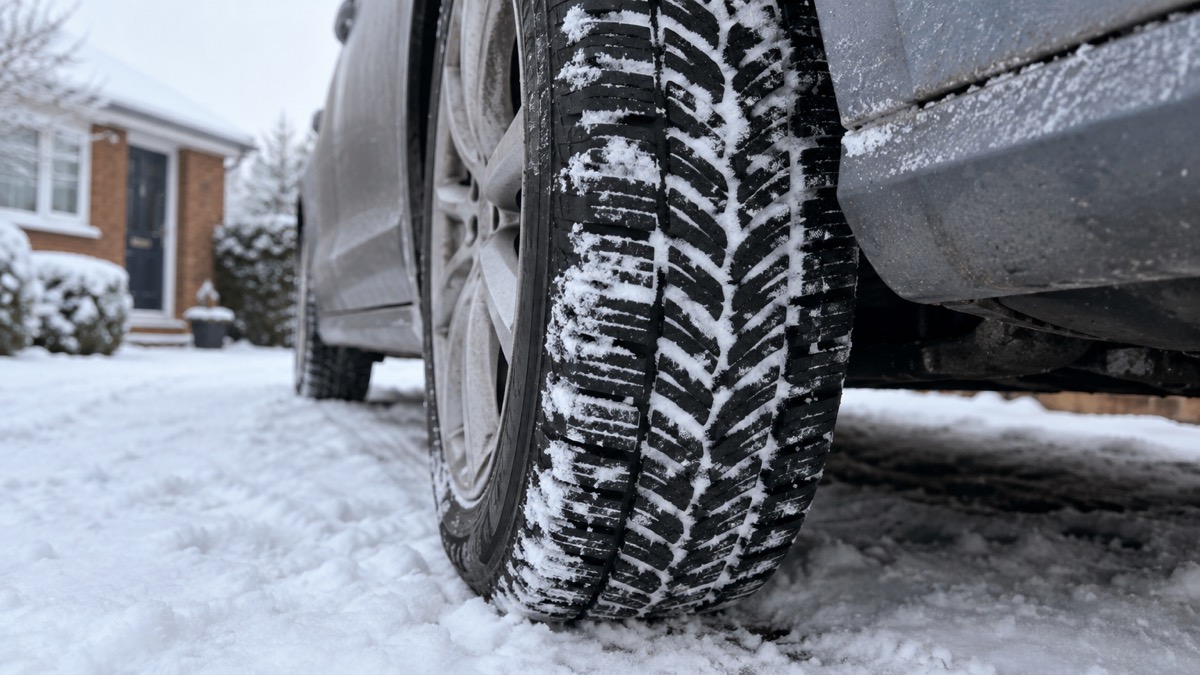
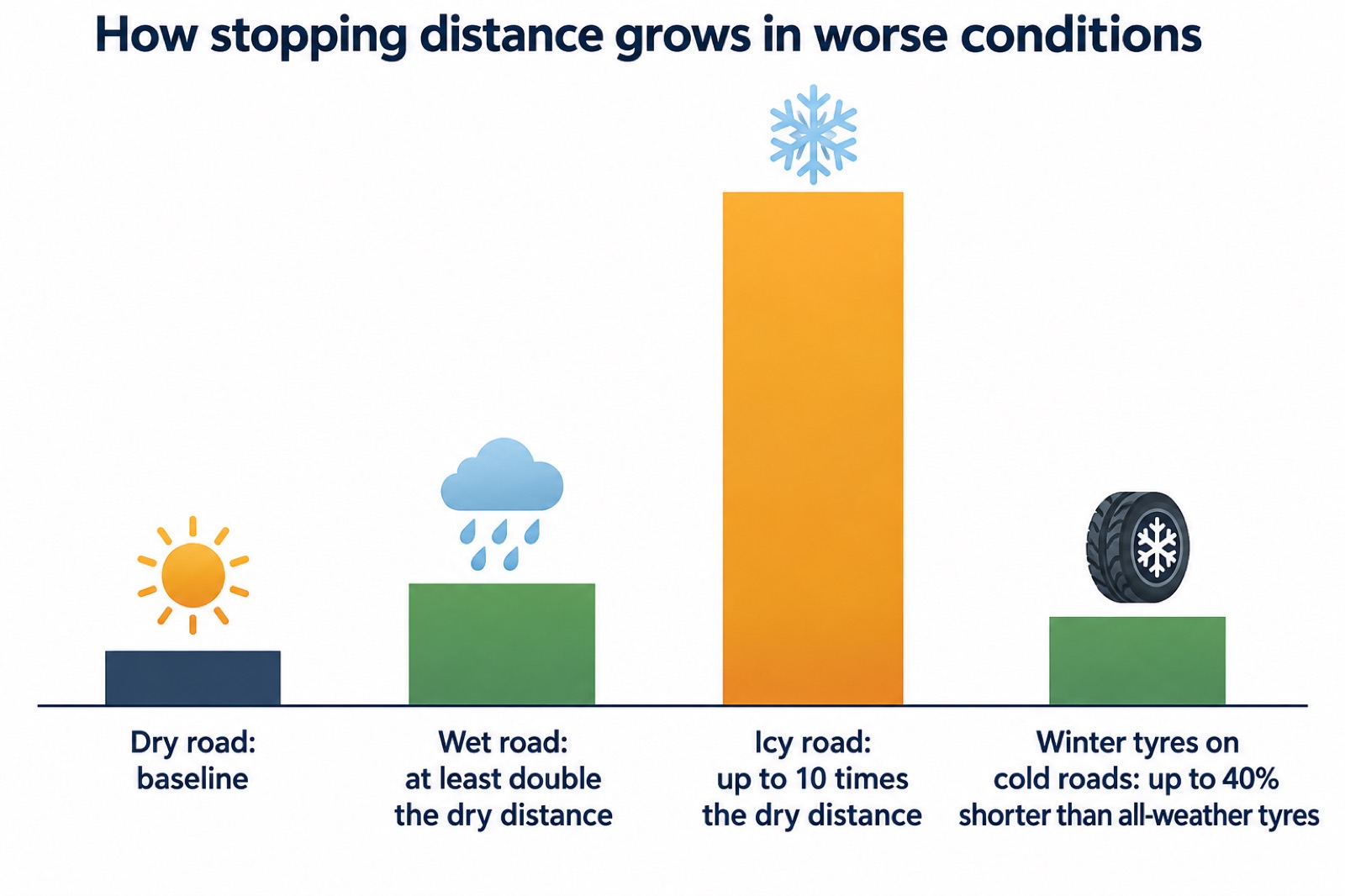
The headline figure is that winter tyres can reduce stopping distance by up to 40%3. That is the difference between stopping short of the car in front and not. But it is only part of the picture, because the conditions themselves stretch stopping distances far more than any tyre can recover.
On ice, the numbers are stark. It can take 10 times longer to stop in icy conditions than on a dry road6. Traffic Watch Northern Ireland warns that stopping distances can be ten times greater than on dry roads11. Ceredigion County Council gives the same multiplier: it can take 10 times longer to stop in snowy or icy conditions12. West Yorkshire Prepared's checklist says stopping distances can increase by ten times dry weather distances13.
| Condition | What happens to stopping distance | Source |
|---|---|---|
| Dry road | Baseline | 6 |
| Wet road | At least double the dry distance | 9 |
| Icy road | Up to 10 times the dry distance | 6 |
| With winter tyres | Up to 40% shorter than on standard all-weather tyres | 3 |
The lesson is not that winter tyres make ice safe. They do not. The lesson is that they buy you margin, and you still need to drive to the conditions. Allow extra time for your journey and reduce your speed, as Devon County Council advises14. Keep well back from the road user in front11.
Where winter tyres are worth fitting and where all-season tyres are enough
This is the decision most UK households actually face, and the official guidance is more nuanced than tyre marketing suggests. Traffic Scotland says winter tyres may be necessary for drivers in the Highlands and throughout rural Scotland, but that Central Scotland's relatively warm and wet climate means many drivers will not need them for drives in typical conditions1. That is a useful template for the whole country: the colder, snowier and more rural your driving, the stronger the case.
Where the case is strongest:
- Highlands and rural Scotland. Traffic Scotland says winter tyres may be necessary in the Highlands and throughout rural Scotland1.
- Rural and untreated routes anywhere. Councils treat priority roads first, and Bedford Borough Council says more roads may be treated in prolonged snow and ice only when priority roads are clear15. Rural lanes can go untreated for days.
- Drivers who must travel whatever the weather. If you cannot simply stay home on a snow day, the margin matters more.
Where all-season tyres are usually enough:
- Mild, wet, low-lying areas with occasional snow that clears quickly.
- Drivers on mainly gritted, treated routes who can delay or skip journeys in bad weather.
- Low annual mileage in town and city conditions.
Argyll and Bute Council's advice is a fair summary for anyone unsure: keep tyres at the right pressure with plenty of tread, and consider fitting winter tyres16. Staffordshire County Council goes a step further, suggesting you can consider changing to winter tyres to improve your car's performance even more17. Neither says everyone must.
A word on studded tyres. Bedford Borough Council notes that some other countries request motorists change to winter tyres, and that studded tyres give good traction in snow but would be of very rare use in the UK15. For most British drivers, studs are not the answer.
How each behaves in snow, ice and cold
The difference between the two types shows up most clearly in snow and on ice. Traffic Scotland says the deeper tread on winter tyres offers grip even when snow is compacted, and provides improved manoeuvrability over all-season tyres, even for two-wheel drive cars1. That deeper tread is doing real work: it clears snow and slush out of the way so the rubber can reach the road.
That applies whatever tyre you fit. A worn winter tyre is worse than a fresh all-season one.
| Situation | Winter tyres | All-season tyres |
|---|---|---|
| Cold, damp road below 7°C | Superior grip2 | Acceptable, less grip |
| Light snow | Good grip from deeper tread1 | Copes, less margin |
| Compacted snow | Grip even when compacted1 | Reduced grip |
| Ice | More grip, better performance18 | Limited |
| Mild wet winter | More than needed | Adequate |
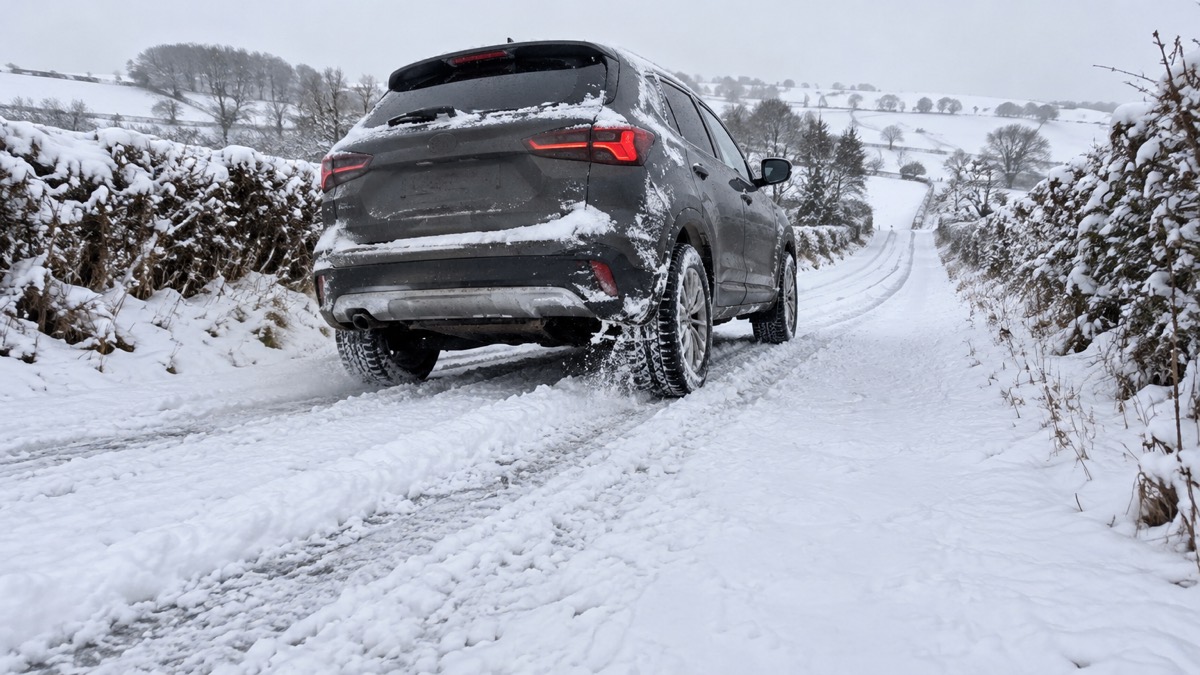
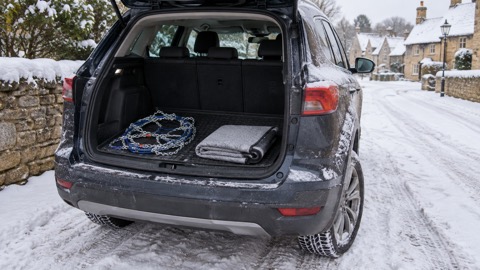
If you need to drive in snow and ice and want extra help, Ready Scotland advises getting winter tyres, snow chains or snow socks19. Traffic Scotland explains that snow socks and snow chains are an alternative to winter tyres: they improve your vehicle's grip in icy conditions by covering your tyres in either a high grip fabric or steel equivalent1. Snow chains are harder wearing than winter tyres but trickier to put on1. For a fuller comparison, see snow chains or snow socks.
Whatever you fit, check your grip on the road surface where there is snow or ice by choosing a safe place to brake gently, as Traffic Scotland advises. If the steering feels unresponsive, that may indicate ice and your vehicle losing its grip. When travelling on ice, tyres make virtually no noise6.
When to fit winter tyres: October to March
North Yorkshire Council recommends winter tyres for use in the UK between October and March, when temperatures can often be below 7°C4. That window matches the 7°C threshold: fit them as the cold sets in and swap back when it lifts.
The councils' own winter seasons give a sense of how long the cold risk lasts. Suffolk County Council's winter season runs each year from 1 October to 30 April21. Traffic Watch Northern Ireland says its season usually lasts from early November to late March, but winter service will be provided outside this period if necessary11. In other words, the official gritting season is longer than the tyre window, and the weather does not always keep to the calendar.
A practical routine:
- Check the forecast and your tread in early October. Replace tyres before the tread reaches the legal minimum22.
- Fit winter tyres as temperatures settle below 7°C, typically from October4.
- Keep them on through the cold months, checking pressures regularly.
- Swap back in spring, once the risk of cold and ice has passed.
Most UK cars come fitted with summer tyres, so if you have never changed them, you are starting from a summer baseline, not an all-season one13. That is worth knowing before you assume you already have all-season grip.
No legal requirement to use winter tyres
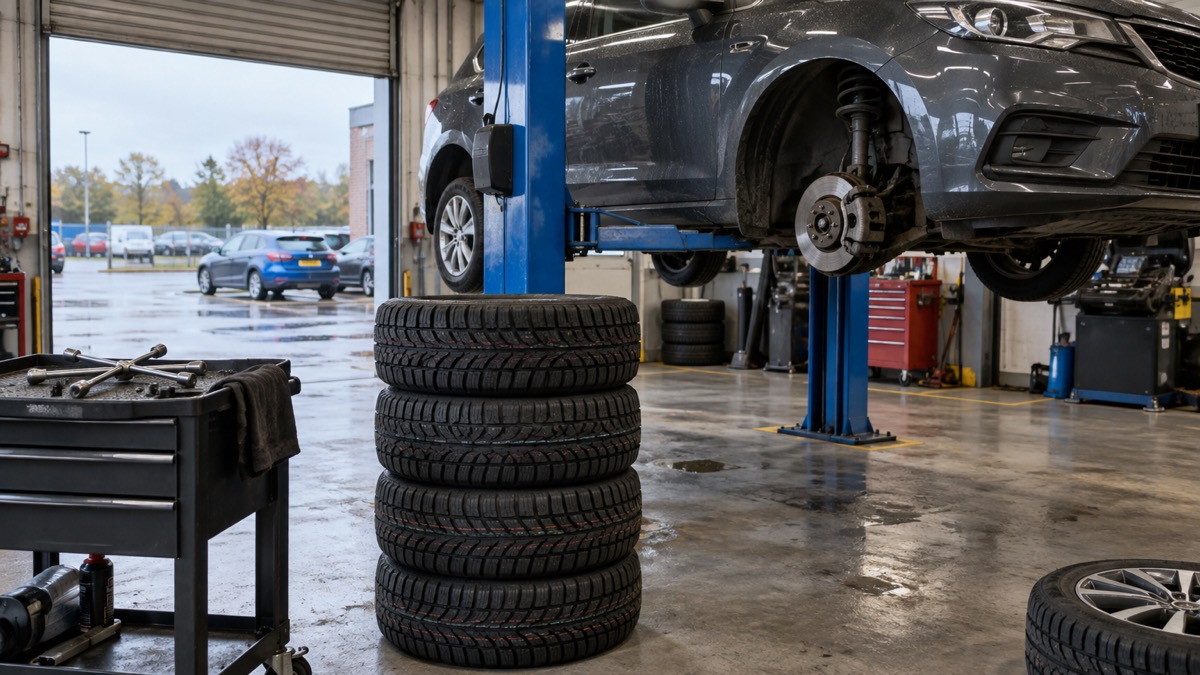
There is no legal requirement to use winter tyres in the UK1. You will not be fined for driving on all-season or summer tyres in winter, and you do not need a special marking or sticker. The choice is yours.
That said, the law does set a floor on tread depth, and the law of physics does the rest. The legal minimum tread depth is 1.6mm23. The deeper the tread depth, the better your car will perform25.
The same "no legal requirement" logic applies to clearing snow, which is a common source of confusion each winter. There is no law stopping you from clearing snow and ice on the pavement outside your property, pathways to your property or public spaces, and if an accident did happen it is unlikely you would be sued as long as you are careful and use common sense26. Warwickshire County Council's snow warden guidance says the same24. If you want to help clear your street, see can I clear snow from the pavement outside my house.
Tread depth: the legal limit and what winter driving needs
The legal minimum tread depth in the UK is 1.6mm23. That is the line you must not cross. For winter driving, it is not a target to aim for; it is the point at which a tyre is already past its best.
Replace tyres before the tread has reached the legal minimum of 1.6mm22. The deeper the tread depth, the better your car will perform25. The reason is simple: tread clears water, slush and snow from between the tyre and the road. As it wears down, that ability fades, and it fades fastest in exactly the conditions winter throws at you.
A winter tyre check, in order:
- Measure tread across the whole tyre, in several places, not just the middle.
- Replace before 1.6mm, not at it5.
- Check pressures and keep tyres correctly inflated5.
- Look for damage such as cuts, bulges or embedded objects.
- Check all tyres, including the spare if you carry one27.
For a fuller walkthrough, see what tyre tread depth do you need for winter.
Driving safely whatever tyres you fit
Tyres are one part of winter driving, not the whole of it. The official advice is consistent across the UK: slow down, leave more space and allow extra time. Devon County Council advises allowing extra time for your journey and reducing your speed14. Traffic Watch Northern Ireland says to keep well back from the road user in front11.
A few habits that matter as much as your tyres:
- Check the forecast before you set out, and consider whether the journey is necessary. See should I delay my journey in bad weather.
- Clear your windows and lights fully before moving off. See how to de-ice a frozen windscreen safely.
- Keep your mobile charged, but never use it while driving18.
- Do not park where you may block a salting route14.
- Watch for gritters and give them room. See should you overtake a gritter or snowplough.
Gritting helps, but it has limits. Surrey County Council warns that if road temperatures fall below minus 7 degrees Celsius, the effectiveness of grit diminishes and it will not prevent roads from icing up28. On those days, no amount of salt keeps every road clear, and your tyres and your driving are what you have.
For the wider picture on driving in winter, see driving in snow and ice and car checks before winter.
Sources (28)
- Winter tyres guide, Traffic Scotland, 2026
- Winter driving, Derbyshire County Council, 2026
- Winter driving, Traffic Scotland, 2026
- Winter, summer and wet weather driving tips, North Yorkshire Council, 2026
- Driving in Snow - Winter safety - Seasonal Safety - Keeping You Safe - North Wales Fire And Rescue Service, North Wales Fire and Rescue Service
- Driving in snow and ice, Traffic Scotland, 2026
- Driving safely in winter weather - Met Office, Met Office
- Winter driving, Manchester Fire and Rescue Service, 2026
- Driving in adverse weather conditions, nidirect, 2026
- Cold weather advice, West Midlands Ambulance Service, 2026
- Winter news, Traffic Watch Northern Ireland, 2026
- Snow and ice, Ceredigion County Council, 2026
- Winter driving checklist, West Yorkshire Prepared, 2020
- How can you help, Devon County Council, 2023
- Keeping winter roads safe, Bedford Borough Council, 2026
- What advice can you give me on driving, Argyll and Bute Council, 2026
- Winter driving, Staffordshire County Council, 2026
- Driving in heavy rain, Mid and West Wales Fire and Rescue Service, 2026
- Cold, snow and ice, Ready Scotland, 2026
- Cold, snow and ice, Ready Scotland, 2026
- Check which roads are gritted, Suffolk County Council, 2026
- Staying safe in the snow, North Yorkshire Fire and Rescue Service, 2026
- Road safety, Warwickshire County Council, 2026
- Snow wardens, Warwickshire County Council, 2026
- Top tips for keeping warm and safe this winter, North Yorkshire Fire and Rescue Service, 2023
- Snow code, Derbyshire County Council, 2026
- Adverse Driving Conditions - South Wales Fire and Rescue Service, South Wales Fire and Rescue Service
- Salting and gritting, Surrey County Council, 2026
 Snow Chains vs Snow Socks