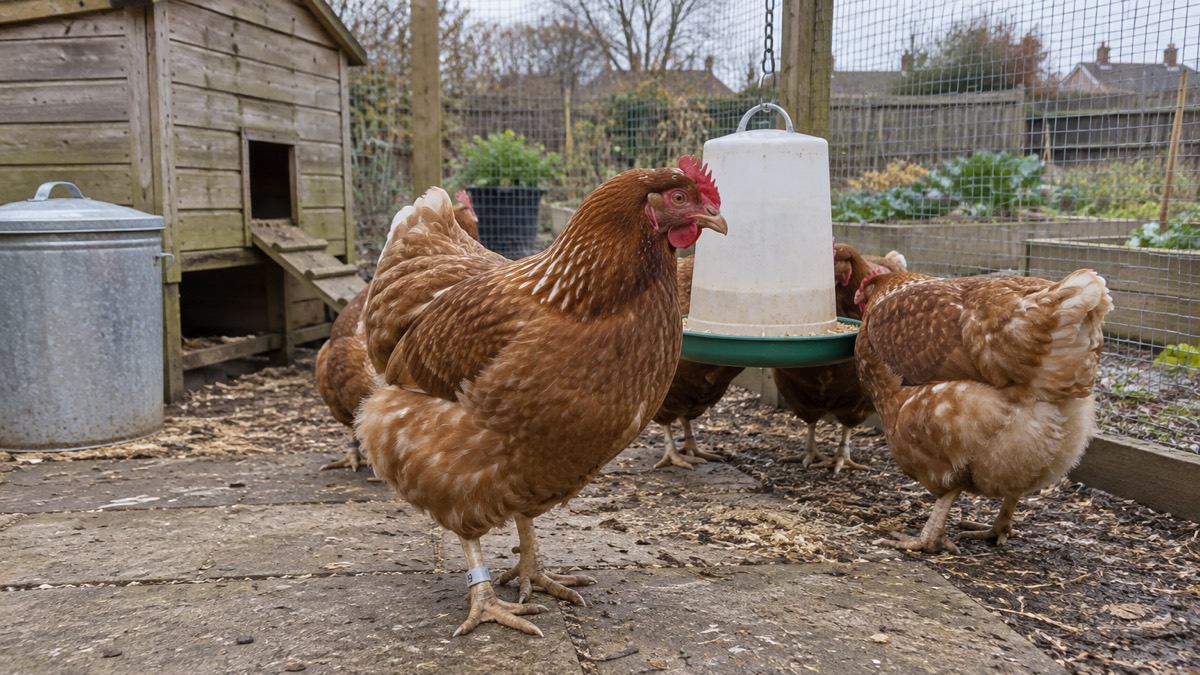
If you keep chickens, ducks, geese or any other captive birds in England or Scotland, you must register them with the Great Britain Poultry Register. There is no small-flock exemption: the rule applies to all bird keepers, no matter the flock size, from 1 October 2024 in England and 1 September 2024 in Scotland1. A handful of hens in a back garden counts.
Registration is free and takes a few minutes, and it is the single thing that means the Animal and Plant Health Agency (APHA) can reach you if there is a bird flu outbreak near you. Defra requires it so that APHA can get in touch with disease alerts and guidance1. Keepers who register are notified of bird flu or disease outbreaks in their area and given information on protecting their flock3.
This page covers who has to register, when the rule came in, what registration actually gets you during an outbreak, how to do it, and what to do if you suspect disease in your birds. It also covers the separate APHA alert service, the reporting phone numbers for each nation, and where the rules differ across the UK.
Yes: every bird keeper must register, no matter how small the flock
The rule is deliberately broad. Since October 2024 all keepers of poultry or any other captive birds must register regardless of how many they keep4. The RSPCA states it in the same terms: new measures require all bird keepers, no matter the flock size, to register their birds with the Great Britain Poultry Register1. The British Hen Welfare Trust recommends that all keepers of pet birds and flocks, small and large, register their birds on the register6.
The register covers a wider list of birds than many people expect. It includes chickens, ducks, turkeys, geese, pigeon bred for meat, partridge, quail, guinea fowl and pheasants, and any pet bird or bird kept outside for shows, races, exhibitions, competitions, breeding or for sale4. If you keep a few hens for eggs, you are in scope. If you keep a parrot in an outdoor aviary, you are in scope.
| Bird kept | In scope of the register? |
|---|---|
| A few garden hens | Yes, no minimum number4 |
| Ducks and geese | Yes4 |
| Turkeys, quail, guinea fowl, pheasants | Yes4 |
| Pigeons bred for meat | Yes4 |
| Pet birds kept outside, or birds kept for shows, racing, exhibitions, competitions, breeding or sale | Yes4 |
There is no threshold below which you can ignore it, and no distinction in the rules between a commercial flock and a family flock. The practical effect is that almost anyone who keeps birds outside, for eggs, for meat, for showing or simply as pets, has a registration duty.
If you are new to hen keeping, the guide to keeping chickens covers housing, feeding and the wider legal picture, and the pet hens kit checklist sets out what you need before the birds arrive. Registration sits alongside those basics rather than replacing them.
When registration became mandatory in England and Scotland
The dates differ north and south of the border. Registration became mandatory from 1 October 2024 in England and 1 September 2024 in Scotland1. Both changes came from the same set of measures requiring all bird keepers, whatever the size of their flock, to register with the Great Britain Poultry Register1.
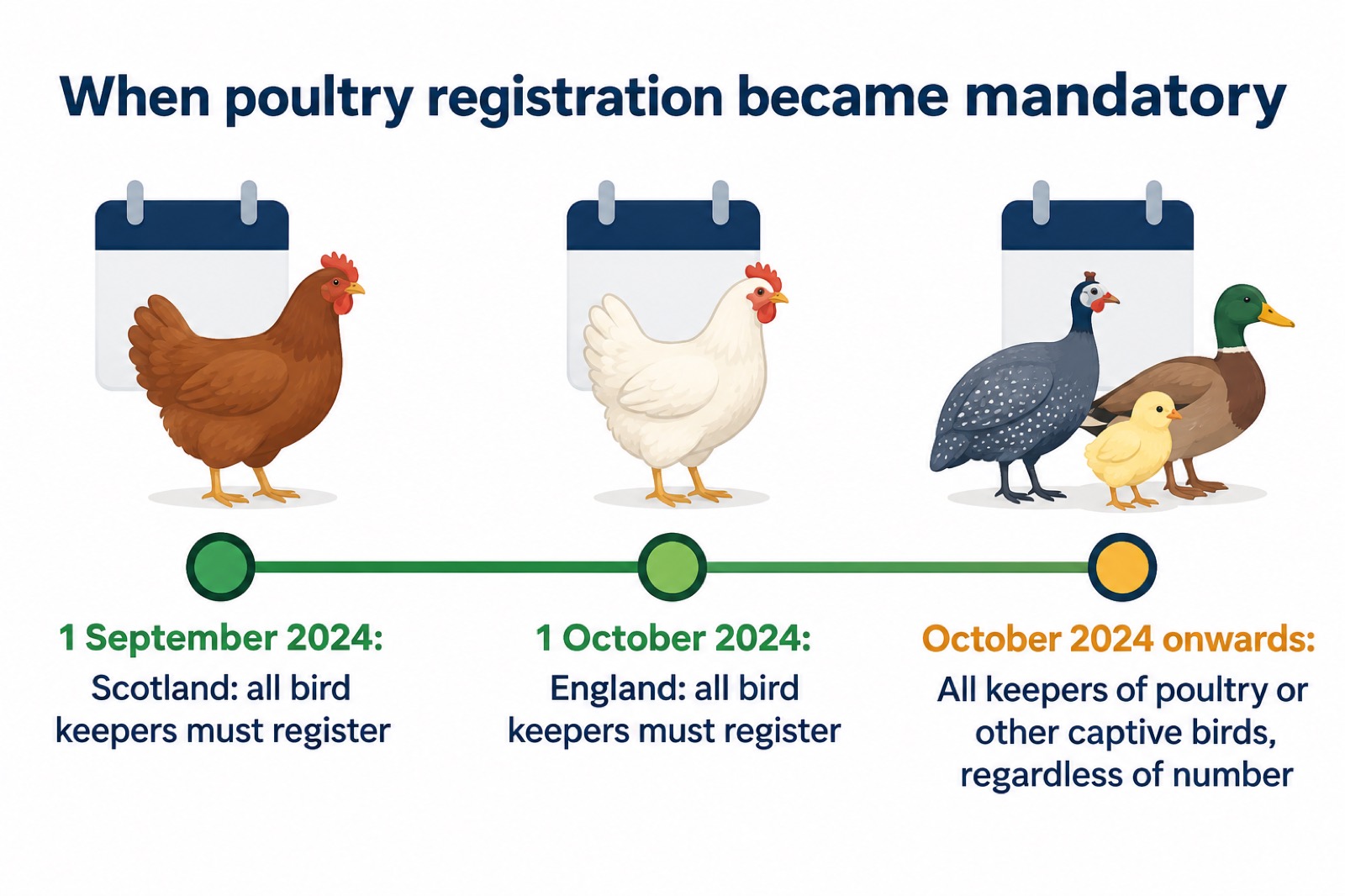
Before those dates, registration was aimed mainly at larger flocks. The change removed the size threshold, which is why keepers who had kept three or four hens for years without registering suddenly had a legal duty to do so. If you kept birds before October 2024 and never registered, the position now is that you should.
The register is called the Great Britain Poultry Register, and the name reflects its coverage: England, Scotland and Wales. The duty is described as a legal requirement for anyone with hens in England and Wales3, and the Scottish requirement is set out in the same terms as the English one1. Northern Ireland is not covered by the Great Britain register, and the sources here do not describe a separate Northern Ireland scheme, so if you keep birds in Northern Ireland, check the position with your own agriculture department before relying on this page.
Why Defra requires it: disease alerts from APHA
The purpose of the register is contact, not paperwork. Defra requires registration so that APHA can get in touch with disease alerts and guidance1. The RSPCA describes APHA as a Defra department specialising in notifiable diseases6. In other words, the register exists so that a government vet agency knows who to ring when something is spreading.
That matters because poultry diseases move fast and the response is often local and time-limited. The British Hen Welfare Trust notes that APHA will notify you by text should there be a notifiable disease outbreak in your area, which will give you time to take effective measures to protect your hens3. A text in the first days of an outbreak is the difference between housing your birds before the disease arrives and finding out afterwards.
The principle is the same one that runs through other official registers. Livestock keepers register with the Animal and Plant Health Agency7, and the early reporting of any suspicion of animal disease is treated as vital by official planners8. For notifiable animal diseases, you are legally obliged to officially report to APHA even if you only suspect an animal may be affected9.
What registering gets you during a bird flu outbreak
During an outbreak, registered keepers are notified of bird flu or disease outbreaks in their area and given information on protecting their flock3. That is the core benefit, and it is why local councils tell people to register their poultry, even if only kept as pets, so that they can be contacted during an outbreak4.
The information that follows a notification is practical. In an Avian Influenza Protection Zone, pet hens must be housed, increased biosecurity measures must be taken, and anything which may be contaminated must be disinfected immediately after transportation5. You must also keep a record of anyone who visits your home and has contact with your poultry5. None of that is guesswork if you are on the register: it arrives with the alert.
In all disease control zones, the official duties are wider still4:
- Follow biosecurity rules and comply with biosecurity rules imposed by a veterinary inspector.
- Keep a record of anyone that transports or markets poultry or poultry eggs, with exemptions for table eggs.
- Follow the rules for fresh meat.
- Do not organise or attend bird gatherings.
- Do not release game birds.
If you suspect any of your birds have bird flu, you are legally required to report it straight away3. It is also a legal requirement to report suspected cases of avian influenza to APHA10, and the same duty applies to suspected Newcastle disease11. Early reporting of any suspicion of animal disease is vital, and if you have concerns about the health of your animals you should discuss them with your veterinary surgeon or report to Defra APHA directly8.
How to register with the Great Britain Poultry Register
Registration is done through the Great Britain Poultry Register, and the trust's guidance is to register all pet birds and flocks, small and large6. Registration ensures you receive disease alerts and guidance that will help you look after your birds' wellbeing1. Have your details to hand: the number and types of birds you keep, and the address where they are kept.
- Gather the details of every bird you keep, by type and number, including pet birds and birds kept for shows or sale4.
- Register on the Great Britain Poultry Register, or ring 0800 634 11123.
- Keep your details up to date, particularly if you move birds to a new address or change what you keep.
- Separately, sign up to the APHA alert service for free alerts of any outbreaks of avian flu in Great Britain6.
- If you are in a control zone, follow any instruction to update your details or register immediately, which is a legal requirement in that situation12.
That last point is specific and worth knowing. Keepers within the 3km or 10km control zones near Penicuik were told to update their details or register on the Scottish Kept Bird Register immediately, and the guidance states plainly that this is a legal requirement12. Control zones can appear with little warning, so keeping your registered details current is what makes that instruction possible to follow.
Reporting disease: the numbers to keep
If you think your birds could have bird flu, contact APHA12. The number depends on where you are, and the sources give different numbers for different purposes, so it is worth writing the right one down.
| Situation | Who to contact | Number |
|---|---|---|
| Suspected bird flu in your birds, England | APHA | 03000 200 3015 |
| Suspected bird flu in your birds, Wales | APHA | 0300 303 82685 |
| Suspected bird flu in your birds, Scotland | Your local Field Services Office | See local office details5 |
| Suspected sick or dead animals that might be a disease, England | APHA | 03000 200 30113 |
| Dead wild birds | Defra | 03459 33 55 7713 |
The two Defra numbers do different jobs and should not be swapped. The APHA number is for reporting sick or dead animals you suspect might have a disease13, while the Defra wild bird line is for reporting dead wild birds13. If in doubt about your own birds, contact your local poultry-friendly vet, or APHA as the department specialising in notifiable diseases6.
Text alerts and the APHA alert service
Registration and alerts are two related but separate things. Being on the register means APHA holds your details and can contact you during an outbreak1. Separately, keepers can sign up online to a service from APHA to receive free alerts of any outbreaks of avian flu in Great Britain6. Signing up to both is sensible: one puts you on the map, the other pushes news to you.
The alert habit is worth building beyond poultry. Local resilience bodies encourage residents to sign up to receive alerts and information about risks in their area15, and the same pattern of free SMS or email warning appears in local flood alarm schemes16. For bird keepers, the APHA avian flu alerts are the specific service to look for.
Rules in Wales, Scotland and Northern Ireland
The register is a Great Britain register, so England, Scotland and Wales are covered by the same scheme, with different start dates and different reporting numbers.
- England: mandatory from 1 October 20241; report suspected bird flu to APHA on 03000 200 3015.
- Scotland: mandatory from 1 September 20241; report suspected bird flu through your local Field Services Office5; keepers in control zones must update or register on the Scottish Kept Bird Register immediately, which is a legal requirement12.
- Wales: the duty is described as a legal requirement for anyone with hens in England and Wales3; report suspected bird flu to APHA on 0300 303 82685.
- Northern Ireland: not covered by the Great Britain register described here; check with your own agriculture department.
If you keep poultry or captive birds within the 3km or 10km control zones near Penicuik, update your details or register on the Scottish Kept Bird Register immediately, which is a legal requirement4. The daily biosecurity for backyard poultry keepers page sets out the routine measures that make those zone rules easier to follow.
Registering other livestock, and other registers that work the same way
Poultry are not the only animals with a registration duty. Livestock keepers register with the Animal and Plant Health Agency7, and the reporting principle is identical: notifiable animal diseases are ones you are legally obliged to officially report to APHA, even on suspicion9. If you keep other livestock and are unsure which register applies, ask your vet or contact APHA.
The same logic, that a register exists so someone can warn you, runs through several other household schemes:
- Dogs: it is a legal requirement to make sure your dog is microchipped17.
- Bees: the Bee Diseases and Pests Control Orders were amended in 2021 to require that the presence of varroa is reported to the Agriculture Department for that country18. The BeeBase registration page covers the beekeeping equivalent of the poultry register.
- Electrical appliances: registering appliances helps manufacturers contact you with important safety updates or recalls19, and fire and rescue services recommend it so you can be made aware if a product is recalled20.
The pattern is consistent: where a hazard can spread or a product can fail, the official answer is a list that lets the responsible body reach you directly. Poultry registration is that list for your hens.
Sources (20)
- Keeping chickens: health and welfare, RSPCA, 2024
- Ducks and geese, RSPCA, 2024
- Hen adoption FAQs, British Hen Welfare Trust, 2026
- Avian influenza (bird flu), Suffolk County Council, 2026
- Avian influenza (bird flu), British Hen Welfare Trust, 2025
- Hen husbandry, British Hen Welfare Trust, 2026
- Community Risk Register 2025, North Yorkshire Council, 2025
- West Mercia Risk Register, West Midlands Ambulance Service, 2025
- Animal disease, Wiltshire and Swindon Prepared, 2024
- Avian influenza, British Hen Welfare Trust, 2026
- Newcastle disease, British Hen Welfare Trust, 2026
- Avian influenza, Scottish Borders Council, 2026
- Preparing for an emergency: be ready, stay safe, act now, Sussex Police, 2025
- Community Risk Register for Sussex, Sussex Police, 2026
- Heatwave, Lancashire Prepared, 2026
- Groundwater flooding, Lincolnshire County Council, 2026
- Your pets, Wiltshire and Swindon Prepared, 2026
- Bees and the law, National Bee Unit, 2021
- Electrical safety, North Yorkshire Fire and Rescue Service, 2026
- Maintain appliances and recalls, Greater Manchester Fire and Rescue Service, 2026
 Beekeeping Starter Equipment
 Pet Hens Starter Kit
 Bringing Home Rescue Hens
 Hay Bale Fires
 Livestock in a Heatwave
 Livestock Water Outage
 Sky Lanterns
 BeeBase Registration
 Broody Hen Hatching
 Cleaning a Chicken Coop
 Coop and Run Space for Hens
 Care for Ex-Battery Hens
 Reporting Foulbrood
 Fox-Proofing a Chicken Coop
 Daily Hen Feed Amounts